An invisible thread passes from father to son
Issue 45 : Nov/Dec 2005
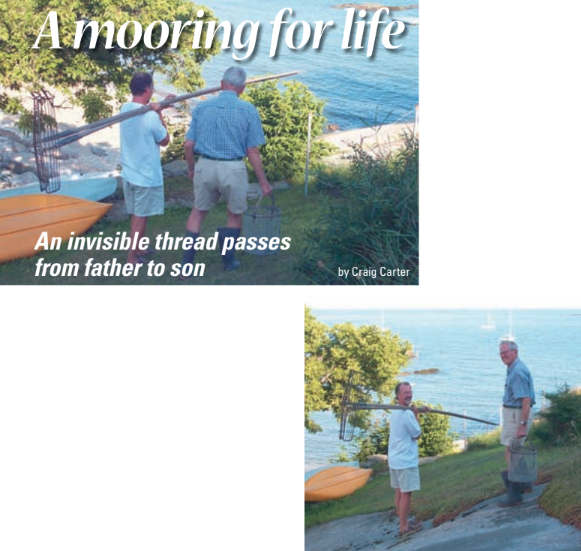
Dad first took me clamming when I was 10 years old. On a still August morning we loaded the long-handled tongs and climbed from the slippery rocks into the family rowboat. Barnacles brushed the bottom of the wooden skiff as we pulled away from the shallows and out into the glassy cove. I rowed and Dad sat aft, smoking his pipe and balancing the giant clamming tongs on the gunwale. We moved slowly out of the protected cove, bound for Southwest Clump, a cluster of rocks that seemed distant, shrouded in the morning fog.
I thought myself a strong rower and was surprised when I found I was struggling to make headway in the currents outside the cove. I put all of my weight into the oars and, little by little, the cottages on the shore fell away. When my skinny arms finally gave out, we changed places, and Dad rowed onward. He rowed effortlessly and instinctively, pausing for a glance toward our destination and to stoke his pipe. His purchase on the oars was solid and his strokes graceful. I watched the miniature whirlpools spin from the oar tips and eddies swirl from the stern.
We finally came alongside the rocks and drifted for a moment before setting the anchor. A slight swell lifted us and then gently set us down before spilling over the seaweed-covered rocks. Dad lifted the tongs over the gunwale and let the long wooden handles slide through his grasp, guiding the basket as it plunged to the bottom. He worked the handle ends, pumping and squeezing them open and shut, digging the tines deeper into the mud with each bite. Squeezing shut the handles, he could feel the clams pinched between the steel jaws, then he leaned over the gunwale and dug deeper still.
Mud-caked quahogs
Smoke curled from his pipe like a steam shovel as he locked the handles closed and brought the basket up. I reached in and plucked out the mud-caked quahogs, rinsed them until they were shiny-black, and put them in the pail.
When it was my turn, I found that the tongs were heavy and the giant handles difficult to control. I couldn’t open the tines far enough, and I lacked the strength to drive them deep into the mud. I stretched them open as far as I could and wrestled them closed, but the tines merely scraped the mud bottom and didn’t penetrate. Like so many things that Dad made look easy, I knew that something more was required. I wasn’t ready.
Dad introduced me to a number of things this way. Woodworking would be another such endeavor. And, of course, sailing. Although I may not have been ready for them at the time, these things would ultimately become genuine and lasting pursuits. Little or no instruction was ever given, but an invisible thread was passed from father to son, a thread that would become the mooring that would define who I am and how I choose to spend my days. I sometimes catch Dad wondering how it is that I can be skilled at things that neither he nor anyone else ever taught me. “It’s just common sense,” he concludes, but we both know there’s something more.
I wasn’t disappointed that August morning when I pulled up the catch basket and found only a small stone and a slippery-green belt of seaweed inside. I can still feel the steel tines scraping the mud bottom and the boat riding up and down on the gentle swell.
Thank you to Sailrite Enterprises, Inc., for providing free access to back issues of Good Old Boat through intellectual property rights. Sailrite.com