She’s a modern example of “working sail”
Issue 89 : Mar/Apr 2013
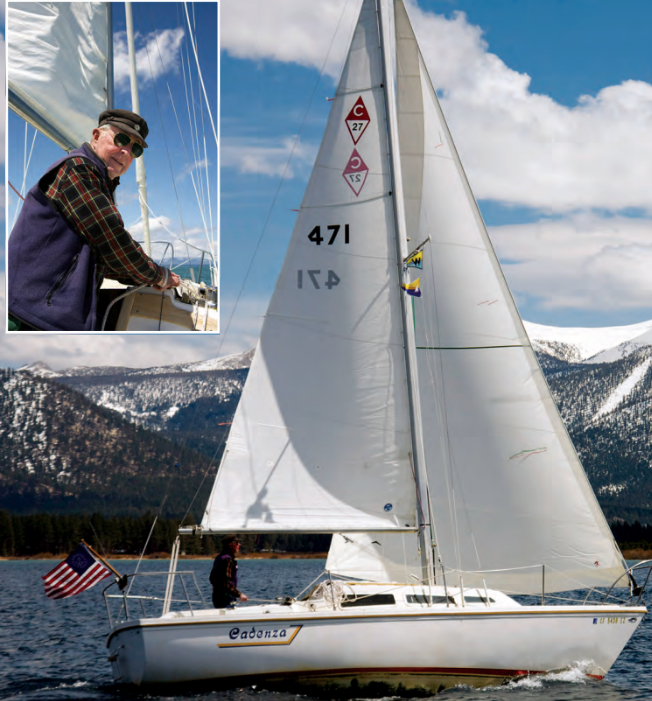
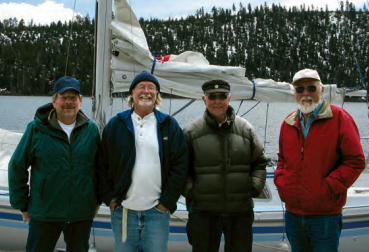
We began thinking of them as “the Tahoe Four.” There are other winter sailors on Lake Tahoe but this is the core group. Jim Hildinger is clearly the ringleader on his Catalina 27, Cadenza. Each trip this group makes is practically a one-design event . . . but don’t call it a race. Two more in the group have Catalina 27s: Erik Vindum on Myrna J and Steve Mason on Gold Dust. The fourth, whose name is so similar we had trouble keeping track of the Steves, is Steve Madsen. His boat is a Cape Dory 27 named C-Jam. Did I mention that this is a group of hard-core singlehanders?
Lake Tahoe, situated on the state line between California and Nevada, is a powerboat paradise in the summer and a stunning skiing destination in the winter. For this intrepid band of sailors, it is also a sailboat paradise during the winter months. There’s a reason for this. Jim grew up on the family resort his father established on Angora Lake, just over a ridge to the southwest from Lake Tahoe, and summers for Jim and his wife, Gloria, and their two grown children have always been occupied with taking care of the resort’s grounds and the guests.
“That was home,” Jim says. “Everywhere else was where we spent the winter.” These days, the family closes the resort in September ahead of the big snowfalls that block all access until late spring. Then, Jim says, October is hiking month. The sailing season begins in earnest in November. You wouldn’t expect November to be the start of sailing season for a mountain lake receiving an average of 18 feet of snow each winter, but that’s the joy of it for the Tahoe Four. Even their closest neighbors in California don’t expect sailing season to begin somewhere in the mountains above 6,000 feet in November and, as a result, they have the place to themselves. At least they did until we spread the secret around with this article.
A special place to sail
Of this so-called Lake of the Sky, Jim says, “For sheer beauty, Lake Tahoe is unexcelled. Skiers already know this and sailors won’t be long in finding out. Summers and falls are lovely. Winters and springs are spectacular.” Imagine snow-capped mountains in every direction. Think of crisp mountain air and skies of an incredible blue. The lake’s clear fresh water is deep, averaging 989 feet, and extremely cold — 40s in the winter — but not so cold that it freezes over. Nevertheless, the mountain breezes do pick up a certain chill as they blow across the lake’s surface. No matter. Adventurous sailors dress for that.
After retiring in 1987 from the South Lake Tahoe school, where he was the music teacher, Jim invented reasons (as if any are needed) to get out sailing about five days a week during the winter, weather permitting. As time went on, a few other adventurous souls joined him as often as their own work and family schedules allowed. Over time, the Tahoe Four developed as a group that connects randomly with a phone call or two, arrives independently at the Tahoe Keys Marina in South Lake Tahoe, and sails individually toward Emerald Bay. There they dock together and spend lunchtime in Jim’s Cadenza, telling stories about the ride over (the neighboring mountains make for some rather challenging and unpredictable wind) and professing that the trip “was not a race.” (“But what took you so long?”)
A Catalina success story
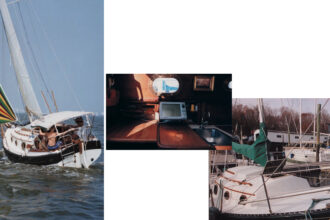
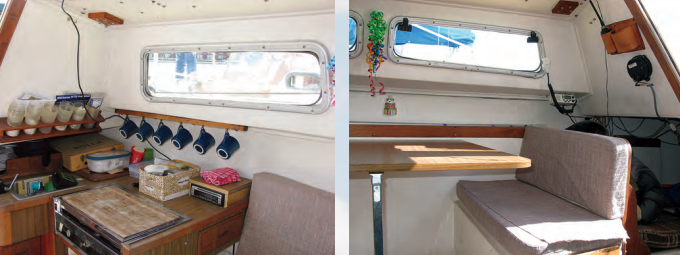
The boat that serves as host to these guy confabs of good-natured teasing is Jim’s Cadenza, due to her dinette layout. In this marvelous design, a step up to the dinette table puts the ports at eye level so diners can appreciate the view while seated. A few other boat manufacturers went with this design. Why they didn’t all come to this conclusion is beyond me.
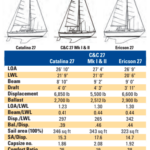
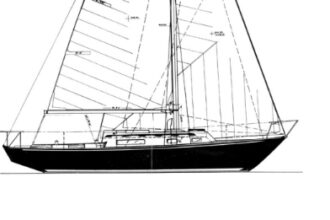
Robert Finch and Frank Butler are to be credited with the design for this incredibly popular boat, which was delivered with two accommodation plans, the other being the more traditional layout with opposing settees and a drop-down table.
The Catalina 27 was the second boat introduced by Catalina, following the very popular Catalina 22. Like her little sister, the 27 was an instant success and, beginning in 1970, enjoyed a 20-year production run of more than 6,660 boats. In 1991, Catalina replaced this classic with the redesigned Catalina 270. Over the years, the Catalina 27 morphed this way and that, as is often the case when a boatbuilder listens to its customers’ demands. A tall rig was available, there were two cabin arrangements, customers could purchase their boats with inboards (beginning with the Atomic 4, of course) or outboards, and there were eventually two keel designs (a 3-foot 6-inch wing keel and the standard 4-foot shark-fin arrangement).
A love pursued
Catalina company records show that Cadenza was built in 1972 and sold on August 18 that year through a broker in Sacramento. Jim doesn’t need this background information because he was tracking her history almost from the beginning. Carrying sail number 471, she was originally sold to Lyle Davenport of Stockton, California, for sailing in the fresh water of the nearby California Delta. She did that for a year before being purchased by Art Smith, who moved her to Lake Tahoe. Jim was immediately smitten with this “new girl on the lake.” He approached Art several times over a period of 10 years with a purchase offer and finally convinced him in 1992. It was either that . . . or Jim was going to buy a different Catalina 27. Art relented.
Jim says he asked Art, “Are you ready to sell your boat to me yet?” As Jim recalls the conversation, Art replied, “Jeez, I guess so. I’m 76 and it’s time to move on.” It is not lost on Jim that he has now reached his 80s and beyond, but he is, as yet, unwilling to sell Cadenza to the individual who will become her fourth owner. A 20-year-old boat by the time of her sale to Jim, Cadenza sold for $10,000.
“The first year was exciting as I re-rigged the boat to satisfy my desire to race it singlehanded,” Jim says. “I rigged internal halyards. All lines were led aft. A spinnaker was designed and attendant gear installed. Life was getting really good!” Not too long ago, he added a roller-furling jib and replaced the hatchboards as well as the cushions in the cabin. Except for replacing the forestay when he installed the furler, he has never renewed the standing rigging. Somewhere along the way he added a VHF and CD/radio.
A local character
Jim Hildinger is a bit of an icon around Lake Tahoe. He established himself as a noteworthy musician and also as a prominent local photographer. He was a well-known teacher in the public schools for many years and for decades has been influential as a long-time resort owner in an important tourist town.
As a kid, he developed a passion for clipper ships. “I learned all the ropes,” he says. “A ship like that has 34 miles of rope. I knew every one.” He built models and was fascinated with the hull shapes. “Speed was the thing in those days,” he points out. “You had to be the first home from China with the tea.” He also discovered the Horatio Hornblower series of nautical historical fiction and still reads the full series once a year. “I wanted to stand on the deck and pace the quarterdeck like Hornblower,” he says.
As a young man he enhanced his gift for music by practicing the violin for many hours a day . . . but not to the exclusion of dabbling with boats during summers at the family resort. His first command was a Styrofoam board boat that proudly advertised Kool cigarettes.
A more practical craft, a Rhodes 19, followed, delivered with some difficulty up a steeply inclined mud path to the resort on Angora Lake just as the snow was melting. “We needed a truck with chains,” he says. She was appropriately named Rubato, a musical term meaning stolen time. An O’Day 23 Tempest of the same name was next. This one, however, Jim sailed on Lake Tahoe in the winter. He was beginning to redefine the term “sailing season” to meet his most peculiar needs.
By the time Cadenza came along, Jim says, “I was retiring and didn’t need stolen time anymore to go sailing.” Cadenza, another musical term, means improvised. Her dinghy is named Coda, another musical term that signifies the closing section of a movement or an afterthought.
Jim points out that, once he had rigged his Catalina 27 for singlehanding, he pretty much sailed her “as is.” That is to say that this boat is, in many ways, much like she was when delivered from the factory in 1972. Neither Jim nor the previous two owners made many modifications (for better or worse).
“Cadenza is not a pampered showpiece but rather a workboat,” Jim says. “This is a vessel used for the pure purpose of sailing. I love to be on the water under sail. I do not like working on boats.” He likes to compare Cadenza against Erik Vindum’s well-cared-for Catalina 27. “Erik’s Myrna J, named after his delightful wife, is the anti-thesis of mine,” Jim says. “Every square centimeter, nay millimeter, of his varnished woodwork is in immaculate condition at all times.”
Photographic memories
As well as sailing, Jim “developed” a passion for photography. His father earned his living with his camera, taking school photos back in the day with a large box-type camera covered by the traditional black hood. Like Jim’s own career, his dad’s winter work in the schools dovetailed nicely with the summer resort work. Jim says he borrowed his father’s camera one day, climbed Echo Peak, and shot photos. When he developed them, he experienced his own epiphany. “I developed the photos and thought ‘Whoopie!’” Jim says.
For the next 30 years he seldom went hiking in the beautiful mountains surrounding Lake Tahoe with anything less than 40 pounds of camera gear. He shot primarily black-and-white images during that time, earning himself a quote in the March 1992 issue of National Geographic magazine that called him the Ansel Adams of Lake Tahoe.
“I bought a Hasselblad in 1971,” he says, “and took more than 10,000 photos with that thing. It never once misfired.” Jim recently donated many of his photos and slides to the University of Nevada, where they will be appreciated for their great value as a vibrant visual history of the Lake Tahoe area over the decades.
At 80-plus, Jim is slowing down somewhat, although anyone can see that his outdoor life has been good for his health. “I have no regrets,” Jim says. “I’ve had a good life all along. I’ve had a great wife, two great kids, and three great boats.”
Even if Jim sells Cadenza, or if he chooses in the future to sail with friends rather than solo, whatever nod he makes to his advancing years, the Tahoe Four or Five or Six will continue to sail in the winters, tease each other, and drink a glass of wine to the ringleader who helped them realize that winters on Lake Tahoe are for sailing.
Karen Larson is the editor of Good Old Boat. She and her husband, Jerry Powlas, agree that winter sails on Lake Tahoe are similar in some respects to summer sails on Lake Superior: the water is cold and the breezes are bracing. All that’s missing is the snowy scenery.
Thank you to Sailrite Enterprises, Inc., for providing free access to back issues of Good Old Boat through intellectual property rights. Sailrite.com