Hobby, haven, labor of love, and a great escape
Issue 109 : Jul/Aug 2016
Chesapeake Bay water runs in Clark Robins’ veins. “My grandfather captained the cargo schooner Ella Worden on Mobjack Bay in the early 1900s,” he says. “My dad settled in Richmond, where I grew up, but other family members and friends stayed in the Gloucester area — my uncle in a house on the Ware River and a good friend on the York River at Gloucester Point. Dad’s leisure time was spent fishing, so most weekends we’d be at one place or the other. With that background, I learned the ways of the water.”
This Gloucester is in Virginia, and Mobjack Bay, near the south end of Chesapeake Bay, is the entrance to four rivers, among them the Ware. It’s not surprising that spending time on the water would remain an important part of Clark’s life.
Sailing entered Clark’s waterborne activities when he was in his 20s. Time he spent on a friend’s sailboat convinced Clark he needed one too. In partnership with another sailor, he bought a Catalina 22, then moved to a C&C Redwing 30 with a different partner. Those two kept that boat for about three years, long enough for Clark to hone his sailing skills while thoroughly enjoying the new way of
being on the water.
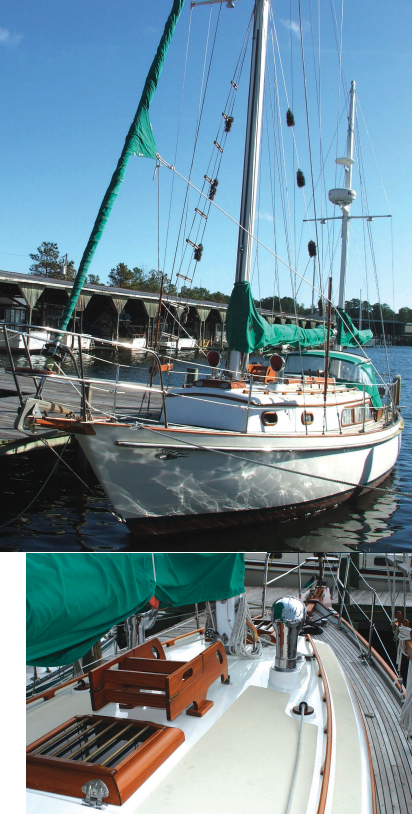
He found Solitude, a 1973-vintage Cheoy Lee Offshore 33, in a yard on Maryland’s Eastern Shore and bought her “as is” in the spring of 1988.
“The boat was in pieces,” Clark says. “The sticks and rigging were down and scattered throughout the yard. The lifelines were missing, the teak decks were obviously a wreck, the cabin sole was unfastened. But I’d been inspired by photos of a canal boat I’d seen in a book at my uncle’s house. In my mind’s eye, my next boat should have a ‘funky/salty’ feel to it, but at the same time allow a sense of style bordering on the eccentric. Solitude definitely had a funky smell. But the bones were there, and I was hooked.”
On the practical side, he says, the boat had a full keel, so would track well under sail, and the 3-foot 8-inch draft would be a definite advantage for the Chesapeake’s shallow creeks. Just as high on his list of priorities: he could stand up in the interior.
Clark’s wife, Isabel (Isa), was not as enthusiastic about his acquisition. “The word ‘horrified’ still comes to mind,” he says.
A thunderous reception
Bringing the boat to Gwynn’s Island on the Bay’s western shore brought an unexpected challenge. Solitude almost made it to the Piankatank River in time, the key word being almost. Just off the entrance, one of the Chesapeake’s notable afternoon squalls bore down with typical vengeance. Bay sailors are all too familiar with this phenomenon: wind on the nose pushing water against a boat trying to enter the river. On this day, hail added a loud and nasty emphasis. Despite almost no visibility and winds above 55 knots, the journey ended safely. Solitude reached her new home in Deltaville, the self-described “Boating Capital of the Chesapeake.”
Like anyone who buys a boat that needs far more than cosmetics, Clark was aware that others neither understood nor shared his excitement about his new purchase. “Maybe you have to be a little twisted to take on a project like this,” he says. “But that’s OK; I don’t use the word disparagingly. If someone owns an old MGB or an Austin-Healey, they had better love working on the car or they should get another car. In the boat’s case, I keep her in shape, and I’ve been upgrading her as well. I’ve tried to keep an eye toward the original design while adding safety or creature-comfort features. And I’ve had some fun with her, too, with things like belaying-pin racks, ratlines, and baggywrinkle.”
Fortunately, Isa got over the initial shock of owning the new boat. “She’s a city girl,” says Clark. “She wasn’t raised this way, but she puts up with it now — she’s been a good sport about it all. Isa enjoys being a hostess, and on a typical Saturday evening she fixes a special dinner for us on the boat, complete with wine and candles.”
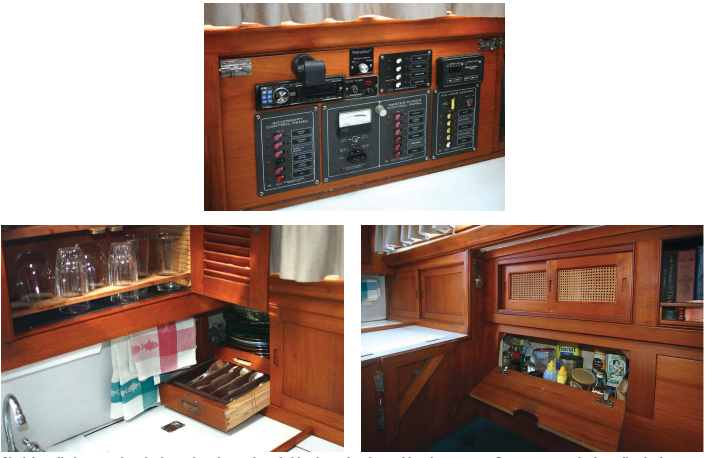
Clark had Isa in mind when he made several upgrades to the galley — the stemware and china holders and the silverware drawers are just a few examples.
“For me, the boat is my escape,” he says. “I work too-long hours and it’s important to be able to relax and recharge, whether I stay at the marina or go out on the hook.”
Clark built his Richmond-based business around his expertise in carpentry. It evolved into designing and building diverse projects, and the company now handles new construction, upscale additions, renovations, and restorations, all of which help to explain the level of care he brings to his boat projects.
Clark likes building things for the boat. He does some of the woodwork in his business workshop: “It’s a real treat to be able to bring parts home and fix or rebuild them in the shop,” he says. “Most of these jobs become winter projects, and in that way the work extends the boating season.”
Exterior projects
Obviously, not all fixes are movable. Early in Clark’s ownership of Solitude, a few osmotic blisters appeared on the hull, a dreaded discovery on many an older boat. He gave these the standard repair treatment (opening the blisters, draining and drying them, then filling them with epoxy putty) followed by the standard epoxy barrier coat for the entire hull. There has been no recurrence. Solitude is hauled out in the winter months, enabling the dry-out time considered by some to be a factor in preventing blisters.
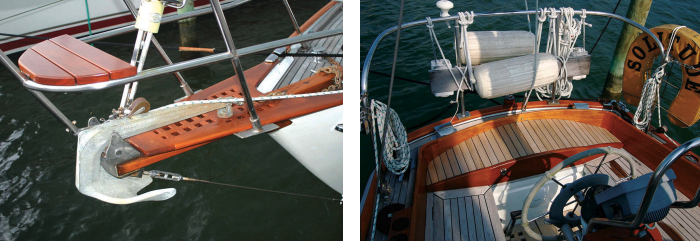
An early change Clark made was to replace the bow pulpit that had been poorly fastened to the top of the toerail with just screws. The new pulpit is bolted through the deck. And to give the the existing anchor platform a more substantial look, he added a teak grating and a seat.
Teak decks on an older boat trigger an immediate warning sign to new owners. Solitude’s were no exception. The original decking strips had been fastened with screws, and water had seeped into the screw holes and rotted the deck structure under the teak in scores of places. Repairing the damage was a lengthy process that entailed removing the old teak, rebuilding or replacing all the affected support sections, and grinding the substrate to a clean flat surface. Finally, Clark epoxied the new teak strips in place — no more screw holes — and caulked the seams between them.
Rather than apply a coating, Clark chose to let the teak deck turn its natural silver. He wanted to create a non-skid surface, and his solution was unusual. He scrubbed the deck using an abrasive teak cleaner, which removed the softer wood and left the grain raised. It also left the caulking a little bit proud, and the deck now provides good footing whether it’s dry or wet. Since then, he has used less aggressive products when scrubbing the deck.
The cabintop is painted with Awlgrip, and every chromed item has been replated. Surprisingly, and this is surely a testament to the quality of the original gelcoat, the hull has not had to be painted.
This is the first ketch Clark has owned, and he likes it for the better control he has with the shorter rig. The masts were already painted at the time of purchase, which raised the concern that the paint was possibly covering damage. Fortunately, that turned out to be a needless worry.
Many cruising boats have ratlines on the shrouds as a more traditional alternative to steps on the mast, but few of today’s sailors make use of baggywrinkle. Solitude sports both. Clark even invented a machine to make baggywrinkle and used the traditional three-stranded Manila — another wintertime project, and one more way to make Solitude unique.
Deck woodwork
Solitude’s toerail is new. “I think I’ve replaced just about all the exterior wood on the boat,” says Clark, “except the original base for the anchor platform.”
The exterior wood is protected with Cetol, and Clark plans to maintain a six-coat base application with an additional two coats each year. He completely rebuilt the overhead hatches and fitted each of them with a row of bronze rods to protect the Lexan lenses. The hatches are hinged to open from forward or aft and all the hardware is original.
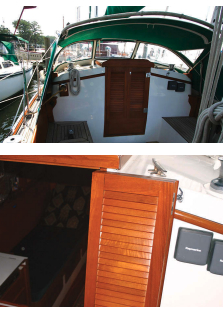
At the stern, Clark used teak strips to form an arched seat that spans the full width of the cockpit, providing good seating at the helm no matter what the angle of heel. A traditional wooden boarding ladder is stowed atop the cabin behind the mainmast. Louvered inserts take the place of the original solid plywood panels in the companionway doors. Decorative knotwork on handholds and treads, an expression of Clark’s interest in marlinspike seamanship, adds a safety factor.
The dodger is a straightforward design. Clark added handholds on both sides and across the back of the dodger to provide an added measure of safety for when he must move forward or aft.
Everywhere the eye wanders on this classic sailboat, another clever or handsome touch reveals the depth of her refit. And that’s just the exterior.
Interior comforts
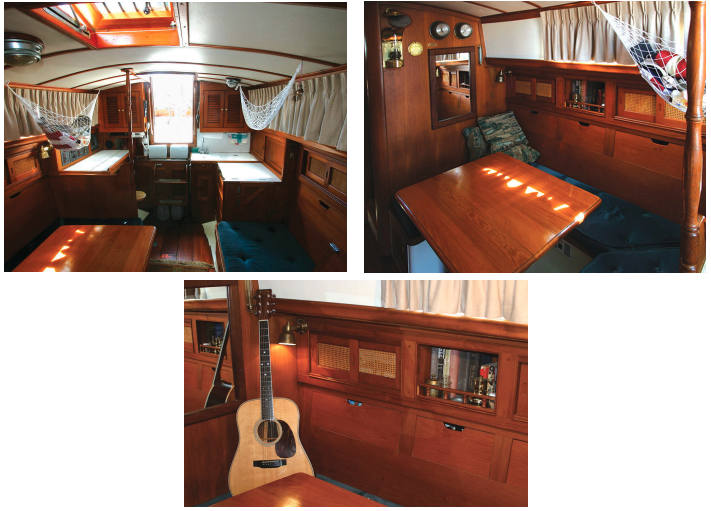
In some sailboat interiors, the atmosphere seems dark and enclosed. In contrast, the feeling upon descending into Solitude’s comfortable cabin is of entering a light, open, and welcoming space. Some of Clark’s projects made the difference.
Originally, the cabin could be set up with upper and lower bunks in the main seating area, but Clark saw a better use for that space. He removed the hinged portions of the upper bunks, which most of the time had served as backrests for the settees. This left the upper areas open for shelves and the backrest areas available for built-in storage lockers. Clark claims he borrowed the idea from another boat, but the craftsmanship is all his. The new lockers are dividedinto practical stowage spaces and finished with satin varnish to match the rest of the interior woodwork. Decorative pillows provide comfortable, movable seatbacks.
The port settee can be widened for occasional use as an extra bunk by the addition of a slide-out section. Fully extended, it also provides seating at the dining table. Clark replaced the original table with a simpler one-piece tabletop, large enough for meals but small enough not to crowd the center of the boat.
Like most sailboats of her time, Solitude was built with a quarter berth and, like most quarter berths today, hers has been altered.
“The original electrical panel was at the foot of the quarter berth,” Clark says, “and not very user-friendly.” He replaced it with a new Marinetics panel that he installed farther forward above the chart table, which now has a new top with storage space underneath.
In the galley, Clark fitted new sliding-door lockers that are carefully partitioned and built for ideal every-thing-in-its-place storage, including places for a coffee maker and a toaster oven. A two-burner Origo liquid-alcohol stovetop replaced the pressurized-alcohol stove that was in the boat, and Clark built two drawers into the space vacated by the oven.
One item that has not changed is the refrigeration system. The Cheoy Lee icebox has always been one of Clark’s favorite features. The box is built into the galley in such a way that ice can be loaded into it from the cockpit and beverages can be reached from the cockpit, but the food (and ice cubes, when desired) can be taken out from inside the boat.
As for the necessary and practical boat systems, Clark has replaced all the electrical wiring and fittings and added air conditioning. He also rebuilt the plumbing systems with new fixtures and hoses and added the required holding tank. He replaced the original Westerbeke engine with a 33-horse-power Yanmar. It’s accessible either from the cockpit sole or from behind the companionway ladder.
Clark made many more upgrades with the goal of making Solitude easier to sail singlehanded. Those include a Raymarine radar, chartplotter, and autopilot, as well as halyards and singleline reefing led to the cockpit.
A musician’s retreat
As if business and boat work don’t keep Clark busy enough, he manages to make time for music. As a hobby, he plays in a band. He keeps an electric keyboard on board and usually has a couple of guitars with him. Friends and the occasional transient visitor to the marina join him on the boat from time to time for impromptu jam sessions.
“There’s a term for learning your part in a band,” Clark says. “It’s called woodshedding. The boat is the perfect
place to do just that . . . to do some woodshedding with no distractions, to get your part down. It’s also a place to brainstorm new material.”
For Clark, it’s also one more way he can enjoy time on the water.
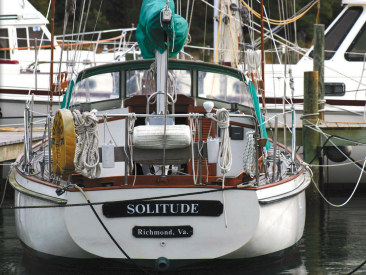
The Cheoy Lee was named Solitude when Clark bought her. “At the time,” he says. “I felt no compelling need to rename her. As the years have passed, she has come to represent exactly what her name implies: a place of solitude.”
Zora Aiken and her husband, David, are the authors of several books about boating and camping. They have also published seven children’s books illustrated by David. Their movable studio, office, and home is Atelier, a good old, now classic,1963 Chris-Craft sloop.
Thank you to Sailrite Enterprises, Inc., for providing free access to back issues of Good Old Boat through intellectual property rights. Sailrite.com