Centerboards, daggerboards, bilgeboards, and leeboards
Issue 89 : Mar/Apr 2013
Sailboats need draft if they are to sail to windward efficiently, but deep draft limits boats to sailing in deep waters and the resistance of a deep keel slows a boat that’s sailing downwind. To counter these deep-draft disadvantages, adjustable-draft devices are used on boats of every size and description, from sailing canoes to ocean cruising yachts.
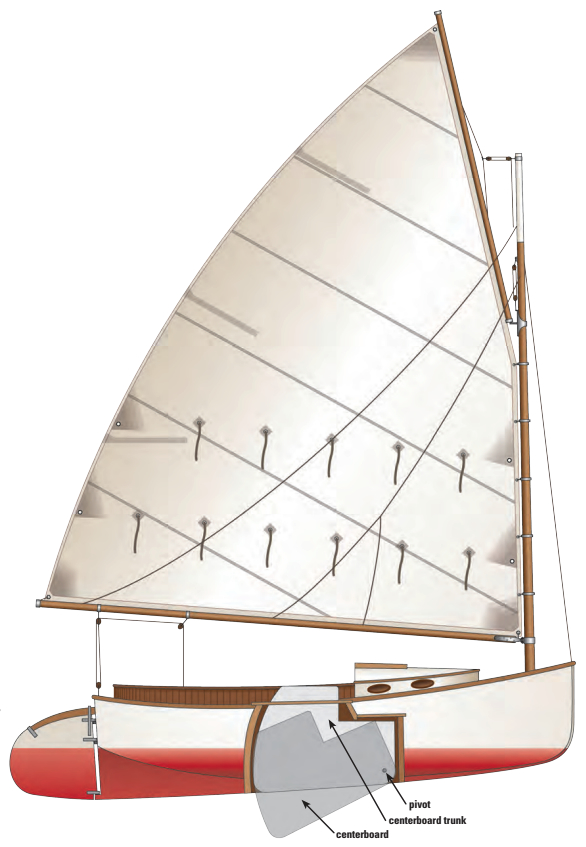
Centerboards
A centerboard is a retractable board that pivots downward. It is housed in a watertight sleeve, called a centerboard trunk, and can be raised when the boat is sailing on a run or in shallow water. On trailerable boats, centerboards make launching and hauling easier.
The efficiency of a centerboard increases with aspect ratio: a deep narrow centerboard creates less drag than a wide board and it also provides more lift. Since the position of the centerboard affects the boat’s center of lateral resistance, the centerboard can be raised or lowered to help balance the boat.
The centerboard trunk is usually located on the centerline of the boat. On some wooden boats, however, it is fitted just off the centerline so it doesn’t compromise the strength of the keel.
One of the problems a centerboard poses to a designer is that the centerboard trunk often divides the cabin. A compromise is to append a fixed shoal-draft keel that contains the centerboard trunk and eliminates the intrusion in the cabin. This type of design is called a keel/ centerboard (Note: See the July 2012 issue for an article on keel/centerboard designs. –Eds.)
With a few exceptions, centerboards do not provide significant ballast weight. Their primary purpose is to provide lateral resistance. A heavy centerboard needs a raising and lowering mechanism with some mechanical advantage. This is usually achieved with a winch or a block and tackle. A very light board might need a means of holding it down.
Daggerboards
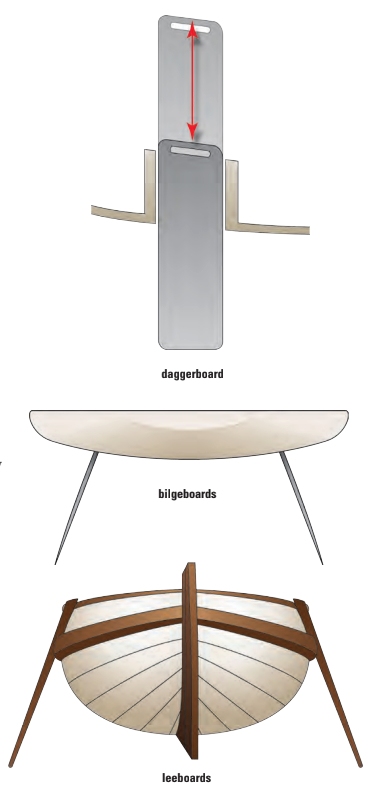
A daggerboard creates lateral resistance and lift in the same way as a centerboard but slides down and up vertically in its trunk, much like a dagger in its sheath.
An advantage of a daggerboard on a small boat is that, in the event of a capsize, putting weight on the daggerboard can help to right the vessel. A disadvantage is that the daggerboard will probably be destroyed and the daggerboard trunk could be damaged if the boat runs aground or hits an underwater obstruction. The damage sustained might result in an emergency situation at worst or a major repair at best. In the same situation, the pivoted centerboard, on the other hand, would simply be pushed up into its trunk.
Bilgeboards
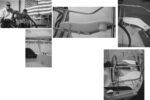
When two boards similar to centerboards and daggerboards are fitted in trunks on either side of the boat’s centerline, they are called bilgeboards. These boards are raised and lowered in the same way as a centerboard or daggerboard. In North America, bilgeboards are used primarily aboard racing scows.
Rather than being symmetrical like centerline boards, bilgeboards, which are each only immersed on one tack, can be asymmetrically shaped to create added lift to windward. They are also angled so the leeward board, when lowered, will be close to vertical when the boat is under way and heeled. The windward board is raised so it will produce no drag or lift in the wrong direction.
Leeboards
Leeboards are similar to centerboards except they’re fitted outside the hull, one on each side. They are so named because the leeward board is lowered while the windward board is raised. A leeboard is pivoted at its top. When lowered, it rests against a rubrail on the side of the boat, usually just above the waterline. It is this rubrail that takes most of the lateral force. As with bilgeboards, leeboards can be asymmetrically shaped to create optimum lift to windward.
The board on the windward side of the boat should not be lowered because the force on it due to leeway would pull it away from the boat, putting stress on the pivot point.
Leeboards originated in China and were adopted primarily by the Dutch for large craft and sailing barges. In the U.S. they are often seen on sailing canoes and other small craft where a centerboard or daggerboard cannot be used. Leeboards have never been popular in North America on larger boats. L. Francis Herreshoff’s Meadowlark is one of
Don Launer, a Good Old Boat contributing editor, built his two-masted schooner, Delphinus, from a bare hull. He has held a USCG captain’s license for more than 40 years and has written five books. Don’s 101 articles through November 2012 are now available for downloading as a collection from the Good Old Boat download website, . Look under Archive eXtractions.
Thank you to Sailrite Enterprises, Inc., for providing free access to back issues of Good Old Boat through intellectual property rights. Sailrite.com