A fast and well-built Bill Lapworth design
Issue 89 : Mar/Apr 2013
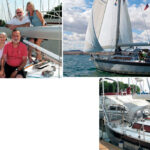
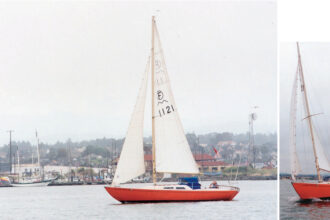
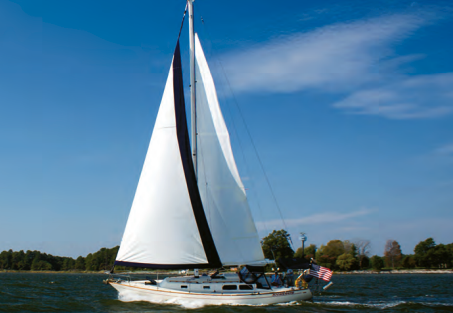
Each year, my wife, Sandy, and I look forward to early October, when we head for Annapolis and the U.S. Sailboat Show. Our fall 2012 trip was made even more enjoyable by the chance to visit, sail, and review the Cal 39 Mk II. Our review boat is a 1980 model owned by Charles and Gina Strasburger of St. Michaels, Maryland. Her name is Boomerang and, according to her owners, she earns an exclamation point at the end of her name!
Charles is an experienced offshore racer. He’s done several Transpac and Newport-Bermuda races on Cal boats. He told us he was completely smitten by these boats “for their ability to track, to point, for their easy motion under way in a seaway, the way they surf down a face of a wave, and the way they sail under spinnaker.” When they were seeking their own Cal, the choice was clear. “I knew the 39 was the better boat for Gina and me,” says Charles, “because the 39 is more suited to cruising . . . the 40 being more Spartan.” In late 2009, a friend told him about an available bank-owned Cal 39 Mk II in Baltimore, and hull #103 was soon theirs. After an extensive refit that included mast, boom, and oversized rigging for offshore sailing, she was reborn. Boomerang is now a common and beautiful sight on Chesapeake Bay.
History
In 1957, boatbuilder Jack Jensen stepped into designer Bill Lapworth’s office. The two men could not have known how great an impact that small step would have on the future of the recreational sailboat industry. On that day, they agreed that Jack would build a 24-foot Lapworth design in fiberglass. Jack wanted to name the boat the Lapworth 24, but Bill already had another 24-foot boat being built for someone else, so they settled on the name California 24, later shortening it to Cal.
That agreement signaled the beginning of the Cal line. Jensen Marine produced a number of Bill Lapworth designs at its Costa Mesa, California, facility, all under the Cal name. Jensen Marine was absorbed by conglomerate Bangor Punta in 1973 and the Cal line went with it. Bangor Punta continued to build Cals, moving production from Costa Mesa to Tampa, Florida, in 1980 and finally to Fall River, Massachusetts. Cal production ended in 1987.
C. William “Bill” Lapworth was born in Detroit in 1919. He earned his degree in Marine Engineering at the University of Michigan and served as an officer in the U.S. Navy during World War II. When the war ended, he settled on the West Coast and made a name for himself designing some very successful offshore racers. In 1963, yachtsman George Griffith commissioned Jensen Marine to build a 40-foot offshore yacht. Bill turned out a design that was radical at the time, with a spade rudder and fin keel. Named the Cal 40, it set the racing world on its ear by winning the 1965 TransPac. In the years that followed, new Cal designs were introduced at a rapid pace.
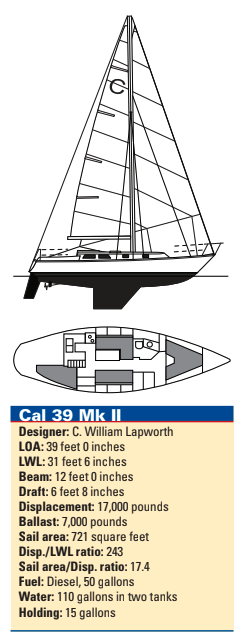
In 1970, Bill designed the Cal 39 to include cruising amenities in a boat that was still quick and responsive. The boat has a swept-back fin keel and a skeghung rudder. He modified the design in 1978, giving the Cal 39 Mk II a spade rudder and a fin keel with a vertical trailing edge. The Cal 39 Mk II has a displacement/LWL ratio of 243 and a sail area/displacement ratio of 17.4. Those figures mark it as a cruiser/racer.
Cal 39 Mk II production numbered 184 and, in 1983, the Cal 39 Mk III brought more changes, primarily in the interior layout.
Bill Lapworth continued to design Cal boats into the mid-1980s. He died in April 2006 at the age of 86.
Construction
The Cal 39 Mk II has a solid fiberglass hull and the decks are balsa-cored, with plywood coring in high-stress areas. The deck and hull are joined on an inward-facing hull flange with through-bolts and an adhesive bond. Leaks have been reported at the hull-to-deck joint.
Interior bulkheads are tabbed to the hull to provide stiffness and structural attachment points for the stainless-steel chainplates. Molded liners are used on the cabin sides and top.
The deep fin keel contains 7,000 pounds of lead ballast encapsulated in fiberglass. The rudder is constructed as a fiberglass shell around a stainless-steel armature and filled with foam. Leakage into the rudder and subsequent saturation of the foam can occur with this method of construction.
Rig
The aluminum mast is stepped on the keel. There have been reports of fairly significant water entry through the mast, so the keel step should be inspected when possible and repaired as needed. The mast has single spreaders supported by dual lower and single upper shrouds. A double-spreader tall rig also was available. The boat is equipped with a removable inner forestay.
The boom is an aluminum extrusion with mid-boom sheeting to a traveler mounted over the companionway hatch. A slab-reefing system for the mainsail is incorporated into the boom.
On deck
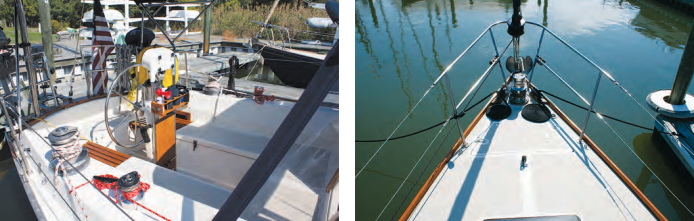
The deck layout is all business. Barient winches were standard, and the boat was delivered with primaries, secondaries, and two halyard winches on the mast. Genoa tracks are fitted inboard of the toerail and a short track on the cabintop forward is for staysail sheeting. Tracks atop the aft toerail are for outboard sheeting of genoas or for spinnaker sheets.
Wide sidedecks allow clearance for crew going forward and the solid teak toerail is attractive and functional, if something of a maintenance headache.
Storage space for an anchor rode is provided under a hatch in the foredeck and there is room for a vertical windlass. An anchor roller is incorporated into the stemhead fitting. Cleats are mounted inboard of the toerail but there are no chocks. Stainless-steel chafing strips protect the tops of the rubrails at the cleats. A stainless-steel bow pulpit and double lifelines are standard equipment.
The V-berth hatch is on the foredeck forward of the cabin trunk, leaving the top of the cabin trunk unobstructed all the way to the mast. Two lengths of grabrail along each side of the cabin trunk provide secure handholds and also serve as foot braces for crew working at the mast. The saloon hatch is aft of the mast and forward of the sea hood that protects the companionway hatch. The traveler crosses the cabintop above the aft end of the sea hood.
The cockpit has a wide coaming for comfort and security and a bridge deck at the companionway — a desirable feature in any boat that is taken offshore. While the cockpit seats are short, only 52 inches, they can be extended to more than 7 feet with teak inserts placed between the ends of the seats and the aft helm seat. However, this negates the purpose of the T-shaped seating arrangement, which is to allow access around the steering wheel and its Edson pedestal and guard.
Lockers are located under the side and aft seats. The genoa winches are accessible from the helm, but the midboom mainsail sheeting arrangement makes singlehanding difficult.
Belowdecks
The fit and finish of the teak interior is better than expected. The light headliner and hull sides temper the dark teak and the feeling is one of comfort and warmth.
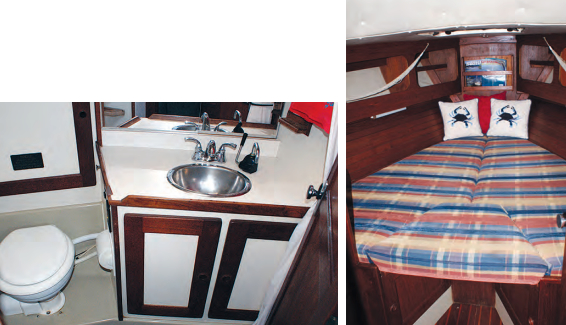
With its insert in place, the V-berth provides accommodations for two. At 6 feet 8 inches long, it doesn’t suffer from the foot-room deficit common in V-berths. Teak ceilings cover the lower hull sides; teak panels with cubby openings are fitted higher up. Hanging lockers are fitted port and starboard forward of the V-berth privacy door.
The head is to port, aft of the V-berth. It has a vanity, sink, and marine toilet that discharges to a 15-gallon holding tank. There is a teak grate over a sump and curtains that provide closure for an in-head shower. An opening port provides light and ventilation.
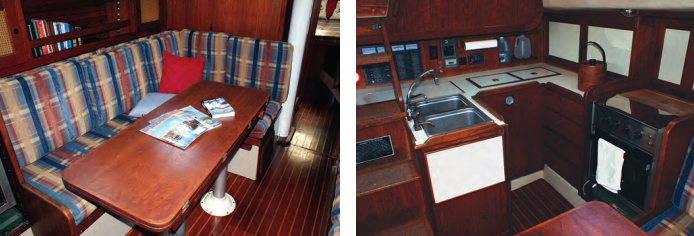
The saloon is spacious, with an L-shaped settee to port and a straight settee to starboard. A pedestal-mounted table unfolds and provides ample space for six. The port settee can be converted into a double berth. Forward and to starboard is a four-drawer storage cabinet with a fiddled shelf and, above that, more storage behind attractive leaded glass doors. Farther forward is another hanging locker. Behind the settees on both sides are storage shelves with caned doors on each end. Large fixed ports aft admit plenty of light and an opening portlight on each side forward of them admits air. Charles and Gina installed Newfound Metals portlights to replace the original plastic opening ports.
The U-shaped galley is on the port side and has ample counter space for meal preparation. It has a 7.7-cubic-foot icebox with optional refrigeration, a three-burner stove and oven along the port hull, and a two-basin stainless-steel sink inboard. Storage space is provided in four drawers in the cabinet aft of the stove and in lockers above the counter and stove to port. Water is supplied by a pressurized hot and cold system. The electrical panel for the boat is on the aft bulkhead. The top and bottom stair sections of the companionway are removable for engine access.
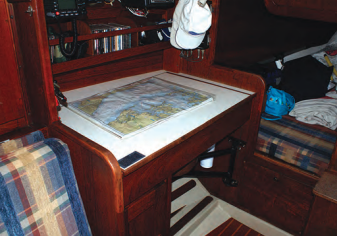
A chart table with a swing-out seat is to starboard of the companionway. Shelves above it provide storage and a mount for the VHF radio. Behind the chart table is a good-sized quarter berth.
The boat was also offered in a three-cabin model: the saloon was moved forward with the head reduced in size to make room. A second head was added aft to port, forward of a private port quarter berth. The chart table disappeared and the galley was moved to the starboard side.
Under power
The Cal 39 Mk II was powered by a Perkins 4-108 diesel. Some later models had a Universal diesel or a Pathfinder, a marinized VW diesel. The Pathfinder engines have had problems.
A hatch in the galley counter over the engine provides reasonable access for quick checks, and more access is available with the lower companionway steps removed. Charles and Gina had their Perkins 4-108 rebuilt and it runs beautifully.
Under power, the boat requires little helm correction to maintain a straight course when moving forward. The boat has a mild prop walk to starboard in reverse. Charles takes the starboard prop walk into account when maneuvering in tight quarters and has no problems bringing the boat into their fairly tight slip.
Under sail
There was chop on the Choptank River, a tributary to Chesapeake Bay, when Boomerang headed out for the test sail. My wife, Sandy, and I followed in our chase boat, a beautifully restored Chesapeake crabber named Frank. Mike Gosnell is the chase boat’s skipper and owner. It was a treat to be able to look at not one, but two, classic boats on this fine day.
With breezes at 15 to 20 knots, Charles and Gina prudently tied in a reef. We noted how well the sails trimmed even when reefed. Boomerang romped off close-hauled on a port tack as soon as the sails were set; Frank needed plenty of throttle to keep up. After several tacks, the Strasburgers bore off on a broad reach back toward Oxford. With each gust, she put her shoulder down and accelerated. It was obvious that Boomerang was a responsive performer. Some boats look fast just sitting in their slips but disappoint under sail, but the Cal 39 Mk II lives up to her sleek dockside appearance. When the breeze is up, she’s fast and nimble on all courses.
With the photo session over, Sandy and I stepped aboard Boomerang. Once we were back under sail, I took the wheel and found myself handling a sensitive and precise helm. The spade rudder provides tight control on all points of sail, even with the wind up. Steering required only fingertip effort. There is a slight amount of weather helm for safe control, and bringing the boat through a series of tacks was a snap. The boat drives well to windward and, despite being reefed, she easily pointed within 35 degrees apparent.
We eased the sails and fell off on a beam reach. Boomerang surged ahead under easy control. Sailing this boat gives one confidence that it will stand up to seas and winds that leave many others wallowing or heading for port.
We fell farther off until the wind was at 160 degrees apparent. She displayed nice manners and little roll tendency on the deeper course. We did not attempt a controlled jibe since the wind was up. We brought the boat back up to windward, tacked, and bore off on the opposite broad reach. The maneuver was crisp and clean and the boat handled precisely.
Bill Lapworth’s skill in designing fast and seaworthy craft became evident to me as we sailed the Cal 39 Mk II. Her stiffness and good seakeeping combine with features such as the full bridge deck and secure cockpit to make her an able passagemaker. The cruising accommodations are sufficient for an extended voyage. Boomerang has wind-vane steering installed. Cal 39 Mk II owners have made significant offshore passages in this sturdy design.
The Cal 39 Mk II is widely raced and is competitive with more recent designs. Its PHRF rating of 114 (108 for the tall rig) on San Francisco Bay compares favorably with a much newer Tartan 3700 deep keel at 105 and a Catalina 42 wing keel model at 111.
Prices and availability
A search found nine examples on the market at asking prices ranging from $35,000 to nearly $80,000, with the average just under $55,000. A look at the lower-priced boats shows a lot of deferred maintenance. Anyone wanting a Cal 39 Mk II and willing to do a little work might discover a bargain.
Two of the available boats are in Hawaii and a third is in New Zealand. This again speaks to the offshore capability of this design.
Tom Wells is a contributing editor with Good Old Boat (and his musical contributions at the Annapolis and Chicago boat shows have also earned him the title of Troubadour). He and his wife, Sandy, own and sail a 1979 Tartan 37, Higher Porpoise. They have been sailing together since the 1970s and look forward to going cruising upon retirement.
Thank you to Sailrite Enterprises, Inc., for providing free access to back issues of Good Old Boat through intellectual property rights. Sailrite.com