A solid, dependable racer/cruiser that’s just plain fun to sail
Issue 91 : Jul/Aug 2013
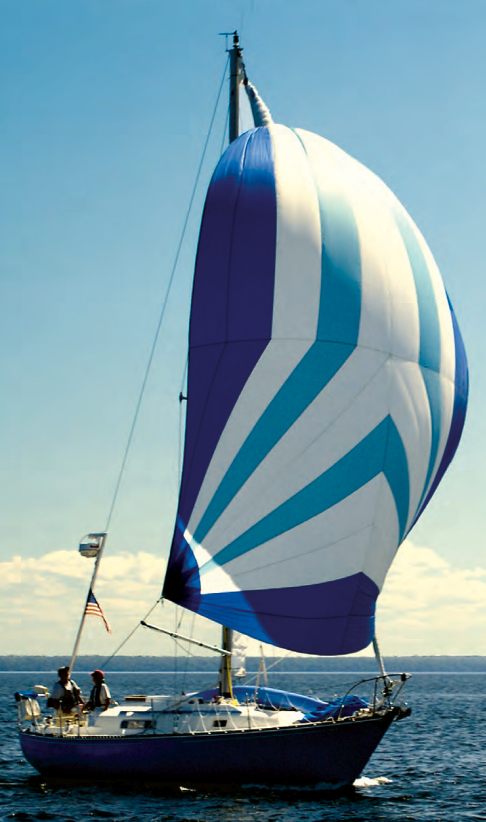
Boat reviewers are tasked with finding a good example of the subject boat to sail and photograph. When the C&C 30 came up as a review candidate, I knew there could be no better example than Mystic, the blue-hulled C&C 30 that just happens to own Good Old Boat founders Karen Larson and Jerry Powlas. When it comes to their magazine, they are modest to a fault and don’t willingly enter the spotlight. It took a considerable amount of pleading and a bit of arm-twisting, but they finally agreed that Mystic would represent her sister ships. That’s a plus, because their story is as fascinating as Mystic’s.
Last summer, my wife, Sandy, and I traveled to Lake Superior’s Apostle Islands to join Karen and Jerry for a few days to give Mystic a thorough going-over and to sail in her company aboard a chartered Tartan 34.
Finding Mystic
I’m convinced that we do not choose our boats, they choose us. To assign intelligence to an aggregation of metal, fiberglass, and wood is undeniably irrational, but somehow boats do seem to find their proper custodians. Jerry relates how he and Karen came to own Mystic.
“During our courtship, and even after our marriage, Karen and I raced my Flying Scot on Lake Minnetonka, west of Minneapolis. For our honeymoon we chartered a Catalina 30. This was a nice boat and we enjoyed sailing it for a week. The next year we chartered a Hunter 34. This boat was not in good shape, but we still enjoyed our cruise and began to think how nice it would be to have a ‘big’ boat to cruise. So we began looking at boats.
“At first I admired the teak-trimmed goddesses, but we got over our desire to buy a half acre of teak and eventually found an ad for Mystic in the Saturday newspaper classifieds. She was right in there with the board boats and Hobie Cats. You don’t find 30-foot sailboats in that section, so it caught my eye. We called the number and the owner talked to Karen for an hour.
“She hung up and I said, ‘Well?’ She said I should talk to the guy, so I called him back and he talked to me for an hour. He was very proud of his boat. I hung up and Karen said, ‘Well?’
“I said, ‘I think it’s a good boat and the guy has taken care of it.’ We called him back a third time and told him we’d pick him up at 5 a.m. and make the 5-hour drive up to the Apostle Islands where the boat was and go for a sail.
“The next day dawned with small-craft warnings. Once we’d arrived, I said, ‘We won’t really take the boat out, will we?’ The 76-year-old owner said, ‘We will just use the main and working jib.’
“We did take the boat out and she sailed like a dream in weather that would have had us fighting for our lives in our Flying Scot. The owner was a consummate sailor. When we got back, Karen and I walked down the pier holding hands saying, ‘We have to have this boat.’
“We bargained back and forth for a couple of weeks and the guy finally came down $50 and she was ours. We sold the Scot a few months later and never looked back. That was more than 20 years ago. I cannot imagine not having Mystic. She is like family.”
History
C&C Yachts is one of the most storied of all North American boatbuilders. The name originated in Port Credit, Ontario, when yacht designer George Cuthbertson and design associate George Cassian joined forces.
The 40-foot Red Jacket, designed by Cuthbertson & Cassian and built at the Bruckmann yard in the mid-1960s, dominated the racing world on both the Great Lakes and ocean circuits. They began to work with small Ontario boatbuilders Hinterhoeller Yachts, Bruckmann Manufacturing, and Belleville Marine, eventually merging in 1969 as C&C Yachts. A pioneer in balsa-cored hulls and decks, C&C was renowned for building stiff, fast boats.
C&C introduced the C&C 30 in 1972. It drew largely on the lines of the highly successful C&C 27 and quickly became a very popular model. Over the next 12 years, more than 800 were built, all at the Hinterhoeller plant in Niagara-on-the Lake, Ontario.
Although the company produced a series of successful models, it went into receivership in the 1980s, then through several changes of ownership. Many of the molds were lost in a fire. In 1998, Fairport Marine, the parent company of Tartan Yachts, bought the surviving assets and the C&C name and began production of three new Tim Jackett-designed C&C model sat its Ohio plant. (For more information, see “History of C&C Yachts,” September 2002.)
Design and construction
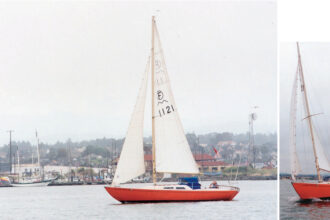
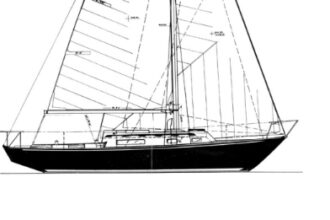
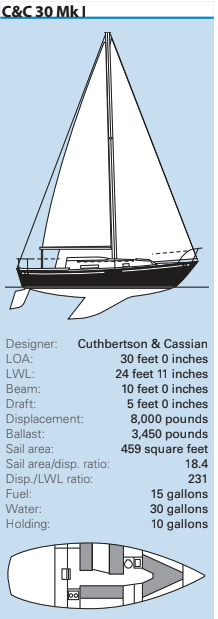
Like nearly all C&Cs, the 30 is a moderately light racer/cruiser design. It has a raked bow, traditional counter transom, and a saucy sheerline; it has a handsome, somewhat aggressive look. With a displacement/length ratio of 231 and a sail area/displacement ratio of 18.4, the boat is relatively fast and well suited to club racing.
The swept-back keel is attached with stainless-steel bolts, and often displays a slight “smile” at the hull-to-keel joint at haulout. Keel-bolt torque should be checked from time to time, but cleaning, filling, and fairing the joint is all that’s usually needed before applying new bottom paint. The rake of the rudder stock extends the trailing edge of the spade rudder well aft of the transom.
The hull is solid fiberglass; balsa coring was used only in the deck for stiffening and weight reduction. The deck joins the hull on an inward-turned flange with a layer of butyl sealant between them. They are secured by through-bolts through the slotted-aluminum toerail — a C&C signature. It may be necessary to tighten the toerail bolts if leaks develop. The slots in the toerail make great attachment points for snatch blocks.
Raised platforms on either side of the cabin trunk (intended for mounting halyard winches and also used as boxes for Dorade vents) impart added stiffness to the deck. There have been minor issues of water saturation in the deck’s balsa core near chainplates and other deck penetrations.
Except for modifications to the interior and the design of the portlights, the C&C 30 stayed relatively unchanged throughout its production life.
Rig
The C&C 30 Mk I has a keel-stepped masthead rig with single spreaders and single upper and lower shrouds led to common chainplates located on the sidedecks. The keel step was fabricated of oak, and many owners
have reported that dampness in the bilge leads to deterioration and, occasionally, to mast-step failure. It is a fairly simple matter to repair, and failures usually result only in a drop of the mast into the bilge, not loss of the rig.
The original design called for a single backstay. Later production boats offered an optional split backstay. The end-boom mainsail sheet attached to a traveler mounted just forward of the helm avoids issues with midpoint loads on the boom and makes for easy singlehanding. The fairly low boom was raised on boats produced from 1978 on. Primary headsail-sheet winches mounted on the coamings are operable from the helm position.
On deck
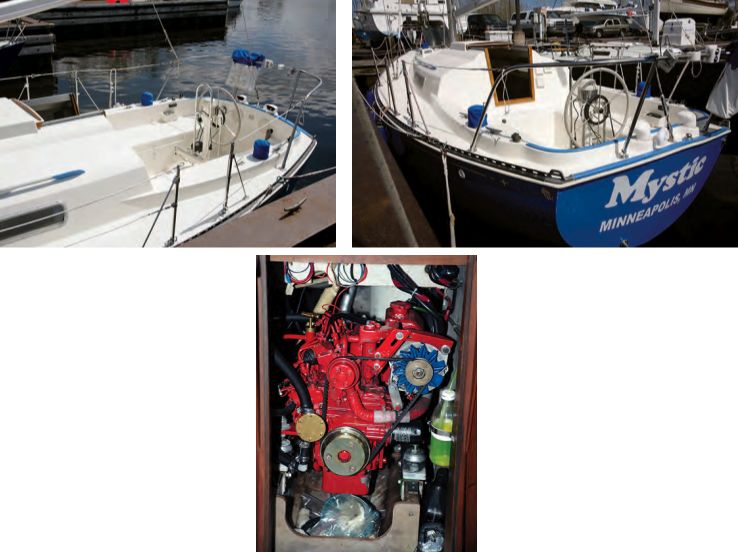
The pronounced sheer raises the freeboard at the bow, making the C&C 30 a relatively dry boat in a chop. The open foredeck provides good workspace for anchoring and line handling. The stem fitting has chocks for mooring lines. Cleats were fitted port and starboard and some boats had a single cleat on centerline. A stainless-steel bow pulpit provides security. Mystic has no anchor locker, although some of the boats do, and her rode stows in the forepeak via a hawsepipe. Jerry has added a windlass and dual bow rollers.
Fairly wide sidedecks allow passage forward for crew with little interference from the chainplates. Double lifelines extend from the bow pulpit to the stainless-steel stern pulpit with lifeline gates port and starboard. A large hatch forward in the coachroof admits light and air. Crew must be careful with their footing at the mast, but the winch plat- forms and teak grabrails provide some extra security. The companionway hatch retracts into a high sea hood aft of the mast.
The deep cockpit is protected by high coamings, and hatches in the full-length seats open to reveal roomy lockers. The boat was originally designed for tiller steering but most were delivered with pedestal wheel steering. Just aft of the pedestal, the squared top of the rudder stock, to which the emergency tiller can be attached, can be a hazard for feet. To get behind the wheel, the helmsman must step up onto a seat or squeeze between the wheel and the seat, but the traveler, located just forward of the wheel, makes some sort of evasive action necessary in any case. A seat-height bridge deck protects the companionway.
Belowdecks
The C&C 30’s layout makes good use of available space. The V-berth is 6 feet 4 inches long and, while it narrows considerably toward the bow, two can comfortably sleep here if they are at least “good friends.” Aft of the V-berth is a hanging locker to starboard and a small but functional head compartment to port for the marine toilet and vanity.
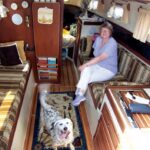
The saloon has 6 feet 2 inches standing headroom, but forward of the mast tall people need to watch the passage doorway that can be a head-knocker. The saloon has a long settee to starboard with shelf storage above. Karen and Jerry have added mesh hammocks aboard Mystic to provide more usable storage capacity. To port is a small dinette table with seats forward and aft. Four can be seated here but it’s cramped. Sliding doors provide access to outboard storage compartments.
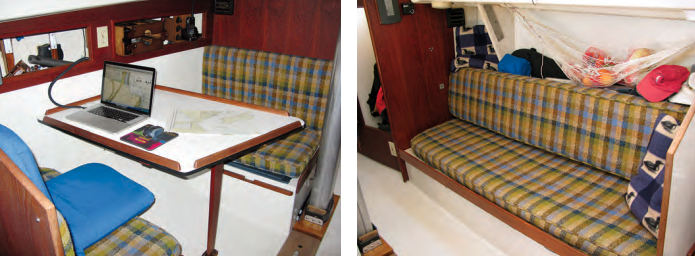
The cabin sole is textured gelcoat. Some owners cover it with outdoor carpeting. Fixed ports on both sides allow in ample light. The Dorade vents and hatches provide a little ventilation, and owners have fitted opening ports of various kinds to improve airflow.
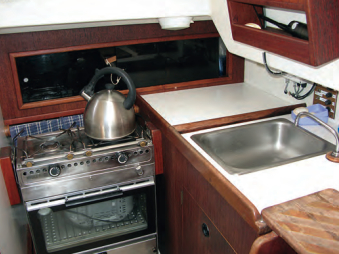
The galley occupies most of the space between the saloon and companionway. Formica counters are fitted on both sides of the companionway ladder with a sink and two-burner stove to starboard in an L configuration and more counter space and an icebox to port. The electrical panel is along the aft bulkhead near the companionway.
The interior is attractively trimmed in teak, with teak-veneered plywood bulkheads forward and partial-height teak bulkheads between the saloon and galley.
Power
Atomic 4 gasoline engines originally powered the C&C 30s and many are still in operation today. A 1-cylinder Westerbeke diesel was also installed in some early models. Later models were equipped with diesel engines, primarily the Yanmar 2GM. Mystic’s A4 has been replaced by a Beta Marine diesel. Performance under power is good, as the sleek hull is easily driven. Moderate prop walk to port is noticeable in reverse but it can be overcome with judicious use of helm and throttle.
Sailing in the Apostles
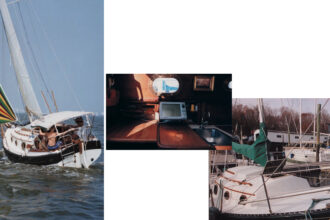
We sailed in company with Mystic for several days and that bolstered our appreciation for her fine performance and appearance. Winds were strong during most of our time in the islands but Mystic took them in stride with a reef in the mainsail and a partially furled jib. Sandy and I were sailing a good boat with a longer waterline, but keeping up with Mystic was not an easy task.
On our third day out, we sailed to a large bay and transferred to Mystic to begin our test sail. In the interest of full disclosure, I’ll admit that I had spent many an enjoyable hour at the helm of a C&C 30 before taking Mystic’s wheel. Longtime friends brought a C&C 30 named Dei Gratia to our own marina in the early 1990s and later sold her to mutual friends. I’ve sailed Dei Gratia with both sets of owners, so Mystic’s performance was no surprise.
Winds abated somewhat, so our test sail was done under a full main and genoa. The boat is quick and responsive. We started on a broad reach out of the bay and turned down a bit onto a run. This is where I discovered the simplicity and beauty of Jerry’s vang preventer system (see “Vang Preventer: A Fast, Effective Safety Device,” November 1998) that eliminates the need to run forward on deck and keeps the mainsail under full control, even during an unplanned jibe. The line is double-ended and retained by cam cleats near the helm.When you bring the stern through the wind, you simply ease the line on one side and take up slack on the other.With this system in place, Jerry and Karen eliminated the traveler. Mystic’s mainsail now sheets to a sturdy eye centered forward of the helm on the former traveler track.
As we charged across the bay toward the open lake, I looked astern and saw a familiar sight. When a C&C 30 is at speed, the flow pattern from the hull produces an upwelling of water about 10 feet aft of the stern. I first saw this phenomenon aboard Dei Gratia, and I had seen it on another C&C 30 as well. I call it the “C&C Roll.” It’s a good sign that you’re getting the most out of the boat.
We brought the boat up to a reach and then to a beat. Mystic’s deck is a bit busy, since Jerry and Karen use a two-person kayak in lieu of a dinghy, but even with a kayak stowed neatly to port, the running rigging was unfettered and tacks were easily accomplished. Using the deck for stowage like this means the jib should be cut fairly high.
Helm control on all points is crisp and precise. The rudder projects well aft of the transom and provides excellent turning leverage for control. (Note: That aft rudder projection can be hazardous. If you are anchored in a pleasant cove and want to take a dip, watch out for the rudder! This extension also makes Med mooring without damaging the rudder a challenge. –Eds.)
The C&C 30 is a fast, stiff boat that revels in higher wind speeds. When the breeze comes up, the boat simply puts her shoulder down a bit and surges ahead. I’ve personally outrun many a larger boat in heavy air aboard a C&C 30. The high bow, companionway sea hood, and secure and protected cockpit make this boat a capable coastal cruiser that can also handle work offshore. Several of these boats have indeed made long offshore passages, and Mystic herself has cruised the length and breadth of boisterous Lake Superior and into Lake Huron’s North Channel.
C&C 30s are widely raced and quite competitive with newer craft. PHRF ratings vary from 174 on San Francisco Bay to 180 on Chesapeake Bay. This compares favorably with a much newer Tartan 28 at 174 and the late 1980s Hunter 30 at 180.
Price and availability
At least 18 C&C 30 Mk Is were available in early 2013. Asking prices ranged from a low of $17,000 to a high of just over $34,000, with the the average at $22,100. A surveyor should carefully examine the condition of the mast step and look for possible water saturation in the deck core.
Tom Wells is a contributing editor with Good Old Boat (and his musical contributions at boat shows have also earned him the title of Troubadour). Tom has recently published a suspense novel, Superior Run, with a sailing theme. He and his wife, Sandy, have been sailing together since the 1970s and own and sail a 1979 Tartan 37, Higher Porpoise.
Thank you to Sailrite Enterprises, Inc., for providing free access to back issues of Good Old Boat through intellectual property rights. Sailrite.com