Prevention demands diligence and vigilance
Issue 90: May/June 2013
Ellen and I have been involved with two major boat fires over the years. The first was in the Caribbean on board Entr’acte, our Nor’sea 27. We had guests on board, something that disrupts the usual routine. We had just returned from a day’s snorkeling and were all hungrily anticipating dinner.
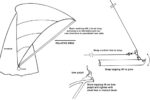
Entr’acte was anchored in St. John, USVI, and the winter trades were blowing in earnest. All the hatches were open and the wind scoop was drawing welcome cool air into the boat. Ellen was preparing dinner in our small galley for more people than usual. The stove was running. While waiting for a pot of water to boil, Ellen tried to get a jump on the next day’s varnishing. She opened a gallon can of denatured alcohol and began to pour some into a 2-pint bottle.
I was in the aft cabin with David, my brother-in-law, while Ellen’s sister Joanne was writing postcards at the chart table and their son Jayson was in the cockpit playing with his new-found hermit crab in a bucket of water.
There was no sound, no flash, no warning — all we heard was Joanne saying, “Guys, we need you up here, NOW!” She actually sounded calm.
As I entered the cockpit, I was knocked back toward the aft cabin by a blast of heat from the main cabin. In front of me all I saw was a wall of flame. Joanne had climbed out the forward hatch but, through the flames, I could clearly see Ellen still inside the cabin, clothes smoldering. With all the willpower in the world, I tried to get to her but the force of the hot air pushed me back. Joanne finally succeeded in helping Ellen escape through the forward hatch, by which time her clothes and hair had started to burn. In one motion she came up through the hatch and dove over the side.
Disoriented? You bet! Ten seconds before, we were happily discussing the lobsters we caught for dinner and suddenly Ellen was in the water and we were fighting a raging inferno.
There was so much fire and so many flammable materials (oil, alcohol, paper, plastic, varnish, teak oil, cloth, and imminently wood) it was impossible to decide what technique was right for fighting each type of fire. There was no time to think, only to act!
A frantic few moments
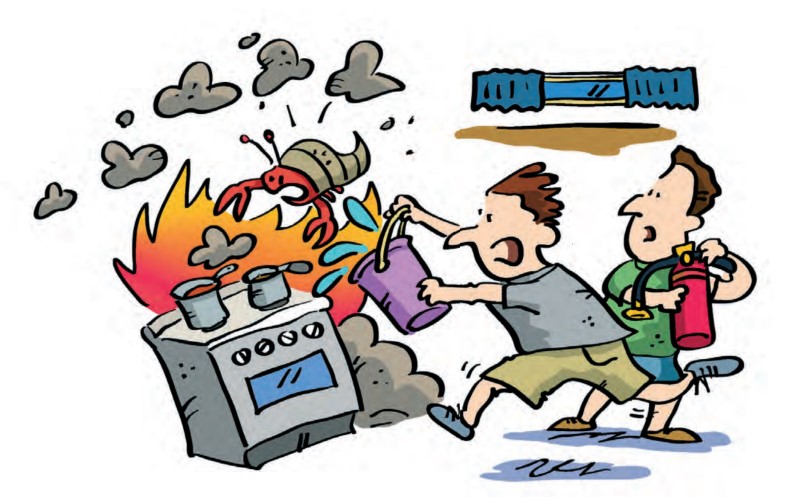
I grabbed the fire extinguisher from the aft cabin and shot at the companionway to gain entrance. My next shot was the stovetop to extinguish the burners, that were now torches, but they immediately reignited. My third shot fared no better. David came to the rescue by unceremoniously dumping the bucket of water, along with one very surprised and panicked hermit crab, onto the stove. This bought me enough time to reach the master kerosene shutoff valve and throw the fire blanket on top of the burners. My last shot of this extinguisher was saved for gaining access to the second extinguisher that was covered with burning alcohol.
The rest of the time was a blur of shooting dry powder at everything that burned, accompanied by copious buckets of water continually thrown onto everything inside the boat, whether it was burning or not. This was no time for finesse!
The entire event from ignition to extinction lasted less than a minute. Yes, time does slow down during these events. It is just fantastic what can happen in only a minute!
Alcohol inferno
The ignition had set in motion a complex series of events. First, the gallon can of alcohol exploded in Ellen’s hands and sprayed flaming alcohol all over her and everything in the main cabin. The ignition itself extinguished the flames of both burners on our kerosene stove and they immediately cooled to below the vaporization point. This resulted in liquid kerosene spraying upward to be ignited by the ambient flames and turning the two burners into blow torches.
Everything in the cabin was covered with burning alcohol that, as it burned away, would set fire to all of the combustible surfaces beneath: varnish, wood trim, books, papers, ship’s log, clothing, and plastics. The flames from the floor were sucked up through the louvers of the head door as by the draft of a chimney. Anyone who had been inside the head compartment at that moment would have been asphyxiated or burned alive as the flames ignited the toilet paper, wood, and a nylon jacket hanging there. The jacket instantly evaporated into a cloud of invisible hydrogen cyanide. Even the fire extinguisher in the main cabin was on fire!
Aftermath
Ellen had second-degree burns on her face, hands, and fingers. Her hair was singed, her eyebrows burned off, and she had what appeared to be one incredible sunburn. Fortunately, she kept her face in the water throughout the battle, which we believe kept the burns from getting worse. We treated her for shock and kept her under watch, but she had no further complications beyond severe blistering on her hands and fingers. With rigorous attention and care, these faded away after a few weeks with no permanent scarring or other lasting effects.
Incredibly, Entr’acte emerged unscathed. Aside from the indescribable mess, the only evidence of this event is the scorched louvers of the head door, which had just started to ignite. To this day when we clean, we look at them and shake our heads.
When we were building Entr’acte, Ellen and I had discussed just such an event. We decided that — should a fire occur — it would probably be associated with the stove and the first reaction would be to get away from the fire. It seemed, therefore, that mounting a fire extinguisher close to the stove was not a good idea. Instead, we installed one near the forward hatch and another in the aft cabin. That aft cabin extinguisher saved our boat.
The cause of the fire
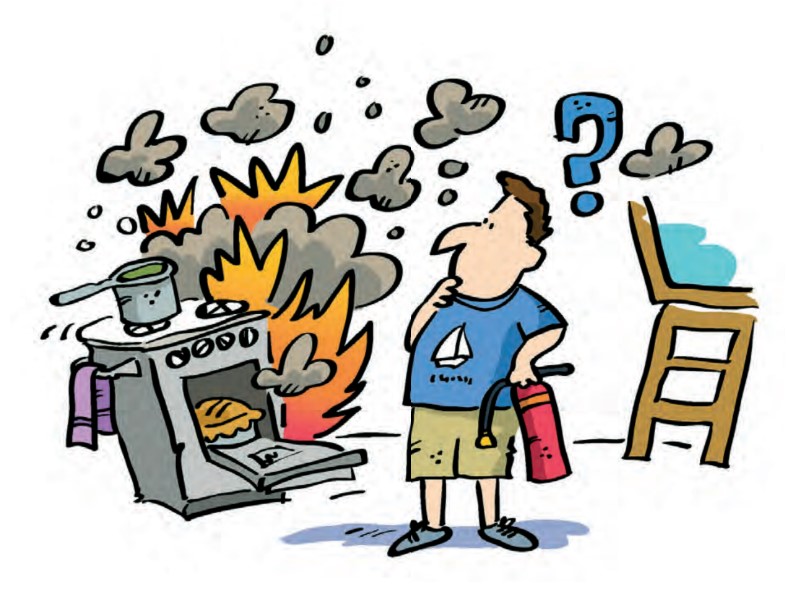
We were anchored into the trade winds. The wind scoop was drawing beautifully and provided perfect ventilation. It was actually more like a wind tunnel, but it felt wonderful. Even though Ellen was forward, pouring the alcohol almost 8 feet away from the lighted stove, the wind carried the fumes right through the boat to the burners and . . . BAM!
Could this fire have been avoided? Absolutely! Did we know better? Yes! But this had been a week of sheer chaos and we were off-balance, rushed, and frazzled, trying to entertain company and keep a 9-year-old occupied and happy. Had we been alone in our usual mode, we would never have done anything so abjectly stupid!
What we learned
- Beware of anything flammable around any heat source, especially if it has an open flame. This includes cooking stoves, but also heat guns, hot-air heaters, hair dryers, candles, and birthday cakes. This sounds like a no-brainer, but in a small space like a boat the danger is greatly magnified.
- Fumes from many solvents are heavier than air and will settle low in the boat. They can be ignited by a hot engine manifold, lighted stove burners, cabin heaters, oil lamps, and candles. Beware of solvents. (Note: After writing this, Ed wrote, “Just the other day in Vanuatu, a guy wanted to clean his bilge so he went at it with copious amounts of acetone. After he finished, he used a 12-volt vacuum cleaner to finish up. He started the vacuum and BOOM! The vacuum sucked the acetone fumes into its motor and, horribly, the explosion set off his propane tanks. There was not much left.” –Eds.)
- You can go from a beautiful carefree day to absolute disaster in less than a minute.
- Fire extinguishers should be placed away from areas where fires are most likely to start. At least one should be stored in a cockpit locker.
- You can never have too many fire extinguishers.
- The only type of extinguisher to have on board is one rated A-B-C, for all types of fires, because you will be fighting all types at once.
- Inspect extinguishers regularly to see that the gauges are in the green. If not, replace them immediately.
- Shake and roll your extinguishers regularly, and especially after long passages to windward. This prevents the powder from settling and compacting over time. We store our extinguishers in a horizontal position so the powder has less tendency to pack tightly.
- The tradition of following a shipboard routine has a practical purpose. Entertaining guests, especially children, distracts you from your normal routine, causing you to do things you would not normally do. Try not to let the presence of guests disturb your onboard routine.
- Heroics go out the window. As hard as I tried to enter that cabin, it was impossible until after the first shot from the extinguisher and the bucket of water. Without the aft-cabin extinguisher, we would have lost the battle.
- Any boat must have alternate and unobstructed means of exit, both forward and aft. Without the forward hatch, Ellen would have been burned alive.
- Cooking on board a boat is a full-time job, different from cooking ashore. When cooking on board do only that! Period! Do not multi-task cooking with entertaining or preparing for some other maintenance task.
Another galley fire
Our second experience with a boat fire was many years later. This fire was more insidious in its cause, something none of us would ever have expected.
We were traveling the ICW in company with another boat heading to the Bahamas. Nadine was a 28-foot sloop owned by Fred, Monica, and their young sons, Josh, 11, and Justin, 9.
Like us, Fred was fond of kerosene stoves and he had outfitted Nadine for this cruise with a used one he’d found in a marine consignment center. It was in great shape. He installed it, and off we went.
On a cold Chesapeake Bay afternoon, they were happily cooking dinner when POOF! The entire galley was in flames. Fred didn’t panic. He grabbed his rather large extinguisher and gave the fire a solid blast. Out it went. POOF! Another ignition. Another hit. POOF! The fire would not die! They quickly exhausted all of their extinguishers, but the fire kept reigniting. The cabin was now full of smoke and, with the fire raging, Fred gave the order to abandon ship. As I came alongside with two more extinguishers, the kids took to my dinghy while Monica remained behind to take care of Fred, who was exhausted and somewhat overcome by the smoke.
Unlike with our fire on Entr’acte, I could enter the cabin. This fire had more smoke but far less heat because it was still confined to the galley area. I took a deep breath and dove into the cabin. I could see the flames, but could not find their source. I knew I had about a minute or so before I had to breathe and would have only one chance. From studying the flames, I determined that the source was associated with the oven.
Opening the door, I saw perhaps the most magnificent pie I have ever seen and, at the same time, located the source of the flames: inside the framework of the oven itself!
I had to make a terrible choice: save the pie or the boat and, believe me, I thought about it. That pie was right out of a storybook! But common sense prevailed and I shoved the nozzle of the extinguisher into a vent hole and let her rip, not once but several times with both extinguishers. I kept shooting until I could not hold my breath any longer and bailed out. That did the trick. The fire was dead, but so was that apple pie.
All ended well. No one was injured and we all lived to continue the voyage south.
Lessons learned
- Cause: The fire was caused by oil-soaked oven insulation. Fred’s used stove was an older unit such as you might find on any good old boat. Throughout its years of use, raw kerosene from leaks, cleaning fluids, cooking grease, and food oils had gradually found their way through screw holes and assembly points and accumulated in the fiberglass insulation common to all stoves, even those in our homes. Over time, the fiberglass insulation soaked it all up like a sponge, slowly becoming a giant cigarette lighter. Eventually, the day arrived when there was sufficient oil buildup that the heat from the burners caused it to ignite.
- Proper use of the extinguisher: All fire-extinguisher instructions say to “shoot at the base of the fire.” This deprives the flame of much-needed oxygen. If you just shoot at the flame itself, the fire will re-ignite. It was only when I aimed the nozzle into the vent hole and directly at the source of the fire that I introduced enough powder to smother the flames. I shot a lot of powder into a small space!
- Check your oven insulation: In the days following the fire, we disassembled both Nadine’s and Entr’acte’s stoves. They were in the same condition. Entr’acte’s insulation was a ready candidate for the same event. Over many years, the insulation had soaked up spills made when filling the tank and cleaning burners as well as cooking oils and other oily stuff. For $5, we replaced the insulation in both stoves.
Kerosene was not the culprit. While these stoves have long been criticized because of the need to prime them with alcohol and the danger of flare-ups, this fire was not a result of either of those activities. Cooking releases grease and oils that settle on galley surfaces that are easy to see and clean, but they also accumulate in unseen and completely inaccessible spaces, such as our oven insulation. We remove our stove from its mountings annually and clean away an amazing amount of grease buildup, but we had never thought to inspect the insulation. Upon discussing this issue with friends, they disassembled their gas cooker and also found oil-soaked insulation. If a flare-up of this nature had happened with a gas stove, it would have been catastrophic.
No matter what cooking fuel you use, the danger is there. This certainly surprised us. Check your older stove and you may be surprised as well.
Recipes for disaster
Boats are lost for many reasons, many of which are beyond our control. No matter how diligent a watch we keep, whales, submerged containers, trees, and logs are invisible in a running sea, especially at night. Navigating in low visibility puts many things somewhat out of our control. An onboard fire, however, is perhaps the most “avoidable” of hazards. The real horror is in its suddenness. One minute you are happily living your dream and the next everything is literally going up in smoke.
Here are a few potential fire sources we have experienced first-hand or witnessed over the years, all of them eminently avoidable.

Engine-room hygeine
How clean is your engine?
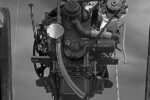
A clean engine and engine room is not an affectation of a gearhead hot rodder. I am amazed when I look into engine rooms and see greasy monsters lurking there in the dark. Years of buildup from fuel and oil leaks can easily ignite, especially during a long hot run in the tropics. We’ve seen this time and again.
Do not tolerate any leaks!
Oil is insidious. A little goes a long way to create a mess. Fuel from leaky lines, engine bleeding, and filter changes, and oil from filter changes and leaking gaskets runs along wires. It pools inside electrical tape and the conduit of the wiring harness, building up over time to eventually cause a malfunction of some kind or even lead to a fire.
We blew an oil line on Entr’acte two years ago. Despite meticulous cleaning, even now I still find oil in places and in quantities that surprise me. A scrupulously clean engine, engine room, and bilge go a long way toward preventing a fire.
Engine-room firefighting
If you do have an engine room fire, do not rush to open the compartment door. That gives the fire an abundant fresh source of oxygen. You are far better off closing all vents to the engine room and firing the extinguisher through a small opening — perhaps built in and capped for just this purpose. This is a great argument for a built-in automatic engine-room extinguisher.
Stove safety
Alcohol stoves have always been deemed “safe.” This is because an alcohol fire can be put out with water. However, alcohol fumes, like gasoline fumes, are heavier than air and are capable of violent explosion. A friend was boiling water for coffee when the burner shut off suddenly because the tank had run out of fuel. Being quick on the trigger, he wanted to refill the tank and continue with his task so he would not lose the prime. As he opened the fill cap on the pressure tank, alcohol vapor — under pressure — escaped from the tank to fall invisibly onto the still-hot burner and BANG! Both of us were blown right across the cabin. All the hair on his arm was burned away and his face and T-shirt were scorched. He should have waited for the burner to cool before opening the fill cap. The fumes in an “empty” tank make it far more volatile and lethal than a full tank.
Beware when priming kerosene and alcohol stoves. Those of us who use pressure alcohol or kerosene to cook must prime the burners with alcohol. If for some reason you “miss the prime” or the burner goes out and needs to be re-primed, beware! Wait for a minute or two to allow the burner to cool down and then prime a different burner. Never attempt to re-prime a hot or warm burner or an adjacent one until the burners have cooled for a minute or two. It’s a waste of time and alcohol because even a warm burner will vaporize the priming alcohol long before the burner becomes hot enough to function properly. More important, by pouring alcohol onto a hot burner, you run the very real risk of having the burner ignite not only what is being poured but also flashing back to the alcohol container you’re using.
How many times have we seen someone squirt a bottle of charcoal lighter onto the briquettes of a grill before they are lit? Fine, but after they are lit, it is the height of folly. Don’t prime your kerosene or alcohol stove this way.
Never, ever, leave your stove unattended. We have seen cooks set a pot to “simmer” while going out spearfishing. You might get away with this in a house but doing it on a boat is asking for trouble.
Electrical-fire sources
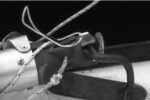
Don’t overlook electrical wiring. I had an “instant fire” one afternoon as I was installing a new engine-hour meter. It was a very simple operation: remove two small nuts and out comes the gauge, two more nuts and off come the wires, reassemble everything and reattach the panel. That’s it! Two minutes later, as we were preparing to go ashore, we smelled smoke and I saw flames behind the instrument panel. I immediately turned the batteries to the “off” position and disassembled the panel. The wiring studs on the new meter were a little bit longer than those of the old meter . . . just enough to make contact with something behind the panel. Even though the studs had rubber boots to cover them, the pressure of the panel being screwed down was enough to dislodge one. Had we left the boat sooner, it would have been a disaster.
Always leave plenty of space between electrical connections and cover all connecting wires securely with rubber boots, tape, liquid electrical tape, or heat-shrink tubing.
Battery charging
Battery chargers are culprits too. Boats have been lost due to battery chargers. Many people leave their boats connected for weeks or months at a time in their absence. We never leave Entr’acte connected to a charger when we’re away for any length of time. Turn it off and disconnect the boat from the power source. Many marina electrical systems are overloaded beyond belief. You and the charger are at the mercy of whatever faults occur.
High-output alternators and fast charging systems also cause fires. Battery fires are truly frightening. We have seen several battery fires recently caused by “fast charging.” Some fast-charging systems allow the user to regulate the output of the alternator while monitoring and regulating battery temperature and voltage. The danger arises when trying to charge a large battery bank in an hour of engine time. The faster the charge rate, however, the higher the heat buildup.
We have a high-output alternator. It certainly has a place and, when used properly, performs a wonderful service. We like a simple externally regulated system. It fully charges the batteries in its own good time and is much smarter and more patient than I am. It takes longer to charge, but it is far safer.
Handle gasoline with care
You can never be too careful around gasoline. Even boats with “safe” diesel engines carry gasoline for outboard motors and generators. Jerrycans spring leaks. Be careful where you store them and be careful when transferring fuel from them to other containers.
One afternoon while at anchor, I needed to filter a gallon of gasoline. The foredeck was out of the question as I was afraid the fumes would find their way through the forehatch even if was closed. I chose the cockpit instead.
We all learn that when at a fuel dock you should close all hatches and doors until departing. With this in mind, I closed all the doors and the hatches and proceeded to make my pour. It only took 30 seconds and there was more than adequate ventilation. From below, however, came the cry, “Why am I smelling gas in here?” I looked down and, surprise! — I was right next to the open vents to the engine room. I had forgotten to spin them closed. Needless to say, we opened everything up and spent some time blowing out the engine room. Perhaps the foredeck would have been the better place after all.
Remember your outboard motors and generators. Why would we be sensible enough to be pathologically afraid of gasoline yet store outboard motors and generators when not in use or during layup in the head? Sure their tanks are empty, but what about their carburetors? Remember that an empty tank is more dangerous than a full one.
Beware of that jerrycan stowed on deck just outside your open port or hatch. Completely full, it’s not a problem, but notice how it bulges on a hot day when it’s half full. Can it crack under this pressure?
Be smart with propane
Propane use is also problematic. We were recently in a marina where a boat two boats away from ours had a propane tank sitting in the wheelhouse and the “working tank” clearly visible in the galley below. If that boat ever blew, it would take out the entire marina and us with it. I mentioned our concern to the owner, who was happily standing next to the tank while using a belt sander, sparks flying, to spray powdered fiberglass all over the boat next to him. He was unmoved. We mentioned our worry to the marina management and they also were not concerned. We left the marina.
A few years ago we were visiting the boat of someone who writes for the foreign yachting press. He was using a stove fueled by Camping Gaz, where a gas canister screws directly to the stove itself — inside the boat in his galley! During dinner preparations, the stove ran out of gas. We were absolutely appalled when he lifted a mattress to retrieve a new gas bottle. Under his bunk were no fewer than 20 gas cylinders — some full, others empty, and many of them rusty.
We have witnessed gas explosions on two occasions. In both cases, everything was installed properly, well-maintained, and used with proper care. Obviously something went undetected.
On board a boat we must always play the game “What could possibly happen?” As I move about Entr’acte, I always ask myself this question and try to forestall the events I imagine. You never know what might get you.
Ed Zacko the drummer met violinist Ellen while playing in the orchestra of a Broadway musical. That show ran for only three weeks but their show is still running after 36 years. Ed was reading Sailing Alone Around the World and Ellen said, “Why do you want to go alone?” They built their Nor’Sea 27, Entr’acte, from a bare hull and since 1980 have crossed the Atlantic to Europe and back four times and sailed to New England, the Caribbean, and the Bahamas countless times. After seven years in the Pacific, Entr’acte is headed to northern France for a second trip through the French canals. Follow their voyage at www.enezacko.com.
Thank you to Sailrite Enterprises, Inc., for providing free access to back issues of Good Old Boat through intellectual property rights. Sailrite.com