Phil Bolger’s take on a gunkholer is . . . different
Issue 72 : May/Jun 2010
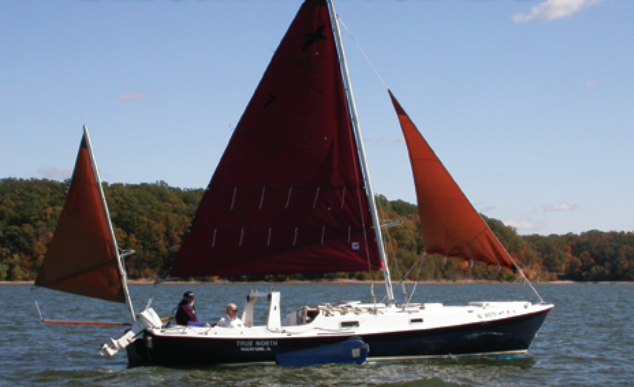
Phil Bolger’s small boat designs are quite unlike those of other designers. Not many builders would have the courage to put one into series production, but Bolger found a willing partner in Edey & Duff, which built his Dovekie and Shearwater 28. Our review boat, True North, is a Shearwater 28 owned by Nick and Gayle Scheuer of Rockford, Illinois, who have towed it to many great sailing destinations in the Midwest, East Coast, Canada, Texas Gulf Coast, and west coast of British Columbia.
Peter Duff and Mait Edey started out in 1968 building the Sam Crocker-designed Stone Horse in Peter’s Mattapoisett, Massachusetts, backyard and living room. They went on to build 150 of the full-keel 23-foot cruisers and nearly 1,200 boats in all — from the tiny Fatty Knees dinghy to the Nathaniel Hereshoff-designed Doughdish, the Stuart Knockabout, and more recently, the handsome Joel White-penned Sakonnet 23 daysailer. In 1978 they introduced the Bolger-designed Dovekie, a 21.5-foot, 600-pound, extreme shoal-draft sailboat. The Shearwater 28 evolved from this design and E&D built 11 of them between 1985 and 1997. The partners sold the business to Tony Andersen (who owned three E&D boats) in 1987; in 2007, Harding Boat Works bought it from Tony’s estate and continues to build boats in its Aucoot Cove facility under the name of Edey & Duff.
Design
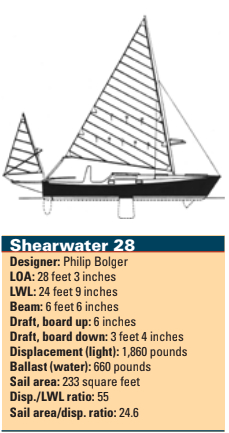
The Shearwater 28 is a good example of Phil Bolger’s “form follows function” design philosophy. Edey & Duff intended the Shearwater 28 to be a larger Dovekie. Both designs have kick-up rudders and twin retractable leeboards to get into the thinnest of waters and keep going to windward: 4 inches minimum draft for the Dovekie and 6 inches for the Shearwater 28. The hull form of the Shearwater 28 is more akin to a long canoe than a sailboat. The bottom is flat and turns sharply into flat topsides with no deadrise or rocker — not quite a sharpie but nearly so. The transom is heart-shaped and incorporates the engine mount. The shape gives a lot of initial or form stability but not a lot of ultimate stability. There is 660 pounds of water ballast or 600 pounds of lead (an option taken in half those built, including True North) to make the Shearwater 28 self-righting in a knockdown.
An unusual feature of both the Dovekie and the Shearwater 28 is a small bow centerboard. Originally installed to cure a lee helm problem with the Dovekie, the feature was retained in the Shearwater 28, where it is used for trimming and holding the bow into the wind, particularly in combination with the mizzen sail. Nick Scheuer removed the bow centerboard and trunk and glassed over the slot. Fellow owner Harry Mote, owner of the standard rig Shearwater 28, Ardea, ordered his built without the feature, finding it less useful than advertised and believing that it would hinder boat speed. Nick followed Harry’s lead in adding 400 pounds of lead ballast to stiffen the boat.
Nick’s boat is the only Shearwater rigged for headsails. The rest are considered cat yawls. The deck hatches provide access to running rigging on the mast and to ground tackle forward.
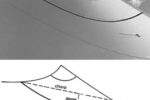
The Shearwater 28 has a sweeping sheerline at the hull-to-deck flange, and a dark hull shows it off very nicely against the straighter line of the flush deck. With a beam of 6 feet 6 inches and a weight of 1,200 pounds empty, the boat is well within legal trailering limits.
The hull and deck are a sturdy sandwich of 1⁄8-inch skins of unidirectional E glass and polyester resin either side of a 3⁄4-inch Airex foam core. Together with additional flotation, the volume of the core makes the Shearwater 28 unsinkable. The bottom of the hull has extra laminations as the boat is designed and engineered to be beached and to sustain minimal damage from the occasional altercation with rocks.
The hull/deck joint has no mechanical fasteners; outward flanges on the hull and deck are stuck together with 3M 5200 and the joint is glassed over on the inside. This kind of outward-turned joint can be unkind to the topsides of other peoples’ boats during a raft-up.
The rudder is wood encased in fiberglass. It retracts into a sturdy transom-hung fiberglass housing that serves as a short rudder even with the rudder blade fully raised. The aluminum mizzen mast attaches to the transom and the sail sheets to a boomkin clamped atop the stern.
Symmetrical wood and fiberglass leeboards give the boat a draft of 3 feet 4 inches when down. Weighted to drop, they can be set to varying depths with a stopper to hold the pendant. Nick and Harry modified their leeboards to provide a lifting foil, claiming better windward performance. Edey & Duff felt no such need, insisting that for maximum lift and resistance to leeway, both boards can be left down while sailing; they claimed the Shearwater 28 can be tacked through 84 degrees.
On deck
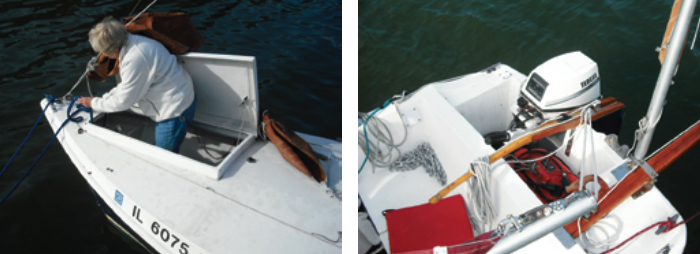
Although Phil Bolger intended that the sails and ground tackle would be handled from the hatches, there are times when you need to walk on the cabintop. As there is no non-skid, you must take care when it’s wet. A very large forward hatch lets you handle the ground tackle and docklines and, in the case of True North, the jib as well. Mid-deck is another large hatch intended to provide access to the mast. Both hatches have hinged, solid-fiberglass covers that can be removed quickly. The deck has two molded-in recesses to receive optional 30-watt solar panels.
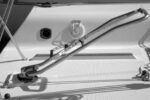
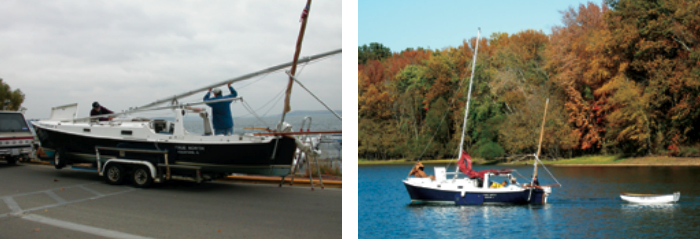
Like the Dovekie, the Shearwater has a mid-cockpit fiberglass boom gallows to support the mast and sprit when lowered. This is useful for trailering, of course, but the spars can be easily lowered while under way, making it possible to pass beneath bridges with 6-foot or more clearance. The gallows/arch also serves as a foundation for a full-cockpit canvas enclosure that combines with the companionway dodger to make the cockpit an outdoor saloon.
A well aft accommodates a 10-hp outboard motor and its tank. The cockpit seats are exceptionally long and deep with high backs that make for comfortable sitting or sleeping. The self-draining cockpit is 8 feet 6 inches long by 52 to 58 inches wide with three lockers.
The footwell is just right for windward bracing and can be spanned with a filler board to make a queen-sized berth. The companionway has a very low sill and four weather boards. It’s a handy spot to stand out of the breeze while sailing, with or without the dodger. There are no lifelines or pulpits.
Accommodations
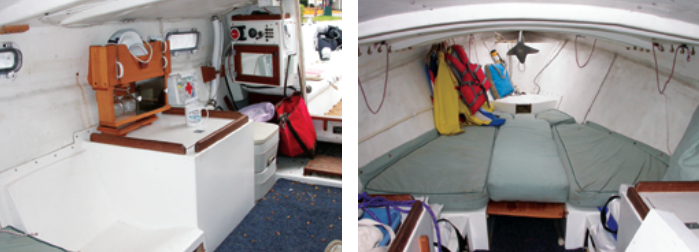
Molded interior components line each side of the boat. They are stuck to the hull with 3M 5200 and pop riveted to the inner laminate of the sandwich hull. They incorporate the forward berth flats, a low, ergonomically shaped and quite comfy seat each side, a molded sink/galley/storage area on the port side, and an insulated non-draining icebox or optional 12-volt refrigerator on the starboard side.
Originally, four hinged, removable boards supported the 72 x 65-inch V-berth. Nick replaced these with a single reinforced plywood panel that makes going forward much easier. A small anchor locker below the forward hatch is accessible from the inside.
Two sliding drawers pull out into the cabin from under the cockpit seats, and there is some additional space below and forward of these drawers. Nick has located his portable toilet to starboard.
An electrical panel with circuit breakers and battery switch is to starboard on the bulkhead, while to port is a sort of medicine chest cabinet with a mirror. Headroom is only 49 inches under the companionway hatch and 46 inches at the galley. Crouching and crawling are necessary for getting about inside the cabin, but it has more than adequate storage for most gunkholing that a couple might undertake.
There is no ceiling or overhead cabin liner, just the painted hand-laid glass of the inside hull. With the three deck hatches open, the cabin is very light, fresh, and airy. Four screened opening ports provide good ventilation when the hatches are closed.
Rig
As unique as the hull is, the rig is equally uncommon on a boat of this size. The roachless main and mizzen are of a “leg o’mutton” style supported by an aluminum sprit in lieu of a boom. A “snotter” line at the forward end of the sprit acts as both outhaul and vang and is adjusted by moving it up and down the mast. Two reef points are provided on both sails. Depending on the boat, the sails may or may not have battens. Battened sails are furled conventionally, while those without battens furl to the mast.
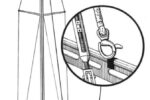
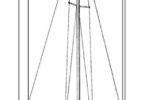
The deck-stepped aluminum mast can be easily raised and lowered by one person. True North has upper shrouds and baby stays (for mast stepping), while the others in the fleet have only single shrouds. There are no spreaders or backstays and deadeyes, not turnbuckles, tension the shrouds. The sprit is well above anyone’s head and much safer than a standard boom. There are no sheet winches for the mainsail or jib. Halyards and snotter controls are handled from the mid-hatch, except on True North where some lines have been led aft to the cockpit. In brochure photos of the Shearwater, no lines lead from the cockpit forward because of the cat rig. The mizzen’s lines are on the mast and boomkin.
Depending on the tack, the sails may press up against the sprit, but owners say chafe is not a problem and performance is not affected. At only 29 square feet, the mizzen is not intended to provide much drive except off the wind. Its contribution is more for balance and as a steadying sail at anchor. The 204-square-foot mainsail of the cat yawl rig is sufficient to drive the long narrow hull. Edey & Duff literature states the Shearwater 28 has held up well in winds up to 35 knots.
Let’s go sailing
We sailed True North on a cold and dreary late-October day on Wisconsin’s Lake Geneva. Nick said the Shearwater 28 will capsize if attention to placement of “bio ballast” is not taken seriously. I believe him.
The Shearwater 28 feels like steering an aircraft carrier — the view is long, wide, and flat. Turning is sluggish. On the plus side, pulling the line to extend the rudder to vertical took little effort and, as long as the rudder is properly secured down, the helm is light. The tiller is a short, solid, wooden affair that does not tilt up — a feature that would have been handy on several occasions. Steering from the helmsman’s seat was a bit uncomfortable as the tiller was near shoulder level and there aren’t many other places you can sit and still steer.
The mainsheet is attached to the rudder head and is held by non-removable belaying pins through the tiller. In steady or light air, the sheet can be tied off and left alone. In gusty conditions, however, the Shearwater 28 is tender, so we gave the mainsheet half a wrap around the tiller and held it by hand. The sheet ran easily when we needed to depower the rig. I felt weather helm as we sailed to windward, but we later realized that the rudder had been trailing partially up. Nick says the boat usually has a neutral to slightly lee helm that can be corrected with the mizzen. On the day of the test sail, the waves never got high enough to determine if the flat hull pounded in chop, as one might suspect.
With the breeze building, Nick felt we’d be safer if we reefed the main. This involved lowering the sail as normal and hooking the tack on the reef hook, but the sail had to be released at the clew and the sprit lowered to the gallows. The main flew like a flag while we rolled the foot up and secured it with many reef points. Nick then reattached the clew to the sprit, and pulled the snotter line tight, which raised the lightweight sprit and exerted outward tension on the sail. A separate outhaul line on the sprit can trim the sail as well. A reef in the jib also was an option.
As always seems to happen, as soon as we had reefed the main, the wind abated. We cruised comfortably past the elegant homes surrounded by muted fall colors. In the light air, we had to back the jib to come about.
A shift brought fresh wind and we broad reached back along the 10-mile length of the lake, with the leeboard pennant singing. True North tracked straight and true with good acceleration to what felt like 5 knots (Edey & Duff claims the Shearwater 28 is capable of 10 knots in heavy air). She probably could have done 7 knots with the genoa hanked on. Off the wind, steering from a perch on the aft cockpit coaming provided a great view and was easy and comfortable. The boom gallows didn’t impair visibility nor was it in the way when we moved about in the cockpit.
Throughout our sail, the large hatches proved very handy. We could comfortably stand with our torsos protected from the cool breeze and be secure while working. The same was true of the forward hatch when we were docking or attending to the jib. The mid-cockpit gallows is another place to stand and feel secure.
Under power, Nick’s Yamaha 9.9 high-thrust outboard gives powerboat-like handling. His ability to “slam on the brakes” as he approaches the dock and stops the boat is the envy of the marina.
Conclusion
All in all, the Shearwater 28 is a comfortable, capable boat that can explore very shoal areas few others can. For the Florida Keys and the backwaters of the Chesapeake Bay, it’s ideal. Being light and shallow, it has limitations in open water, so you have to bear that in mind when deciding on where you want to go sailing.
Finding a Shearwater 28 for sale is a matter of being in the right place at the right time. As of this writing, none were listed for sale on the Internet. According to Nick and Harry, selling prices in the last 10 years have been between $12,000 and $18,000. Edey & Duff still has the molds and might build you a new one if you can afford it. However, there are other boats out there designed by Phil Bolger that embody his design philosophy: keep it simple to construct, simple to sail, and efficient under sail or power.
Allen Penticoff is a freelance writer, sailor, and longtime aviator. He has trailer-sailed on every Great Lake and on many inland waters and has had keelboat adventures on fresh and salt water. He presently owns three sailboats: an American 14.5, a MacGregor 26D, and a 1955 Beister 42-foot steel cutter that he’s restoring.
Thank you to Sailrite Enterprises, Inc., for providing free access to back issues of Good Old Boat through intellectual property rights. Sailrite.com