A small Danish motorsailer for all-weather cruising
Issue 71 : Mar/Apr 2010
Larry Rosen dreamed of owning a boat that sailed well, was suitable for extended cruising, and that he could comfortably live aboard. He wanted to be able to invite friends to join him for a week or two of pleasant cruising. After some research, Larry bought an LM 28, sight unseen, from a seller in Minnesota, who had found the boat too large for the small lake he had moved to.
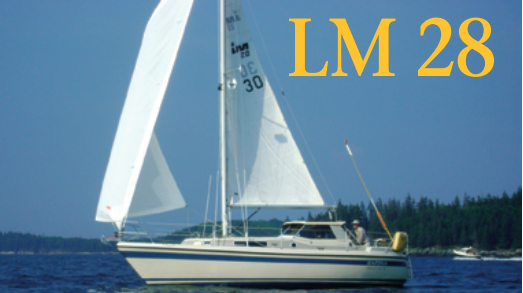
Every boat is designed around priorities and compromises, and the LM 28 meets several requirements often thought of as essential: comfort, seaworthiness, good sailing capabilities, excellent accommodations for its size, and the ability to motor comfortably and efficiently so you can get where you need to go on schedule.
It was these characteristics that first attracted Larry to the LM 28. When he first launched Safina on Chesapeake Bay (where he kept her until trucking her to Maine) he watched with some trepidation as she came off the trailer. To his relief, Larry found the boat “was just as the magazines had described it — a lovely sailing boat with brilliant design features.”
An evolving business
The LM 28 was designed by Danish designer Bent Jull Anderson and built by LM Glasfiber in Kolding, Denmark. LM Glasfiber started as a small company manufacturing wooden furniture under the name Lunderskov Mobelfabrik (Lunderskov Furniture Factory.) In the early 1950s, LM shifted its focus to the use of fiberglass and subsequently changed its name to LM Glasfiber. In 1972, the company began manufacturing a line of small motorsailers ranging from 24 to 32 feet. The LM 28 was the last of five models that LM would build; its nine-year production run ended in 1991. Although the focus of the company had shifted to fiberglass, its woodworking legacy is evident in the LM 28; few production boats have as many clever and well-thought-out details in their joinery.
After 1991, LM Glasfiber shifted gears once again and, having left the boating industry, became the world’s largest manufacturer of wind turbines.
Design
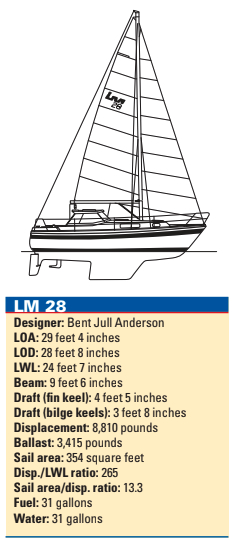
Pilothouse boats are not easy to design, especially under 30 feet where so many elements compete for attention. The LM 28 is surprisingly attractive, with a gentle sheer, raked bow, and countertransom. It was offered in two configurations: with a deep fin keel drawing 4 feet 6 inches or with twin bilge keels drawing 3 feet 8 inches. The rudder is located quite far aft and is mounted on a partial skeg.
Displacement is moderate; the displacement/LWL ratio is 265, which is actually a bit on the light side for a motorsailer. The sail area/displacement ratio of 13.3 indicates a sail plan that is small yet, in a breeze, capable of moving the boat without auxiliary power.
Construction
The LM 28’s hull is solid hand-laid fiberglass, and is certainly a little overbuilt. In some places it is overan inch thick, a fact brought to Larry’s attention when he was installing a depth sounder. The deck is fiberglass cored with end-grain balsa, which reduces weight and increases stiffness, making the deck less likely to flex when you walk on it. The balsa core is replaced with plywood where deck hardware is fitted and in high stress areas. The deck is bonded to the hull using bolts and chopped-strand mat, and bulkheads are bolted to tabs that are bonded directly to the hull.
The LM 28 has iron ballast encapsulated in the keel and covered inside the hull with a partial pan. In fact, the builder made extensive use of fiberglass liners. Wood trim is well-fitted mahogany ply with a matte finish and interior glass surfaces are painted. Altogether, the LM 28 is a solid and rugged little boat.
The pilothouse
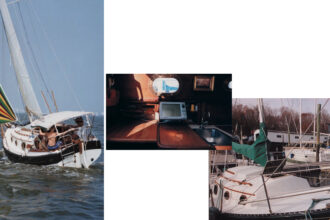
The first thing that strikes you about the LM 28 is the pilothouse. It is small, which minimizes its aesthetic and structural impact, and just large enough to house a chart table and a helm station. The front, sides, and even the aft bulkhead of the pilothouse consist almost entirely of glazing (although two 8-inch wide supports make the cabintop sturdy and are thoughtfully positioned to minimize visual obstruction). This makes the pilothouse a warm, sunny, and pleasant place to while away many miles, while also allowing a virtually unobstructed view of the water ahead through the pilothouse from the cockpit.
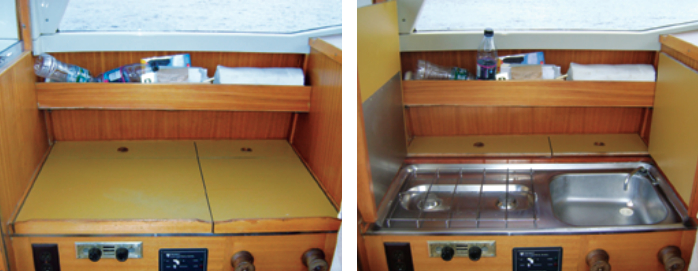
On the port side, the pilothouse has a chart table that opens up into a galley with a two-burner stove and a sink with hot and cold pressure water. Larry likes this arrangement because it allows him to cook and navigate while still being within easy reach of the helm, which is on the starboard side of the pilothouse (the refrigerator is under the helm seat). A sliding hatch on the pilothouse cabintop directly above the helm seat allows the helmsman to stand up with his head through the skylight for a better view when docking. It also enables the helmsman to easily see the rig and sails while steering from inside the pilothouse. A companionway-style hatch shuts off the pilothouse from the rest of the interior during inclement weather.
Cockpit and deck
The pilothouse is right in front of the cockpit. It provides shelter for the crew in the cockpit — no dodger necessary — and its expansive glass gives the helmsman excellent visibility forward and excellent protection from the weather.
A removable tiller is used for steering the boat from the cockpit. When the the tiller is in use, the pilothouse wheel can be disconnected from the rudder by disengaging a simple locking mechanism. This eliminates the friction and effort required to turn the wheel and makes for a lighter and more sensitive helm while sailing.
A canvas awning can be folded out to enclose the entire cockpit, to substantially expand the living space when at anchor or to provide shelter in heavy weather. Larry had his awning built with roll-up windows and netting, so he can set the awning and keep the bugs out but still enjoy a breeze flowing through. With the awning and the pilothouse, the difference between “down below,” and “on deck” is significantly blurred.
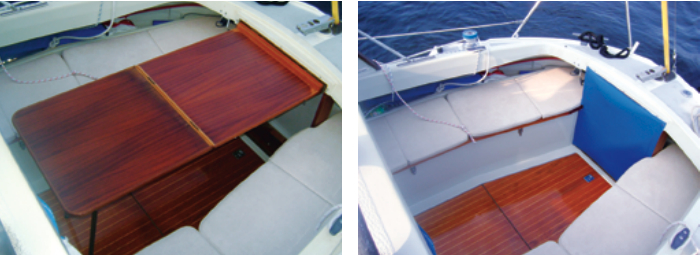
The cockpit has copious amounts of storage — in cockpit lockers and in the open space underneath the deck. A clever fold-up table allows comfortable al fresco dining and, coupled with the awning, makes the cockpit a wonderful place to spend time in pretty much any weather or port.
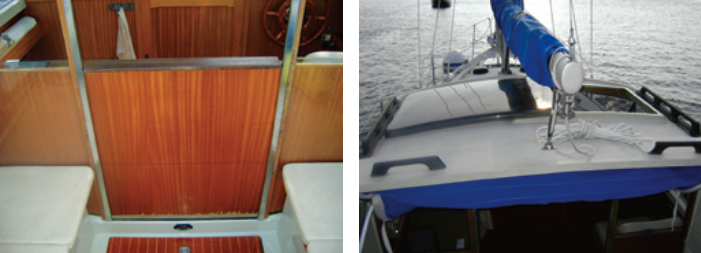
Larry installed several substantial handrails on the roof of the pilothouse to provide security for anyone moving around on deck in rough weather. The original handrail was so small and skimpy he felt he was literally hanging on by his fingertips.
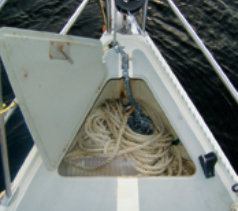
Forward, an anchor well makes dealing with the ground tackle quick, easy, and convenient.
The rig
The aluminum mast is stepped on deck and has a single set of spreaders. The genoa sheets are trimmed aft by the cockpit, and the mainsheet is led to the top of the pilothouse. This system works well, especially in heavy weather, as all the sheets can be accessed from under the awning. The jib is fitted with roller furling, and the mainsail is contained by a Dutchman sail-handling system.
Larry inherited the boat’s present reefing system from the previous owner, and it’s a bit odd: two lines are spliced into one and then led aft to the cockpit. When the time comes for a new mainsail, Larry thinks he will probably set it up with regular old-fashioned lazy-jacks and two-line reefing.
As mentioned earlier, the rig on the LM 28 is small for the average cruising boat. This limits performance in light winds, but in those conditions the boat would most often be motoring. In heavy weather, the small rig makes the boat easy to handle, adding to the comfort of the crew.
Accommodations
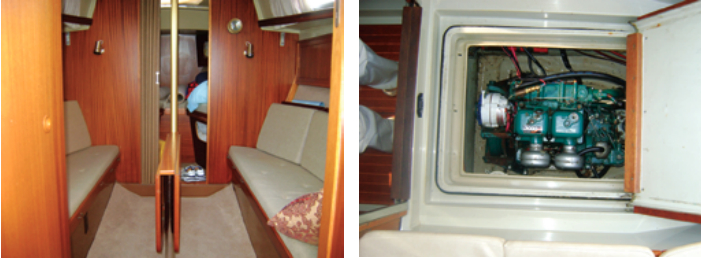
Forward of the pilothouse, the layout is conventional and practical. Aft near the pilothouse, and perfectly positioned for quick access from the pilothouse and cockpit, are the head to port and a large hanging locker to starboard. The head is well thought out, with many small shelves for storing toiletry items and cleaning products, and has a sink that pulls out from behind the toilet on tracks. Details like the hanging locker, which is an ideal place to stow foul weather gear, make it easy to forget that the LM is only a 28-foot boat.
Farther forward, the saloon has full-length settees facing each other. The port settee can extend all the way out to the table to make a double berth without impeding access to the forward cabin.
All the way forward is a V-berth. The LM 28 can comfortably sleep four or five people but, like all 28 footers, it is best suited for just two.
The boat has an impressive amount of storage space. In addition to the lockers in and around the cockpit, it
has a large lazarette. It also has storage under the pilothouse sole, under the galley, under the settees in the saloon, in attractive shelves built just under the deck in the saloon and above the V-berth, and in a locker forward between the V-berth and the anchor locker. A cruising boat has a tendency to pick up all sorts of small, unexpected items, and on the LM 28 there is plenty of space to store them. The storage capabilities make it well suited, despite its size, for someone living aboard.
A distinguishing feature of the LM 28 is the high quality of the joinerwork throughout the vessel. The cockpit table, chart table/galley, clever locking systems for doors and access panels, and cleverly designed lockers for holding dishes and glassware secure in even the worst conditions, remind us that the LM builders started out as furniture makers. One particularly clever solution is that for closing the companionway. Instead of the usual hinged doors or loose teak dropboards, a single companionway dropboard stows in a slot in the aft pilothouse bulkhead. It pulls up from under the sill when needed and is completely out of the way when not in use.
Under way
As a motorsailer, the LM 28 relies heavily on its engine. The diesel engine on Safina is a Volvo Penta 28-hp sail drive located under the cockpit. Larry likes the sail-drive setup because its horizontal propeller shaft improves efficiency and maneuverability for docking, especially when reversing. (One magazine review says the fin-keel version handles better than the bilge-keel version, which doesn’t back up well.)
This engine drives the boat at a top speed of 6.5 knots and enables it to cruise between 5.5 and 6 knots at 2,000 to 2,200 rpm. At this speed, the LM 28 has a range under power of about 300 miles. This relatively small range reminds us that this boat is, though a motorsailer, still very much about sailing. This is evident in its relatively deep fin keel and separate rudder. While the LM 28 won’t blow your socks off with blistering upwind performance, it easily tacks through 90 degrees, has a comfortable and light helm, and makes easy work of a chop. The small sail plan makes it easy to handle in heavier winds, and is a reminder that though it sails very well, the LM 28 is designed to sail and motor at the same time.
Conclusion
Larry is an anthropologist who has spent much of his professional life in the Arab world. In Arabic, safina means “light dancing on the surface of the water.” Having cruised in her all around Penobscot Bay and the coast of Maine, Larry says Safina has lived up to her name.
L. Francis Herreshoff believed that the term “motorsailer” carried too many negative connotations. He never viewed his Marco Polo design (a 55 foot motorsailer rigged as a three-masted schooner) as a motorsailer but saw it simply as a capable and seaworthy boat for any type of cruising. Cruising is not a sailing- or motoring-specific activity; it is the covering of many happy miles on the water. By the same token, the LM 28 is a good choice for someone looking for a rugged small boat on which to spend time on the water.
Today, a serviceable example of the LM 28 could probably be bought for around $50,000.
Milo Feinberg recently graduated from Westlawn Institute of Marine Technology’s Elements of Technical Boat Design Program. He is a freshman at MIT and plans to major in mechanical engineering with a concentration in ocean engineering. Milo has spent many summers sailing in Castine, Maine, where his family sails an Edey & Duff Stone Horse. He had the good fortune to race with Olin Stephens.
Thank you to Sailrite Enterprises, Inc., for providing free access to back issues of Good Old Boat through intellectual property rights. Sailrite.com