. . . with two other husky, seaworthy cruisers
Issue 72 : May/Jun 2010
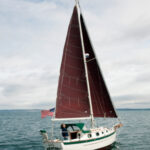
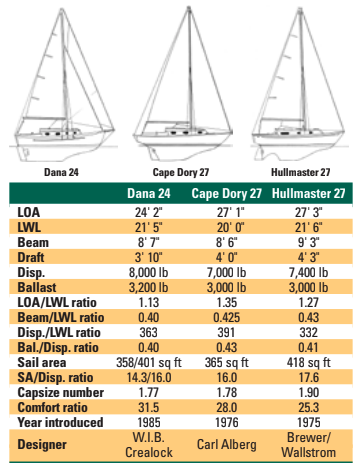
Selecting designs to compare to the feature boat is never easy; it often boils down to finding similar yachts of the same length. In this case, the feature boat is rather unusual with her short length on deck, heavy displacement, and offshore capability so I selected two boats with a reasonably similar waterline length, beam, and displacement, regardless of their length on deck. Actually, the Dana 24 measures 27 feet 3 inches with her bowsprit, so her overall length is quite close to the others, at least when you pay the slip fee!
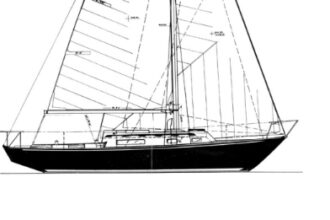
In searching for two husky yachts to compare with the Dana 24, I resorted to a 35-year-old design I did with Bob Wallstrom in the 1970s. This design does make an interesting comparison, with her rudder separated from the aft end of the longish keel for better control. My other choice was a solid Alberg design, the Cape Dory 27, due to her reputation for quality and offshore ability.
The well-built Dana 24 is a very capable craft. At least one of these boats has made a successful circumnavigation and many others have made adventurous bluewater voyages as well. I would not be the least surprised to learn that a Cape Dory 27 has circumnavigated. The Hullmaster 27 has also proven capable offshore; one of the boats has been sailed, solo, between Vancouver, Canada, and Mexico for a number of years. All three are very husky yachts with a high displacement/length ratio for their size. Indeed, any of them will take you wherever you want to sail and bring you home again in safety, if not in absolute comfort — there are some limits to size.
Comforting numbers
The motion comfort figures of the three are quite good. The number for the Dana is unusually high for a small boat, with the Cape Dory a close second. Obviously, the Dana 24, having such short overhangs, will not develop as much reserve buoyancy as the longer-ended boats. This may make her wetter on deck in short, choppy seas but it may also reduce any tendency to hobbyhorse in certain conditions. The capsize numbers of these boats are also unusually good for their size. The Hullmaster’s figure is a bit higher, due to her more generous beam, but this does add to interior space and form stability, one of the tradeoffs that designers often have to make.
All three boats have deck-stepped masts. This is not ideal for a bluewater cruiser, as it makes it much more difficult to set up a jury rig if the boat is dismasted . . . and it can happen. The careful seaman will ensure that every piece of rigging is in perfect condition and will carry ample spares when heading out on a long voyage. Fitting a strong tabernacle would strengthen the spar and could also simplify setting up a jury rig. That modification might be worth considering if distant waters beckon.
The Dana’s measured sail area seems small at 358 square feet, but her working sail area with both jib and staysail set is actually 401 square feet. That makes quite an improvement to her sail area/displacement ratio and to her potential performance in lighter air. She is the only one of the three that comes with a double-headsail rig. That is advantageous when the wind pipes up, as it provides more combinations for reducing sail. In brisk winds, the Dana will get along very nicely with just the staysail and reefed main. In more extreme conditions, a storm main and storm staysail can be set.
There is no sign of the Dana having running backstays, however, and I feel these are desirable with a double-headsail rig. Runners can keep the staysail luff taut, thereby improving windward ability, and they can keep the mast from panting when everything around you has gone to hell in a handbasket. I strongly suggest that any sailor planning to head across the oceans in a small yacht consider adding a staysail stay and running backstays and having a storm staysail made.
There you have it: three small cruisers that can accommodate a crew of four. Each will make a good family week- ender yet, unlike many small cruisers, also has the potential to take an adventurous couple to distant shores and sunwashed islands when the sea gods call.
Ted Brewer is a contributing editor with Good Old Boat. As one of North America’s best-known yacht designers, he has put his hand to most everything from America’s Cup yachts to pocket cruisers.
Thank you to Sailrite Enterprises, Inc., for providing free access to back issues of Good Old Boat through intellectual property rights. Sailrite.com