How they’re built and repaired — and the many good reasons for owning one
Issue 14: Sept/Oct 2000
People have built, paddled, and sailed boats for tens of thousands of years. Throughout that time, almost all watercraft have been built of wood. Although today wooden boats are seen by many as old-fashioned and undesirable, there are still loads of good reasons to own a wooden boat (see Good Old Boat, May 2000 issue). But what kind of wooden boat? Not surprisingly, there are a number of different construction techniques, each with distinct advantages.
Dugouts to racers
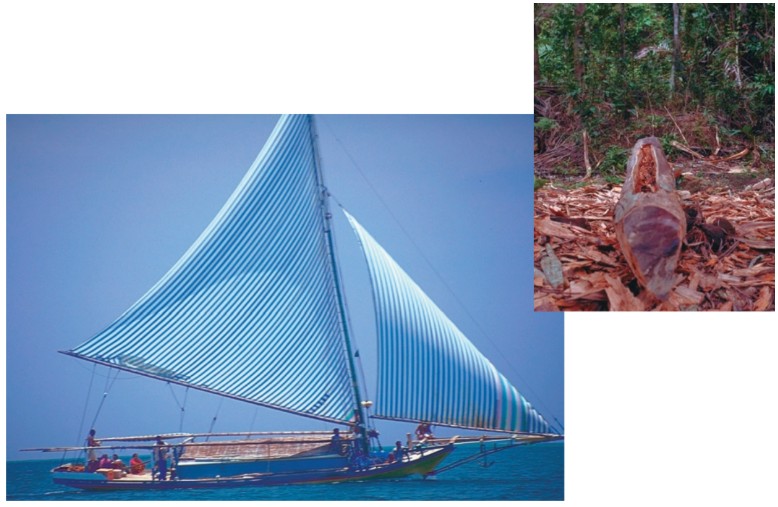
Our distant ancestors built watercraft by shaping and hollowing logs with the aid of fire and simple stone tools. Over time, those boats were improved with planks added to increase the boats’ capacity and seaworthiness. From such simple beginnings a fascinating variety of craft evolved, but all shared several features: planks were edge-fastened (typically with pegs or splines), and each was unique in shape, with the boat’s form determined during construction through a combination of tradition, the builder’s skill, and the nature of the wood available. Prior to the widespread use of fiberglass, such edge-fastened craft accounted for most of the world’s small, locally built fishing and trading craft. The technique is still in use today in some remote areas, with boat-builders who have never set eyes on a designer’s drawings producing lovely, seaworthy boats.
Today’s yachts are almost universally built to carefully drawn plans, but the tradition of smooth hulls with edge-fastened planks lives on. Strip planking, where nails and glue join the planks and a keel replaces the original log, is the modern equivalent.
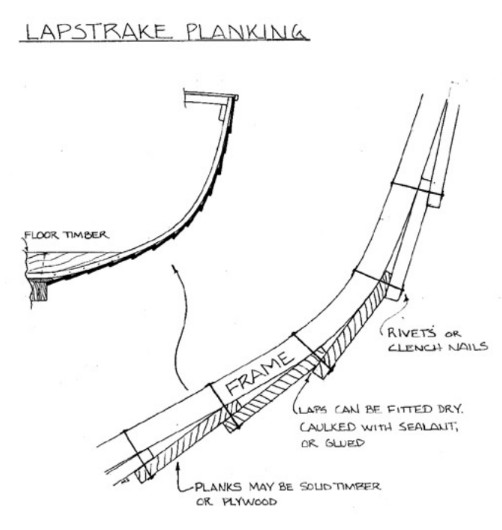
Boatbuilders in northern Europe developed the edge-fastened vessel to the utmost, using thinner planks and lapping them to provide extra strength. The Norse longboats proved themselves over the centuries on the rough North Sea, and the building technique has stood the test of time as well, remaining essentially unchanged as today’s lapstrake planking. As capable and beautiful as they are, however, lapstrake boats do have some limitations, among them constraints in the boat’s shape and the difficulty of building really large boats.
Bigger vessels
As European trade and military forces expanded some 500 to 600 years ago, so did the demand for larger and more burdensome vessels. It led European builders to develop a construction technique in which each plank was independent of the next, being supported by an internal skeleton rather than by the adjacent planks. This revolutionary technique was adopted for use in smaller craft and came to be known as carvel planking. Among other advantages, it allowed the builder to maintain precise control over the shape of a boat during construction. The majority of wooden yachts afloat today are carvel planked.
Modern adhesives such as resorcinol and epoxy have led to new construction methods, including the use of plywood for planking, and cold-molding, where thin veneers are glued together to form the boat’s skin. These, together with strip, lapstrake, and carvel planking, form the five most common wooden boatbuilding methods and, more than likely, any boat you encounter was built using one of them.
One of the most important distinctions between wooden boats is the way in which the planking is fastened. Is it fastened only to the framework (as in carvel planking), fastened to the framework and its neighboring planks (lapstrake and strip planking), or glued up from thin veneers, creating an almost one-piece hull (as in cold-molded and some modern plywood hulls)? This is important not just from the standpoint of building a boat; it also largely determines how repairs should be carried out and suggests what you should look for when evaluating the condition of an older boat.
Is there a best building technique? Are all carvel or strip-planked boats created equal? And is there a reason to consider anything other than the latest epoxy-glued, cold-molded hull?
Carvel planking
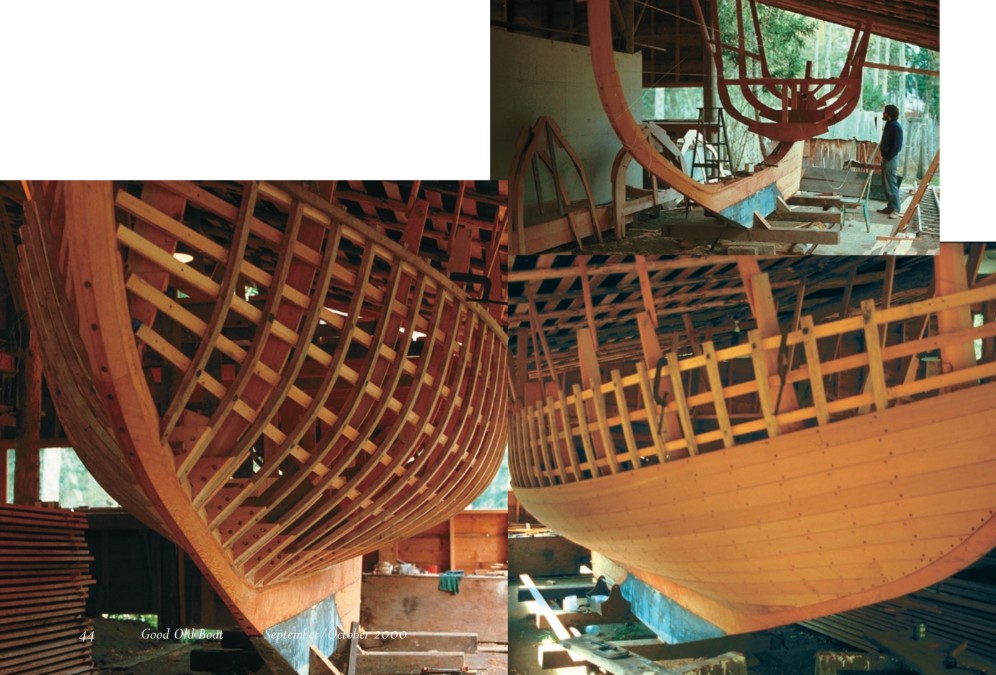
The structure of a carvel-planked hull is easily understood if you imagine yourself building such a boat. In the past, the keel, stem, and stern post were usually sawn to shape from large timbers that were then bolted together. With large timber becoming scarce, they are more often laminated up from thinner stock. Although many small dinghies and open boats are built upside down, almost all larger carvel-planked vessels are built upright. When braced upright, the backbone mimics a child’s drawing of a boat, outlining the shape from the bow, down along the keel, and up to the stern. To define the shape of the hull, a ribcage is added to the backbone. This is done first with molds, which can be thought of as temporary bulkheads spaced every few feet for the entire length of the boat. Ribbands, or longitudinal stringers, are then fastened over the molds, spaced every 6 to 12 inches. The molds and ribbands together form a rigid framework over which a carvel hull is built.
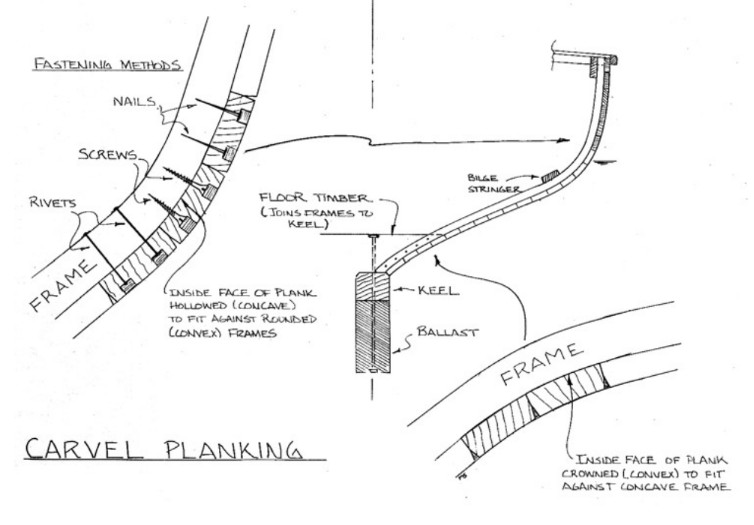
Although sawn frames are sometimes used, most small- to medium-sized yachts employ steam-bent or laminated frames. Frames can be installed either inside or outside the ribbands; the former method is most common on the East Coast, and the latter on the West Coast. Floors, which serve to connect frames to keel, are also fitted at this time. (Floor has a special definition here, which is not common or intuitive. It is not what the crew walks on. -Ed.) Floors can be of wood, plywood, steel, or bronze. Frame and floor spacing varies with each design and with the size of the boat, but a spacing of 8 to 12 inches is typical.
Planking is applied over the frames, using nails, screws, or rivets to hold each plank in place. Planks are fastened wherever they touch on the hull’s framework — at the stem, along the keel, at the stern, and to each frame — but not to each other. Instead, when planking is complete, the hull is caulked, usually with cotton, which will act to seal the seams, as the planks swell after the boat is launched. By forcing each plank against its neighbor, caulking also helps makes a boat’s structure more rigid.
Simple repairs
Repairing a carvel-planked boat is simple in some respects because planks are fastened only to the framework, and not to each other. Once the fasteners are removed (this is easiest with planks that are screw-fastened) a damaged plank or two can be removed, replacements made and then fastened in place, all with a minimum of fuss. Old planks can be used as patterns, though the technique of spiling, used to determine the shape of a plank when no pattern exists, is not difficult to learn. But the quality of the wood and the work must be good. Vertical grain timber should be used for planking stock, and fits must be precise.
Major structural repairs on carvel hulls can be difficult, as the interior of the boat must often be dismantled in order to reach and replace damaged frames or floors. And while a few cracked frames on a strip-planked hull can often be ignored, cracked frames on a carvel hull should be repaired, as they provide the planking with its only support. On the other hand, major repairs to stem and stern are eased by the fact that planks can be removed quite easily, giving access to the damaged backbone.
Generally speaking, the independence of the various parts of a carvel hull must be maintained: planks swell and shrink and the entire structure moves, and repairs must take this into account. The exception to this rule is the rather radical fix that is sometimes done to older hulls, and which involves cold molding several layers of veneer over a conventionally planked hull. The laminated outer “skin” has sufficient strength to resist the movement of the original planking, and the result can be a new lease on life for a tired old boat.
Lapstrake planking
Lapstrake hulls generally use a backbone similar to that of a carvel-planked boat, but from there the construction differs. Planks are lapped over each other and fastened at each lap, giving even an unfinished hull considerable strength. This allows lapstrake hulls to be framed after they have been planked, rather than before, meaning that ribbands can be dispensed with when setting up. Molds are erected on the backbone as with carvel planking, but these are usually more widely spaced; small boats may even be built using only one midships mold. The fewer the molds, the more the shape of the boat will be determined by the bending characteristics of the wood.
Once the molds have been trued and faired, planking can begin, starting with the garboard plank, which is secured to keel and stem. Subsequent planks are fastened at the stem or transom and where they lap over their neighbors; rivets or clench nails are commonly used, and the laps are often glued as well. Frames may be sawn, steam-bent or laminated, and these and any floors are usually installed after planking is complete.
Repairs are largely similar to those on carvel hulls, except that there are also fastenings between planks to worry about, and the fit of the planks is even more critical. Plywood can be used as planking stock, and if the original construction featured glued plank laps, new planks could be epoxied in place, easing the boatwright’s task somewhat.
Strip planking
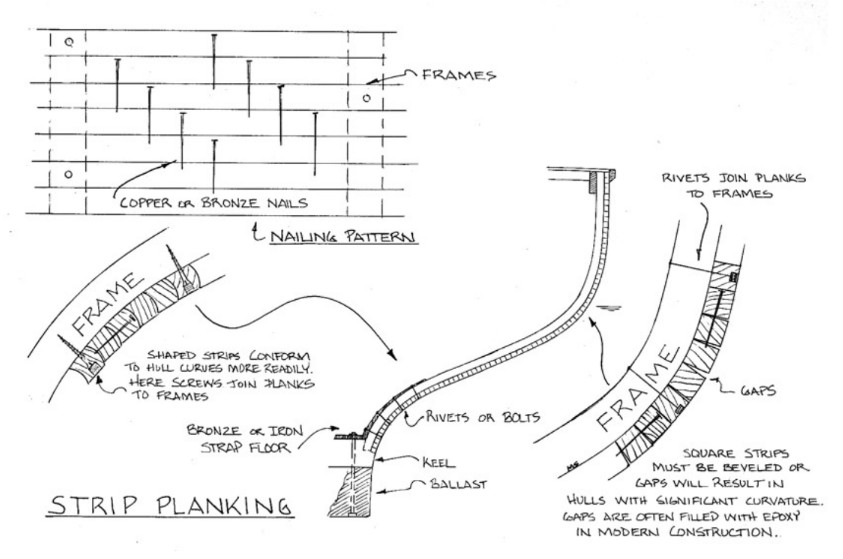
Strip planking bridges modern and traditional building techniques. In its traditional form it might be thought of as a modified type of carvel planking, where the frames are a bit more widely spaced, and additional fastenings (usually nails) join each plank to its neighbor. The backbone, setup, and construction technique would otherwise mirror that used with carvel planking, and the planking would be fastened to the backbone and the frames in much the same way. My own strip-planked boat, Nomad, built in 1964, even features a caulking seam along stem and garboard.
In its modern form, strip planking has more in common with cold-molding. Today, strip-planked hulls are typically glued up with epoxy, and may be built without frames, with glass cloth or other reinforcing (set in epoxy) providing the necessary athwartship strength. Backbones are almost always laminated, using an inner and outer stem that simplifies setting up and planking.
The strips themselves are often specially shaped, concave on the top and convex on the bottom; strips are also available that incorporate a tongue and groove. Most builders fasten the strips with glue and nails, and the best builders use square copper or ringed bronze boat nails.
Strip-planked hulls move very little, due to the multitude of fastenings and glue joining the planks. This makes it possible to glue replacement plank sections directly in place. But the fastenings between planks must all be cut when removing damaged or rotten planking, and this can be a frustrating job. In addition, it is impossible to back the planks off the stem, stern, or keel as one can do with carvel and lapstrake hulls. As a result, backbone repairs on strip-built boats must be managed with planking in place. Typically, new wood must be scarfed or laminated onto the existing structure, a procedure that can be very difficult if the repair is extensive.
Laminated construction
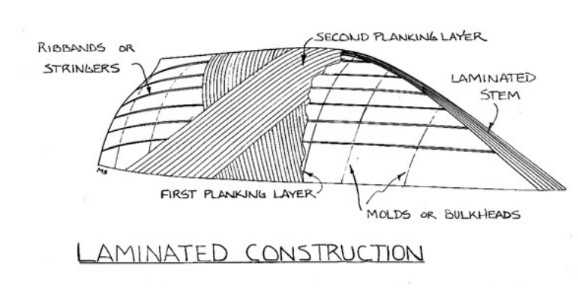
Although the technique of cold-molding far predates the epoxy era, it’s with the advent of epoxy that laminated hulls, constructed of thin strakes or veneers, have become commonplace. Epoxy is a high-strength adhesive that bonds well to most woods; what’s more, it can provide an excellent moisture barrier when used to coat or sheathe timbers. These properties have made it possible to build lightweight laminated boat hulls that absorb a minimum of moisture as they age.
Cold-molded hulls are set up in much the same way as their carvel cousins (although almost always inverted), with molds and ribbands defining the hull’s shape. On some hulls the ribbands may become part of the final hull, serving as stringers. Thin veneers are laid over this framework, usually starting at 45 degrees to the keel, with each subsequent layer set at 90 degrees to the former. Framing usually consists of bulkheads and stringers, though it is increasingly common to build frameless hulls.
An excellent way of doing this is to combine strip planking with cold-molding. Molds are set up, the hull is planked with a layer of thin strips, and then several layers of veneer are laid over the strip planking. This eliminates the need for ribbands or stringers, and the resulting hull is very strong.
Repairs to cold-molded hull planking are carried out by laminating new wood directly in place, having beveled or stepped back the edges of the damaged area. If the damage is extensive, temporary internal framing may be required to help define the shape of the hull, and to support the new planking as it is being glued and fastened in place.
If a cold-molded hull has many internal stringers and these are damaged, they must also be repaired. As with the repair of frames on a carvel planked hull, gaining access is often the most difficult task. With cold-molded hulls, damaged frames and longitudinal stringers can be cut back and new wood laminated directly in place. Backbone repairs on these hulls generally have the same complications as do those on strip-planked hulls.
Plywood construction
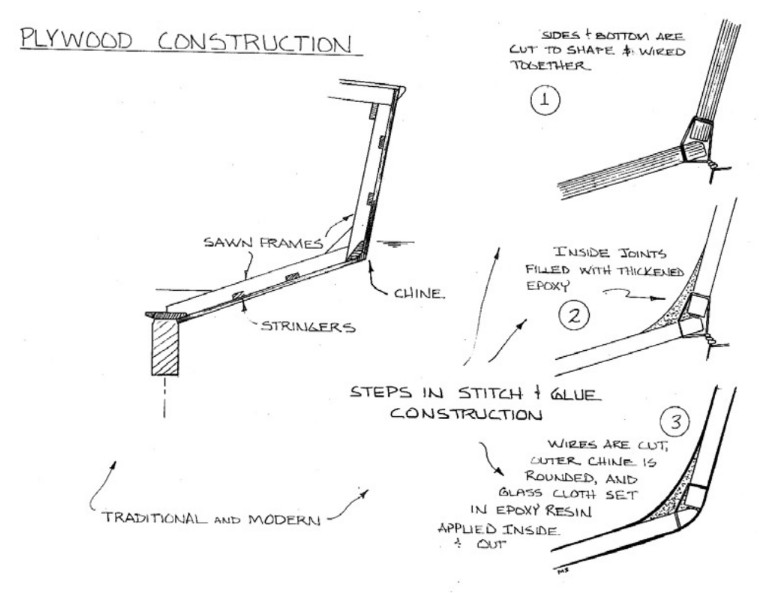
Plywood does not enjoy a good reputation as a boat-building material, and its use is generally limited to decks, joinery, and small craft. But fine boats can be built with plywood, provided the material is of good quality (marine grade is best) and it is properly protected. Older boats — usually V-bottomed — were often planked with plywood over a substantial framework of sawn frames and longitudinal stringers. They were usually sheathed with fiberglass cloth set in polyester resin. Boats built in this way may still be sound after 25 or 30 years, but polyester resin’s poor adhesion to wood, and plywood’s tendency to rot when saturated with moisture, makes this far from certain. Ensure that you have an especially thorough survey done if you are contemplating the purchase of an older plywood boat.
Modern plywood construction almost always incorporates epoxy. If hull planking is laminated from two or more layers of thinner plywood, the result virtually mirrors cold-molded construction. Plywood’s primary limitation is its inability to bend in two directions at once, and some designers have adopted a radiused chine to overcome the disadvantages of a chine hull form. Designs for stitch-and-glue construction are also becoming increasingly common. These generally require no lofting or setting up, and need little interior framing, making them much faster to build. Plywood is also finding increasing use as a planking material for lapstrake hulls, usually with the laps bonded with epoxy. It’s an excellent construction method that can produce a beautiful, strong, low-maintenance boat.
Repairs to plywood planking are relatively easy and involve beveling or stepping back the plywood at the edge of the damaged area, and scarfing in a new section. On older hulls, where the plywood has not been epoxied to the backbone, backbone repairs can be tackled fairly easily after removing any necessary hull sheathing. On newer hulls constructed with epoxy, the usual complications arise.
Older wooden boat faults
Well-built wooden boats can last for decades, but all boats can and will develop problems over time. How sound any older wooden boat will be depends on many factors, including the design, the type and quality of the original timber and workmanship, and the maintenance they’ve received over the years. Regrettably, even the use of modern “miracle” materials doesn’t guarantee a trouble-free boat. Remember that fiberglass was once thought to be maintenance-free, and no thoughts were given to the need for painting or blister repair.
Similarly, although much hype has attended the development of boatbuilding epoxies in the past 20 years, we’re now learning that building a wooden boat with epoxy doesn’t mean that problems can’t develop. Epoxies weaken dramatically as temperature increases, and this may be a contributor to the glue failures that have been experienced with some cold-molded hulls in recent years. The answer lies not in avoiding epoxies at all cost, but in being aware of the potential for trouble, and possibly using alternatives (such as resorcinol) for some applications.
Is there a “best” construction technique? Not to my mind. If I were contemplating the purchase or construction of a wooden boat, I’d consider boats constructed using any of the techniques I’ve described. The type of boat would narrow the options somewhat: plywood is not suitable for round-bilge hulls, and lapstrake planking is best used on boats of about 25 feet and less in length. But in many ways, the choice comes down to one of personal preference and circumstance. To my mind, nothing beats a well-finished, carvel-planked hull for its feel and ambience. And there are more carvel boats to choose from than any others. On the other hand, a properly built, cold-molded boat will almost certainly require less regular maintenance.
The unknowns
Knowing the origins of a boat — who designed and built her — can be valuable, in part because one of the biggest unknowns facing the buyer of an older boat is the quality of the wood that has gone into the boat. Knowing the species of wood used is important — a boat planked with teak is less likely to develop rot than one planked with pine or mahogany — but an inexperienced or unscrupulous builder may use an inferior grade of an otherwise excellent timber species, resulting in future problems. Buying a boat constructed by a reputable builder can help avoid such difficulties.
Keep in mind, however, that many fine wooden boats have been built by unknown craftsmen working in tiny shops and backyards. What’s more, wooden boats are individual creations, and even the best set of plans is not always followed by a builder. Besides, even the best built boat may be in sad condition if it hasn’t been properly cared for.
The best way to evaluate a wooden boat’s condition is through a thorough survey. Unless you’re an expert, you’ll want any boat checked out by a professional who specializes in wood, but if you look carefully, there’s a lot that most boats can tell you about their condition. In addition, some features are especially desirable, while others should definitely be avoided.
Mark started sailing at 10 on an 8-ball dinghy his dad built. He studied boat design with the Yacht Design Institute and says any number of “next boats” sail across the drawing board. Since buying Nomad in 1993, he and Kim des Rochers have been alternately sailing and repairing her in various parts of the South Pacific. They’re currently in New Zealand. Mark has a Web site which shows his recent designs and cruising philosophy: smaalders.net/yacht_design.
Thank you to Sailrite Enterprises, Inc., for providing free access to back issues of Good Old Boat through intellectual property rights. Sailrite.com