It’s neither mediocre nor boring
Issue 98: Sept/Oct 2014
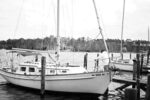
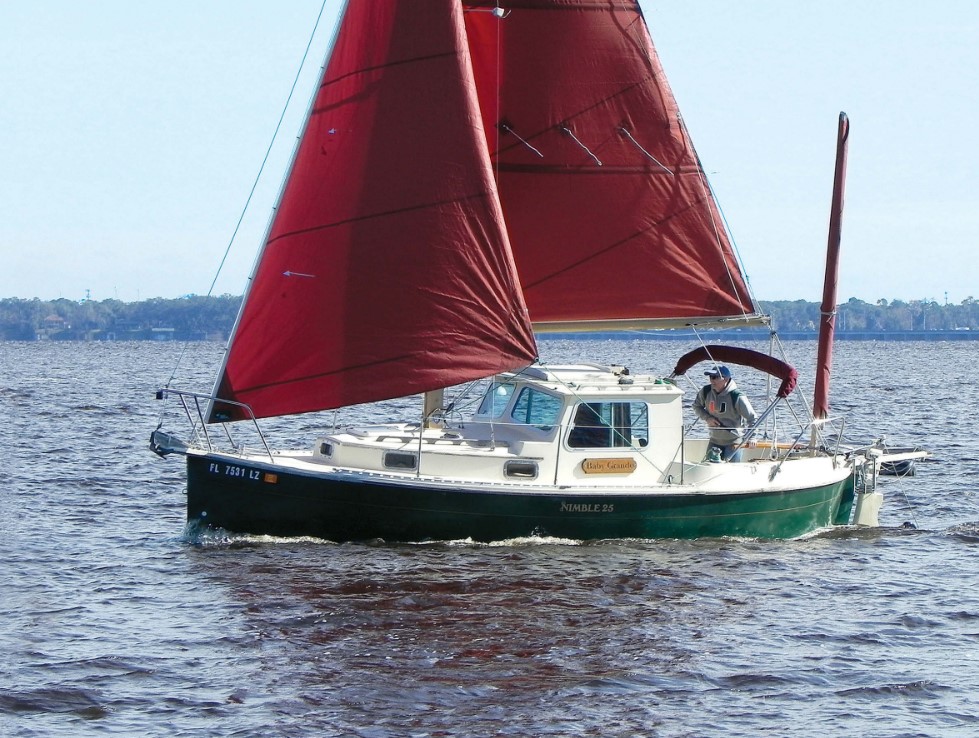
We go to Florida in January to get away from the cold north, but Florida weather conditions allowed the boat I tested near Jacksonville to live up to its model name: Nimble Arctic. It was 45° F and blowing 10 to 15 knots on the St. Johns River when owner Mark Nye and I took his 1992 Nimble Arctic 25 for a test sail. It turned out to be a great boat to sail in “arctic conditions.”
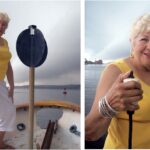
Mark and his wife, Suzanne, sail their Arctic 25, Baby Grande, from the marina at the Jacksonville Naval Air Station. Mark is a retired U.S. Navy pilot and now flies for a private jet time-share company. They keep Baby Grande fully rigged to sail on her trailer in a large fenced yard at the marina. It takes almost no time to get her to the ramp and launch her at the excellent facilities there. Mark, Suzanne, and family bought the boat in 1999 and sailed Chesapeake Bay before relocating. They have made trailer-sailing trips to Pensacola and occasionally cruise Florida’s east coast. But the St. Johns River has much to offer, particularly for boats with shallow draft.
Design
Jerry Koch founded Nimble Boats in 1985 in Clearwater, Florida, and relied exclusively on naval architect Ted Brewer for all his Nimble designs. From the first Nimble 20 of 1985 to the current 29-foot trawler, most Nimble boats have had double-ended sharpie-type hulls with relatively flat bottoms, hard chines, and flat topsides that offer tremendous form stability and lend themselves well to shallow-water explorations.
No sharpie hulls were sharper or flatter than the 14-foot Peep Hens, designed by Reuben Trane. Jerry acquired the molds for this unique design because it fit in with his Nimble line and his iconoclastic views. He built 13 of these boats in the Nimble plant from 1998 to 2003.
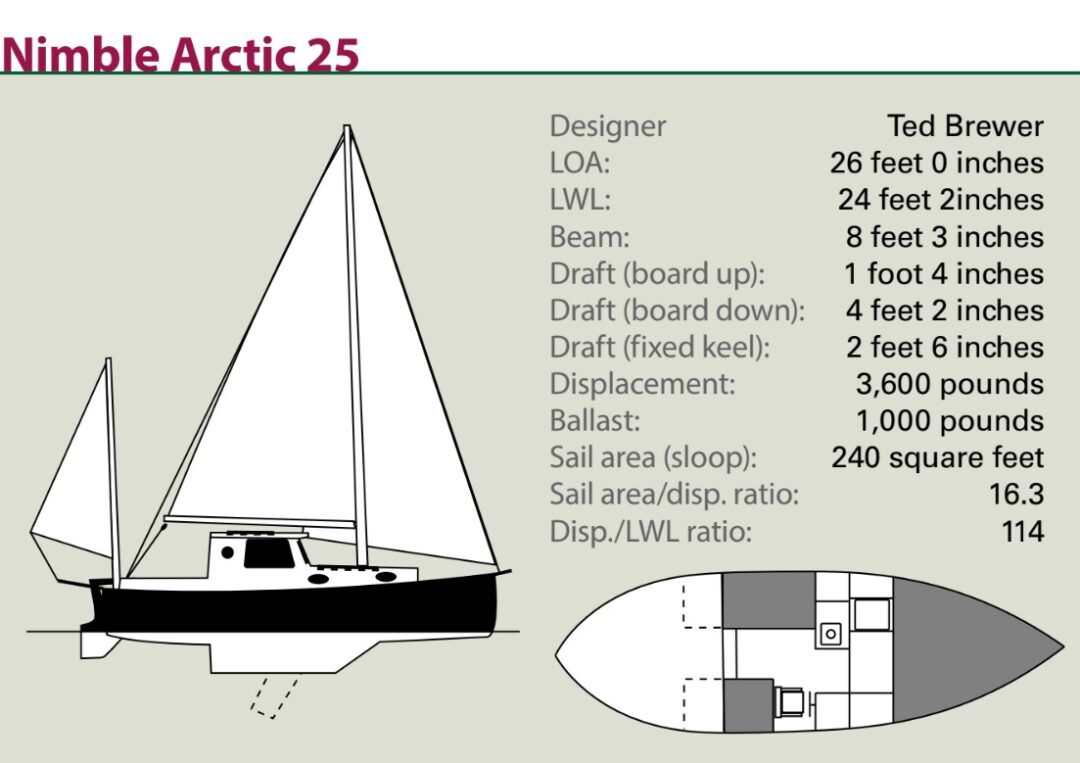
In 1988, Jerry had Ted redesign the Nimble 24 to include a pilothouse for Jerry’s personal use. At first, it was called the Nimble Arctic, but later the number 25 was added to avoid confusion with the Nimble 24 built in the same hull mold. With a small bowsprit, the Arctic 25 has an overall length of 26 feet and a waterline length of 24 feet 2 inches. At the end of the Arctic’s run in 1993, it evolved into the Kodiak, with a larger cabin trunk and pilothouse. Later, the Kodiak morphed into the 1997 Wanderer motorsailer. All three designs are easily identifiable by the plumb bow, green topsides, tan deck, and pilothouse. Upon Jerry’s death in 2003, Nimble Boats was taken over by former supplier Ken McCleave and other investors, who continue production in Tampa, Florida, as Nimble Boat Works. They still promote the boats with Jerry’s old slogan: “A vote against boredom and mediocrity!”
The Nimble Arctic 25 could be purchased either with a 16-inch-deep stub keel and an unballasted centerboard that extends the draft to 4 feet 2 inches (as Baby Grande has) or with a long shallow fixed keel that draws 2 feet 6 inches. Beam measures in at 8 feet 3 inches — trailer legal in most states. The displacement is open to debate. Mark says the figures he has seen indicate 2,600 to 3,600 pounds, but when he weighed Baby Grande on a scale he found her empty weight to be nearer to 5,000 pounds.
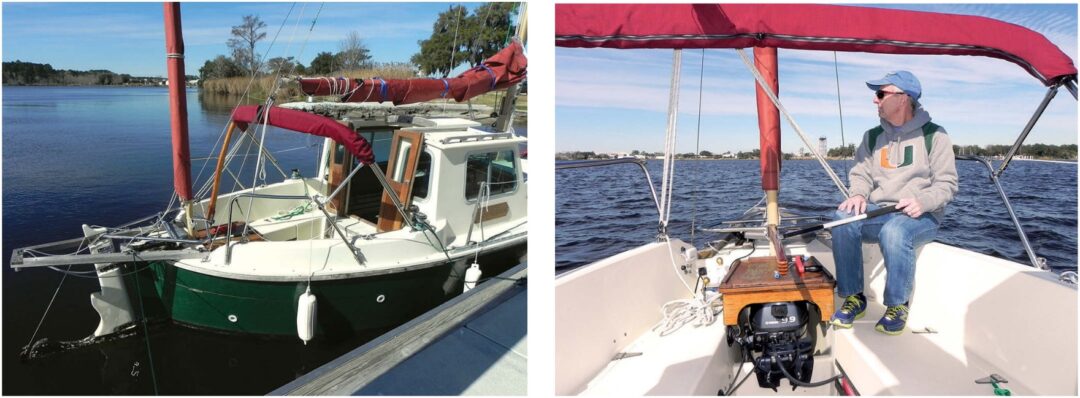
The Arctic and the Nimble 24 have the same transom-hung “barn-door” rudder. A retractable extension is intended to provide more turning power at low speed and good balance when down in deeper water and normal conditions. An inside steering wheel is connected by hydraulics to a beefy tiller in the cockpit. The outboard motor resides in a cockpit well and is not retractable, though the propeller is well protected by the stub keel. Mark says the motor well has ventilation problems in some conditions. Some boats are powered by inboard diesels despite Jerry Koch’s personal opposition to the additional noise, weight, and expense.
Construction
“Nimble builds a very high-quality boat and each boat is essentially a custom build,” Mark says. “The cored hulls are very strong but fairly light. All of the gear is adequately sized and mounted with appropriate backing. After 22-plus years, my boat has virtually none of the gelcoat cracking common on more lightly built boats. Installation of the inside woodwork and electrical wiring are very well done.”
To that, I’ll add that I saw nothing flimsy during my inspection of Baby Grande. The hull and deck are cored with Coremat and Divinycell foam. They are joined at an inward-turning hull flange, bonded with 3M 5200, and fastened with 1⁄4-inch stainless-steel bolts on 6-inch centers. A teak rubrail capped with a brass strip surrounds the hull at the sheerline. Winches and large items have full backing plates while small deck fittings have washers. The handrails are through-bolted. A fiberglass interior pan provides support for the furniture.
The rig
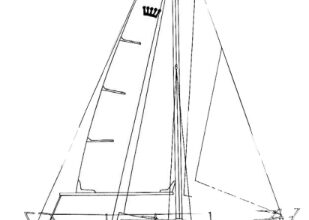
The Nimble Arctic 25 is rigged as a yawl or a sloop with painted aluminum spars. The yawl’s mizzenmast is stepped freestanding in a hole in the deck inboard of the transom. The mizzen sail has a sprit boom, sheets to a boomkin, and furls around the mast when not in use.
The original mizzen sail was 30 square feet, but Baby Grande’s previous owner had a 70-square-foot sail built with a standard boom. The mainmast is stepped in a tall sturdy tabernacle so it can be lowered for trailering or to pass under bridges. It would not be unusual to see an Arctic 25 cruising in a river or canal system with the mast down. Some were even sold without masts as small trawlers called the Nimble Nomad.
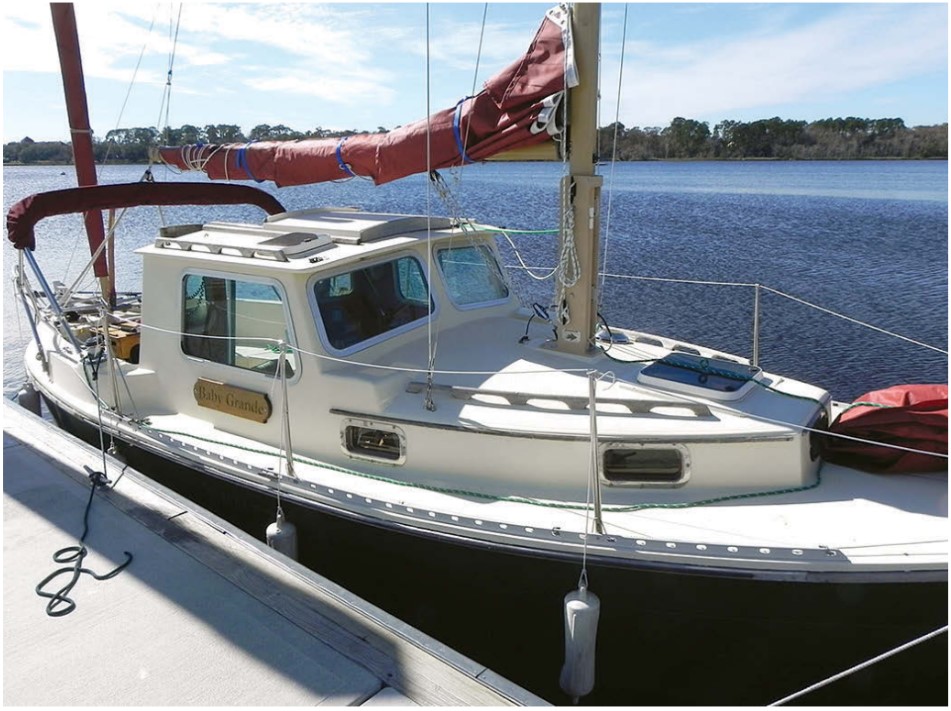
Tanbark sails are not uncommon on Nimbles. They look right with the hull shape and colors. Early Arctics had 7⁄8 fractional rigs. Later boats had single-spreader masthead rigs, with single upper and lower shrouds that connect to substantial bronze chainplates mounted on the cabin trunk.
A 135 percent genoa was standard for the Arctic 25, but interference with the spreader limited its effectiveness to windward. Upon the recommendation of a sailmaker, Mark acquired a 145 percent genoa for off-the-wind sailing and a heavier 125 percent jib that sheets in close without touching the spreaders. He reports much improved performance on all points with these sails. He also changed from roller furling to hanked-on sails that improved performance and made setup easier. Baby Grande also sports an asymmetrical spinnaker.
On deck
It’s quite easy to get around the Arctic 25 on sidedecks that are fairly wide and free of obstructions. The molded-in non-skid is good and there are plenty of teak handholds on the cabin trunk and pilothouse, the latter at waist height. The Arctic 25s were delivered with only a bow pulpit. Baby Grande’s previous owner added single lifelines and a stern pulpit. The stern is quite cluttered but without compromising cockpit use.
The anchor resides on the bowsprit secured to a sturdy chrome samson post and the anchor rode passes through a chain pipe to a locker below.
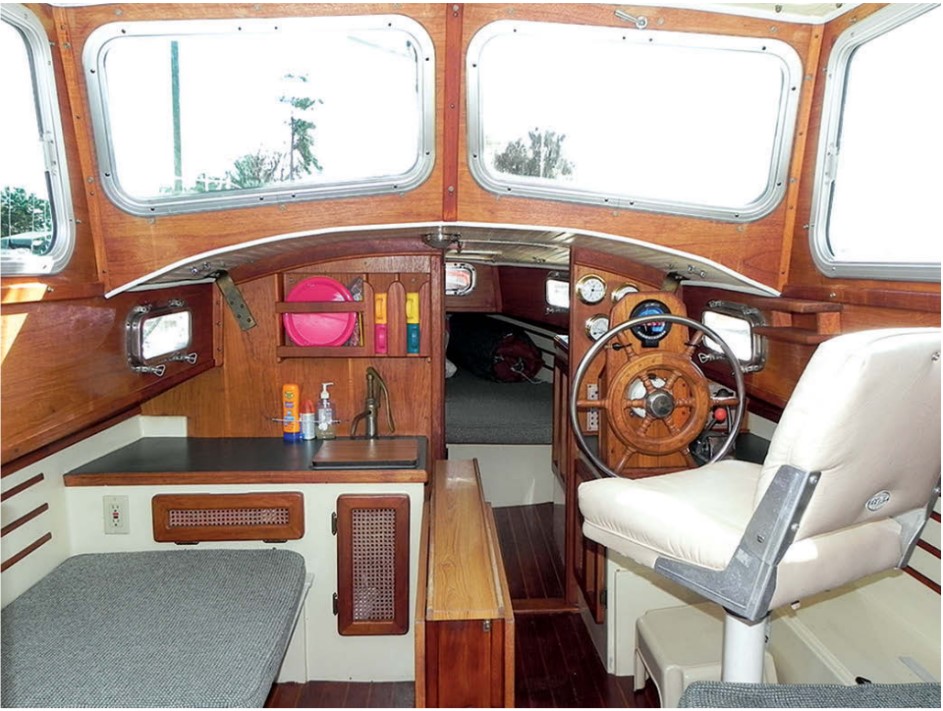
The cockpit is wide and comfortable with great napping potential — Mark says that Suzanne likes to stretch out on top of the pilothouse too. There is a large deep storage locker to starboard. The portable fuel tank is in a locker to port. Baby Grande has the optional engine-well cover that serves as a cockpit table and dampens engine noise.
Entry to the cabin is through a sliding hatch and two tall removable teak doors that are not in the way while open and allow a view through the pilothouse. The pilothouse has fixed and opening windows. Mark had so much trouble trying to replace oozing sealant around the pilothouse windows that he replaced all the windows with new ones from the original maker.
Accommodations
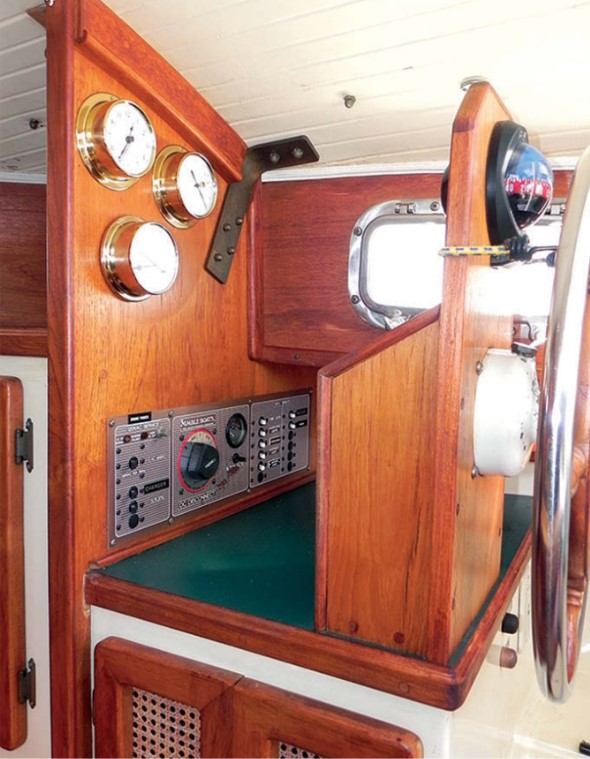
The cabin, which has more than 6 feet of standing headroom with a 360-degree view, is easily entered with one step onto the teak-covered cooler and another onto the teak-and-holly sole, but watch out for the centerboard pendant tube. The overhead liner panels are a fiberglass beadboard wainscoting and the hull sides are fiberglass. There is plenty of teak and bronze to catch your eye and several panels are ventilated with wicker. The centerboard trunk intrudes somewhat. It has a port in case the board needs to be pushed down and even has built in storage space for tools. The fixed-keel version does not have this trunk.
Visibility from the inside steering location, located to starboard, is excellent. The pivoting pedestal helm chair can be removed to convert the starboard settee to a berth. A similar chair can be set up to port.
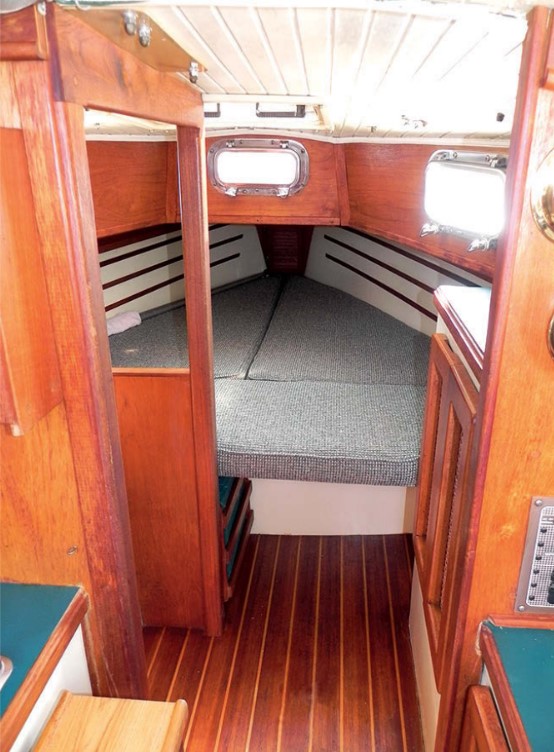
Forward there is a toilet compartment and a V-berth. Headroom is limited and the berth may be a bit tight for two adults, but one person can sleep on the port saloon settee berth. Another option in warm weather would be to enclose the cockpit and create sleeping arrangements there. Ventilation forward is quite good. Mark says that despite the name Arctic, Baby Grande has proved to provide excellent hot-weather ventilation and cabin comfort.
A two-leaf dinette table is mounted on the centerboard trunk. A small sink with a bronze hand pump is fitted forward of the table on the port side and there is space for a stove. Plentiful stowage is available throughout the cabin.
Under way
The boat won’t rock as you step aboard. The hard chines resist your weight well. This resistance to heeling is a blessing to sailors who like their sailing on the level.
Baby Grande’s auxiliary is a Yamaha 9.9 outboard that can push her along at 6 knots. At higher speeds, though, the swirling prop wash (“P-factor” in aeronautical terms) against the big rudder puts a lot of torque on the tiller that makes it hard work keeping a straight course. Steering under power or sail with the small inside wheel is easier due to the hydraulic advantage. A valve in the cockpit disengages the wheel steering so you don’t have to push the hydraulics around when steering with the tiller. The rudder can be adjusted to trim out some of this fight, but I found even with the wheel there was a bit of helm under power due to the P-factor.
Because of gusty conditions, we hoisted only the main and genoa for our test sail. On a windy day, the weather helm on the tiller can be impressive. Mark says it’s the limiting factor in sailing the Arctic 25 upwind; weather helm builds to the point you run out of rudder to counter it. He finds the upper limit for using the mizzen is about 15 knots, after which weather helm becomes unmanageable. The boat will not be heeling greatly, but it is hard to control. Reefing helps restore control and does not make it appreciably slower. Boats with the standard mizzen, or sloops, would undoubtedly have somewhat less weather helm than Baby Grande, but the pilothouse and spars aft will always add to the tendency to round up.
While the Arctic 25 tracks straight, it is a bit slow to tack, so backwinding the jib will help her come about in very light air. Off the wind, the boat really shines with good stability. Because of its flat bottom you can expect pounding in choppy water, but the sturdiness of the Arctic 25 alleviates any concern about structural integrity. “I can pretty much count on averaging 4 knots regardless of weather,” Mark says.
I found forward visibility good whether I was seated on a cockpit seat or coaming or standing. The view through the pilothouse is much better than you might expect. Better yet, the pilothouse will block that arctic breeze, especially if you duck inside to steer with the wheel. Sitting on the coaming and steering with a hiking stick was the most comfortable position for me. The cockpit seats are comfortable and a good distance apart for bracing the feet while heeled. The Arctic 25 seems to beg you to move about the boat while under sail, so feel free to wander!
Conclusion
There seem to be few issues with the Arctic 25 other than those noted. Owners recommend changing the centerboard pendant every three years, and a hot topic for posts on the forum seems to be shortening the barn-door rudder and placing some rudder area ahead of the pivot to improve the feel of the helm.
As an inland sailor who likes to explore, I’ve long been interested in the Arctic 25. In fact, I was aboard this very boat long ago at a Nimble dealer in Peoria, Illinois. Approximately 38 to 46 (depending on source) Arctic 25s plus 112 of its bigger sister, the Kodiak, have been built. Due to the high quality of the build and unique design, they are not going to depreciate to a rock-bottom price unless poorly maintained . . . and the kind of sailor who buys a Nimble is likely to take excellent care of it. Mark reported one for sale in Chattanooga, Tennessee, for $18,000. I was tempted to stop and take a look on my drive home.
Allen Penticoff, a Good Old Boat contributing editor, is a freelance writer, sailor, and longtime aviator. He has trailer-sailed on every Great Lake and on many inland waters and has had keelboat adventures on fresh and salt water. He presently owns an American 14.5, a MacGregor 26D, and a 1955 Beister 42-foot steel cutter that he’s restoring.
Thank you to Sailrite Enterprises, Inc., for providing free access to back issues of Good Old Boat through intellectual property rights. Sailrite.com