A Bristol modern daysailer with a Bristol heritage
Issue 110: Sept/Oct 2016
From my Florida condo over- looking Sarasota Bay, I frequently scan the water with binoculars, looking for interesting boats. For several weeks my focus was on a beautiful dark blue Alerion Express 28 being smartly sailed on a regular basis. I just had to find out more about her, but the Bay is surrounded with marinas, yacht clubs, boat basins, and private docks and I had no idea where this boat was kept or who the owner was.
One day, I received a phone call from my old friend and foredeck man, Roger Faust. He had recently met his son Harry for drinks at the Coq d’Or in Chicago. Harry was regaling his dad with stories of his first Mackinac race when a man in the next booth leaned over. “I’m sorry to intrude,” he said, “but I’m a sailor and I’m fascinated by your conversation.” The man went on to tell Roger that he had retired to Sarasota and was now sailing an Alerion Express 28.
“What a coincidence,” Roger said, “I have a good friend Bill who lives and sails there.”
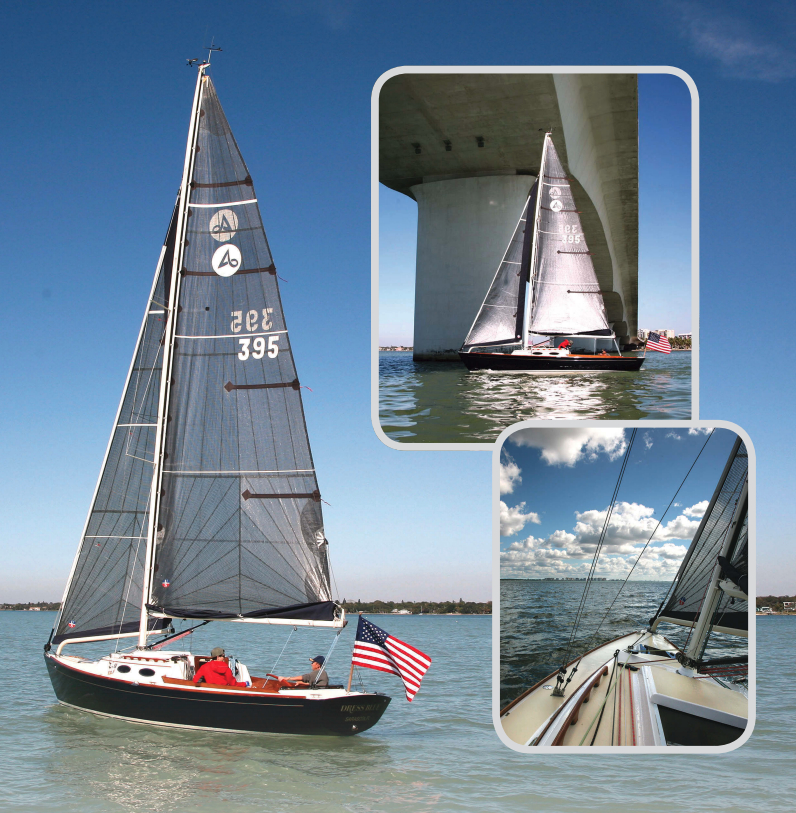
So, through a chance meeting in a bar in Chicago, I was introduced to Stephen Neumer, owner of the Alerion I’d been admiring. It turned out that Dress Blue is hull #395, built in 2008.
I learned Stephen has a background similar to mine; we share a history of racing sailboats on Lake Michigan. His first boat was a Merit 25, a West Coast speedster dating back to 1978. After several years with the Merit, Stephen wanted a larger boat that would be better suited to competing in the port-to-port distance races held each summer by the Chicago Yacht Club. He purchased a new Express 27 designed by Carl Schumacher, one of the young naval architects then making their names in northern California.
When competitve sailing began to conflict with the demands of his work life as an attorney, Stephen stopped sailing and took up golf. A 12-year hiatus from sailboats ended when he retired in 2009 and purchased a winter residence in Florida. The excellent sailing conditions at his doorstep on the shores of Sarasota Bay rekindled his desire to sail. He set out to find, in his words, “the perfect daysailer.”
A new horse for a new course
Stephen knew he wanted his daysailer to be reasonably fast and stiff enough for upwind sailing. She would have beautiful lines, an inboard engine, and be easily singlehanded. His main interest was daysailing, so he did not want lifelines to mar the appearance of the boat and he had no need for a full cruising interior. A comfortable cockpit was important. It had to be large enough for the occasional guest and to accommodate all the sail-control lines led aft.
Searching YachtWorld.com with those criteria, Stephen quickly zeroed in on the Alerion Express 28, the boat that, when introduced in 1990, launched an entirely new genre of sailboat, the “elegant daysailer.” In response to the Alerion’s success, more boats of similar design appeared on the market. Among the builders that produced them were Bluenose, Bruckmann, C.W. Hood, Friendship, Hinckley, Morris, Sabre, W.D. Schock, Tartan, and Wally Yachts. Other monikers for this genre include, “gentleman’s daysailer” and, “modern classic,” the latter inspired by the generous overhangs, sweeping sheer, and low freeboard that designers gave some of the new designs.
But, like so many things in life, the elegant daysailer was not a completely new concept. It harkened back to the early 20th century; an old concept propelled into modern-day focus.
The work of the Wizard
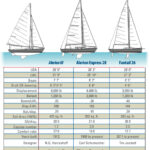
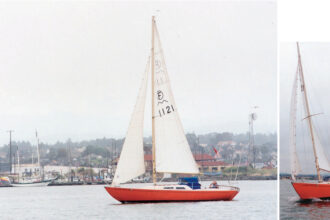
In 1912, renowned naval architect Nathanael “Captain Nat” Herreshoff, also known as the Wizard of Bristol (Rhode Island), designed a 26-foot keel/centerboard daysailer for his own use, a boat he could singlehand in shallow bays in Bermuda, where he spent time in winter. He named her Alerion III, his third boat named after a mythological bird from medieval times. Alerion III passed through several owners, the last of whom donated her to Connecticut’s Mystic Seaport.
Fast forward three-quarters of a century, to 1988 and a racing sailor in Connecticut, John Schacter, who had a desire for an uncomplicated daysailer. His vision included a hull with the classic good looks of Herreshoff’s Alerion III but, as a racing sailor, he also sought the kind of performance that could be achieved only with a fin keel. Familiar with the ultra-light, ultra- fast boats coming out of Santa Cruz, California, John scheduled a meeting with Carl Schumacher, a renowned designer of the type. The two men sat down and discussed John’s objectives. The Alerion Express 28 was born.
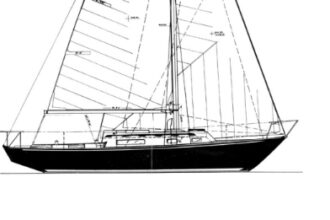
Even on paper she was beautiful. Her sweeping sheer encompassed generous overhangs and relatively low freeboard. A 9-foot-long cockpit and less than 8 feet of beam would allow just enough space below for a four-bunk interior, a small galley, and a head that was not enclosed. Below the waterline, the design’s fin keel and spade rudder promised the agility under sail that John was seeking.
Production of hull #1 began in 1990, after John partnered with Holby Marine in Bristol, Rhode Island. Holby built seven boats before selling the molds to Tillotson Pearson, Inc. (TPI). By the end of 1992, TPI had built another 25.
After a few years, concerned that the Alerion Express 28 was a little on the tender side, TPI called in Garry Hoyt, creator of the Freedom line of sailboats and the Hoyt Jib Boom. The result of this collaboration was the addition of a lead bulb on the keel, bringing the ballast up to 2,200 pounds, and the Hoyt Jib Boom on the foredeck.
After making these modifications, TPI built more than 300 more boats. Today, USWatercraft makes several models of Alerion sailboats, including the Express 28, for Alerion Yachts.
Stephen was looking for one of these boats that was used but in excellent condition, and he found one in South Carolina. Her owner, a retired airline pilot, had named her Dress Blue. Stephen took a trip to see her and, after a rigorous survey, he purchased Dress Blue and had her shipped to Florida. He had her hull polished and her bottom painted at Snead Island Boatworks in Palmetto before sailing her the last 20 miles to Sarasota.
Tuning the well-tuned
After a couple of seasons sailing on Sarasota Bay, Stephen began looking for ways to make Dress Blue faster and easier for him to sail singlehanded. He contracted with Doug Fisher, the owner and sailmaker at Ullman Sails in Sarasota.
As well as running a successful loft, Doug has a specific interest in keeping aging sailors in their boats for a longer period of time. He believes some of the technology developed for racing sailboats can be adapted to cruisers and daysailers to make sailing them easier. “It makes me happy if I can help an owner stay in his boat and keep sailing,” says Doug, whose father is in his 80s and still sailing.
He presented a number of suggestions he thought would make Dress Blue meet Stephen’s new expectations. The first was a new suit of sails built of carbon fiber-reinforced sailcloth instead of Dacron. Stephen did not intend to regularly race Dress Blue but he does enjoy going fast, so he was interested. Beside the speed benefits, Stephen learned the exotic material is an excellent choice for reducing deterioration under the hot Florida sun, as carbon fiber is more resistant than Dacron to damage from UV rays.
“The laminates enclosing the carbon fiber threads are still not as durable as conventional sailcloth, but they are getting better all the time,” says Doug. “The material makes excellent cruising sails. The only disadvantage is the initial cost, which is about twice that of a Dacron sail.”
Doug also told Stephen that, because the carbon fiber cloth is much lighter than Dacron, the mainsail would be easier to hoist. To Stephen, the gains in performance, durability, and ease of handling were appealing and worth the investment. Dress Blue got a new radial-cut main and working jib.
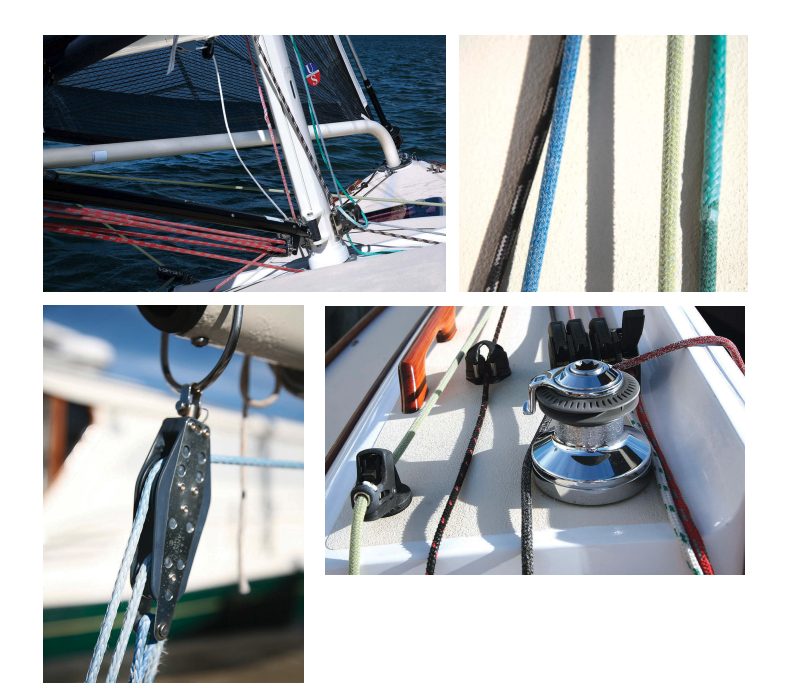
The roller-furling jib’s carbon fiber cloth is further protected from the sun with a leech cover. A clew block on the jib allows Stephen to easily control the sail’s shape from the cockpit.
To make singlehanding easier, Doug gave the main halyard a two-to-one purchase and installed the Strong track-and-slide system from Tides Marine on the mast. Guided by new lazy-jacks, the mainsail drops obediently into a custom mainsail bag permanently attached to the top of the boom. Doug also added purchase on the main outhaul, the traveler car, and the backstay.
Stephen had Doug replace all of the standard running rigging with low-stretch Dyneema yacht braid, which is stronger than polyester line and allows smaller, lighter line to be used, reducing weight aloft. Taking it a step further, Stephen had the covers stripped off the running portions of the halyards and control lines to reduce friction where they pass over sheaves. All this attention to detail resulted in a finely tuned, high-performance, easily handled daysailer. Stephen is delighted with his “new” boat.
The voyeur gets a ride
Admiring this boat through binoculars was one thing. Getting a chance to sail aboard Dress Blue was another.
On a breezy late-winter day, I met Stephen at his slip. The first thing I learned is that he is a perfectionist. He’d made sure everything was ready for the day, down to carefully laying out the docklines in preparation for leaving the dock.
Stephen introduced me to his ultimate accessory for easy sailing, Patrick Hibbs, an excellent young sailor who frequently accompanies Stephen. Patrick is an able deckhand and his eagle eyes are constantly searching the water ahead for crab pots, shallow water, wind shifts, and other boats.
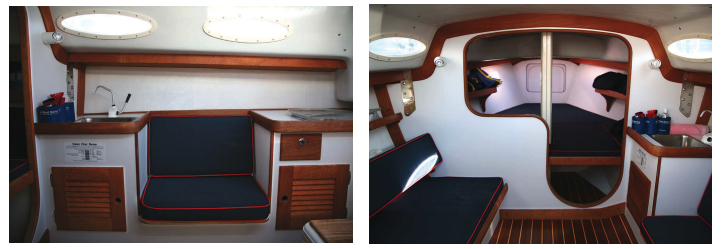
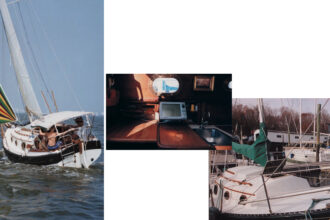
Before we cast off, I took a quick look belowdecks, stepping through the companionway hatch onto the removable ice chest that doubles as a step. The Alerion’s low profile allows only 5-feet 1-inch of headroom below, but that is plenty for sitting in comfort. In Herreshoff style, smooth white laminate surfaces are trimmed in teak and the sole is actual teak and holly. There is a V-berth forward and a settee and a handbasin in the main cabin. While she doesn’t boast a liveaboard interior, Dress Blue would be very comfortable for an overnighter or even for a weekend cruise.
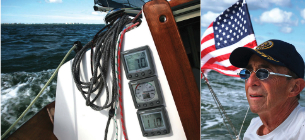
As we motored out of the channel, I raised the carbon fiber mainsail, and was impressed with how little effort was required to pull the sail up the mast with its double-purchase halyard. A nice sea breeze built in from the southwest, probably 10 to 15 knots. When we unfurled the jib, Dress Blue began to fly. The large instrument displays mounted on the bulkhead next to the companionway showed us making an honest 7 knots on a beam reach.
At the forward end of the cockpit, color-coded control lines exit a bank of rope clutches mounted on either side of the cabintop. These manage the boom vang, traveler, slab-reef lines, jib boom, and backstay tension. Beneath each clutch, extra line is coiled neatly and close at hand. Some might consider so many lines allowing for so many adjustments a bit excessive for daysailing, but Stephen, with his racing background, enjoys constantly tuning the sails and rig to match every change in the wind.
Because all the control lines for the sails are led aft to the cockpit, there is little need to go on deck and, accordingly, I didn’t miss the lifelines. I did appreciate how their absence improved the sightlines.
Of course, on a daysailer, the cockpit is the focus of activity, and Dress Blue’s can comfortably accommodate four adults when sailing. The cockpit seats have a molded radius edge where they turn down to the cockpit sole, and the angled coamings, which are faced with teak that extends above the deck, provide plenty of support.
I took the helm and was pleased with the perfect balance of the tiller in my hand. Even in sudden puffs I needed no more than two fingers of pressure to keep her in the groove. Apparently, the ballast bulb was doing its job. Contrary to what I expected, Dress Blue is remarkably stiff in a breeze despite her relatively narrow beam.
I have sailed many boats over the last 50 years and the Alerion Express 28 is exceptional. It feels like a much larger yacht while retaining the sportiness of a dinghy. The jib boom, which I had considered a visual blemish to Dress Blue’s lines, can only be appreciated under sail. The ease with which we tacked the boat, is incredible. Simply put over the helm and both main and jib slide smoothly to fill on the opposite tack. No releasing and no trimming — a godsend for the singlehander. The boom controls the leech tension on the jib, so the sail can be easily adjusted for wind strength and direction without the need to move jibsheet fairleads.
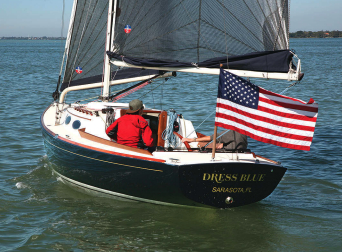
We sailed most of the length of Sarasota Bay (about 7 miles) in less than an hour and reluctantly turned around for the sail home. When we reached the dock, I enjoyed watching the precision with which Stephen and Patrick backed the boat into the slip, picking up each carefully placed dockline and making them fast. I can’t imagine a more perfect afternoon of relaxed — yet high performance — daysailing. The Alerion Express 28, as prepared and maintained by Stephen Neumer, is a beautiful, very modern example of the daysailer envisioned by Captain Herreshoff almost a century ago.
Bill Jacobs has been sailing for more than 50 years, racing one-designs and offshore boats as well as cruising the Great Lakes and the Gulf Coast. His current boat, and probably his last, is a 27-foot wooden sloop designed and built by George Luzier in 1962. She is genuinely old and genuinely good.
Thank you to Sailrite Enterprises, Inc., for providing free access to back issues of Good Old Boat through intellectual property rights. Sailrite.com