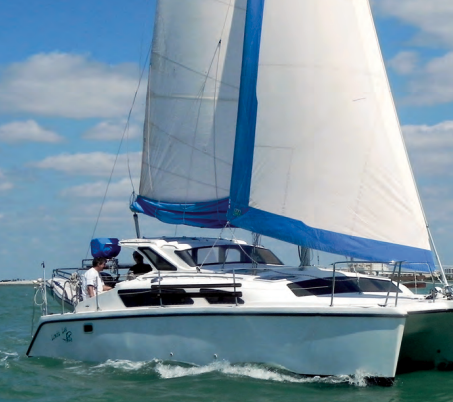
A popular cruising catamaran
Issue 92 : Sept/Oct 2013
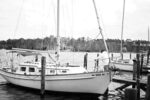
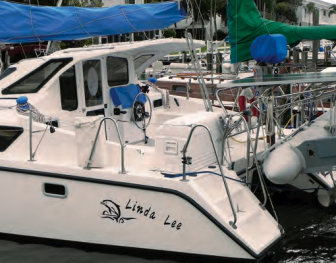
When Henry and Linda McKevitt traded in their S2 9.2 center cockpit in October 2011, they had been looking for a comfortable boat for cruising the shallow waters of Florida’s west coast. What they found was Linda Lee, a 1999 Gemini 105M. Henry, a retired contractor, took the impressive step of taking lessons in operating a catamaran from a local catamaran dealer. These vessels are not the same as monohulls; coaching helps avoid some easily preventable problems. Not long ago, I readily accepted an offer to sail to the Dry Tortugas aboard Linda Lee.
Cruising catamarans are very different from beach catamarans. They do not fly a hull when sailing. Tony Smith, who designed the Gemini, once offered a reward for a photo of a Gemini or any other cruising catamaran flying a hull. He never had to pay. One of the most appealing features of a cruising catamaran is that it sails nearly level. Five degrees of heel is typical. These boats do not roll while anchored, nor do they tend to sail on the anchor. While cruising cats are promoted as being faster than monohulls of similar length, overloading them with cruising gear and provisions slows them down considerably.
With two hulls connected by a complicated bridge deck and super-structure, more material goes into a catamaran than a monohull of the same hull length, so it costs more to build. For a given length, however, a cruising catamaran offers much more space than a monohull, and it is a different kind of space on deck and below. Many cruising cats have broad foredecks for lounging and handling anchors and sails and all have large cockpits that are great for entertaining.
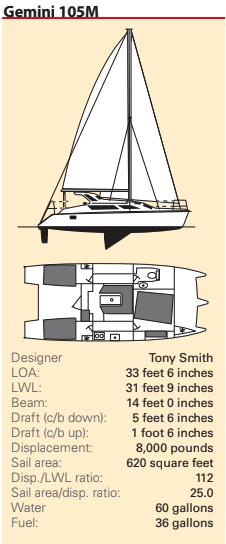
Cruising cats also draw very little water, only 18 inches in the case of the Gemini with the two centerboards raised. The downside is a general slowness to respond when under way. Cruising cats are not spritely sailers. They are good at going one direction for a long time but not so good at repeated quick maneuvers. Consequently, the engines become more important to cruising cats than to most monohulls. Many cruising cats have two engines, which is a great help when maneuvering in confined spaces, but a problem if one engine is inoperative. The Gemini 105M has the great compromise of a single small diesel engine with a steerable and retractable Sonic drive leg. Earlier Geminis had single or twin outboard motors mounted on the transom of the center bridge deck.
History
Geminis have their roots in Great Britain, where Tony and Susan Smith first designed and built the successful line of fiberglass Telstar folding trimarans. After they moved to the U.S. in 1981, Tony continued to build theTelstar under the name Performance Cruising Inc. (PCI), until a fire destroyed the molds. Fortuitously, he owned the molds for the 30-foot, 6-inch Aristocat catamaran that he brought onto production as the Gemini 31. These boats had outboard power and rudders that lifted daggerboard-style in cages hung on the transom of each hull. A key feature of all Geminis has been a relatively narrow beam, at 14-feet, allowing them to berth in most standard-sized slips and to be hauled with a moderate-sized travel lift. A Gemini can also be transported by highway, albeit as a “wide load.” Production was geared toward simplicity and not many options were offered, thus a relatively low initial cost for a cruising catamaran made them very appealing.
The 31 was superseded by the very similar Gemini 3000, which remained in production until 1990, when it was replaced by the slightly longer Gemini 3200. The longer yet 3400, still based on the Aristocat’s hulls, was introduced in 1993. The Gemini 105M, redesigned with wider hulls, arrived in 1996. PCI had built about 200 of the 105M by 2003, when it introduced an updated version that it called the Gemini 105MC.
Also in 2003, PCI introduced a new version of the Telstar trimaran that was produced through 2009. In the disastrous economic downturn of 2008, the company went into partnership with The Catamaran Company, a successful catamaran dealer headquartered in Fort Lauderdale. The Smiths retired and their daughter, Laura Smith Hershfeld, became president of Gemini Catamarans, which markets the boats that are now produced by Hunter Marine in Alachua, Florida, at the rate of about one boat a month. Altogether, 1,000 Geminis of all models have been built.
Design and construction
The Gemini 105M has pleasing lines with a slightly raked bow, flat sheer, and sugar-scoop transoms. The rakish cabin profile is emphasized by black acrylic windows and accent lines. The rudders can be retracted and lowered with lines led to rope clutches at the transoms. The centerboards kick up as well and are raised with a hand crank and held in place with friction nuts. They take up no noticeable cabin space.
The two hulls and bridge deck are molded as one piece, leaving no seams to leak. The solid deck is similarly all one big piece. Several fiberglass pans and liners make up the interior furniture. The hulls are laid up with solid fiberglass and the deck is cored with balsa and plywood. Catamarans are more lightly constructed than monohulls because light weight is essential to their performance advantage and, in part, because they don’t have to support the weight of a heavy keel. Should a hull of the Gemini 105M be holed, buoyancy tanks built into each hull (but not claimed to be watertight) are intended to float the holed hull high enough to prevent water from reaching the bridge deck and flowing into the other hull. Gemini recommends filling these tanks with foam if the boat is heading offshore.
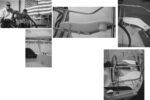
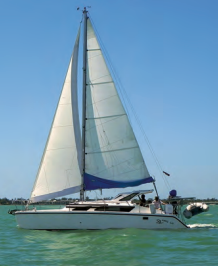
While catamarans don’t require a strong supporting structure for a keel, rigging loads are high because they don’t heel as much as monohulls. The Gemini is rigged as a masthead sloop with double spreaders, removable check stays and baby stay, and twin backstays. The forestay is mounted aft of a small anchor sprit between the two bows. All the shroud chainplates are attached to the bridge deck, not to the hulls. The mainsheet, attached to a traveler that runs the width of the transom, is easy to handle, but the traveler lines need to be secured during maneuvers. On Linda Lee, lazy-jacks, Battcars, and a Mack Pack make handling the mainsail a snap in most conditions. The headsail is set on roller furling.
Deck
There is a lot of deck on a cruising cat. What draws one’s eye first is the large cockpit that seems like an outdoor ballroom. For all this real estate, however, the seats in the Gemini’s cockpit are a bit narrow for comfortable sitting and lounging, although a wide cushion helps. On the other hand, you can set out a folding chair or two and sit in real comfort or go forward to stretch out on the spacious foredeck.
The sidedecks provide a precariously narrow path for going forward but there are plentiful handholds. If, as on Linda Lee, lines are not led aft from the mast to the cockpit, adding grabrails near the mast would provide support when working halyards — catamarans don’t heel much but they are still affected by waves. There is a large storage compartment in the port bow, and the anchor locker, with external windlass, is extra large as well. Foredeck work with the anchor couldn’t be easier. Henry finds his wireless headsets indispensable for communication with the helm.
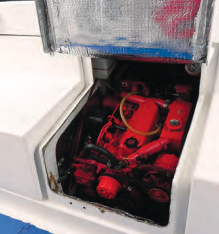
The 27-horsepower Westerbeke diesel engine is located in a compartment in the transom of the bridge deck, along with the fuel tank. Engine access is excellent. The hydraulic system that retracts the Sonic drive leg (doing so improves sailing performance) is also located here. A freshwater hose for personal desalination is convenient to a swim ladder on the starboard transom. Linda Lee has davits to carry a dinghy.
Accommodations
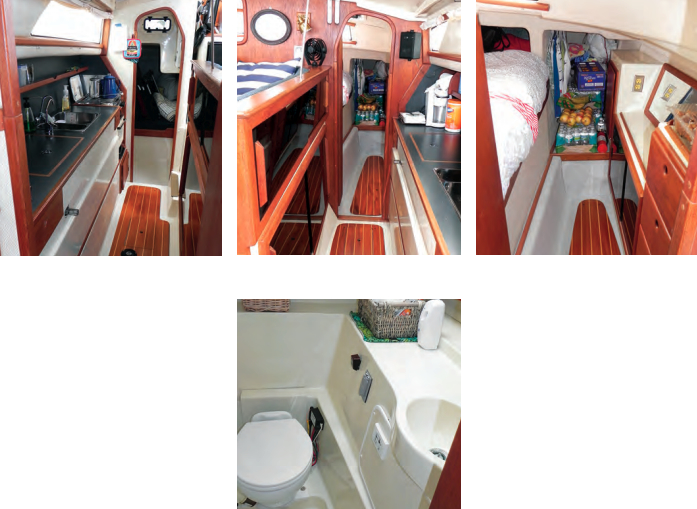
Space and light abound in the well-ventilated interior. Sleeping quarters are found in a queen-sized berth in the bridge deck forward and a substantial berth aft in each hull that is roomy for one but tight for two. The queen berth can be tight for tall people as the foot end is close to the cabin overhead. In order to get out, the inboard person must first ask the outboard person to vacate.
A very useful linear galley is in the starboard hull and a long counter in the port hull serves as a standing navigation station. Storage cabinets are fitted along the inboard sides of both hulls. The narrowness of the passageways makes movement and standing very secure while at sea. The U-shaped saloon settee (that’s convertible to a berth) and the folding table it surrounds are roomy enough for a party, but headroom is somewhat limited at the forward end. It’s a great place to hang out with its light and airy feel.
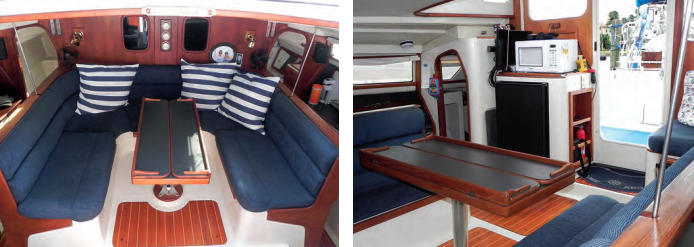
The saloon settees are not quite long enough for a power nap. The feet of the off watch hung over the end and the watch crew had to be careful not to bump into them while moving about the cabin. A true front-loading refrigerator that uses multiple power sources is a nice feature. Linda Lee also has a combination heater and air conditioner. The head is forward in the port hull and easy to use at sea in that narrow part of the hull.
Under sail
The hulls make nearly no wake as they slip through the water. During our cruise we motorsailed most of the time, averaging 6 to 7 knots. This enabled the Sonic drive leg to help with steering in the steep 5- to 8-foot, nearly breaking seas. We were beam and broad reaching much of the time. The Gemini showed no signs of broaching but would occasionally surf to 13 knots and demand attention not to bury the leeward bow in the wave ahead. I found the ride comfortable, if noisy. Waves would pass under us with little rocking action. Anything thoughtlessly placed on the galley counter stayed there. My berth was in the port (windward) hull aft, where I found I could keep the small port open for ventilation without any water coming in. It was a good ride for sleeping.
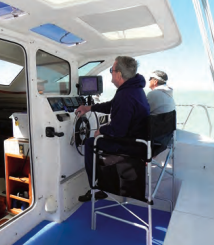
The Gemini 105M is steered from the starboard side of the cabin trunk. One looks through the windows to see forward, but Linda Lee’s windows are hazed with age and were crusted with salt spray. Henry sits behind the wheel on a tall folding captain’s chair that showed no tendency to become unbalanced even during the roughest times. We often steered from sitting on the seat or coaming to starboard of the wheel so we could see forward, get sightlines, and check for traffic. Docking port-side-to could be a bit tricky with the wheel far to starboard. The throttle lever was in a place where passing derrières frequently bumped it down.
A nice feature is having the cabin floor on the same level as the cockpit. Coming and going was effortless as most of the time the door between them was left open. The off watch can reside in the saloon ready to be called if needed.
When following seas threatened, the door was closed as a precaution, although no wave came close to coming aboard. The windows next to the door or in the door can be opened for ventilation and communication. I could have wished for handholds on the edge of the hard Bimini and bit more height under it — I bonked my head frequently on its edge when passing under it.
One drawback is that the low bridge deck — with only a foot of clearance at the transom — pounds when at sea and at anchor.
When we were able to do some sailing without the engine, I found that, off the wind, everything is a piece of cake. The one area where catamarans fall flat is tacking to windward. To get the Gemini to come about, we had to backwind the jib or start the motor and power around. I did not get a chance to sail to windward in any sea that would show what the ride was like, but the Gemini 105M points reasonably close to the wind due to the centerboards. There is little feel to the helm and we depended on the compass a great deal even when sailing to windward. You basically point the boat where you need to go. Many owners simply use the autopilot.
Conclusion
The Gemini line is still in production, which shows there is still a demand for this very capable boat. Gemini Catamarans also provides service and support for the older boats.
Owners’ reports regarding quality of construction vary widely. The Sonic drive leg, while a great combination of diesel and outboard, is known for troubles. We had them too; it would not retract. If the lines between the drive leg and rudders are not rigged properly, the handling will be awful. Some of the details are simple and look less than yachty, but they are functional ways to curtail costs and make the boat affordable. Buyers of these boats overlook this and see value in the whole package but, as with any boat, a very thorough pre-purchase survey should be considered essential.
Geminis hold their value in resale. An Internet search found a 1982 listed at $36,500. Most Gemini 105Ms are listing from $70,000 to $100,000. Newer versions have more features and are priced accordingly.
Allen Penticoff, a Good Old Boat contributing editor, is a freelance writer, sailor, and longtime aviator. He has trailersailed on every Great Lake and on many inland waters and has had keelboat adventures on fresh and salt water. He presently owns an American 14.5, a MacGregor 26D, and a 1955 Beister 42-foot steel cutter.
Thank you to Sailrite Enterprises, Inc., for providing free access to back issues of Good Old Boat through intellectual property rights. Sailrite.com