A handsome cruiser with highly evolved amenities
Issue 92 : Sept/Oct 2013
Pearson Yachts updated several of its more popular designs in the late 1980s, releasing them as what is commonly referred to as the -2 series. The Pearson 34-2 was an upgrade of the Pearson 34 (introduced in 1983) and one of the last models to be introduced by the company. Its three-year production run began in 1989 and ended in 1991 when Pearson Yachts closed its doors.
Design
The Pearson 34-2 is one of 43 boats that Bill Shaw designed during his nearly three-decade tenure at Pearson Yachts, first as a designer and later as general manager. Bill believed that the -2 series was an improvement on the over‐marketed “cruiser/racer” theme, so the Pearson 34-2 is not a direct knock-off of the earlier Pearson 34. The 34-2 is beamier and carries that beam farther aft. It also has a longer waterline, a flatter bottom, and more ballast. The fin keel and centerboard option of the Pearson 34 was replaced by a wing keel and elliptical rudder. The most dramatic difference between the two boats lies in their interior accommodations — they are like night and day!
While Pearson Yachts built fewer than two dozen 34-2s, Bill’s design did outlast his company. In the mid 1990s, a group of investors started a company called Cal-Pearson. One of the first boats they introduced was the Cal-Pearson 35, which was nothing more than a 34-2 with a redesigned interior and a sugar-scoop transom (the 34-2 has a walk-through transom). The company didn’t last long and built only a handful of the boats.
Construction
The hull of the 34-2 is hand-laminated solid fiberglass above the waterline and balsa cored from there to the keel. Around all the through-hulls, the coring was replaced with solid fiberglass. The deck is balsa cored and joined to the hull by means of a vertical flange that is often referred to as a “shoebox” joint. The overlap is chemically bonded and mechanically fastened and covered with a vinyl rubrail.
Interior features include varnished teak woodwork, a teak-and-holly sole, and a fiberglass headliner, except in the saloon where it’s vinyl. There is considerable fiberglass reinforcement around all the structural bulkheads. The solid lead wing keel is externally mounted and the rudder is a foam-filled fiberglass sandwich. All deck hardware is through-bolted with backing plates.
Hull #7
While on a trip to the Chesapeake, Don and Sheila Brown stumbled upon a Pearson 34-2 for sale. It was hull #7, built in 1989. Don says what drew them to the boat was “. . . its clean lines and drop-dead good looks.” Sheila added that the spacious interior and the island berth in the forward cabin were a real plus. A close inspection and a survey confirmed that the boat had been reasonably well cared for and that there were no major issues. The deal was finalized and the boat was trucked to the Great Lakes.
That was a little over three years ago, and Don and Sheila have been upgrading Banshee ever since. Don installed a dripless shaft seal and replaced the lifelines. He also installed new portlight lenses and removed all
the deck hardware, filled the holes with thickened epoxy, redrilled them, and rebedded the hardware using butyl tape. Not wanting to neglect the creature comforts and aesthetics, they had custom cockpit cushions made, installed a stereo system, and added new vinyl boot and accent striping and custom graphics. Future plans include the purchase of a cruising spinnaker, having the mainsail cleaned and serviced, and possibly refinishing the sole in the saloon.
On deck
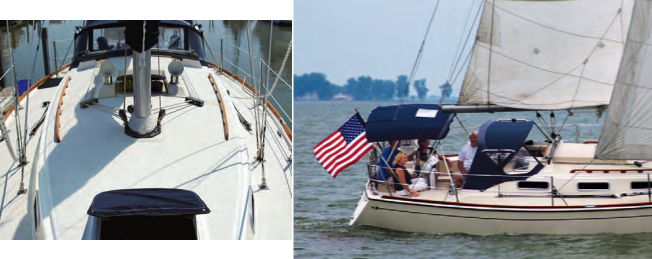
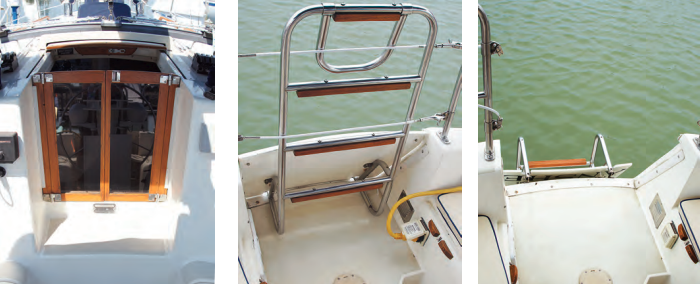
Other than a pair of 9-inch open-throat cleats and an ample anchor locker, the foredeck of the Pearson 34-2 is free of obstructions and is a spacious and stable platform when working forward is required. The shrouds and genoa tracks are placed well inboard, allowing the crew easy movement along the relatively wide sidedecks. A midship cleat, with adjacent captive chock incorporated into the teak toerail, is fitted on each side of the boat.
Four of the boat’s five hatches are on the cabintop. The largest hatch is mover the forward compartment, the next largest is above the saloon, and the two remaining smaller hatches add light and air to the head compartment and galley. Two Dorade vents with large stainless-steel cowls flank the saloon hatch and a sea hood protects the companionway’s sliding hatch. Three opening portlights and one deadlight are mounted on each side of the cabin trunk.
The cockpit measures 6 feet 4 inches overall, 5 feet of which is forward of the binnacle. The curved and angled seating with its 14-inch-high backs conforms well to the human body and the footwell is narrow enough to provide good bracing. Lockers are provided beneath the seats port and starboard. The starboard locker is cavernous. Even though it houses the water heater, refrigeration compressor, the 20-gallon plastic holding tank, and the access to the 22-gallon aluminum fuel tank, there’s still plenty of room. The port locker is very shallow because of the headroom over the quarter berth below.
Flanking the helmsman’s hump-shaped seat are a propane locker to port and an icebox to starboard. The seat is removable to give access to the walk-through transom and deck shower. A swim ladder is attached to the hinged panel that closes the walk-through transom. Water entering the cockpit is contained by a bridge deck and escapes through four 3⁄4-inch drains — two in the sole and two in the curves of the seats.
Aggressive non-skid, a 2-inch teak toerail, stainless-steel bow and stern pulpits, dual lifelines, and two 5-foot sections of teak handrail complete the on-deck safety package.
Belowdecks
The interior layout of the 34-2 and other models in the -2 series is an evolutionary refinement of previous Pearson models. It is targeted at families or possibly two couples cruising together.
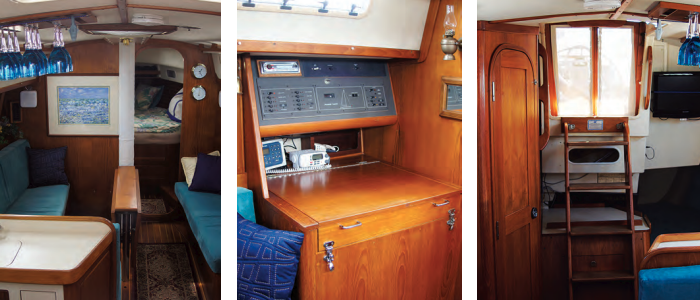
Rather than the conventional V-berth, the prominent feature in the forward cabin is an island double berth. It doesn’t offer much to brace against when the boat is heeled but it does make getting in and out of bed easier. Because of the access on either side, it’s also easier to make up than a traditional V-berth. Beneath the berth are four large drawers, storage bins, and one of the boat’s three plastic water tanks. His-and-hers hanging lockers with bureau tops, a bookshelf, and port-and-starboard alcove storage outboard and above give this cabin the feel of a true stateroom. A pair of opening portlights and the forward hatch provide ventilation and light, while a two-panel teak door and a scrap of sole add privacy and a changing area. Headroom is 6 feet 3 inches.
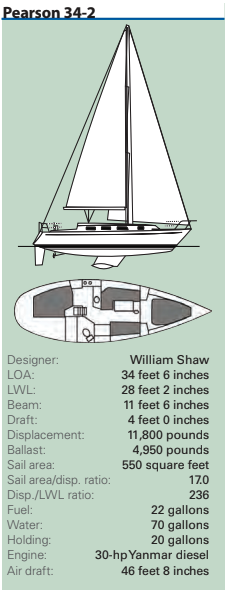
Two opening ports, two fixed ports, and the overhead hatch make the saloon bright and airy. Every port is equipped with a built-in translucent accordion shade. This cabin’s main features are an L-shaped settee on the port side that converts into a double berth, a centerline drop-leaf table, and a straight settee berth to starboard. Above each settee are double bookshelves with fiddles and a locker with a sliding door. The starboard locker is specifically designed as a spirits locker. Beneath each of the settees is a small amount of stowage space and a plastic water tank. This brings the total water capacity to 70 gallons in three tanks. A pair of teak grabrails is overhead and headroom is 6 feet 5 inches.
Aft of the settee on the port side is the L-shaped galley. In addition to numerous drawers, cupboards, and bins, the galley is equipped with a gimbaled two-burner propane stove and a single stainless-steel sink with pressurized hot and cold water. An overhead hatch and an opening portlight ventilate and illuminate this area nicely.
Opposite the galley and slightly forward on the starboard side is a large icebox/chart-table combination. The chart-table top lifts to reveal a convenient compartment for storing plotting instruments and charting accessories and, beneath that, a large icebox. Above this area is the electrical panel with some space for electronics.
Aft of the galley is a near-queen-sized quarter berth with stowage bins beneath it and a shelf outboard. Although half of the berth has sitting headroom and the entire forward portion is quite open, the part under the cockpit could get a bit claustrophobic.
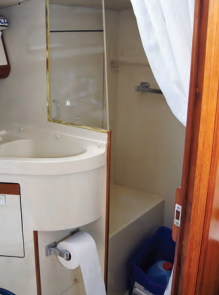
On the starboard side, directly across from the galley, is the head compartment complete with a separate shower stall with a seat and a wet locker — true luxuries on a boat of this size. Other amenities include a molded vanity and sink with hot-and-cold pressurized water, a full-length teak-framed mirror, several lockers, and a hamper. An opening portlight and an overhead hatch provide light and air.
The rig
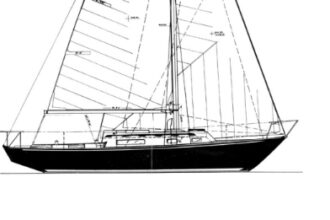
The Pearson 34-2 has a masthead rig with double swept-back airfoil spreaders. Four sets of shrouds (caps, intermediates, and double lowers) and a split backstay support the keel-stepped mast. The wire-to-rope halyards are led inside the mast and all control lines are led aft through clutches to a pair of Lewmar 40 self-tailing winches mounted one each side of the companionway on the aft cabintop. The mainsail is sheeted mid-boom to a traveler mounted on the cabintop just forward of the companionway. The primary headsail winches are self-tailing Lewmar 43s mounted on the cockpit coamings.
Under way
The boat is responsive to its helm, can exceed hull speed when surfing with a following sea, and points reasonably high. With a fresh breeze and attention to sail trim, the boat will sail quite well at close to 35 degrees apparent wind.In about 15 knots of wind, she will easily do 6 to 6.2 knots. The boat is also an acceptable light-air performer.
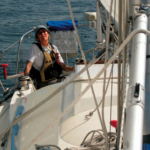
Don says Banshee performs better than expected. He has been caught in some bad weather and was quite comfortable with the boat’s performance. As a result, he’s confident that, with prudent seamanship, aPearson 34-2 will take care of its crewin a blow.
The Pearson 34-2 has a 30-horse-power Yanmar 3GM30F diesel for auxiliary power. Coupled to a two-blade prop on a 1 1⁄4-inch bronze shaft, it easily moves the boat at hull speed. Access to the engine for maintenance is very good.
Not many of these boats are raced, and the only PHRF rating is 138 seconds per mile, which compares favorably with the Sabre 34 at 135. To put a given boat in perspective, it’s always useful to look at similar-sized J/Boats, which are known more for performance than for cruising comfort. The J/34 generally rates from 114 to 117.
Things to check out
As is the case with most balsa-cored boats, delamination of the core due to water saturation is a potential problem. Don says he found “soft spots” around some of the deck hardware, most notably the lifeline gate stanchions.
Another area to check out is around the portlights. Don found a couple of them leaking and applied fresh sealant when he replaced the lenses.
Having done a bit of investigation around the head and its holding tank, Don is confident that the persistent head odor is coming from saturated hoses, rather than anything more serious. Replacing the hoses (with solid PVC pipe where possible) should relieve the problem.
Conclusion
The Pearson 34-2 is an attractive, well-mannered, and versatile craft. Its hull and rigging conform closely to the latest thinking in conservative cruising boats at the time it was built. It was marketed as a family or two-couple cruiser. Not many of them were produced before the company went out of business. Today, they usually sell for around $55,000.
Gregg Nestor is a contributing editor with Good Old Boat. He has authored three books on sailing, including Twenty Affordable Boats to Take You Anywhere and The Trailer Sailer Owner’s Manual. He’s currently contemplating his fourth, maybe an e-book.
Thank you to Sailrite Enterprises, Inc., for providing free access to back issues of Good Old Boat through intellectual property rights. Sailrite.com