A daysailer with gunkholing aspirations
Issue 110: Sept/Oct 2016
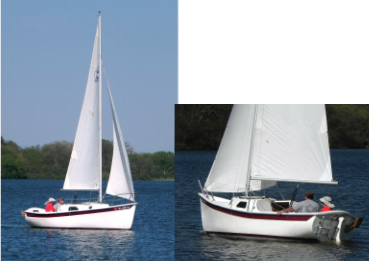
What better place to review boat than in my own backyard? The Slipper 17 that is the subject of this article came into my care when a member of the Rockford (Illinois) Yacht Club, of which I am a member, passed away and left in his estate a small sailboat. When the estate sold the house, his widow had to move the boat. She had nowhere to take it, so I brought it to my home. And there, while I cleaned it and worked on it, I began to fall in love with my new lawn ornament with its pretty lines.
History as we know it
Nick Hake began building a line of four sailing dinghies in 1973. In about 1981, under the name Starboard Yacht Company, he began building the Slipper 17 to his own design.
In 1984, Nick moved the company from Miami to Stuart, Florida, and began using the name Seaward for his sailboats, including this 17-footer. The Slipper name is commonly applied also to the Seaward 17, so I will use Slipper 17 throughout this review. The Seaward 17 became the 1993 Seaward Fox. Although the LOA of the Fox is listed as19 feet 9 inches, the hull and layout are nearly identical to the Slipper 17.
Today, Nick is listed as the designer for Seaward Sailboats (Hake Marine LLC) which builds the Seaward 26, 32, and 46 retractable-keel cruising sailboats. In April 2016, Hake Marine acquired the assets of Island Packet Yachts and Blue Jacket Yachts and planned to continue producing all three brands in the former Island Packet facility in Largo, Florida.
Design
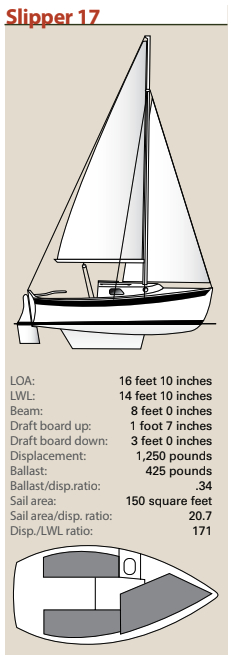
The high bow, swooping sheer, and slight tumblehome to the topsides were all part of Nick Hake’s design philosophy of blending traditional looks above the waterline with modern underbodies. A high bow keeps her dry, a near-plumb stem gives her a long waterline, and broad beam ensures stiff resistance to heeling. The stainless-steel centerboard housed in a long ballasted fin keel is a common feature in other Seaward models. Draft is a mere 1 foot 7 inches with the centerboard raised and about 3 feet with it down.
Construction
Construction details indicate the hull is a single skin hand-laminated with fiberglass cloth only. The deck and interior liner are laminated with fiberglass mat. There appears to be coring in the deck at the cabintop. If so, it’s likely a synthetic core as Nick Hake is averse to wood cores. The hull-to-deck joint is formed by a molded bulwark at the deck edge that laps over an inverted “J” molded along the sheer of the hull. As well as being bonded, the joint is fastened with 1⁄8-inch machine screws on 6-inch centers through an aluminum strike rail. This joint is unlikely to leak, and it creates a standoff that protects the topsides against damage from lying against pilings.
On examining the inside of the boat, I saw no backing plates where hardware is attached, just small washers. But it is a small boat that should see only small loads. A laminated-wood compression post supports the deck under the mast tabernacle. The balanced foil-shaped transom-hung rudder is short enough that it will remain free if the keel grounds.
Deck
Long, wide cockpit seats with high, nicely angled seatbacks can accommodate six people, though perhaps not when sailing. I found the handsome laminated tiller on the review boat inconveniently long and too high. With crew aboard, I had to maneuver under it to change sides when tacking. A shorter straight or downward-curving tiller would be more convenient.
The tiller passes from the rudder through a trapezoidal hole in the high, shapely transom. While the large (and heavy) balanced rudder provides plenty of helm authority, it should be unshipped for trailering. Bolts serve as pintles, and there is enough slop that I could feel some vibration in the rudder under sail.
A short section at the aft end of the port cockpit seat is teak. A hinged section in it opens to reveal a storage compartment for a 21⁄2-gallon fuel tank. Otherwise, there are no lockers or cubbies in the cockpit.
A narrow bridge deck a little higher than the cockpit seats keeps cockpit water out of the cabin. A sliding hatch and a single plywood dropboard close the companionway.
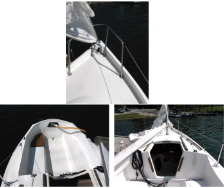
Relatively wide sidedecks, secure footing provided by the bulwarks, and teak handrails on the cabintop make going forward relatively easy. The upper shrouds are mounted outboard; the lowers attach to the cabintop. There is no anchor locker, but the crowned foredeck is spacious enough for handling an anchor and working with the hanked-on jib. Three metal cleats are provided for docklines, but I’d prefer bigger cleats that could accommodate larger line. A single lifeline each side runs from the stainless-steel bow pulpit to a stanchion just forward of the cockpit, and thence to the deck forward of the transom.
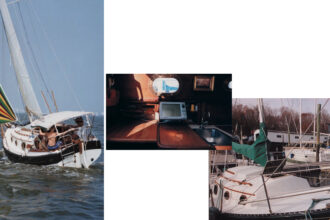
Two opening portlights and two fixed portlights admit a little light and air to the cabin, but the sliding companionway hatch provides most of both. On the review boat, a homemade drop-in screen made to replace the dropboard keeps out bugs.
Rig
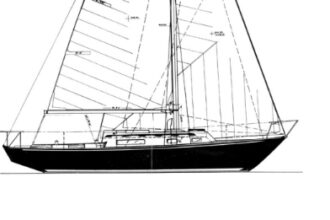
The Slipper 17 has a 3⁄4 fractional sloop rig with no spreaders or backstay. The main shrouds attach quite far aft to chainplates that are bolted to the hull sides without benefit of backing plates.
I had not rigged this boat before the day of the test sail and photo shoot, when I had fellow yacht club member Burnie Turner and his friend Tim West along to help. Although the mast is stepped in a tabernacle and light enough for two people to raise, we didn’t find it easy. The step from the cockpit seats or footwell to the top of the cabin is too high to negotiate while lifting the mast. A fabricated step would be very beneficial, and a support strut in the stern would help to keep the mast off the companionway in the process. We managed by having the person on the bow pull hard on the forestay.
After raising the mast twice to get the halyards right, we discovered that we could not get the standing rigging taut. We adjusted it as best we could but found that, while sailing, the jib’s luff boltrope was serving as the forestay. On getting back to shore, I noticed that the plywood block between the deckhead and the compression post under the mast was crushed.
Our test boat was not rigged with a boom vang and was also missing a topping lift. The mainsheet traveler is the full width of the cockpit aft of the companionway. It is of some help in holding the boom down but is not easy to use. A powerful purchase gives good control of the mid-boom mainsheet. Fortunately, the Slipper 17 doesn’t need to be sailed as a dinghy with the sheets free.
With 150 square feet of sail and a displacement of 1,250 pounds, the Slipper has a sail area/displacement ratio of 21 — but that ratio becomes closer to 17 with two people and gear aboard. Jibsheets run through fixed fairleads mounted on the cabintop and are stopped with cam cleats. There are no winches. Halyards are made fast at the mast on horn cleats. After the mainsail has been hoisted, luff tension is adjusted by hauling down the gooseneck, as on a dinghy. The main has one reef point, but no jiffy reefing.
Belowdecks
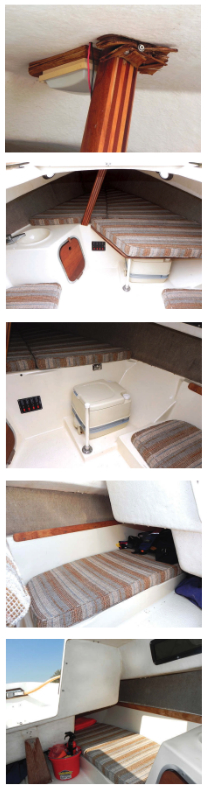
While quite yachty in some respects for a 17-foot boat, with fiddled ledges outboard, a table, and a sink with a faucet that draws from a bladder tank, the interior is barely functional. At least the centerboard is housed in the keel, so there is no trunk dividing the cabin, but sitting headroom is marginal above thin seat cushions, the quarter berths are too cramped for adults, getting into the V-berth takes considerable agility, and the portable toilet is front and center when in use.
As well as the tiny sink that drains through a through-hull with no valve, there is a molded-in cavity under the starboard V-berth to hold a fullsize 12-volt house battery to power the lights and a fuse/switch panel to control them. This is all part of the one-piece furniture liner. The underside of the deck is painted, and the atmosphere below is softened somewhat by gray fabric glued to the hull sides. No areas are unfinished, and I encountered no sharp edges when poking around.
Some storage is provided under the sink, and a long space under the cockpit footwell will accommodate necessary gear, such as a bagged anchor and rode. But, as on all small boats, the berths become the storage spaces. A DIY project could be to open up the furniture pan under the V-berth to provide more storage space.
Under way
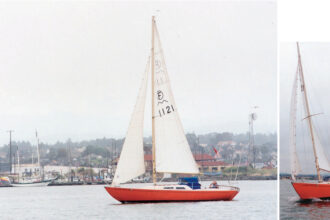
In the photos, the Slipper 17’s pretty lines are not marred by an outboard hanging from the bracket on the transom. That’s because I laid the 2-horsepower 4-stroke Honda on the wrong side while transporting it and oil fouled the cylinder — an easy mistake for a longtime owner of a 2-stroke to make. We used a paddle to propel the boat away from the dock.
Where the Slipper 17 shines is sailing. Oh, what a delight! It’s very responsive to the helm and tacks in a blink. With the sails properly trimmed it has very little weather helm. Thanks in part to the long stub keel, a light touch on the tiller is all that’s needed to keep it tracking straight.
This is a boat to spend a day on. The jibsheets are handy on the cabintop and, along with the centerboard (which is easily deployed and retracted), allow tight tacking angles. For our test sail, we had variable winds from light to gusty. When the gusts hit, the Slipper heeled a bit more and accelerated, and I felt no need to depower it by easing the mainsheet or pointing up. The boat took it as though it were a 30-footer, rather nonchalantly shedding the puffs with its generous 8-foot beam and 425 pounds of ballast. It accelerated quite briskly on reaches, which surprised me. I looked at the Slipper 17 as heavy and beamy, and expected somewhat lackadaisical performance. Far from it. Nick Hake knew what he was doing with this modern underbody design.
I did find the high bow limits the view forward, and the cockpit seats are too far apart for bracing while heeled, an unusual issue in a 17-foot boat. As for napping, seats that are long enough, wide enough forward, but too narrow aft to support a stretched-out nap earned a PNI (Penticoff Napability Index) of 3.5 out of 5. A little bench between the seats under the tiller would raise the rating. A bent-knee nap is OK, and the angled cabin bulkhead makes a fine backrest.
Conclusion
In my view, the Slipper 17 is really a comfy daysailer. At best, one adult and two children could sleep on board. Carrying a tent to pitch on a beach, or setting up the cockpit with a filler and a boom tent, could make it more of a pocket cruiser. It has shoal-enough draft to gunkhole anywhere filled with water, yet it is enough of a boat to stand up to a pounding. It is certainly trailerable and doesn’t require a large tow vehicle. With a little work, the set-up time could be cut to under a half hour.
This could be a first boat for a keen daysailor, or a last boat for someone downsizing who has a home with a dock and wants to go out sailing and not have to worry about a capsize. It’s a pleasure to handle, perfoms nicely, and onlookers will admire it as it sails by.
Overall, this is a well-built small boat. If anything, it seems over-capable, which may tempt some sailors to take it out in conditions it was never really intended for. Things to check for are softness in the wood at the top of the mast compression post and if the chainplates have backing plates.
Because the cockpit is not self- draining with people in it, the plug must be placed in the transom drain before launching. It should be removed, and the drain kept clear, when the boat is stored outside, as water will pour into the cabin if it tops the low bridge deck.
On the test boat, a PVC tube had been fitted around the centerboard control cable where it comes up through the cockpit sole, I suspect to keep water out. The cable needs to be secured when the centerboard is fully retracted. The cam cleat on this boat was not the right solution and the cable easily came loose, which was a problem when trailering and launching.
The Slipper 17 was built from about 1981 to 1986. Early ones were made by Starboard Yachts, but in reality are little different from the Seaward-branded boats. Including the Seaward Fox, approximately 800 boats were built. Prices range from $1,500 for those in sad shape to $5,500 for one in premium condition. A good Slipper 17 can be had for $2,500.
Allen Penticoff, a Good Old Boat contributing editor, is a freelance writer, sailor, and longtime aviator. He has trailer-sailed on every Great Lake and on many inland waters and has had keelboat adventures on fresh and salt water. He owns an American 14.5, a MacGregor 26D, and a 1955 Beister 42-foot steel cutter that he stores as a “someday project.”
Thank you to Sailrite Enterprises, Inc., for providing free access to back issues of Good Old Boat through intellectual property rights. Sailrite.com