You don’t need a fortune to live a rich cruising life

Issue 45 : Nov/Dec 2005
A question frequently asked of cruisers is, “What do you do for money?” This inquiry has always amused Jaja and me. It’s an innocent-enough question, but it’s difficult not to be sarcastic when a stranger crosses this line of etiquette.
What folks really want to know is, “How can you afford to go cruising?”
The answer is that it’s all about priorities: it’s not what you save while spending, it’s what you avoid buying. Period.
I can understand the reason The Money Question is asked so often. Life ashore can become very expensive — if you let it. There are the ordinary expenses such as utilities, car insurance, property taxes, and bank loans. But these aren’t the culprits. The killers are in the periphery: cell phones, satellite TV, designer clothes, designer haircuts, new cars, restaurants, Internet shopping, and credit-card interest, to name a few. If that kind of superfluous spending is brought into the cruising life, where you typically forgo a steady income, the question is natural. How would you afford to go cruising?
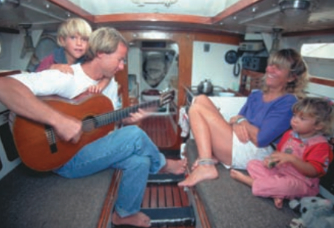
We usually had plenty of funds while cruising because we lived a bare-bones lifestyle and worked wherever we stopped. Even when children began to swing from the rigging, we eked out a living and kept the dream to cruise going forward. To save money, Jaja hand-washed all our clothes, towels, bedding, and the kid’s cloth diapers. Laundromats are expensive … especially overseas. (Due to this drudgery, the kids were all potty trained by 15 months.) Jaja also nursed the kids until they were able to eat the baby food she made from scratch. No formula or Gerber food crossed their palettes. By living on a boat, we also avoided all those baby accessories, things like high chairs, cribs, and special changing tables.
Take any work
To generate income while cruising. I’ve built boats, re-glazed old windows, tiled bathrooms and kitchens, cleaned toilets, and painted houses. Together, Jaja and I have written magazine articles and a book. The trick with working ashore while cruising is to take any work you can get. You are trying to earn a buck, not start a career. Nine times out of 10, a menial chore will lead to something better. Always do your best, even if it’s cleaning 70 toilets a week. The fellow who owned that business also owned a 39-foot sailboat hull. Before long I was working full-time on his boat, building the deck and interior.
I always had confidence a job would be there when I needed one. It’s all about attitude. Even in foreign countries, where I did not speak the language at first, I found work. Impending starvation is a fantastic motivator to get off the boat and mingle with the real world. Working brought us into the lives of the locals. This proximity created some of our best experiences. One of the greatest illusions about the cruising life is that every day should be a vacation. How boring.
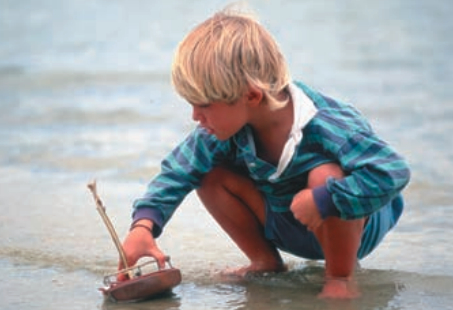
The reason we could survive as a family on a average budget of $6,500 per year in the tropics (1988 to 1995) and $15,000 a year in the high latitudes (1998 to 2003) is that we did not have many superfluous expenses. We had no payments for a house, a car, or furniture. We had no credit-card bills, cell phone, cable, boat payments, boat insurance, health insurance, mortgage, or car insurance. Nor did we eat out much or go to pubs. We bought secondhand books and clothes. I made the kids’ toys, and we avoided marinas like the plague. Everything we owned we carried with us.
Very simple
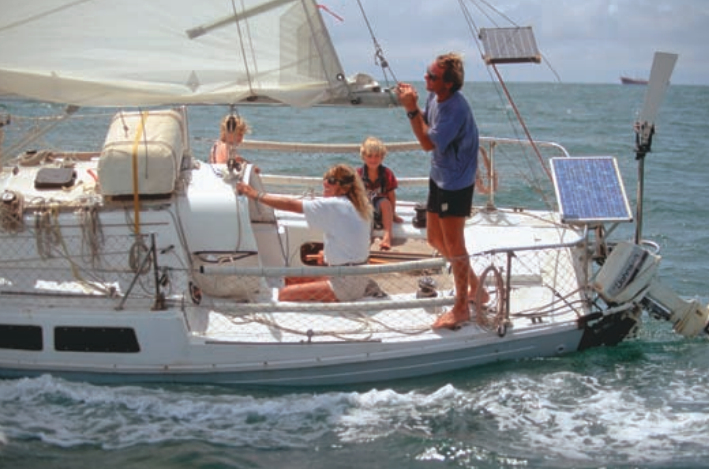
Our two boats, Direction and Driver, were as modest as our chosen lifestyle. At 25 feet, Direction was the epitome of simplicity: one battery, two solar panels, a Casio watch, and a plastic sextant. I worked navigation sights using a pencil and paper. We logged 45,000 miles on that boat and visited two dozen countries. At 33 feet, Driver was a simple boat mechanically. However, we budgeted for a radar, GPS, and a portable reverse-osmosis watermaker. None of these items was vital per se, but they removed some stress from our lives. Priorities.
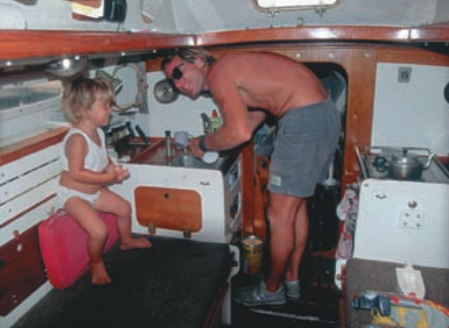
Both boats were easy to maintain, and we performed all the work we could do ourselves. Our biggest expenses were going to the grocery store and buying diesel fuel for the heater in northern climes. Direction was “cruise ready” for $16,000 (1987). Driver weighed in at $60,000 (1997). Our boats were a tad cramped for crossing oceans and raising kids. So what? Coping with a small space is a mental challenge, not necessarily a physical one. Once you get used to it, life becomes “normal.” Were we always comfortable? No. Did we see the world? Yes.
The average length of cruising boats has increased over the past 20 years. We’ve seen couples on 50-, 60-, even 70-foot boats. Not only that, but these couples usually maintain a shoreside home. It takes a sizable income or a nest of investments to buy and support that kind of comfort.
Although these enormous boats are for the well-to-do, they have inadvertently raised the bar of tolerance for what is deemed an “acceptable-sized cruising boat.” It has become a cliché now: big, expensive boats are safe, and small, simple boats are inadequate for anything other than weekends. Glossy sailing magazines are partly to blame for this changing attitude. It’s all about advertising space and selling a dream.

Writing articles
Editorial preference also plays a key role in determining what type of message the reader receives and then tries to emulate. A successful boat broker observed that 20 years ago when folks came aboard his boats, they sighted the mast, twanged the shrouds, swung the tiller, and asked about hull speed. Nowadays, buyers head for the cabin, feel the upholstery, check out the woodwork, and ask about the systems.
Ironically, today’s myriad onboard systems and gadgets — which are meant to enhance a cruise — are the one thing that can just as easily prevent a cruise from ever happening. Who hasn’t sat down with a marine catalog and calculator, then added up all the “have to haves”? You stare off into space and reconcile the need to work for another 150 years to afford all the goodies.
Somehow the adventurous spirit of sailing has begun to give way to shoreside indulgence and instant gratification. Boats are becoming too much like cars, both in looks and in usage: push-button convenience and ergonomics with all risk seemingly taken care of by an array of microprocessors. All of this is fine, but it comes with a high price tag. It’s unfortunate, but “money” and “cruising” are becoming interchangeable terms.
Would you like to go cruising? It is really not that big a deal to buy a cheap boat, sell the house and car, quit the job, and hit the high seas. An older, 30-foot production boat costs less than most new cars. Buy some used sails, replace the rigging, get a hand-held GPS, baby the engine, build a plywood dinghy, carve some oars, and you are cruise-ready. Figure on eating rice and potatoes, and your yearly expenses could be well under $8,000. Do like we did: work for six months, sail for six months. Balance pleasure with purpose.

Burning desire
I can already hear folks digging in their heels and shouting: “But, but, but, I can’t do that! I need to buy . . . What about my job? . . . What about my stuff? . . . ”
The only things you need are the burning desire to go and the attitude that everything will work out for the best. We have passed up many longterm jobs because our drive to explore is more developed than our drive to stay put. We have learned that “stuff” can be replaced and that there are plenty of jobs for motivated people.
Admittedly, lowering an acquired standard of living or forfeiting a familiar way of life might be the greatest challenge. Change is tough, even if it means following a dream. When Jaja and I moved ashore after cruising for many years, we took a big hit in our quality of life. Boat life is tranquil and spontaneous, and it keeps us close to nature. Living ashore is more comfortable at times, but we do not have the same freedom of movement or quality of togetherness. Everyone is always rushing off to do something. But we are enjoying the trade-offs. That’s how life is. That’s how cruising is too.
For Jaja and me, going sailing was our number one goal. All our available cash went into our boats, so they were paid for by the day of departure. We preferred to whittle back expenses to the barest minimum in anticipation of being underway. We thought of cruising as investing in our youth, in our good health, and in our lust for adventure. When we get old and feeble, we will never have to look back with regret and rue the fact that we spent the best years of our lives toiling away just to buy trendy stuff.
The cruising lifestyle has become too over-analyzed. Personally, the more I analyze something, the more I tend to follow in the footsteps of contemporary wisdom. It is at this juncture that I can fall prey to marketing gurus, and my “must-have list” runs on for pages.
The cruising lifestyle is similar to every other way of life. It takes a defined goal and the ability to ignore the way everyone else is doing it. Life is an Aladdin’s lamp that you must learn to rub correctly. Riches await those who figure out how to make it work for them.
Thank you to Sailrite Enterprises, Inc., for providing free access to back issues of Good Old Boat through intellectual property rights. Sailrite.com