Solving a cruiser’s chronic head-bashing problem
Issue 45 : Nov/Dec 2005
I awoke one morning a couple of years ago and felt my usual backache, so I lifted myself to change position and wham! bashed my head against the overhead, having forgotten that we were aboard our Com-Pac 25 and not under the 7-foot ceilings of our bedroom at home. I had always felt a little claustrophobic in the V-berth even though, as V-berths go, it’s plenty big enough.
The cabin extends forward beyond my head and shoulders, so I’m not sure why I felt so confined. I travel aboard Amtrak sleepers all the time and don’t feel overly confined in those little beds; maybe it has to do with being unable to get out of bed in the normal way. Getting out of the V-berth requires that I first crawl forward to get my legs pointing aft. Whatever it is, my bleeding skull began to think of ways to get, if not a bigger boat, then at least a bigger bedroom.
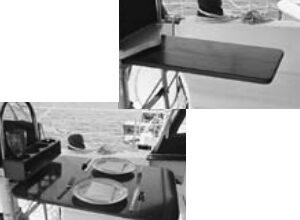
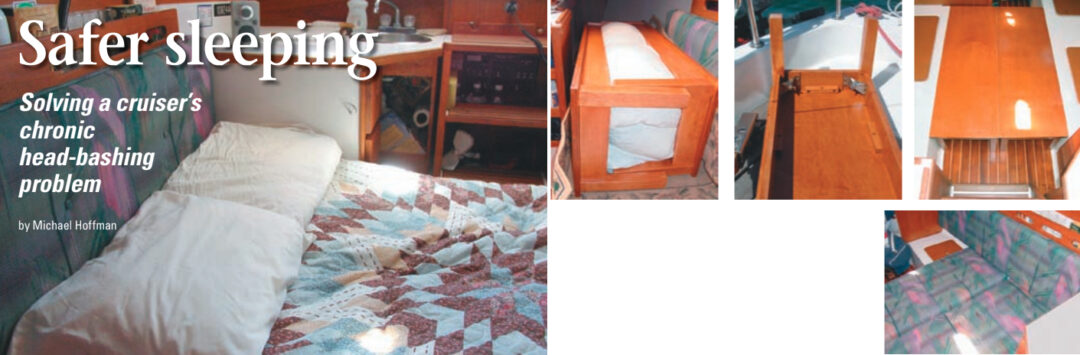
My mate, Mary Ann, and I had already noticed that the seat cushions on the settees, by sheer coincidence according to the manufacturer, exactly fit when laid athwartships, their ends tucking neatly under the backrest cushions. All they needed was a platform between the settees to support them above the passageway, and they’d become a small double bed. If the center platform were divided into two halves, port and starboard, it could be stored in the quarter berth.
The platform halves in concept could be nothing more complicated than two small coffee tables pushed together. I danced on our coffee table at home to test its strength and, seeing that it was up to the task, copied its design. The leg-mounting hardware attaching the legs to the platform allows the legs to be removed, but there’s a good reason to leave them in place when stowed.
Simple trapezoid
The forward ends of the settees are slightly closer together than the aft ends, but their edges are straight lines, making the space to be filled between them a simple trapezoid. The bottoms of the vertical sides of the settees are faired into the sole. This necessitated cutting the corner off the outboard bottom edge of each of the outboard legs of the platforms. We had considered providing hardware for clamping the inboard pairs of legs together, but this turned out to be unnecessary. In place, the platforms are immobile.
Since the platforms are scarcely visible even when in use, we decided it wasn’t necessary to spend a lot of money matching the boat’s interior teak. We used maple and stained it dark enough so that it wouldn’t be completely out of place in the ComPac’s old-timey interior. We covered it with two coats of polyurethane, which has so far survived two New England winters in the boatyard without showing any signs of deterioration.
A happy outcome of the design — and reason to leave the removable legs in place — was that the tables, turned on their sides with their legs pointing inward and slightly offset, form a box into which we stuff the bedding.
We replaced the quarter berth cushion with a short pile carpet. We can easily slide tables and bedding in and out on the short pile.
The arrangement has solved the claustrophobia problem . . . to get out of bed all I need do is swing my legs aft, and my feet hit the sole, ready to spring up the companionway. The unused forward part of the starboard settee makes a nightstand for Mary Ann; the galley area makes one for me. We don’t even have to get out of bed to make our morning coffee and tea. The back cushions are left in place (they anchor the ends of the seat cushions when they are serving as the mattress) and are a comfortable backrest when sitting up in bed. I’m an even 6 feet tall, and I think the bed ought easily to accommodate someone 6 feet 1 inch or even a little taller.
Five-minute job
It takes about five minutes for the two of us to assemble or dismantle the bed. It would be better, of course, not to have to do that. In fact, when we’re in a port for more than one night we sometimes leave the bed in place.
Could there be any improvements? Some older boats with no V-berth have a built-in folding platform that pulls down into place to form a double bed in the main cabin, but I see no way to duplicate that kind of a system in the Puffin with her 8 1⁄2-foot beam.
We removed the cushions from the V-berth and use the area for storage. There’s enough room to stow our deflated dinghy, our duffels, the jib that is not in use, two Strida collapsible bicycles, and all sorts of smaller items that we used to stow in the quarter berth, where they were much harder to retrieve.
Creating more comfort belowdecks in a small boat is one of the great pleasures of sailing. My guess is a lot of readers of Good Old Boat are pretty good at this.
Next on our agenda? Curtains.
Thank you to Sailrite Enterprises, Inc., for providing free access to back issues of Good Old Boat through intellectual property rights. Sailrite.com