This late ‘70s fast coastal cruiser has a pedigreed design
Issue 47 : Mar/Apr 2006
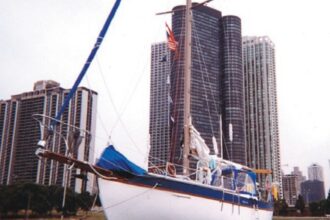
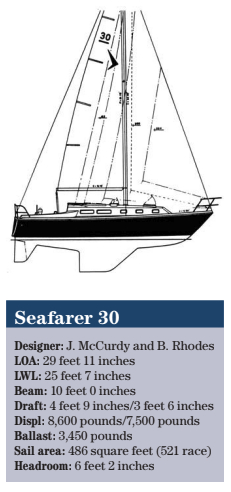
The Seafarer 30 was designed by Jim McCurdy and Bodie Rhodes and was sold from 1979 through 1985. This performance-oriented coastal cruiser has an overall length of 29 feet 11 1⁄2 inches, a waterline length of 25 feet 7 inches, and a beam of 10 feet. It displaces 8,600 pounds with 3,450 pounds of ballast.
The design of the Seafarer 30 can be summed-up in two words: tasteful conservatism. McCurdy and Rhodes have shown great finesse and restraint in carefully blending form and function into the design of this performance cruiser. The boat’s profile presents a fine entry, a turtle-shaped forward cabin, pleasing sheer, and an almost plumb stern.
The hull laminate is hand-laid and comprises alternating layers of fiberglass mat and woven roving. At the centerline there’s a maximum of 10 layers. This equates to a thickness of 5⁄8 inch. The deck is balsa-cored andis structurally laminated to the hull and then mechanically fastened with bolts on 4-inch centers. The hull-to-deck joint is an outward-facing flange, which is protected by a black vinyl rubrail and capped with teak.
The Seafarer 30 was available in two keel configurations, a fin keel drawing 4 feet 9 inches (our review boat) and a shoal keel/centerboard version that draws 3 feet 6 inches with a light (7,500-pound) displacement. Both versions utilized the same low-aspect-ratio skeg-mounted rudder. The skeg does not fully extend down the entire length of the rudder and, therefore, does not provide a lower attachment point for the rudder, nor protection for the rudder’s heel.
On deck
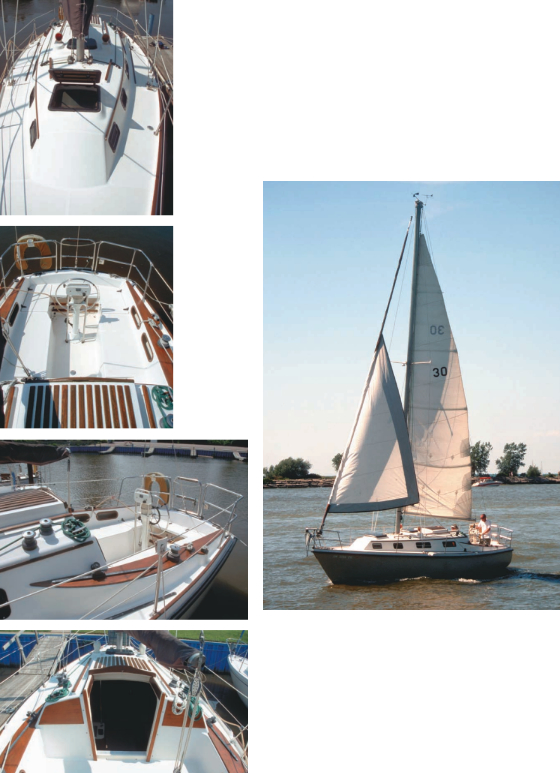
Except for a pair of 10-inch mooring cleats, their companion chocks, and a chain pipe leading below to a chain locker, the foredeck is clean and uncluttered. In spite of the outboard shrouds, comfortable maneuverability on deck is afforded by the teak-capped molded-in fiberglass toerail, the non-skid decking, and a generous 8 feet of dual teak handrails.
Complementing the large hatch that’s located forward on the coachroof is a slightly smaller hatch situated just aft of the mast and flanked by a pair of Dorade vents. Originally, only two of the portlights were of the opening variety. Our review boat was upgraded and now all portlights open. There is sufficient brightwork present to accent the boat, including teak ribbing on the companionway’s sliding hatch. Unfortunately, the sliding hatch does not incorporate a seahood. One could easily be added.
A pair of midships cleats and chocks, along with a pair of stern mooring cleats, provide adequate tie-off points when docking. Stainless-steel bow and stern pulpits, a centerline swim ladder, stanchions, and dual lifelines complete the deck hardware.
The cockpit of the Seafarer 30 is 7 feet long. It’s protected by coamings that are both high and wide. These not only help to keep the crew dry, they also offer good back support and a place on which to mount sail controls. Our review boat’s coamings were each fitted with optional storage “cubbies.” These are great for keeping small items confined and close at hand and are a good place to stuff headsail sheets to keep them from cluttering up the cockpit. There’s a bridge deck and two large cockpit drains. Aft, port and starboard, are a pair of generous lockers. The starboard one houses the manual bilge pump. Beneath the helmsman’s seat is the engine control panel, shorepower receptacle, the emergency tiller connection, and additional stowage. Wheel steering is standard, with throttle and transmission controls close at hand to starboard. Located in the cockpit sole, directly above the fuel tank, is the deck fuel fill.
Belowdecks
The V-berth is 6 feet long and almost 6 feet wide at the widest point. Beneath it and forward is the 42-gallon water tank. Also beneath the V-berth is a stowage locker to starboard and the holding tank to port. Ventilation and illumination are provided by the overhead hatch and a pair of opening portlights. At night, two 12-volt dome lights offer illumination. A folding door separates the V-berth from the head. The head, which spans the hull, contains a stainless-steel sink with vanity and a mirrored hanging locker to starboard; the toilet and a second hanging locker behind are to port.
Our review boat was fitted with a self-contained, recirculating marine toilet. This system uses wastewater, rather than seawater, for flushing and has no provision for overboard dumping. While this system may be loved by the U.S. Coast Guard, it contributes odors to a boat. A pair of opening ports allows for light and cross-ventilation in the head. A second set of folding doors, located between the head and the main cabin, establishes additional privacy and defines the shower area. Shower water drains to the bilge and is sent overboard by the automatic bilge pump.
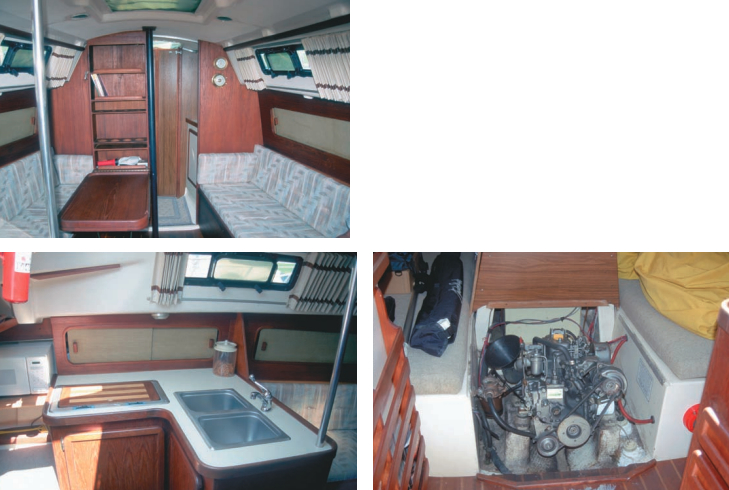
Following aft are the opposing settee berths of the main cabin. The starboard settee is fixed, while the port one converts to a narrow double. Both measure 6 feet 5 inches long and have stowage beneath and behind. Outboard are covered lockers and overhead, 9 feet of handrail. The drop-leaf table folds up against the port bulkhead and conceals a spirits locker, stowage for glasses, plus additional fiddled shelving. An overhead hatch complements the four opening ports. At night, two 12-volt dome lights illuminate the main cabin. The woodwork is oiled Burmese teak. The sole is teak and holly. Headroom is 6 feet 2 inches.
The galley
Aft and to port is the L-shaped galley with its double stainless-steel sink, pressurized hot and cold water, and a two-burner pressurized alcohol stove. The galley has adequate stowage in the form of drawers, lockers, cubbies, and shelving. To starboard is the 150- pound capacity icebox, which doubles as a chart table. Our review boat’s icebox was converted to 12-volt refrigeration. The compact compressor was cleverly hidden in the outboard locker above the chart table.
Beneath the cockpit seats are a pair of large quarter berths. With this configuration, the boat can conceivably sleep seven. The diesel engine is situated between these berths. Farther aft is the 20-gallon fuel tank and the water heater. Both Yanmar and Westerbeke power plants were used as auxiliaries in Seafarer 30s. Our review boat was equipped with a raw-water-cooled Yanmar 2GM. This 15-hp engine is coupled to a 14-inch, two-bladed prop via a 2:1 reduction gear. It appears to be adequate under normal conditions but may be a bit underpowered in heavy seas.
Removing the companionway steps and the combination engine box cover/fiddled table exposes the engine and stuffing box. Access is excellent. There’s a dual-battery electrical system with the fuse panel located above and to the right of the chart table and the battery switch situated at the base of the port quarter berth. All seacocks are bronze.
The rig
The Seafarer was originally available in a standard rig (412 square feet of sail area) or in a racing configuration with 521 square feet of sail area. Both were high-aspect-ratio, masthead-rigged sloops. Our review boat was equipped with the standard rig. Its mast is deck-stepped with a compression post beneath and has a bridge clearance of 40 feet 10 inches. It utilizes a single spreader with single upper and lower shrouds, as well as a backstay.
All halyards are external, lead aft, and terminate at one of the four Lewmar #7 single-speed winches located on the cabintop. There are two winches on either side of the companionway, at the aft edge of the cabin. Each has its own dedicated line stopper and cleat. A pair of Lewmar #30 two-speed winches are located on the cockpit coamings, along with turning blocks and cleats. Our review boat was fitted with three sets of headsail tracks, a 10-foot section on the sidedeck, a 7-foot section on the toerail, and a short 3-foot track on the cockpit coaming. This allows for a variety of headsail configurations.
The boom of our 1981 review boat is of the roller reefing variety. This feature was dropped in later years and replaced by a standard boom with jiffy reefing. Sheeting is end-boom and connects to a traveler located on the bridge deck.
Under way
The Seafarer is a reasonably fast boat. She is initially tender but stiffens up as she approaches 20 degrees of heel. She has a small high-aspect ratio (3.25:1) main. The outboard location of the shrouds restricts the sheeting angle and the boat’s ability to point.
Checklist
As is the case with any boat of this vintage, sound the deck, especially around deck fittings. Delamination of balsa-cored decks is a common problem and, if extensive, can be a dealbreaker. Over the years the original plastic-trimmed portlights can develop leaks and require rebedding. While not so much of a problem as a nuisance, be careful when fueling or checking the fuel level. Having the filler located on the cockpit sole is an invitation for water and debris to find their way into the fuel tank. If equipped with the recirculating marine head, odor problems may be noticeable. Corrective actions include replacing the hoses and/or convert-
ing to a seawater flush. If the engine is raw-water-cooled, run it under load and monitor the operating temperature. The lead keel is encapsulated. Check out the leading edge and determine if the boat has suffered a severe grounding. Damaged or even repaired fiberglass in this area can mean that water has intruded and can lead to problems.
Summing up
The Seafarer is a conservatively designed performance cruiser. Her looks have staying power. She’s a big boat inside with many creature comforts. If she’s guilty of one thing, it’s being “over-berthed.” She’ll perform well around the marks on Wednesday night and comfortably carry a family on a weeklong cruise. Remember that Seafarer Yachts went out of business 20 years ago so there’s no support other than dedicated Seafarer owners. If you’re looking to buy, expect to pay around $17,000 to $24,000.
Thank you to Sailrite Enterprises, Inc., for providing free access to back issues of Good Old Boat through intellectual property rights. Sailrite.com