Chuck Kanter explores the world of older catamarans and trimarans.
His conclusion? It’s thriving
Issue 14: Sept/Oct 2000
You’re thirsting for a cruising catamaran. You just came back from the boat show, and you’re in love. You’ve made the decision that, for your purposes, the many sterling advantages of a cruising catamaran outweigh the few disadvantages. Unfortunately, most of what you saw was beyond your budget. Not to worry; there is an ever-increasing “pre-owned” market, and you might just find the catamaran of your dreams there. Let’s explore that used market, specifically the catamarans beyond 10 years old, and see which boats are enduring, which meet your needs, and perhaps even which to avoid.
A thumbnail history
The prosperity of the 1950s, coupled with the new materials and building techniques developed during World War II, launched the current pleasure boat industry, and catamaran cruising sailboats have been a part of the market and the industry since that time.
Most of the catamaran-building frenzy of the early period took place in England, led by stalwarts like visionary James Wharram. Wharram reintroduced the traditional sailing vessels of the Polynesians who colonized the Pacific a thousand years before the United Kingdom even had an ocean sailing ship.
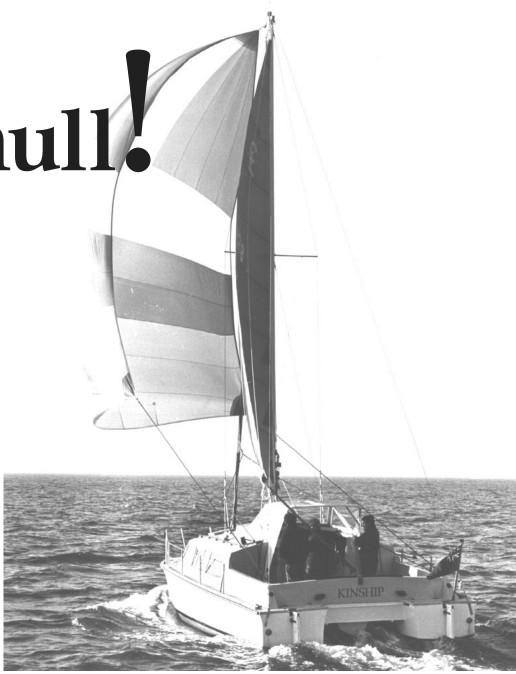
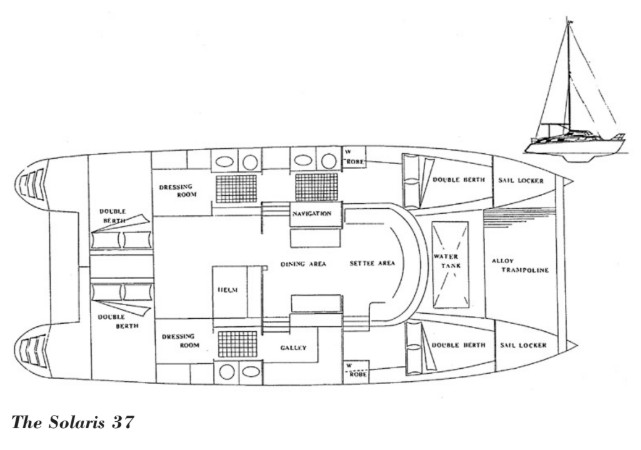
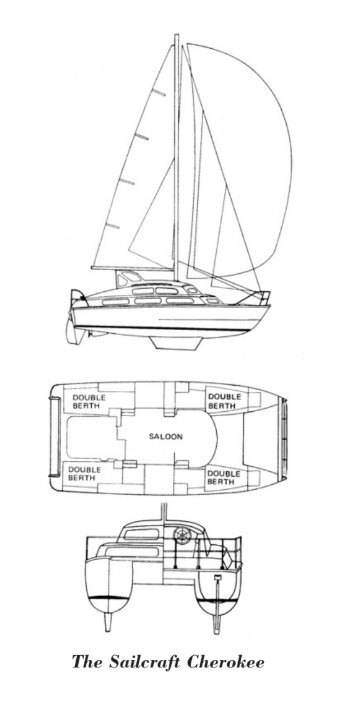
Sailors who were business-men began production of what have become some of our most enduring cruising yachts. Legendary designer Rod Macalpine-Downie and Tornado sailor Reg White built the Sailcraft line of catamarans: Iroquois, Comanche, Cherokee, Apache, and Arapaho. Tony Smith, producer of the modern Gemini, began his meteoric career with the TelStar folding trimaran. Tom Lack produced the 8-, 9-, 10-, and 12-meter Catalacs (Catalac being an acronym of: Cat of Lack). The Prout brothers, who began building around 1950, without doubt produced the most varied line of catamarans: the Sirocco, Ranger, Quest, Snowgoose, Quasar, and many others. There are also the high-quality vessels built by Solaris Yachts.
These notables, along with many others, sparked the formation of the Amateur Yacht Research Society. It’s interesting to note that the British have an extremely high regard for the American Indians and thus named many of their catamaran vessels after various tribes as a way of honoring them.
Escapist movement
On our side of the pond, the 1960s brought about a decade of social unrest and change. In the yachting world, this resulted in a great escapist movement led by Arthur Piver, Jim Brown, and others. This movement was centered in southern California and gave rise to such concepts as “seasteading,” where persons on their floating homes could live entirely off the sea and be free from the increasingly restrictive confines imposed by governments.
Although there was some merit in these ideals and the trimaran technology they proffered, the movement created a certain disdain among establishment types which has continued to color the development and acceptance of multihull technology in the United States until the present era. Therefore, except for the early-model Geminis and Telstars, the used market of vessels 10 years old or older is almost entirely British.
It took the French and their world view of chartering to bring the virtues of catamaran technology to the general public. In the 1980s the French government, in a pact with the labor unions and manufacturers, embarked upon a bold course of designing, producing, and spreading to the world at large a fleet of charter yachts the likes of which had never been seen.
Beginning with aesthetics, these boats revolutionized the sailing world. Completely rejected were the old aesthetic values of low freeboard and graceful sheer. This new breed of cat looked far more like a rocket ship from Star Wars than a sailing ship from history. The public loved it. Within two decades, French-built and French-styled catamarans dominated the charter industry worldwide.
The state of the market
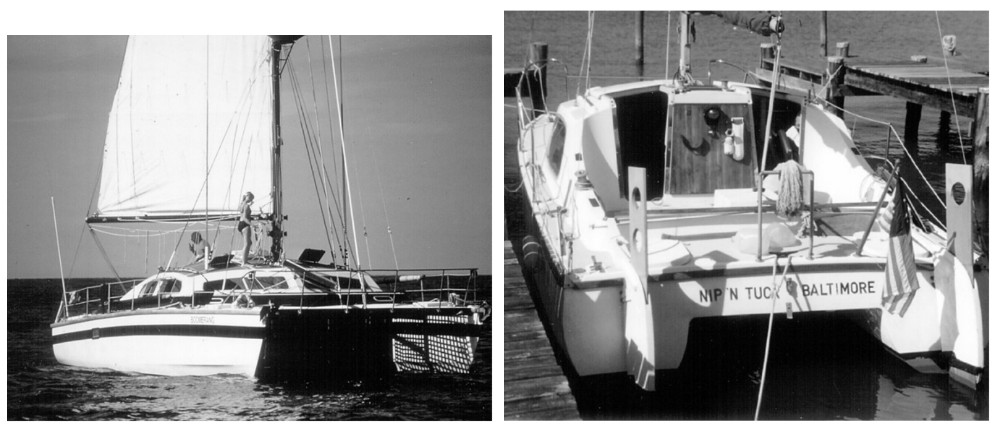
The state of the market is healthy. Based upon past demand trends, I suggest that those purchasing used catamarans or sport trimarans can look forward to an era of increasing value and/or low depreciation. Of course, maintenance is critical. As with junk cars, junk vessels are always available someplace.
Prices – It’s difficult to get reliable pricing data from traditional sources such as BUC, NADA, or ABOS. First, many sales take place privately. Next, few sales are reported to those sources. Finally, a large part of the connections are made outside the traditional marketplace through publications such as MULTIHULLS magazine and through brokerages such as 2Hulls in Ft. Lauderdale, Fla., and Patrick Boyd in England.
The demand side – The demand side of the market is rising. Prices of older catamarans are not likely to ease off in the foreseeable future. Take, for instance, the ever-popular Hirondelle 24. I purchased Hirondelle hull #51 in 1971. I paid $9,500, which included an engine, sails, and spinnaker gear. Today these boats sell for as much as $17,000. I almost bought an Iroquois 30 that year instead of the Hirondelle. It was $15,000 including engine and sails. Now they sell for as much as $40,000. Prout catamarans are a better story yet, sporting above-average resale prices.
The supply side – There are two distinct groups of cruising multihulls: the trimarans and the catamarans. Catamarans can be broken into several groups according to their countries of origin and whether or not they were custom-built. These groups are further subdivided into racing boats, charter boats, and private boats. You may also distinguish between those designed for southern waters and those designed for the north. Of catamarans 10 years old or older, it’s my observation that the best built are British, Canadian, and American, in that order.
The best of the 1980s
Prout – This is a sea-going tank, designed to brave the storms of the North Atlantic. It’s the most ubiquitous of catamaran sailboats. It’s doubtful that there is a port anywhere in the world without at least one Prout catamaran. Prout claims some 2,000 vessels launched by 1990. The early models were the Shearwater in 1954; the Flamingo in 1955; then the Ranger 27 and 30, followed by the Snowgoose 34, which was upgraded to the Snowgoose 35, and then to the Snowgoose 37. In the late 1970s, the Sirocco 26, Quest 31, Quest 33CS, Event 34, Escale 39, and Quasar 50 were introduced. Those are the vessels most likely to be found in the United States. There is also an entire fleet of custom and semi-custom boats built by Prout but owner-finished. These occasionally wind up on the market. Prices will range from $45,000 upward for the smallest, oldest models.
Sailcraft – The Sailcraft boats consist of the Iroquois, Comanche, Cherokee, Apache, and Arapaho. Of those, the Iroquois and the Cherokee are the most popular in the United States, although others can be found on the market. Recent prices of Cherokees range from $60,000 to $99,000. There is wide variation in prices, depending upon condition.
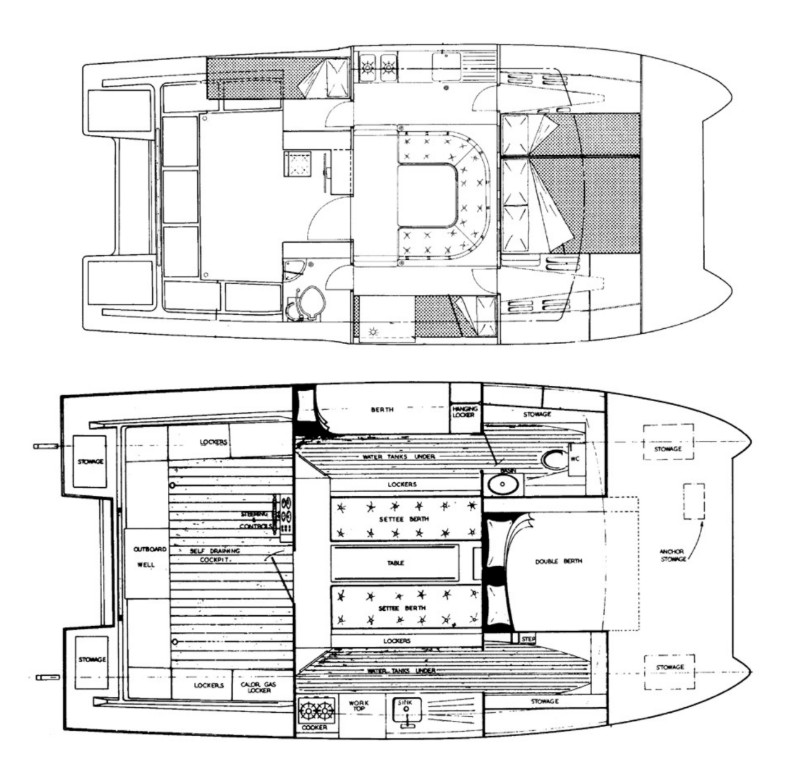
Catalac – Catalac might be considered the “Energizer bunny” of catamarans. They just keep going and going. The original issue in the early 1970s was the Catalac 9-Meter (30). This diminutive 30-foot by 14-foot vessel still has, in my opinion, the best layout for a cruising boat. That opinion is backed by an astonishingly high resale value. Introduced only slightly later, the Catalac 8-Meter (27) was built in the same bottom mold but with a different deck mold and interior. Toward the end of the decade came the Catalac 12-Meter (41) and the Catalac 10-Meter (34).
Catalac 27s occasionally sell in the high $20,000s, low $30,000s. A fully equipped twin-screw diesel 27 sold recently in the $70,000-range. There is one twin-diesel Catalac 30 with three Atlantic crossings to its credit now for sale for $45,000. The larger ones are proportionately higher.
Gemini – This one’s in a class by itself. It is far and away the most popular and best-selling cruising catamaran; sort of the Volkswagen of catamarans. The builder claims: “It is the most cruising boat you can get for the money.” www.geminicatamarans.com. Based on my knowledge of the industry and experience in surveying them, that’s true no matter how many hulls the vessel has. However, you most assuredly cannot buy premium quality for a bargain price. Consider the differences between a Chevrolet and a Cadillac, and you will have the differences between Gemini and some of the more expensive cats.
Prices vary widely. Occasionally you may find a distress case or a poorly equipped Gemini in the mid $30,000s. However, most fetch considerably more. A well-maintained and equipped Gemini in good shape will hover close to its original selling price.
Hirondelle 24 – As previously mentioned, do not expect any real bargains for these boats, not even with boats in poor condition. The Hirondelles are extremely popular, as they are the only boat in that size range that has full standing headroom in the galley and head, a queen-size berth, and two double berths, plus a big cockpit, daggerboards, and a 13-inch draft.
Former charter boats
If you’re thinking of buying an ex-charter boat to get the largest boat for the fewest dollars, consider the following:
Condition – A very high percentage of retiring charter boats need a complete overhaul, including expensive items like engines, sails, trampolines, and interiors.
Location – Most of the bargain boats will be in remote locations, adding to the cost of surveying (never buy a boat without having your own surveyor look at it), transportation, inspection, outfitting for return to your home port, delivery, and so on.
Equipment – Most charter boats have the bare minimum of equipment such as anchors, storm sails, and electronics. In addition, the European electrical systems are two-wire, 220-volt, 50 cycles, while our essential AC electrical systems are three-wire, 110-volt, 60 cycles. Major refit work is required to make European boats usable at U.S. docks and marinas.
Aft steering stations – This affectation may play well in Europe, where they separate the proletariat crew from the aristocratic charter clientele, but on a personal cruising vessel nothing could be more distracting from safe and secure cruising. Visibility from the helm on these vessels varies from very poor to atrocious. Especially to be avoided are boats like the Dufour 39, where you actually steer from the top of the transom with no real seat and only a little thin wire between you and eternity.
The other side of the world
Australia and New Zealand have been building catamarans almost as long as the British. They are decades ahead of the Americans in their development. A few units have shown up on our markets, but the cost of transportation is a serious impediment. I note Australian power cats being used by U.S. Customs officials. For those intrepid folks looking for a real challenge, Australia is a good place to shop for a catamaran. That is especially true right now with a strong U.S. dollar and a very favorable exchange rate. Check Terry Travers (ttravers@tpgi.com.au) and his Web site, www.insidemultihulls.com.au, for an inside track to the Australian market. In New Zealand, contact Malcolm Tenant (malcolm@tennantdesign.co.nz) and his Web site www.tennantdesign.co.nz.
Custom-built boats
Custom-built boats will have the least resale value. That applies to all boats, no matter how many hulls they have. Therefore, good bargains may abound among them. Your best ally in a search of this kind is your surveyor who should have familiarity with the construction method, materials, designer, and design intent. Be ready to accept lower prices when you sell.
Wharram – In a class by themselves are the Polynesian catamarans of James Wharram. Virtually entirely homebuilt, they represent a large segment of the multihull cruising community. They are inexpensive, seaworthy, and very basic. They range in size from 21 feet to 51 feet. There are no bridgedeck cabins on designs built to Wharram’s specifications, and therefore no luxury amenities associated with modern production cruising catamarans. It’s hard to collect real data, but I suspect if catamaran circumnavigations could be tallied, Wharram would show more than all others combined.
History of repair
High-maintenance items – These include the trampolines and forward cross-beams. The catamarans with the lowest overall maintenance and repair histories will be fully decked over, with no forward cross-beam or trampoline, and auxiliary powered by outboard engines. Next would be fully decked-over cats with a diesel engine and sonic drive leg; for instance, most Prouts and some newer Geminis. However, the sonic drive leg itself can be a chronic problem if it’s not properly maintained.
Marginal construction – Many of the French-built boats have marginal scantlings and are plagued with breakages, delamination, window leakage, equipment failure, and poor service records.
Blisters – The history of blistering in catamarans is roughly parallel to that of all other fiberglass boats. However, those in search of bargains may find them in blistered boats. Good surveyors, who understand the problems and potentials, are your allies.
Design considerations
In the early days of construction, for a host of reasons, stainless steel was not universally used. Therefore, certain major structural and operating components of many of the vessels were built of mild steel. For instance, the Prout tiller system used automotive tie-rod ends as connectors. Catalac used steel for tillers, tiller bars, and emergency tiller sockets. Sailcraft used steel main beams and chainplate bases. In vessels that have been properly maintained, this has not been a problem. Many of the vessels have had these components changed over the years as new materials and techniques were developed.
As is the technology today, most decks were balsa cored. However, the catamaran industry was far ahead of the curve in the use of new materials and foam cores. It is not at all unusual in boats built as early as the 1970s to find foam cores. Many of the early multihull enthusiasts were aircraft designers, and the vessels clearly show their impact on the industry. Airex foam core was first used by catamaran builders. It is my opinion that the modern design revolution seen in today’s production monohulls clearly has its roots in the pioneering done by the multihull designers and builders.
Fallen by the wayside
There have been no production cruising trimarans and only a handful of custom trimarans built in the United States, Britain, or elsewhere in recent years. The only exceptions are a few custom-built racing boats. The reasons are obvious: the crowding of harbors, the replacement of marine railways with travel lifts and just plain economics. Whatever virtues cruising trimarans may have had, they were overcome by the negatives.
On the other hand, there is a meteoric upsurge in sport trimarans. The performance virtues of the trimaran, plus the ability to quickly fold it up on a trailer, have captured the imagination of sailors the world over. However, only a very few meet our 10-year-old criterion.
The future
We can look forward to some high-quality vessels of South African and Australian manufacture in the not-too-distant future. Significant production is taking place and considerable innovation is built into many of the units I survey for clients. It will not be long. In addition, highly regarded vessels like the Manta, the TPI-built Lagoon 42, and others will reach the magic number of 10 years old shortly.
Chuck obtained a Venture 15 catamaran as a demonstrator for an Annapolis dealer in 1969. By 1994 he had sailed or surveyed every production catamaran traded in the U.S. Chuck and Corinne live in Marathon, Fla., and sail their 32-foot custom-built catamaran, La Forza. They are the authors of a large number of sailing books and articles. Chuck is an Accredited Marine Surveyor in The Society of Accredited Marine Surveyors (SAMS), where he is known as Mr. Catamaran.
Thank you to Sailrite Enterprises, Inc., for providing free access to back issues of Good Old Boat through intellectual property rights. Sailrite.com