New owner unearths hidden mysteries aboard
Issue 47 : Mar/Apr 2006
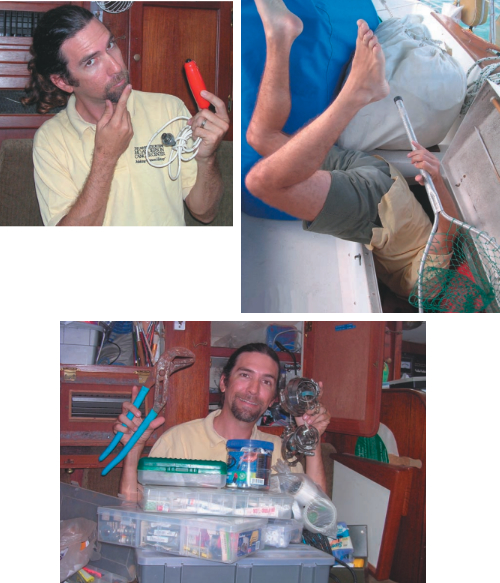
“What is this thing?” I ponder, holding up a hotdog-shaped red bulb with a foot-long wire protruding from one end, terminating in a plug that seems to fit nothing aboard our boat. It’s not the first mystery I’ve come across.
When adopting a used boat, new owners often inherit lockers filled with gear. It seems to me that most boaters, having decided to part with their venerable vessels, don’t have the heart to sort through all of those spare parts and pieces that have settled into the depths of each nook and cranny over the years. Instead, they generously leave all associated gear to the new owner.
When we took ownership of our 38-foot Morgan sloop, Sea Spell (formerly Jada, neé Little Feet), we were blessed with loads of storage space, compared to my first boat, an Endeavour 32. Sadly, Sea Spell’s three previous owners had already filled most of her bounteous space. It seems that 25-year-old boats quite literally come with a lot of baggage.
My wife and I quickly realized that if we wanted to stow any of our clothes and toys aboard, we’d have to sort through what was already there.
Much of the gear comprised the obvious items critical to a sailing vessel, such as sails. In addition to the ones in the cockpit sail locker, a couple of extra sails were piled in the shower. Two years later, the shower is still a sail locker. Who needs to bathe indoors when cruising in the tropics? We also found a little-used dodger buried beneath the sails that hadn’t been included in the ship’s inventory — the first of many bonuses.
Of course, there were also things listed on the inventory that we never did find. Where could they have possibly hidden that 35-pound Danforth? When asked, the immediate past owner admitted it may have been “lost” somewhere in the distant past. This nebulous explanation left me wondering if it might still turn up someday, perhaps tucked away under a settee cushion.
Prospecting below
We dug through our other lockers, spending days sorting things to determine what we’d bought, like prospectors panning for gold nuggets or archaeologists unearthing relics from the past. Some were pleasant discoveries, like spare Autohelms and bilge pumps.
Much of the sifting effort was pure drudgery. It seemed the previous owners had made a game of finding the highest possible number of places in which they could stow nuts, bolts, and other fasteners. We gathered these bits into a container with individual cubbyholes for different types and sizes. Suddenly, when we needed a certain screw or nail for a particular job, we could find it. Without the time spent rummaging for each fastener, projects accelerated.
After emptying the lockers we sorted everything into major categories. We gathered tools in one place (including a hammer from the Morgan yard that we found glassed into a compartment under the stove). Blocks — boy, do we have blocks! — all packed into a tackle box. Plumbing supplies in another. A toxic medley of glues, caulk, and other fixatives in another. Electronics in another. Expired flares in the expired flare box.
Soon things were starting to look organized, further reducing project times. We even began to open up space to stow our own stuff.
Despite our massive reorganization, we still didn’t have a grasp on everything on board. When stocking up with spare parts a year later, we visited our local Perkins mechanic to gather necessary bits for the diesel. He sold us a spare $100 injector and a set of gaskets costing about the same. Of course, we later found a spare injector and the same set of gaskets stowed among our other spare engine parts. Sorting without benefit of either a photographic memory or a complete inventory list can lead to such duplication.
Unidentifiable items
After we’d emptied every crevice and restowed all the identifiable items in logical groupings, we were still left with a small pile of “other” items we couldn’t quite figure out. We didn’t have a clue what they were. My wife would hold something up now and then. I’d squint and try to visualize what it might be. An engine part? A piece from a pump? No. “That’s got to be a gasket for the head,” I’d declare triumphantly. But sometimes my imagination fell short.
Down in the sail locker, for example, we found a couple of oddly shaped boards with barrel bolts on them. I stared at them for a while but failed to fathom their possible use. Then one day we had a friend aboard helping us chase down a short-circuit in the shorepower system. I held up one of the boards and casually asked: “Any idea what these might be used for?”
He glanced about and pointed to the gap between the side seats and pilot seat in the cockpit. Of course. The boards fit neatly in place, creating body-length benches for those nights when we want to sleep outside.
But a couple of things still leave me stumped. What is that hotdog-shaped red bulb with the wire dangling out of one end? It may be some kind of specialized diagnostic tool for an electronic component. I keep it buried in the bottom of a locker just in case we ever need it, although we probably won’t know if we do.
Maybe the next owner will figure out what it’s for.
Thank you to Sailrite Enterprises, Inc., for providing free access to back issues of Good Old Boat through intellectual property rights. Sailrite.com