A pretty sturdy trailersailer with a swing keel
Issue 87 : Nov/Dec 2012
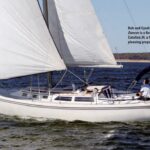
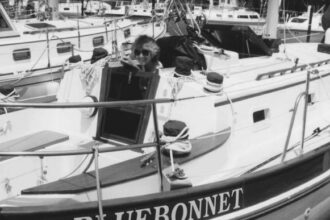
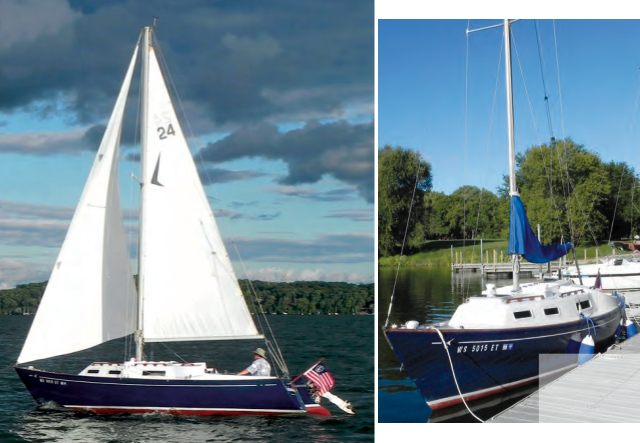
The lovely lines of the dark blue hull caught my eye one weekend while sailing on Lake Mendota near Madison, Wisconsin. I said to my wife, “That’s an interesting boat.” When I caught up with the owner, Steve Cook of Middleton, Wisconsin, I learned his boat is a Seafarer 24. On the stern of his jaunty sloop is emblazoned the name Endeavour, which is fitting because Steve Cook is, of course, Captain Cook.
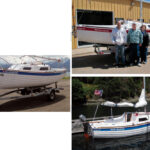
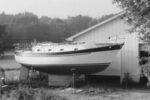
Steve does not know the exact year his boat was built, but believes it was in the early 1970s. He rescued Endeavour from a field along Lake Huron near the Mackinac Bridge, where he found her in decrepit condition, and worked on her sporadically for three years in his driveway with the help of his wife, Diann, their son and daughter, and a few friends. This involved cleaning out “a boatload of mice,” painting the interior and exterior, and repairing or replacing much of the teak, particularly the toerail. The boat had double lifelines, but Steve chose to remove them. They also restored a matching dinghy.
The Cooks have had Endeavour for 12 years now, and keep her ready for sailing on a mooring ball near Marshall Park. Their sailing outings are often dinner cruises with friends.
Design
Seafarer Yachts’ history goes back to Amsterdam, Netherlands, in the 1950s, when G. DeVries Lentsch was building boats designed by Philip L. Rhodes. One of those boats was the 33-foot Swiftsure, the U.S. distributor for which was Seafarer Yachts of Huntington, Long Island, New York, founded in 1959 by Englishman Brian Acworth. Later, production of the Swiftsure was moved to Huntington, where a number of new models, all by top naval architects, were introduced. Bill Tripp penned the Seafarer 31, Sparkman & Stephens drew a 23 and a 48, and McCurdy & Rhodes designed the Seafarer 24 and 11 other models. Seafarer made boats from 7 to 48 feet during a 20-year production life that ended in the bleak 1980s.
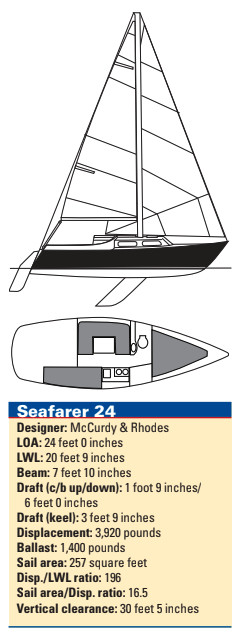
Production of the Seafarer 24 began in 1973 and ran through at least 1979, although the number of hulls built is unknown. The boats were also available as kits and with either a centerboard or a fin keel. Centerboard boats have a retractable rudder behind a short skeg while fixed-keel boats have a non-retractable rudder.
The Seafarer 24 has an attractive sweeping sheer, spoon bow, and reverse transom and was offered with two deck choices, the Classic with a low cabin trunk and the Futura with a so-called “blister” cabin trunk. The Classic, with only 4 feet 9 inches of headroom, was preferred for daysailing and racing. The Futura has a generous 5 feet 10 inches of headroom and a more spacious interior. Either keel configuration could be had with either deck arrangement.
Endeavour has the Classic deck and is the centerboard version, which has performance advantages downwind with the board retracted. With 2 feet less draft, she is better suited to trailering and gunkholing. With her 342-pound centerboard and most of the ballast in the stub keel, Endeavour is nearly as stable as the keel version, although the keel version sails to windward rather more effectively.
Construction
The hull is constructed of alternating layers of hand-laid 1.5-ounce mat and 24-ounce woven roving with a maximum thickness on centerline of 1⁄2 inch. A longitudinal “backbone” running along the keelson is intended to help resist the loads on the forestay and backstay.
The deck is a balsa-cored fiberglass laminate. The hull-to-deck joint is a box-section fiberglass girder formed by hull and deck flanges and capped with a teak toerail. A molded fiberglass interior pan incorporates the galley, berth foundations, cabin sole, and other furniture components.
On deck
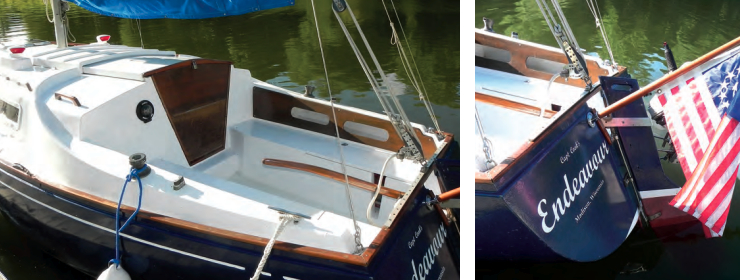
With the handsome laminated tiller swung away, the cockpit is big and roomy for entertaining. Tall coamings give comfortable back support to the long wide seats and provide room for storage cubbies. The seats are well-spaced for bracing against when heeled and are plenty comfy for napping. With a boom tent, they would be ideal for extra berths. A large fuel-tank locker is under the starboard seat and a large lined locker is under the port-side seat.
The wide companionway is offset to starboard above a low narrow bridge deck. The sidedecks are narrow and blocked by the shrouds, but teak handrails and the toerails provide some support for crew going forward. With lifelines in place, one would need to climb onto the cabintop to go forward. On Endeavour, the non-skid has worn off. Two small Dorade vents and an opening translucent hatch (an upgrade) ventilate the cabin and three fixed portlights on each side provide light.
The foredeck is wide, which makes for easy handling of sails and anchor. The anchor chain and rode pass down a cowl vent to the forepeak below, but there is no locker on deck for the anchor, so Steve keeps the anchor tucked away in a locker below. Hefty cleats and chocks round out the foredeck area.
Rig
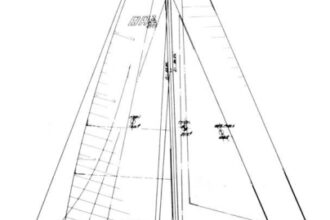
The Seafarer 24 has a masthead rig. The deck-stepped single-spreader mast is supported by 3⁄16-inch upper shrouds, single lower shrouds, and a split backstay with a tensioner. The shrouds all attach to U-bolt chainplates inboard of the toerail. The boom is set up for roller reefing but Steve doesn’t use it. Sails are the standard main and a hanked-on jib.
Accommodations
Literature shows four cabin options were offered for the Seafarer 24, but the differences are small, so I’ll forgo the details and describe only what I found on Endeavour.
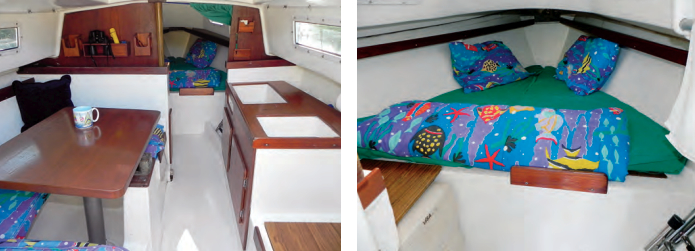
The saloon is one step down from the cockpit through the companionway, and the only standing headroom is in the open companionway hatch. Nonetheless, moving about the cabin is straightforward. To port is a large U-shaped dining area with a pedestal table that can drop down to form a berth. Storage is provided under the settees. The centerboard trunk does not intrude very far above the sole.
To starboard is a small galley with space for a sink and stove and storage beneath. Aft of it is a quarter berth and forward of it a clothes locker. I was impressed that the interior storage spaces were all nicely lined with smooth fiberglass and away from the hull to prevent moisture build-up — with drains to boot! The furniture is trimmed with solid teak and teak-laminate woodwork in abundance. Forward of the main bulkhead, which incorporates a compression post for the mast, is a V-berth with fiddled shelves outboard. There’s space for a portable toilet between the berth and bulkhead.
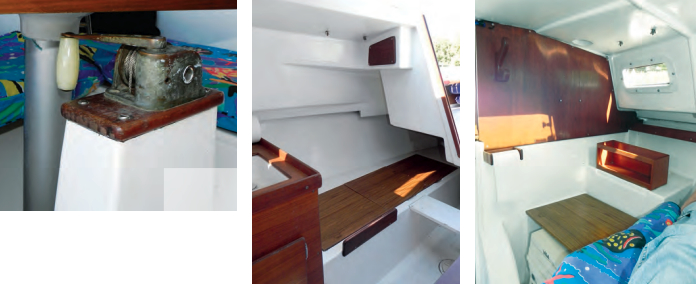
I found lounging in the dining area to be quite comfortable. The seating can accommodate several adults. The table can be removed to make access to the centerboard winch handle easier, but Steve manages to operate it with the table in place. Access to the centerboard pivot pin is easy from inside the cabin.
On boats like Endeavour that don’t have the optional inboard engine, a large area under the cockpit footwell is available for storing sails, poles, and other equipment. On the inside of the cockpit bulkhead are two large instrument boxes, which on Endeavour could be converted to storage since the only electrical devices are the running lights.
Under way
The tiller is connected to a housing that allows the rudder to retract upward for shoal-water sailing. The tradeoff is that the rudder is a loose enough fit in the housing that it vibrates a little. Weather helm was evident (to be fair, the sails are old), but the rudder would not stall and gave the helmsman control even in gusts. We could have reefed the mainsail to reduce weather helm, but did not.
The boat showed a good turn of speed with firm but not heavy feedback on the helm, and it’s heavy enough to carry nicely through a tack. It tracks well with no real change in the helm as it heels.
Lowering and raising the centerboard takes about 30 unwieldy turns of a crank atop the centerboard trunk, under the dinette table. Handling the jib sheets was a bit unwieldy, too, mounted as they are on top of the high coamings. The ancient winches did not help much either. The mainsheet is attached to the end of the boom and to a traveler across the top of the transom. I’ve never been a fan of this setup, particularly on a small boat where changes in wind pressure demand quick reaction, though the Seafarer’s hefty ballast makes this less of a problem than in other trailerable boats of this length.
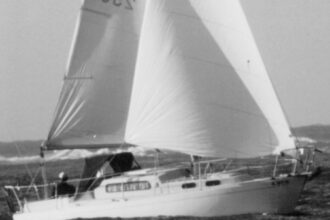
While under way, I found that, in the absence of lifelines, it was easiest to pass outside the shrouds when going forward. The large companionway sea hood makes moving on the starboard side more difficult if you need to hop on top of the cabin. A few Seafarer 24s are still racing, with PHRF numbers ranging from 243 to 252 seconds per mile, slower than a Venture 24 at 222.
Steve has a bracket-mounted 8-horsepower outboard that pushes Endeavour along smartly when the wind can’t do the job.
Conclusion
If I were sailing in deeper waters, and not launching the boat from a trailer, I would look for the fixed-keel version. Gone would be the rudder vibration and the hassle of moving the centerboard up and down, to say nothing of maintaining the centerboard. Cabin space would improve somewhat as well, and I am sure that windward performance would be excellent. Nonetheless, the Seafarer 24 swing-keel is a fine little yacht, capable of delivering pleasure on a short cruise or daysail.
Prices of most models on the used-boat market are between $2,000 and $3,000, a good value for a boat of this weight and quality — if you’re up for the time and expense of restoring and maintaining a boat approaching 40 years old.
Allen Penticoff is a freelance writer, sailor, and longtime aviator. He has trailersailed on every Great Lake and on many inland waters and has had keelboat adventures on fresh and salt water. He presently owns three sailboats.
Thank you to Sailrite Enterprises, Inc., for providing free access to back issues of Good Old Boat through intellectual property rights. Sailrite.com