A blade maker and a good old boatbuilder create the Sage 17
Issue 87 : Nov/Dec 2012
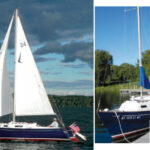
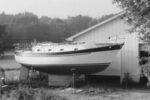
As a brand-new design, the Sage 17 doesn’t exactly fit the standard description of a good old boat. And yet, since this boat is inspired by a classic Lyle Hess design that was tooled and initially built by none other than Jerry Montgomery, it has earned the distinction of being an honorary good old boat in this magazine. Jerry Powlas and I learned of this Montgomery design when one of the first examples showed up at the 2011 Annapolis sailboat show, but the story begins years earlier.
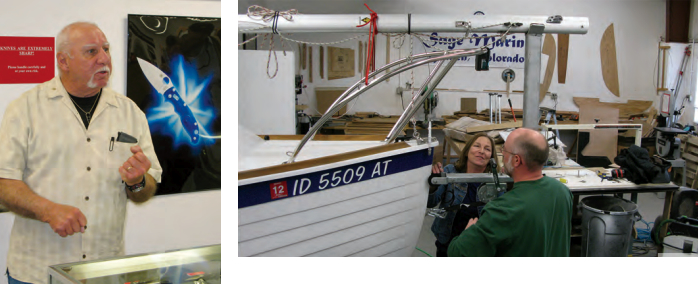
Sal and Gail Glesser built a home, raised a family and, oh by the way, built a little knife-making hobby of Sal’s into a highly successful and well-respected company called Spyderco. While doing this, they also enjoyed sailing their Moore 24 on a nearby Colorado mountain reservoir when they could, although not nearly often enough to suit them. Their growing business kept them plenty busy. It expanded from one building to another and then another until today it has a payroll of 52 people (and growing) with customers and business relationships in 54 countries (and growing) and is once more in need of a plant expansion.
“After nearly 40 years,” Sal muses, “we’re an overnight success.” A tour of the facility convinced the Good Old Boat editors of at least one thing: product quality is the highest priority at Spyderco, and that goes hand-in-hand with treating customers and employees right.
As their children grew up and son Eric began sharing the responsibility for many of the day-to-day business decisions, Sal and Gail found more time for sailing. They valued Jerry Montgomery’s opinions on boats and — because these two think big — Sal approached Jerry about designing a brand-new 16-footer. Jerry had not developed a new design in the past 15 years and much had changed. Sal explained that he and Gail were looking for a new design that, due to advances in technology and as a result of sailors’ experiences over the past few decades, could be an improvement over Jerry’s successful Montgomery 15s and 17s that have achieved cult-boat status with their strong following of passionate sailors.
The Glessers were essentially looking for the Montgomery Version 2.0. In retrospect, Jerry says, “I get asked at least once a year to design a boat and make the tooling for someone.” He notes that the projected
cost of such an enterprise usually ends the discussion. But this was not the case with Sal Glesser. The Spyderco company had grown, Sal notes, “to the point that we could take a risk on a new sideline.” He explains that because their expertise is in materials and production, rather than boatbuilding, they would have to rely on Jerry’s expertise in the sailboat industry.
And so a partnership was born. Sal and Gail cashed in a 401k and put Jerry to work. “We already have a knife company. Sal and I are not drawing a salary from the Sage end of the business,” Gail says. “In fact, we expect to lose money or break even for the next three years.”
Improving on the Montgomery
Jerry, who was already active on several small-boat forums, asked Montgomery 15 owners what improvements they would make to their boats. “They said there was no sitting room in the 15, so we added comfortable settees,” he says. To accomplish that, Jerry added 5 inches to the overall length of the cabin. He added another 5 inches to the length of the cockpit so an adult could lie down comfortably there, stretching what was originally an idea for a 16-footer to a 16-foot 10 1⁄2-inch sailboat, now known as the Sage 17. “The Sage 17 is just the right size for me. It’s on the upper end of the perfect size,” Jerry says.
“It has 6 inches less beam than the Montgomery 17,” he says. “It’s a faster and more refined hull than Lyle Hess’ original design with quarterberths. It has more deadrise so it’s a better sea boat. But the biggest performance advantage is the carbon-fiber deck, making it lighter and better.” He notes that the strength of the carbon fiber makes it possible to eliminate the compression post entirely, vastly improving the possibilities for the cabin layout below.
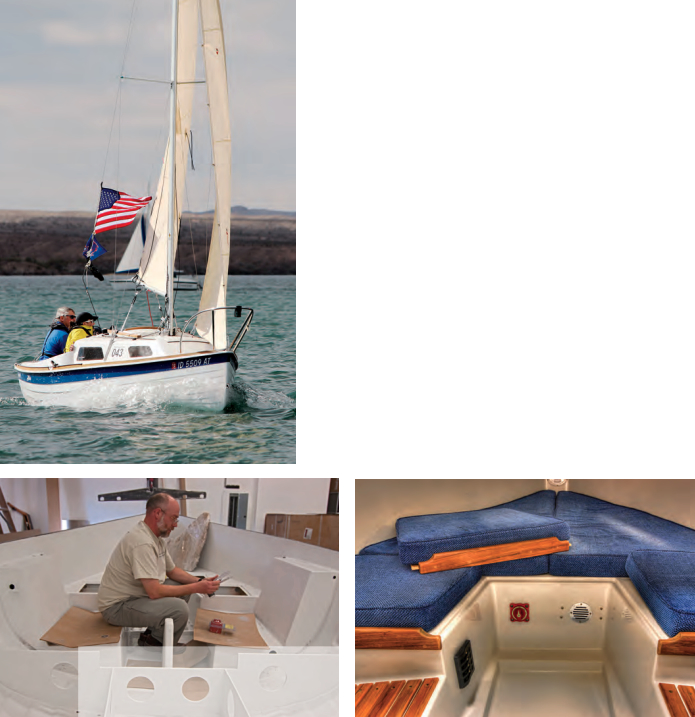
The deck of the Montgomery 15 has 1⁄2-inch balsa core and fiberglass rovings. The Sage 17 also has 1⁄2-inch balsa core, but using carbon fiber in its cabinhouse, deck, and transom saved at least 100 pounds and noticeably lowered the center of gravity. The remainder of the hull is built of fiberglass and vinylester resin. The mast and boom are standard aluminum extrusions. The Sage 17 has a 7⁄8 rig. The shallow keel contains 400 pounds of lead and the centerboard another 120 pounds. The cockpit is self-bailing through the centerboard trunk. The cabin has simple accommodations: seats for two, a full-sized V-berth, and a Porta Potti, plus storage space under the cockpit floor, seats, and V-berth.
“People email me,” Jerry says, “to ask why the Sage 17 is faster than the Montgomery 17. I tell them it’s about the weight, the rig, a more refined hull shape, and a better keel and centerboard shape.”
Industry veteran
Jerry Montgomery learned boatbuilding at Jensen Marine. He was the foreman for most of the Cal 40s that came off the line in the late 1960s. He went to work next for Richard Arthur, building the line of dinghies known then as the Arthur Dinghies. It was there that he met Larry Pardey and Lyle Hess. Lyle also designed the Balboa 20 that Richard Arthur built. Jerry’s subsequent involvement in the building of this design and its tooling wound up in a full ownership of his own Balboa 20. He later sold that boat and, with the proceeds, bought the molds for the dinghies. He renamed them Montgomery Dinghies and built at least 2,000 of the 10-foot model. In 1970, Jerry took one of the first 10-footers to One Design and Offshore Yachtsman magazine’s America’s Teacup trials and won all his races and the only perfect score for quality. “That is how I got my start,” Jerry says.
Lyle Hess also designed the Nor’Sea 27, as well as both boats built by Lin and Larry Pardey, the Bristol Channel Cutters, the Falmouth Cutters, and many other popular, and now classic, good old boats.
“Lyle took me on. He thought of me as a protégé,” Jerry says. Lyle designed the Montgomery 12, 17, and the 23 for Jerry. “All of these boats were my concepts, but at that time I didn’t have enough confidence in my ability to draw a set of lines and wisely turned my drawings over to Lyle,” Jerry says. Later, Jerry designed the Montgomery 15. In every case, he developed all the tooling and built the boats himself.
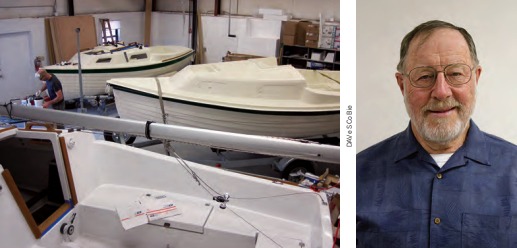
For the Sage 17, Jerry once again developed the tooling and then took Dave Scobie and Matt Thaler under his wing, teaching them the ropes. The hulls are built at a fiberglass production plant in Colorado. Dave and Matt do all the assembly with Dave (a sailor and boatbuilder) focused primarily on the rigging, sails, and electrical systems as well as sales and marketing while Matt (a highly skilled cabinetmaker) concentrates on the woodworking, fiberglass components, and fittings.
Gail is thrilled to be working with Jerry Montgomery. “How many guys can design, tool, and build a boat . . . then go out and win races with it?” She asks. “This boat comes from the heart. We are so blessed. I want other sailors to be as happy.”
Scattered to the four winds
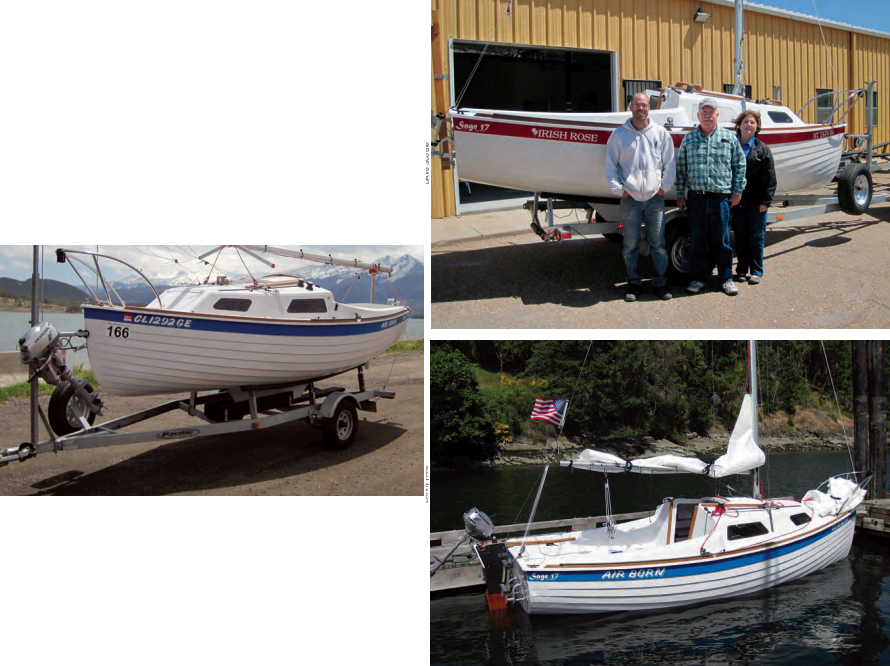
At press time, Matt and Dave had completed six hulls. The first was a prototype, named Goshawk, that belongs to Jerry. Sal and Gail’s boat, Air Born, officially hull #1, was next. Hull #2, Irish Rose, is owned by a couple who live and sail her in Montana. Alida, hull #3, was custom-built for Mary and Phil McCowin, who sailed her for the first time at the Lake Havasu Pocket Cruisers Convention (HPCC) in February 2012. The fourth boat is in Malaysia, the fifth is in New York, #6 and #7 are in the shop, #8 was bound for the Annapolis sailboat show in October, and #9 was on order.
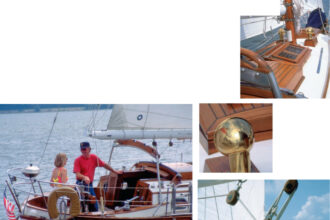
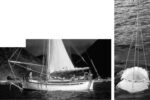
We sailed on Air Born with Dave Scobie in February while taking in the hubbub of the annual HPCC event for trailerable boats. Jerry Powlas says, “We sailed the Sage 17 in light to medium air and flat seas. The boat sailed well and exhibited no vices. Balance was good and I think the fractional rig is a good choice. I was surprised at how the introduction of a little mast bend changed the handling of the boat when the wind picked up.”
Sal and Gail say that, as well as the boats, as many of the components as possible, including sails, are built in the U.S.A. They are also proud to claim that each boat has been delivered on time, with no production delays, and no cost overruns. “There is no sweat regarding delivery dates for our new owners,” Gail says. “We meet our deadlines, do what we promise, and our boats are winning races.”
If you’re wondering about the name, Sage Marine, Sal explains. “A sage is an old and wise person,” he points out. The name felt right to Sal and Gail on a number of levels. And so a new boat design with a new name has arrived on the trailerable-boat scene. This boat earns “honorary good old status” as an updated design, one from the boards and tooling of a highly respected designer and builder.
Karen Larson is a co-founder, with her husband, Jerry Powlas, of Good Old Boat and its editor. Her passion for old boats doesn’t stop her from looking hard at new boats that will age gracefully as the current fleet ages out.
Thank you to Sailrite Enterprises, Inc., for providing free access to back issues of Good Old Boat through intellectual property rights. Sailrite.com