Comparing the Ericson Cruising 31 with two close rivals
Issue 69 : Nov/Dec 2009
First, I have to admit that I intensely dislike the appearance of trailboards on a sailing yacht with a bald (no bowsprit) clipper bow. I see no practical or aesthetic reason for them on such a boat. To me, they seem like an excess of jewelry around the lovely neck of a beautiful woman.
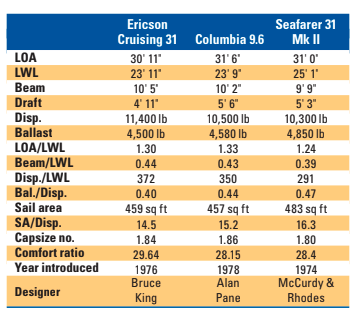
That said, the Ericson Cruising 31 appears to be a solid design with a great deal going for it as a coastal family cruiser and true bluewater voyager. I always try to avoid comparing apples to oranges and, this time, I was particularly lucky to find two very similar yachts to put up against the Ericson: the Columbia 9.6 and the Seafarer 31 Mk II. All three are husky fin-keel boats with many similarities. It is obvious that their designers intended them to be suitable for family cruising as well as for serious coastal and offshore sailing.
The Seafarer is a slightly older design and, perhaps for that reason, has a few inches less beam than the other two. She makes up for it, though, with a foot longer waterline, giving her the lowest displacement/LWL and beam/LWL ratios and, perhaps, gaining a more slippery hull as a result. With her greater sail area and higher ballast ratio, she is probably the fastest of the three around the buoys, but that is not what these boats are all about, at least in today’s sailing world.
Look carefully at the displacement ratio, ballast ratio, capsize number, and comfort ratio for each of the three craft and you will see that, while they are only moderate-sized yachts, they are also very capable bluewater cruisers. Out of curiosity, I averaged the figures for seven other 30 and 31 footers that I have reviewed for these pages and the results were rather enlightening, as well as a bit surprising. These seven boats were the Tanzer 31, Cal 31, Hunter 31, Islander 30, Newport 30, C&C 30, and Tartan 3000.
Their average displacement was 8,530 pounds with a displacement/LWL ratio of 238. The average ballast was 3,483 pounds (41 percent). The capsize number averaged 2.01. The comfort ratio was only 21.9. Obviously these seven boats would be much bouncier in a seaway, have less stability, and be much slower to right if capsized. I thought they might have considerably greater beam than our heavyweights to make up for their light displacement and ballast with form stability. To my surprise, I found that their average beam was only 10 feet 3 3/4 inches. They are not in the same league as our three huskies when it comes to stability, offshore capability, comfort, and general seaworthiness. Those seven were designed for a very different purpose.
Offshore arrangements
Having commended our three boats for their offshore capability, I looked at their accommodation plans for offshore suitability. The Columbia is the only one of the three with a keel-stepped mast and, for that reason alone, would get my nod. On the other hand, her head is tight and I cannot visualize leaning my portly body across the WC to get at the washbasin nor leaning across a hot stove to get at the cold drinks. The Ericson layout is generally workable with a good head and galley but no sign of a chart table. The Seafarer appears to have a good chart table and galley but an athwartship head that cuts off access to, or from, the forward cabin when in use.
Bear in mind that I am looking at very small-scale sketches and, of course, individual needs differ. If you are in the market for a small ocean-cruising yacht, you must judge the layout for yourself. But I will say that, given proper gear and good condition, any one of the three will take experienced skippers wherever they want to sail — in safety and comfort — and bring them home again.
Ted Brewer is a contributing editor with Good Old Boat. He is one of North America’s best-known yacht designers and has designed scores of good old boats.
Thank you to Sailrite Enterprises, Inc., for providing free access to back issues of Good Old Boat through intellectual property rights. Sailrite.com