For Richard and Beth Smith, it’s a best friend
Issue 69 : Nov/Dec 2009
The sailboats Richard and Beth Smith have owned have taught them well. Kuma, their Ericson Cruising 31, is currently in charge of their education. As an occasional liveaboard over the years, Richard learned what he really needs in life and where and how to stow it. He and Beth applied these lessons to the home they designed and built and to the lifestyle they have chosen. For the past several years, Richard has been a contributing editor with Good Old Boat, offering articles penned from his unique perspective.
Architecture and sailboats
In his professional life, Richard studied architecture, practiced architecture, and taught architecture. On the personal side, he was either planning to build a sailboat, building a sailboat, or living aboard a sailboat. These two themes have been the constants throughout Richard’s adult life. They merged in the home on Washington’s Olympic Peninsula, across Puget Sound from Seattle, where the Smiths have lived for the past 15 years.
Their 900-square-foot home is cozy and complete. It is architecturally beautiful while embodying much of the thinking that goes into the design of a sailboat’s cabin.
What Richard and Beth learned from Kuma and her sisters is the fine art of minimizing. By overlaying house plans and boat accommodation drawings, Richard is able to show that their home is not much larger than a sailboat although it, fortunately, has square corners and rectangular spaces. It is raised above the hillside so visitors first cross to the front door over a walkway much like a marina pier.
Inside, Richard and Beth have created storage spaces under seats and below hatches in the floor and stairs. They have open ventilation throughout. Cabinets do not have doors. Living spaces are open and loftlike. The dining nook reminds any sailor of a saloon table. The narrow kitchen is very much like a galley. Their bed is built in a nook much like a V-berth, except that it is not shaped in a V and their feet do not share a tight space.
Naturally, they have had to shed possessions so they can fit into a smaller home. The boats and the home have taught them the fine art of economizing: identifying what’s important and what is unnecessary baggage. Books are important; guest bedrooms, lots of furniture, stacks of dishes, and entertainment centers are not. A workshop and an artist’s studio are important; a garage is not. Being surrounded by nature and beautiful things is important; possessing those beautiful things is not. Being close to your sailboat at the nearby marina is important. Of course.
Small-boat beginnings
Richard’s passion for boats began in Michigan with a $50 Snipe he shared with a boyhood friend. They named her Pride and Joy and taught themselves to sail. College and a stint in the Navy intervened before Richard bought his next boat, a Moth. “It only holds one,” he notes, adding with a knowing smile, “It’s like sailing a potato chip.”
Life interposed a growing family, the acquisition of a master’s degree at the University of Minnesota, and the opportunity to teach architecture in Oregon. Although Oregon sounded like the other end of the world, the move was a good one. “It was a wonderful place to work. Those were the halcyon days,” Richard says. Finally established, he had time to nurture his interest in sailing. “I bought a Tombo, a Japanese sailboat rather like a Snipe. I fixed it up, but the family didn’t go for it.”
Soon thereafter, Richard discovered a book, Volume VIII of The Motorboating Series (now out of print), a compendium primarily of William Atkin’s boat plans (including sailboat plans) published by Motorboating magazine. “Atkin wrote about each boat in a lyrical way with two to three pages of drawings complete enough to build the boat. The writing could inspire you. This is how I got hooked,” Richard says.
Richard fell in love with Atkin’s 18-foot Red Onion. “I built everything according to the plans,” he says. He trailered this boat to the waters of Puget Sound. “It takes a lot of skill to sail a centerboard boat in these waters,” he notes. “It was good training.” Starting with her construction, this was perhaps the first of his boats that taught Richard Smith a few things about sailboats and life in general.
The family still didn’t take to the sailing. Richard, who had now crossed the line over to “passionate sailor,” was soon single.
A first keelboat
A Thunderbird came next and, as Richard recalls, it was “almost a ‘proper yacht’ with a keel. It was fast. For the first time, I could overtake other boats.” A new Ericson 27 followed. “But I couldn’t afford it,” Richard says.
When given a chance to teach in England, he began a long-distance commute in which he lived on a boat during the summers in the Pacific Northwest and sometimes in homes and sometimes on boats in Liverpool.
Next came a Folkboat in need of love. In retrospect, Richard says, “I kept buying star-crossed boats.” He bought this one in Scotland and shipped it home to the Pacific Northwest, but not before doing an extensive refit and learning a few more lessons from a good old boat. The two-cylinder Volvo gas engine was “a bomb waiting to go off,” he recalls.
A student in Liverpool connected Richard with the Fairey Atalanta, designed by Uffa Fox in collaboration with Fairey Aviation. Richard wrote about that boat in our May 2006 issue. The student’s father had been swept to his death from the deck of this boat by a tidal bore. The family had stored it in a garage for several years until Richard rescued and restored it. He sailed it in the area and eventually shipped it home to the Pacific Northwest. The Atalanta was a very unusual boat, designed as a lifeboat that could be dropped from an airplane to stranded air crew. The compromises its design necessitated soon began to bother Richard. “It was slow. Boats were passing me again. I still wanted a ‘proper yacht,’” he says.
A venture into steel
Richard was ready for a new lesson from a boat. “I got it into my mind to build a steel boat. I had worked in wood and fiberglass,” he says. In England once more, he built an Alan Pape 30-foot cutter design that he would name Coot. He was preparing for the great grand adventure: he hoped to sail this boat home to the Pacific Northwest, rather than sending it aboard a ship. He was the first to build this untested Pape design.
“I figured 30 feet was the smallest boat you could take anywhere and it could take anything. I learned to weld. Building a steel boat takes a lot of skills that I didn’t have. I approached it like building a wooden boat out of steel.”
It took three years to build Coot. Richard says he was a man possessed. He did not go home to the Pacific Northwest during the summers. He did not attend friends’ weddings. He worked on that boat. When she was completed, Richard sailed her in the Irish Sea and learned some truths about her handling. “She had a horrible lee helm,” he says. “It couldn’t be corrected.” Coot did not travel to the U.S. on her own bottom or on the deck of a ship. He sold her in England where she was born. He learned many lessons with that one.
In 1988, he was living aboard Coot when he met Beth, a Brit and a non-sailor. This woman, however, embraced the sailing lifestyle. He describes her first night “at his place” in the marina: “I wanted to show her the positive side of life aboard. But it was blowing 40 knots. Halyards were clanging everywhere. It was absolutely wild in the marina.”
Life in small spaces
Beth didn’t know any better and still loves the melody made by loose halyards. She adapted to life in small spaces and embraced the outdoor lifestyle. She was willing to follow her man to the ends of the earth, it seemed. That was important because Richard was soon teaching in Malaysia. They owned an Ericson 26, followed by an Ericson 29. They built their current home, the one heavily influenced by sailboat interiors, while living aboard the 29.
While they were completing the house, Richard received an offer to teach in Hong Kong. They hurriedly finished the house so they could rent it out during their two-year absence. There was just one more piece of unfinished business: buying a proper yacht that would be waiting for them while they were gone. “We had to get to Hong Kong. We were running out of time. But I had to have a good boat to come back to,” Richard says. A sympathetic broker understood the dilemma.
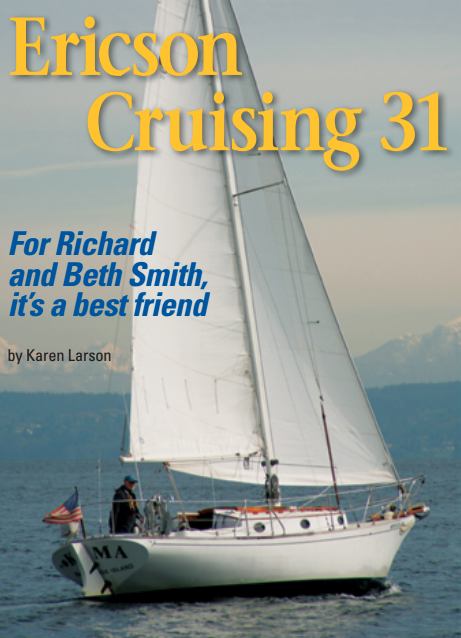
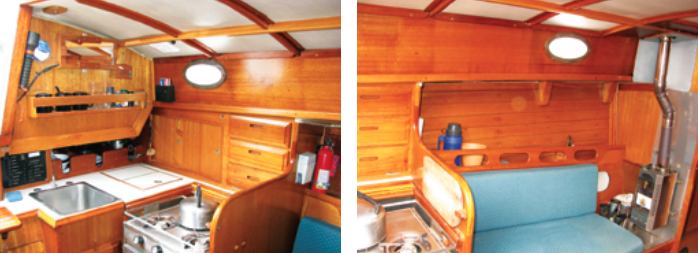
Time was so short that the broker delivered the boat to her slip for them. They had already left. Her name would be Kuma, the word for bear in Japanese. She was an Ericson Cruising 31, designed by Bruce King.
In her charming British lilt, Beth says of this choice in boats, “Richard, being an architect, wanted something a little bit different. It had to be visual. It is, perhaps, a bit eclectic.”
“And,” Richard adds, “It had to be available within a certain price range. We could have sailed her right then, if we’d been in the area, but there were systems that needed to be upgraded and some equipment that needed to be removed.”
A refit via fax
The Smiths liked her looks. The sale was made. They were on their way. Then, while they were gone, some of the modifications were made on their behalf with communications moving halfway around the world by fax.
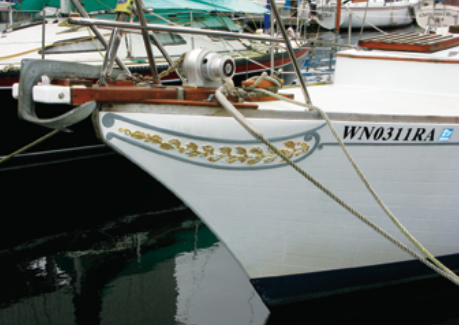
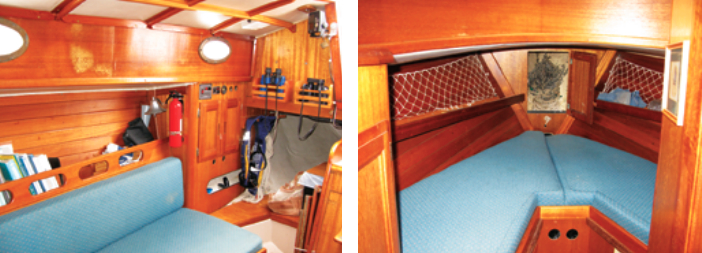
“We had an anchor sprit added and the boat was rewired.” Richard says. “We also revised the propane-tank storage so we could turn off bottle valves from the galley. We added a bridge deck of sorts with bucket storage below. I had a new main built.
“The basic idea in sailing this boat is simplicity. The more systems and equipment I can understand myself, the better.” Richard later removed the rusty water heater and replaced the pressure water function with a foot pump. He replaced the Webasto diesel heater with a wood stove. He removed the boom vang. He and Beth sail with the simplest of navigation instruments, preferring to keep their lookout and do all their chart plotting on paper in the cockpit using basic techniques.
“I don’t fear instruments,” Richard says. “But I have strong feelings about what’s appropriate aboard. It is true that, since I haven’t mastered the electronics manuals, I don’t want to have my face in the instrument — pushing buttons and twisting knobs — when I should be looking around sailing.”
The number of instruments aboard is not the only aspect that Richard and Beth have simplified. They removed the quarter-berth cushion and turned that space into a stowage area. “Berths were expendable,” Richard says. “We had six berths for two people.” One year, they removed the dodger and realized they liked sailing better without one.
Making the right choices
“What’s really important,” he adds, “is getting your boat right for how you sail, who you’re going to be sailing with, and where you will be sailing most of the time.” Perhaps that was the chief lesson learned. After several false starts, Richard has at last acquired his “proper yacht” and the first mate with whom to sail it.
“It’s good for crossing the straits (Juan de Fuca and Georgia, near Seattle). And the underbody is slippery,” he says. “The keel design is more modern than you’d expect with her traditional lines. She’s a fast and reasonably close-winded boat.”
Beth adds simply, “While you’re rowing around her, you’re apt to say, ‘That’s a lovely boat.’”
Their proper yacht came with one more advantage they hadn’t expected: an active owners’ group led by Glyn Judson. Glyn has found all but two of the 69 Ericson 31s. Just to confuse things, they are numbered through 70 because there was no hull number 13.
On his website, Glyn quotes Bruce King’s son, Marty, who says the 31 design was inspired by the Ericson Cruising 36: “Ericson wanted a smaller version of the Cruising 36.” Glyn notes that this Bruce King design was built primarily by Ericson Yachts. Squadron Yachts bought the molds from Ericson and laid up four more hulls.
The first two hulls were completed, and are known as Liberty 31s. The last two were never completed, and languished for years until they were purchased by George Kramer of Waukegan, Illinois. George died in 2002, before completing work on the first of these. The second had an inspired end just prior to being cut up and sent to a landfill. Glyn flew to Illinois and, with permission, sawed off six feet of the bow and the chunk of the transom containing the final hull number. He took these pieces home to California.
Evolving to the Independence
The boats built by Ericson underwent an evolution from a Mark I to a Mark II version, during which its name changed from the Cruising 31 to the Independence 31.
Before creating the Mark II version, the company surveyed the owners of Cruising 31s, asking them what they would like to see in a new boat, and incorporated a number of their suggestions in the Independence 31. Most of the first 25 boats (the Cruising 31) were sloops. A cutter rig was introduced toward the end of that batch and became standard with the Independence, although, just to keep it complicated for those of us looking for simple identifying features, eight of these were built as sloops at the request of their original owners.
Other changes at the Mark II stage involved cabin layout and amenities, cockpit lockers, and portlights. The complete evolution of the Ericson 31 (so far as it is known) is available at Glyn’s Ericson 31 website.
“Glyn is the first person to talk to if you want to buy or sell one of these boats,” Richard says. “He is the guru for these boatowners. He has visited 45 of the hulls he’s located, even one that’s in Ireland.”
Richard continues: “Glyn’s database of owners works as a forum for anyone wanting to modify one of these boats. He publishes “Tiny Tips,” which are very helpful in all manner of ways for the Ericson Cruising and Independence fleets. These cover such items as installing spice racks, lee cloths, better milk storage, and freeing up stubborn holding-tank deck fills. I’ve consulted Glyn about bilge pumps, best rpm settings, propeller sizing, and other project work.”
Cruising on Kuma
These days, Richard and Beth spend approximately three or four weeks cruising each year. Richard goes out alone for shorter sails when Beth is working. She’s an artist with a greeting card business, art shows, classes to teach, and an active website .
When sailing, Beth keeps a sketch-book nearby. “I sketch all the time,” she says. “It’s sort of a log of our sailing.” Kuma has become the place they go to for relaxation. If the wind is howling, they stay put whenever possible, preferring to enjoy the world around them in a quiet anchorage than to head home with a reef or two tucked in and clothed head to foot in foul weather gear.
“Throughout my life,” Richard says, “boats have been very important. Like a dog, a boat can be your best friend.” He pauses and then takes this one step further. “You may lose your friends. No matter where you live, what your work, or who your crew may be, a sailboat will provide the steady keel beneath you.”
Karen Larson and her husband, Jerry Powlas, the founders of Good Old Boat, have been sailing their C&C 30 on Lake Superior for nearly 20 years. They also have a C&C Mega 30 project boat in the backyard. With it they are learning some important DIY truths and don’t welcome questions about how soon it will be ready.
Thank you to Sailrite Enterprises, Inc., for providing free access to back issues of Good Old Boat through intellectual property rights. Sailrite.com