Generating electricity via the prop shaft
Issue 108: May/June 2016
When we are anchored for any period of time, our solar panels and wind generator pretty much keep up with our power needs. On a passage, however, our requirements are higher. The additional electronics — autopilot, navigation instruments, AIS, radar, and so on — all require power. We usually have to run the engine an hour or two each day to keep the batteries charged. We dislike doing this for a number of reasons.
On a long passage, the amount of fuel required just to charge the batteries starts adding up. If we are on a significant heel, we have to alter course or reduce sail before and after running the engine. Using the engine at low rpm and with a light load is hard on the engine. In addition, it’s annoying to disrupt that perfect broad reach on a warm, starry night by having to crank on the engine.
Several of our cruising friends have had success with propeller-shaft generators. In fact, our friend Eric on Fiona has sailed more than 300,000 nautical miles with his prop-shaft generator and has nothing but praise for it. If we could generate another 2 or 3 amps continuously while we were sailing, we probably wouldn’t have to run the engine at all. Adding one to Nine of Cups had been on our to-do list for several years, and when we were in Durban, South Africa, a year ago, I decided to take on the project.
What does a prop-shaft generator do? We have a fixed-blade prop. When we’re sailing, the water moving against the prop causes the prop shaft to rotate. (We actually have a shaft brake to prevent the prop shaft from rotating when the engine is off, but it can be disabled.) By adding a pulley to the shaft, mounting a generator or alternator next to it, and connecting the two with a belt, we should be able to use the rotation of the shaft to generate power as we sail.
That’s the theory, anyway. The rest is just details.
Generator types
One of the more important details is which generator to use. Three types of generators or alternators can be used for this application and each has its own advantages and disadvantages.
Brush-type DC motor – The most basic DC motor, which has been around since the late 1800s, has a rotating coil mounted inside several permanent magnets attached to the outer housing. When connected to a battery, a 12-volt brush-type DC motor will spin. Conversely, spinning the rotor of a brush-type DC motor causes it to produce a DC voltage. If the motor is big enough and it spins fast enough, it can charge a battery.
The advantages are that it is inexpensive and simple to implement electrically. It has several disadvantages, however. Since it has brushes that conduct a large current, the maintenance requirements are higher; it generates electromagnetic interference (EMI), which may be a problem with an HF radio; the maximum allowable rpm for this type of motor varies widely, but is typically 1,500 to 6,000 rpm; and it is more difficult to keep cool.
Brushless DC motor – This type is the reverse of a brush-type DC motor: the permanent magnets are attached to the rotor and windings are attached to the housing. Since the windings don’t rotate, the need for brushes is eliminated. The advantages of a brushless DC motor are that it requires less maintenance than a DC motor with brushes, generates little or no EMI, and is more efficient. The disadvantages are that it is more expensive, it generates a 3-phase AC output that requires a diode bridge to convert it to DC, and the maximum allowable rpm is usually 3,000 to 6,000 rpm.
Alternator – A typical automotive or marine alternator is also a candidate for a prop-shaft generator. It overcomes some of the issues of a DC motor. Since it’s meant to be coupled directly to an engine pulley, the maximum allowable speed is typically greater than 10,000 rpm. The output is easily regulated by varying the field current, it is very efficient, and it is self-cooling. Also, it’s made by the millions, so the cost is relatively low.
Alternators have a couple of disadvantages as well. Since they are meant to run at high rpm, unless the windings are rewound with finer wire, the output at low rpm is quite small. The biggest disadvantage, however, is that an alternator requires a typical field current of 3 to 5 amps. When an alternator is connected to an engine, it spins at thousands of rpm and the field current is negligible compared to the total output. When the boat is sailing, however, and the total output is only a few amps, the field current becomes significant. In fact, at lower boat speeds the field current will be higher than the amperage produced by the alternator.
To keep things simple, unless I’m referring specifically to one of these devices, I will use the generic term “generator” to refer to any of the three types of alternators/generators.
Prop-shaft speed
When Nine of Cups is sailing, the prop-shaft rpm ranges from zero at 3 knots to around 200 on those rare occasions when she is doing 8 knots through the water. When we’re motoring, taking the reduction ratio of the transmission into account, the shaft rotates at between 400 and 1,400 rpm. The generator speed will be some multiple of the shaft speed, depending on the ratio of the two pulleys (one on the generator and one on the shaft). Ideally, I wanted the generator to produce at least a few amps at the low rpm of the shaft while sailing, yet be able to withstand the much higher rpm while motoring.
Pulley sizes
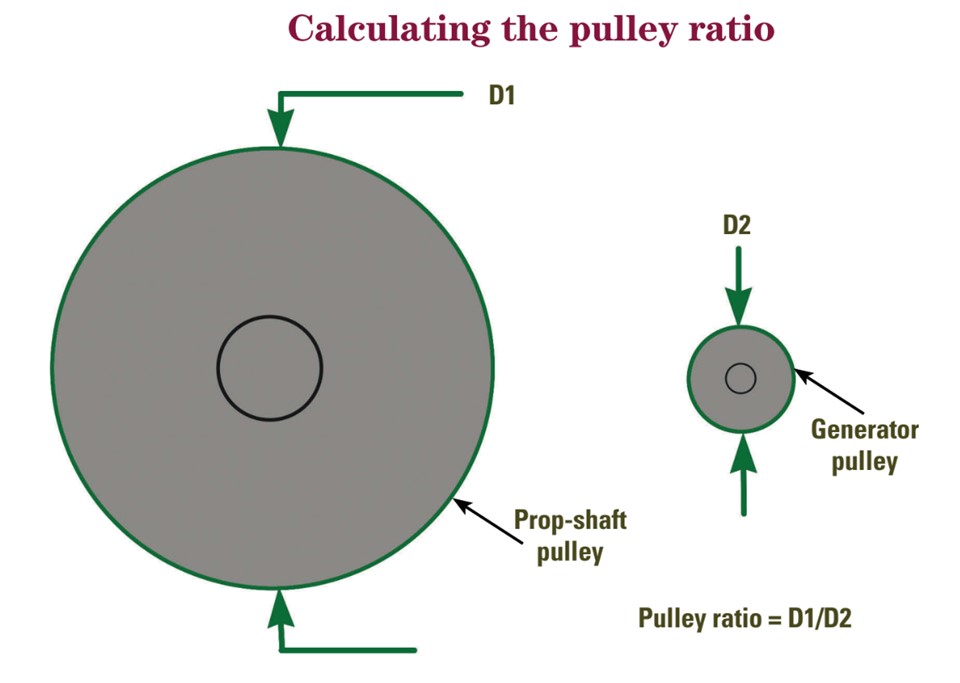
The faster the generator spins, the more current it will generate. The ratio of the two pulley sizes determines how fast the generator will spin, which in turn determines how much current will be generated. To generate the maximum current, we want a large pulley on the shaft and a small pulley on the generator. On the other hand, when the engine is cranked on and we are motoring, the shaft will turn much faster than when we are sailing, potentially destroying the generator if it spins too fast.
To determine the largest pulley ratio that could be used, I divided the maximum allowable speed of the generator by the maximum prop-shaft speed. Nine of Cups has a maximum shaft speed of 1,400 rpm. If I chose an alternator with a maximum speed of 10,000 rpm, the largest shaft pulley I could safely use would have a diameter of 10,000/1,400, or 7.1 times the diameter of the alternator pulley.
Electrical considerations
Each of the three different types of generator has different electrical requirements. The necessary electrical connections, how the generator’s output is controlled and/or rectified, and how the output is handled when motoring differ between the three.
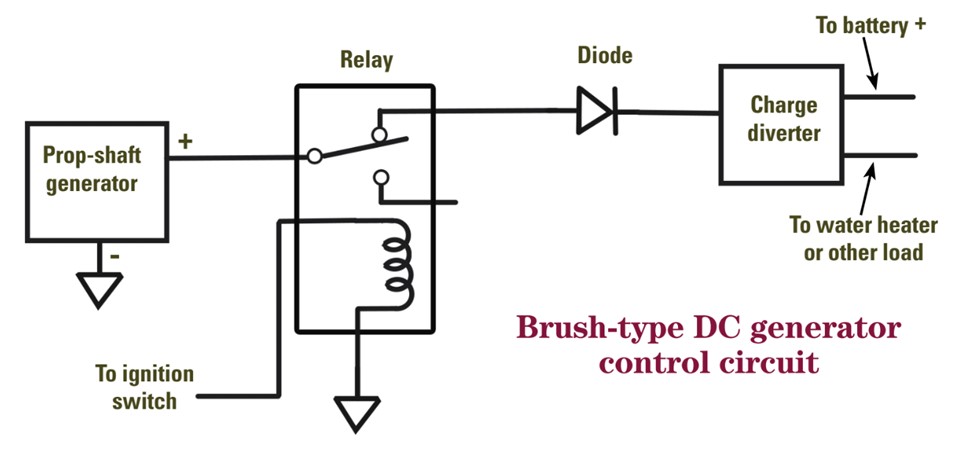
Brush-type DC motor – From an electrical point of view, the brush-type DC motor is the easiest of the three types. In the simplest implementation, the output is connected directly to a battery and when the generator shaft is turned, the battery gets charged. It’s a little more complicated than this, but not much.
First, there must be a diode in the circuit between the battery and the generator. Otherwise, when the prop shaft is not turning, the generator would become a battery-powered motor, and the generator would try to turn the prop shaft rather than the other way around. Also, if the batteries are charged, the generator output current must be disconnected from the batteries to prevent them from being overcharged. One way to do this is with a regulator that diverts the current into a dummy load when the batteries reach their charged state. Many companies that sell wind generators and solar panels also provide these charge controllers. On Nine of Cups, we use the water heater as the dummy load.
Finally, when motoring, the output should be disconnected, allowing the generator to spin freely with no load. The diagram at the top of the facing page shows a typical electrical circuit for this type of generator. The output first passes through the contacts of a relay that is controlled by the engine ignition switch. When the engine is switched on, the relay opens the circuit, disconnecting the output of the generator.
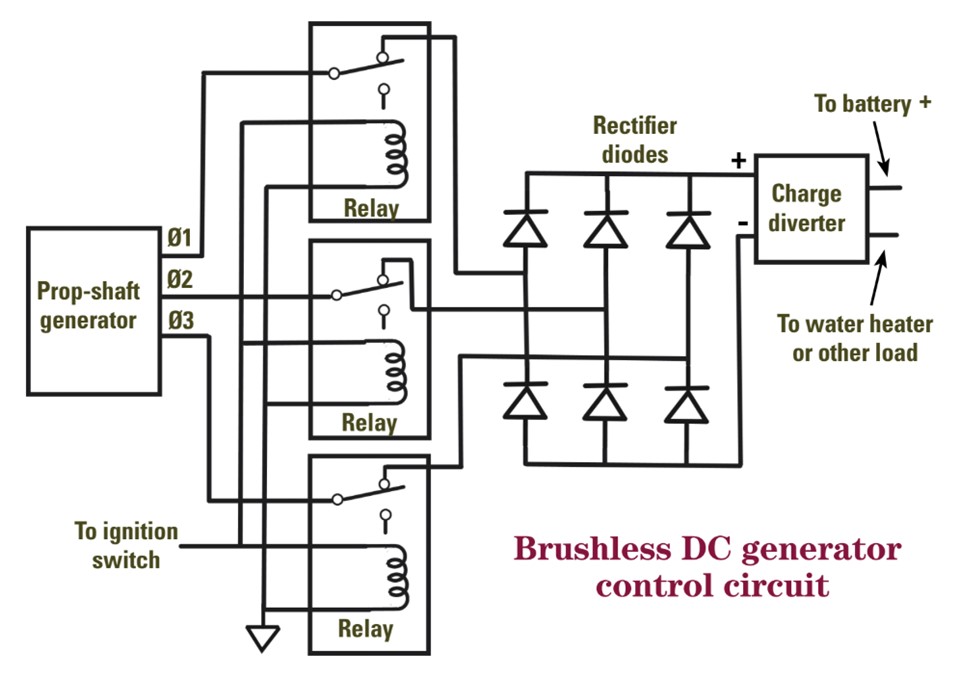
Brushless DC generator – The output of the brushless DC generator is somewhat more complicated. Its output is a three-phase AC voltage, which must be converted to DC in order to charge the batteries. This requires six rectifier diodes connected as shown in the middle diagram on the facing page. An additional complication is that when this type of generator is open-circuited, the output voltage can reach 100 volts or more. To protect the diodes, three relays are needed, one for each phase of the output. As with the brush-type motor, these relays are controlled by the ignition switch.
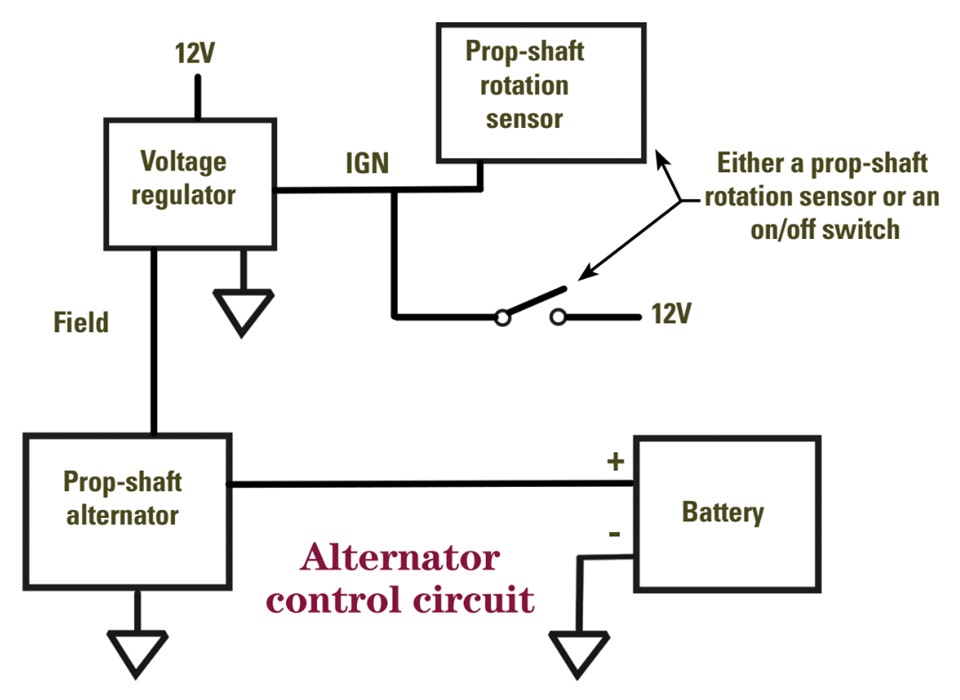
Alternator – The output of an alternator depends on the rpm and field current. A standard automotive or marine voltage regulator would work fine except that the field current would exceed the output of the alternator at low speeds, and sailing at anything less than 3 to 4 knots would put a drain on the battery. A simple switch would do the trick as long as it’s turned off whenever the boat’s speed is below 4 knots and turned back on when the speed increases. A better solution would be a circuit that sensed the alternator speed and turned the regulator on or off accordingly. The diagram at the bottom of this page illustrates a possible circuit for an alternator-based prop-shaft generator.
Installation mechanicals
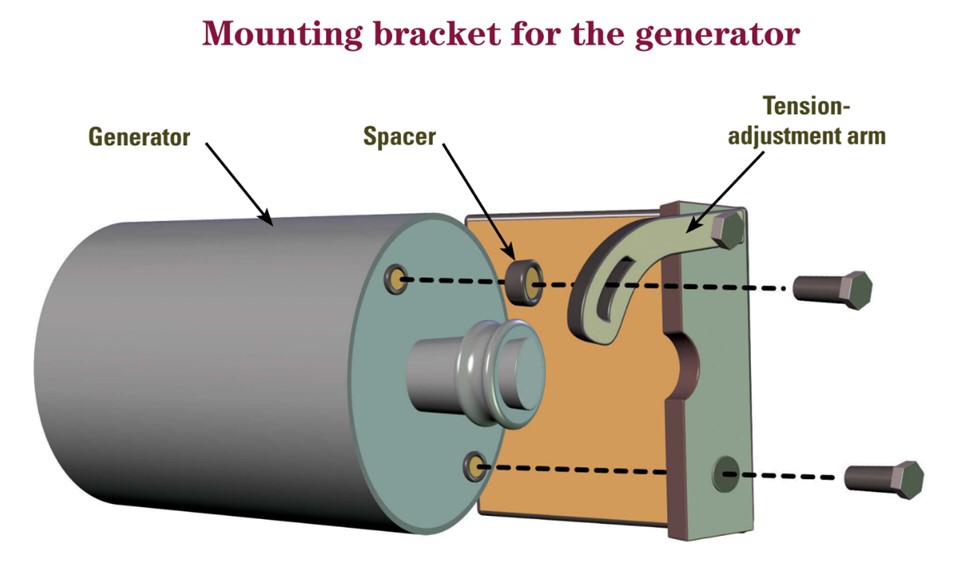
Just like the alternator on an engine, the mounting bracket should allow the generator to be rotated — toward the shaft so the belt can be installed or removed and away from it for tensioning. I made some sketches and worked with a local machinist to fabricate the bracket.
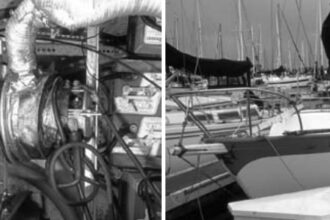
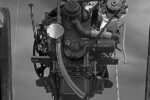
The prop shaft must be disconnected from the transmission in order to slide the pulley and belt in place. I was able to accomplish this while Nine of Cups was in the water, but some boats might need to be out of the water. Since it is difficult to replace a worn or broken belt, I slid a spare belt over the shaft while it was disconnected. I suspended the spare over the shaft from a cup hook until it’s needed. The spare belt is visible in the photos of the installed generators.
Decision and implementation
So which type of generator did I choose? On my first attempt, I used the brush-type DC generator that was a spare for our wind generator. It had a maximum speed of 5,200 rpm, and I selected a pulley ratio that ensured I would be operating within its range. On our passage along the South African coast from Durban to East London, it performed quite well, generating a consistent 2 to 4 amps throughout. As we motored the last few hours into the harbor, however, I smelled the odor of melting insulation. I discovered that the generator had overheated and I removed the drive belt. Based on our engine speed, we had been running it at around 3,000 rpm, well below the specified maximum speed. Apparently, it wasn’t happy running at that speed continuously.
On my second attempt, I found a generator that was a hybrid of sorts. WindBlue Power, a company in the U.S. that makes components for wind turbines, buys standard automotive alternators and morphs them into brushless DC motors. They rewind the windings with finer wire so the output is higher at low rpm; they replace the field coil with a permanent magnet, eliminating the need for the 3 to 5 amps of field current; and they remove the internal rectifying diodes. The resulting generator overcomes most of the shortcomings of a standard brushless DC motor for this application. I modified the mounting bracket to fit the new generator and built a rectifier circuit (see “Brushless DC generator control circuit” diagram). The new generator had a maximum speed of 10,000 rpm, much higher than the brush-type DC motor. Unfortunately, I wasn’t able to find a larger diameter pulley to replace the existing one while in Cape Town.
Conclusions
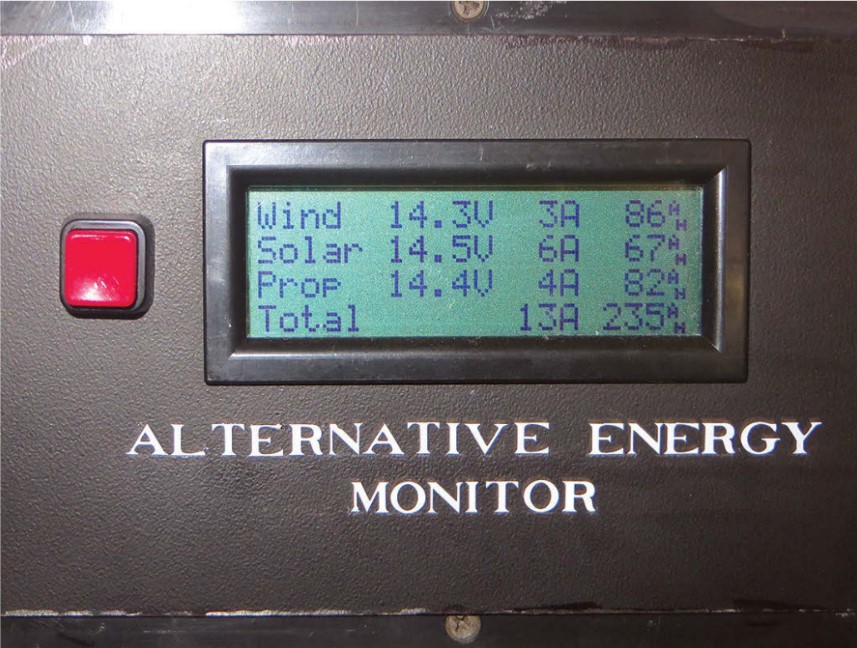
I completed the project in Cape Town and it was in use during our Atlantic crossing. Our alternative energy monitor kept track of the amps being generated and the total amp-hours generated over the previous 24 hours. At 3.8 knots through the water, the generator had an output of 1 amp, which increased to 8 amps at 7 knots. On a typical day’s run of 125 nautical miles, it produced about 80 amp-hours. Except on those calm days when we averaged less than 4 knots, we did not have to start the engine. The output would have been 50 to 75 percent greater had I been able to install a larger prop-shaft pulley.
A side effect is that both the spinning prop shaft and the generator produce noise when we are sailing. After a few hours, however, the hum of the prop shaft and the whine of the generator soon became part of all the other background sounds — creaks, groans, squeaks, chirps — as Cups sailed along, noticeable only when something changed. So far, that has been the only negative, and I regret not doing the project years ago.
Another option would be to disconnect the generator from the shaft when motoring. A much larger pulley ratio could then be used and a higher output could be achieved. One way to do this would be to remove the drive belt whenever we started motoring and replace it when we resumed sailing. This was not a reasonable option for me. I would likely forget to remove the belt as we started motoring into harbor or not have time to remove it if I needed to start the engine in an emergency.
Another method of disconnecting the generator would be to fit it with some sort of clutch. Several types of clutches — centrifugal, hydraulic, and electric — might work for this application and would be worth researching.
Is it for you?
Nine of Cups is a 45-foot, heavy-displacement boat with a 23-inch fixed-blade prop. Once she gets going, the prop shaft has a lot of torque, more than enough to drive a much bigger generator. A smaller boat, or a boat with a smaller prop, will produce less torque, and may not be able to drive a generator. If in doubt, get the advice of a marine engineer.
A note of caution
Some hydraulic transmissions may be damaged if allowed to turn for extended periods of time when the engine is not running. Nine of Cups has a BorgWarner Velvet Drive transmission, as does Eric Forsyth’s Fiona. We now have more than 6,000 nautical miles on our shaft generator, which pales in comparison to Eric’s 300,000-plus nautical miles on his. While neither of us has had any sign of problems with our hydraulic transmissions, I have not researched other types and models of hydraulic transmissions. If your boat has a hydraulic transmission, it would be prudent to investigate whether your particular transmission can be allowed to freewheel before making the decision to add a prop-shaft generator.
David Lynn and his wife, Marcie, have lived aboard Nine of Cups, their Liberty 458 cutter, since 2000 when they sold up and sailed off. Since that time, they’ve put over 85,000 nautical miles under the keel and visited 36 countries on five continents. Their philosophy of “just a little further” has taken them from the Caribbean, twice across the Atlantic, around the five Great Southern Capes, and across the Pacific and Indian Oceans with lots of stops to explore along the way. They completed their first circumnavigation at Cape Town in 2015 and Nine of Cups is currently in the Caribbean en route from Africa back to the USA. David and Marcie blog daily at www.justalittlefurther.com and maintain an extensive website at www.nineofcups.com.
Thank you to Sailrite Enterprises, Inc., for providing free access to back issues of Good Old Boat through intellectual property rights. Sailrite.com