A fine example of Morgan Yachts’ debut design
Issue 91 : Jul/Aug 2013
In July 2011, Dave Pickard of Davis Island Yacht Club in Tampa, Florida, was walking out of the locker room having just won another race in the Thursday night series sailing his Morgan 24. On the club bulletin board was a poster of a boat for sale, Emerald Pelican, a Morgan 34. She was located in Punta Gorda, about an hour’s drive south of Tampa. She captured his eye.
Dave, a lifelong sailor, grew up sailing prams in Pensacola, Florida, and graduated to racing Lido 14s in Texas as a teenager. Thus began his lifelong attraction to boats with centerboards, an interest that would prove practical as he has continued to live along the coast of the Gulf of Mexico. There, the locals say, “We have lots of water, but it’s very thin.” Still, the shallow water offers lots of gunkholing opportunities for sailors in shoal-draft boats.
After settling in the Tampa area as an engineer for the city water company and becoming a family man, Dave wanted a boat larger than a dinghy. His search led him first to an Irwin 27 and subsequently an Irwin 28. His wife and young sons were regular crew on weekend cruises in the Tampa Bay area. Both of the Irwins, built in nearby Clearwater, had centerboards, which gave them full access to the shoal waters of the bay.
Dave acquired his first Morgan, the 24-footer, when the boys grew up and had less time to sail. Her name, O’Tay Too, was a reflection of the way Buckwheat, a character in The Little Rascals pronounced OK.
Dave started racing on a regular basis at Davis Island Yacht Club. “She was the ideal boat for around-the-buoys racing,” he says. “She was light, responsive, and quick in a wide range of conditions. Her centerboard could be adjusted for perfect balance. The centerboard is an advantage for cruising in shallow water and for trimming for speed when racing.”
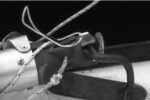
Of the associated maintenance issues Dave says, “An occasional broken centerboard cable is par for the course. Once you learn to deal with them, it’s not a big problem to replace centerboard cables on most boats.” The last time it broke, he replaced the stainless-steel cable on his Morgan 24 with Dyneema SK75 single-braid line.
With new sails by local sailmaker Banks Tampa, Dave began winning trophies on a regular basis. Like most sailors, Dave had a yearning for a larger boat and the Morgan 34 posted on the bulletin board came along at just the right time. His wife wanted to do more cruising, so they took the drive to Punta Gorda “just to take a look.” Dave had called the owner, John Mathews, and arranged to see the boat. Emerald Pelican was sitting at the dock in fine shape. It was love at first sight.
A good steward
John Mathews is, by trade, a finish carpenter who regularly works on the restoration and renovation of architecturally significant houses in Southwest Florida. By definition, he is a detail-oriented professional with hands-on experience. In 2000, he had been searching for a keel/centerboard boat in the mid-30-foot range. Punta Gorda is situated at the upper end of Charlotte Harbor, a wonderful cruising ground enclosed by more than 60 miles of shoreline. He purchased the Morgan 34 in the spring of that year and began working on it whenever he could. He and his wife sailed the boat for 10 years before deciding it was time to switch to a powerboat.
Prior to John’s renovation, the boat had been modified somewhat from original. She had been re-rigged at a local yard in the mid-1990s. Her keel-stepped mast had been cut at deck level and the lower portion permanently positioned to serve as a compression post. The upper portion is now stepped on a custom-made plate that allows easier removal of the mast (and subsequent re-stepping) when the boat is taken out of the water for storage.
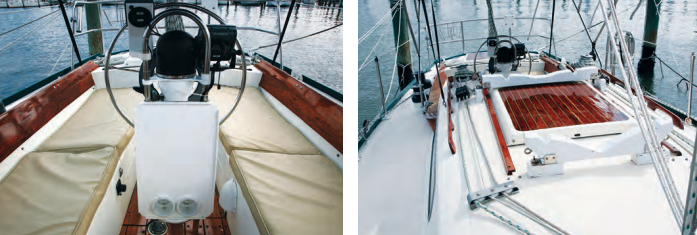
After purchasing her, John replaced her running rigging and fitted new blocks on deck to lead all the lines to the cockpit. He replaced the original Atomic 4 gasoline engine with a 26-horsepower Universal diesel engine. Then he tackled the interior.
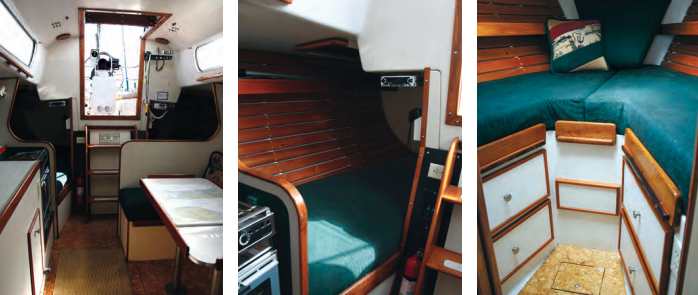
Like other production sailboats of the 1960s, the Morgan 34 was finished in Formica with a wood-grain pattern and jazzy plaid cushions. John sanded the dark Formica and painted it white. He finished much of the hull interior by installing teak ceiling battens, fitted all new cushions covered in a rich hunter green fabric, and replaced all the countertops with Corian.
The teak-and-holly-veneer cabin sole was badly damaged and worn. John covered it with natural cork flooring material that provides excellent footing and dampens sound. Topside, the teak toerails were in poor condition. John filled the holes and dents and painted them dark green to cut back on the need for maintenance. The total refit took about a year and a half and cost somewhere north of $10,000.
A new love
Dave did not just fall in love with Emerald Pelican, he bought her and took her home to Tampa Bay. He was as much taken by the quality of the work John had put into the boat as he was by the boat itself. This summer Dave is starting his third year of sailing on his Morgan 34, renamed O’Tay Too.
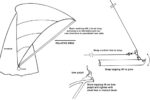
Dave has upgraded the navigation equipment aboard O’Tay Too with a new Garmin GPS. He added a whisker pole and associated rigging for racing in the non-spinnaker, or cruising, class. He went back to his favorite sailmaker for a new 150-percent genoa. Loft owner Dennis Vallenga has built hundreds of sails over the years for Morgan yachts. He says the Morgan 24, 27, and 30 were all very successful race-boats but notes that the person steering the boat makes the most difference and that Dave is one of the best.
Dave’s sons are the backbone of his racing crew. Brian and Dave sail regularly with their father. Occasionally, his other son, Mike, comes along. Not a racer, Mike says, “My dad is so competitive. I’m much more laid back, enjoy relaxing, and would rather go fishing.”
Over the last year or so, Dave has limited the amount of racing he does. He enjoys daysailing in Tampa Bay, but he did win first overall in his section of the 2012 Morgan Invasion. “It was a memorable day of racing. The 10 a.m. start off John’s Pass was in moderate wind. The wind died around noon and we all drifted around until the sea breeze kicked in at a solid 17 knots with a 180-degree wind shift. We had a bit of everything.” This was the frosting on the cake as Dave had chalked up first in class in 2011 with the Morgan 24. He had high hopes for the 2013 Morgan Invasion in May.
A sailing titan
Charley Morgan attends the Morgan Invasion every year. Much has been written about his illustrious career as a sailmaker, yacht designer, boatbuilder, racer, and raconteur — he is one of sailing’s titans. Dan Spurr wrote a profile of him in the March 2005 issue of Good Old Boat. In case you missed that, a brief review of Charley’s career is in order.
Charley started his sail loft in St. Petersburg, Florida, in 1951 and later became interested in the design of sailboats. After some initial success in local races with a homemade plywood yawl, Brisote, he drew up a 40-foot keel/centerboard sloop to be built of fiberglass. Paper Tiger, designed to exploit the Cruising Club of America (CCA) rule, was an instant success, winning overall honors in the Southern Ocean Racing Conference (SORC) in 1961 and ’62.
In 1962, Charley enlisted the help of longtime friend Bruce Bidwell to establish a company to produce his own boats. After doing a financial analysis of labor and material components, they shelved their initial plans of building a line of small boats. “So we opened it up to a 34-footer,” Charley says, “and built a lot of those.”
The 34 appeared to be a smaller version of Paper Tiger with a beamy, shoal-draft hull and a high-aspect-ratio centerboard. Her base price was $14,950. Based on the success of the 34, Morgan Yachts grew quickly within a new market for fiberglass sailboats, ultimately producing hundreds of boats ranging from 22 to 54 feet.
Good looks and performance
The groundbreaking Morgan 34 design was to be the first of the huge range of Morgan-built boats that followed. Dave’s O’Tay Too was built in 1967 and carries hull number 134.
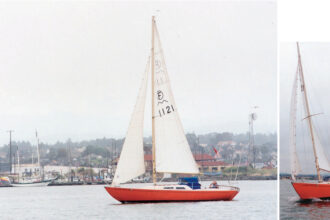
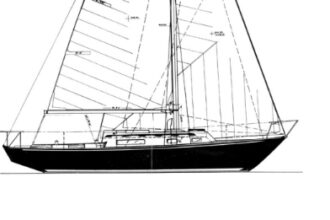
The first time I saw her, she was in her slip at Davis Island Yacht Club. She possesses that somehow wholesome sense of proportion common among boats built to the CCA rule. A distinguishing feature on the Morgan 34 is the slight break in the line of her cabin trunk, as if in homage to a raised pilothouse. The look is reinforced by the careful placement of a large fixed portlight aft in the cabin side and three smaller opening ports forward.
By today’s standards, her cabin trunk is narrow for her beam, resulting in wide sidedecks that allow easy movement from the cockpit to the foredeck. Later, while photographing O’Tay Too, I was able to appreciate more fully the sleek proportions of her hull.
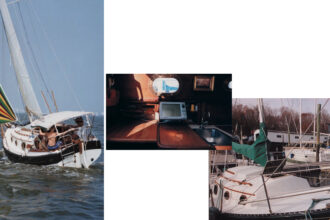
Belowdecks, I was struck by the simplicity of her standard layout and how well the light-colored surface finishes and hunter green cushions set it off. The varnished ceiling battens gleamed. She looked as if she had been designed by Herreshoff himself. John Mathews’ expertise was quite evident.
Dave is very pleased with how the Morgan 34 performs.
“She points well with the centerboard down. She is very fast reaching and goes best downwind with the board up, the whisker pole rigged, and some crew weight forward. When the sails are trimmed properly on any point of sail, she is so well-balanced she can be steered with one finger. The boat is structurally strong, a pleasure to sail, comfortable for cruising with two to four persons, and she sails faster than many cruising boats,” says Dave. Not a bad assessment for a good old boat built almost 50 years ago.
A couple of concerns are worth noting, according to Dave. The cable on the centerboard winch reel can snarl if not watched while raising the board up all the way, and backing up is difficult because of prop walk. “I haven’t figured that one out yet,” he says. “And I’m still not sure I like a wheel as much as the tiller on my old 24.”
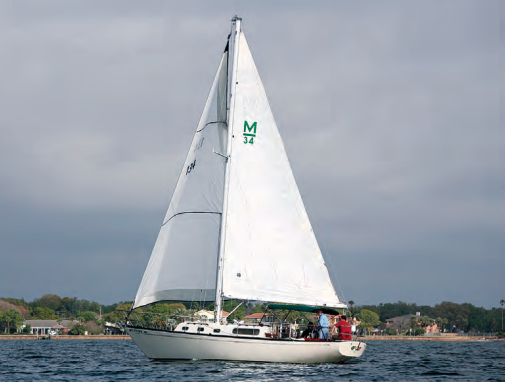
The morning we met at Davis Island Yacht Club was cloudy and cool with a nice breeze blowing up Tampa Bay. Dave was joined on O’Tay Too by son Brian and crewmembers Rory Jones and Mark Rogers. I boarded a 16-foot aluminum fishing boat steered by son Mike with grandson Layton as crew. O’Tay Too made passes by us showing off her sleek hull with its deep sheerline and long overhangs. A rapidly approaching cold front gave us the opportunity to see her in action under a variety of lighting conditions.
When we had enough photographs and turned back toward the yacht club, I noticed Dave and the crew were not done for the day. O’Tay Too was heading out into the bay on a close reach, nicely heeled. They were enjoying a pleasant daysail, and I didn’t blame them.
Bill Jacobs has spent the last 48 years in sailboats and powerboats. A marine photographer and writer, Bill winters in Sarasota, Florida, where he cruises on a Mainship 34. In the summer he can be found sailing his Cape Dory Typhoon on Lake Michigan off the shores of Door County, Wisconsin.
Thank you to Sailrite Enterprises, Inc., for providing free access to back issues of Good Old Boat through intellectual property rights. Sailrite.com