You know which pocket . . . it’s that little one in the front of your jeans . . .
Issue 7 : Jul/Aug 1999
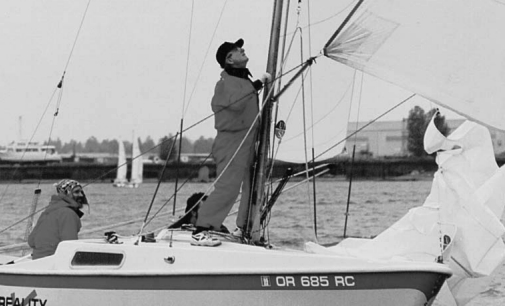
One has to wonder why that extraordinary adventurer, Webb Chiles, chose an open 18-footer like the Drascombe Lugger to sail single-handed three-quarters of the way around the world when he could have done it more safely, in far more comfort, and more cheaply in a used Cal 20.
The Cal 20 is essentially a dinghy with a lid on. She handles like a dinghy; she’s light on the helm and very responsive. But she has a heavy ballast keel that makes her very stiff and safe at sea, and her cockpit is self-bailing. She’s sparsely appointed down below, to say the least, but she does have four bunks — two of which are 6 feet 6 inches long — and the cabin provides a dry, sheltered, comfortable place to sleep. That’s a big step up from a Drascombe Lugger.
Better yet, the Cal 20 is cheap. Nearly 2,000 of them were built by Jensen Marine, of Costa Mesa, Calif., between 1961 and 1974, and the vast majority are still going strong. Some are going stronger than others, of course, but you should be able to buy a Cal 20 in excellent condition for $4,000 to $5,000 and a fixer-upper for about $2,000. Parts are still available, and racing fleets are still active on the West Coast, in the Great Lakes, and in Hawaii.
You’d have to be young and care-free to sail around the world in a Cal 20, but you wouldn’t have to be foolhardy. Although she’s basically a club racer/cruiser designed for nothing more than short coastal trips, she doesn’t need major modification for long-distance voyaging. She has earned a reputation for seaworthiness that is the envy of the owners of many larger, more expensive craft. George Cadwalader and his crew, Duncan Spencer, crossed the North Atlantic in one, sailing from Newport, Rhode Island, to Crookhaven, Ireland. Kun Poi Chin sailed his Cal 20, Chalupa, from San Francisco to Hawaii in the early 1980s.
The one thing she doesn’t have is room. She is the pocket they were talking about when they invented the phrase “pocket cruiser.” It’s the little pocket in the front of your jeans, the one that fills up with pennies, fluff, and paper clips. Like many other boats of her size, she’s little more than a floating fiberglass pup tent — except that if you’re willing to put up with a little discomfort, the Cal 20 has the thrilling ability to whisk you away over the blue oceans to magical tropical islands and palm-fringed beaches.
Basic design
One of the wonderful things about a small boat like the Cal 20 is that everything is so manageable. The sails are small, the anchor is light, and you can anti-foul the bottom in an hour. You never seem to suffer from that dreadful feeling that creeps up on you sometimes in bigger boats, that everything is just too overwhelming.
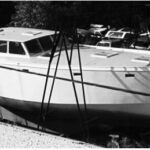
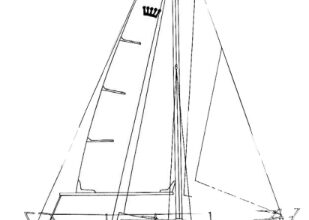
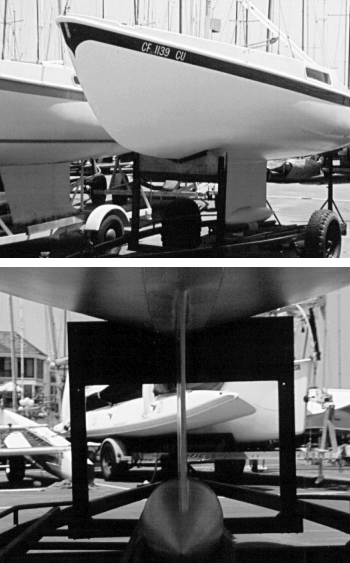
C. William “Bill” Lapworth designed her specifically for sailors moving up from Lightnings and small dinghies. She had to be agile, like a dinghy, but she had to be big enough for weekend cruising for a couple, and possibly two small kids as well. She also had to be fast enough for weekend racing, so Lapworth stuck a 900-pound bulb-style ballast keel on the bottom, much like that on the Star Class. It’s made of cast iron. (Photo on Page 11.)
Her overhangs are commendably short, which gives her the most interior room possible for her length, and her accommodations also benefit from the raised foredeck, a very sensible idea that adds strength to the hull/deck unit. It’s tricky to design a raised foredeck that looks right and doesn’t destroy the pretty line of the sheer, but Bill Lapworth managed it very well here.
Her hull is solid GRP with no coring, but the deck is of composite construction and has a plywood core, which means problems of rot and delamination if water ever manages to seep in around a poorly caulked deck fitting. The Cal 20’s rudder, hanging dinghy-style from the transom on pintles and gudgeons, is about as rudimentary as they come, but its simplicity and accessibility would be strong factors in its favor if repairs were ever needed. In fact, it’s one of the few rudders you could remove, repair, and replace at sea.
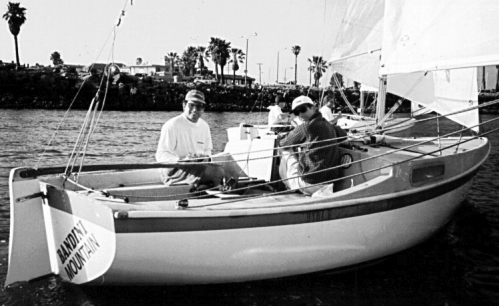
She has a daysailer cockpit an 8-foot-long affair that seats four in comfort for short periods. Its volume needs to be reduced for ocean voyaging and there are several ways to do this. You could, for example, make the well narrower with plywood panels. You might also use plywood to form a box at one end or the other, and gain more stowage area at the same time. But one of the best solutions was discovered by Kun Poi Chin, who simply stored his life raft in the cockpit. That reduced its volume by about 40 percent.
The cockpit coamings, incidentally, are uncomfortable to lean back against. They are too low to provide good support for your back. But few problems are insoluble, it seems. If your boat has lifelines, a roller cushion fitted around the stainless steel wire could be the answer. Some owners have increased the comfort level by fitting stainless steel side railings to rest their upper bodies against.
At the aft end of the cockpit, a well for an outboard motor protrudes up for a couple of inches from the sole, sealed top and bottom with removable hatches. If you remove the hatches, you have a hole in the bottom of the boat that is less than hydrodynamically perfect. It creates swirls and eddies that slow the boat down. It also allows water to slop into the cockpit in rough following seas. But at the same time it forms a huge and really efficient cockpit drain. If you’re going deepsea with this little boat, you might want to do exactly what Kun Poi Chin did. He left the bottom of the well open, but drilled holes in the top hatch and placed it back on. This stopped most of the slop splashing into the cockpit, and still acted as a drain that Chin regarded as very efficient.
The standard outboard is a 6-hp model and probably the most convenient place for it, if you’re going to use the well as a permanent drain in this fashion, is on the transom. In fact, however, the boat is so small that you can sail her almost anywhere, and a pair of 8-foot oars will move you around the marina or anchorage.
Accommodations
To maintain her speed and nippy performance, she had to be kept light, so practically no furniture was built into the fiberglass cave below, apart from a V-berth up forward and two settee berths. Shelves and storage compartments sit at the head of the settee berths, with just enough space for a camp stove on one side and a breadboard on the other. There’s a head compartment aft of the V-berths, big enough for a pump-through toilet. But finding space for the legally required holding tank is such a problem that most owners will opt for a portable potty, or the bucket-and-chuck-it system at sea and the bucket-and-bag-it system in port.
Like any boat of its size and shape, the Cal 20 does not aspire to the luxury of a well to collect bilge water and keep it away from everything else in the cabin. Any water that finds its way aboard will slosh to and fro across the sole and, if it isn’t removed quickly, everything down below will soon be sodden. This means that clothes and important documents should be kept in watertight containers, just in case.
The original boats were supplied with a flush-through toilet between the berths in the forepeak. But current legislation calls for holding tanks to be fitted to fixed toilets, and there is simply no space for a tank of any reasonable size in a Cal 20. So most owners have thrown out the original toilet and replaced it with a portable toilet. This allows them to glass over the two thru-hulls the original toilet needed and reduce the number of holes in the hull.
The rig
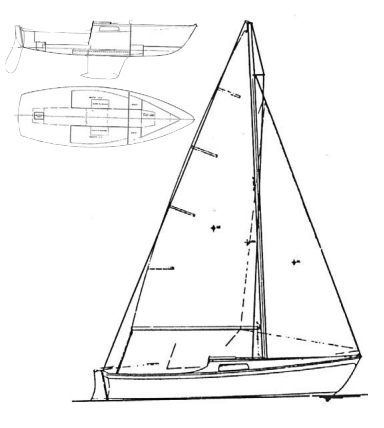
You could hardly design a simpler rig than this. The Cal 20 is a sloop with 196 square feet of sail area, a Bermudian mainsail, and a 7/8ths foretriangle to hang the jib from. No great strains here; but remember, this is a small boat, and a third row of reef points in the mainsail is a good idea for offshore work. The spars are anodized aluminum. The standard stays and shrouds were designed for daysailing. If you’re taking a Cal 20 to sea, you should replace them with ones at least a size bigger all around.
Incidentally, be sure to check out the original spreader brackets for cracks or other signs of deterioration. They’re the weakest part of the rig, according to Steve Seal, an Alameda, Calif., sparmaker and supplier of rigging parts for several makes of sailboats. He carries spare parts for the Cal 20. (See resources section on Page 9.)
Performance
With 46 percent of her nominal displacement low down on her keel, the Cal 20 is a stiff little boat. In fact, she has built a reputation in San Francisco for being able to carry full working sail downwind in 30 knots. Her stiffness means she works to windward at a minimal angle of heel, which is less tiring on the crew but harder on the rigging — hence the need to upgrade the stays and shrouds for ocean work.
She’s no flier, of course. She couldn’t be, with only 18 feet of waterline length on a full displacement hull, but she has earned a respectable PHRF rating of 264 on the Northern California PHRF list. The ubiquitous Catalina 22 with a swing keel rates 270 on the same list.
For a small boat, she’s fairly dry. Her ample freeboard, combined with the raised foredeck, takes care of a lot of the spray. But dryness is comparative, of course, and no boat of this size can truly be called dry when beating to windward in the open sea in heavy weather. Nevertheless, her reputation for seaworthiness is well earned.
As the windspeed rises, she tends to develop some weather helm, which can be cured by reefing the mainsail and keeping the working jib flying as long as possible. When it’s time to change down to a storm jib, it’s time to take in another reef in the mainsail, too. Excessive heeling in this boat is the major cause of weather helm, and sailing her more upright is the key to control, so in really heavy weather a third row of reef points for the mainsail is a good idea. Downwind, though, she really shows her stiffness, and racing Cal 20s often carry their spinnakers long after other classes have doused theirs.
Known Weaknesses
- Check the foredeck for rot of the plywood core and separation of the fiberglass layers, inside and outside, from the core. Water seeping into the plywood over the years will eventually soften the plywood and cause delamination. It’s not easy to fix.
- The original spreader brackets have been known to crack.
- Excessive lee helm or weather helm is sometimes caused by a badly cast or slightly misaligned keel. Some owners have gone to the trouble of fairing out the keel to improve its performance; and re-aligning the keel is not a big job, but it’s one you would rather not have to do in the first place.
- Some boats that have been raced hard have managed to loosen the deck attachment points for the forestay and the aft lower shrouds. Check them carefully, and beef them up if necessary.
Owner’s opinion
If you’re planning to cross an ocean in a Cal 20, you’d do well to contact Cruising World and ask for a copy of an article called “Expand Your Pocket Cruiser’s Horizons,” by Kun Poi Chin. It appeared in the September, 1985, issue. Your local library may also be able to help you locate the article.
As we’ve already mentioned, Chin sailed his Cal 20, Chalupa, from San Francisco to Hawaii in the early 1980s. He weathered six days and nights of gales during the 20-day trip, and went on to cruise more than 1,000 miles among the Hawaiian islands without major problems. He did, however, beef up the original hull before he left. For a start, he glassed in a full-length internal stringer of wood and foam from bow to stern on either side of the hull. He replaced the portlights with 1/8-inch Lexan and through-bolted them.
He stiffened the bulkhead under the mast and installed new keel bolts with extra-large washers. He also replaced the rudder with a stronger one with heftier pintles and gudgeons, and he anchored the aft lower shrouds and the forestay more securely. Chin carried no engine. He relied on a pair of 8-foot oars for auxiliary power.
He summarized his Cal 20 adventure this way: “Taking a small boat, designed for coastal sailing, on the ocean required some compromises. I accepted that. But after a year of cruising, I do not think that I could find another boat of the same size that would provide me with all the fun and joy of cruising at such an affordable price.”
Voyaging in small craft, he added, might not be for everyone, but if you want to do it badly enough, it’s definitely possible. And the key is simple: “An attitude of how little one needs, rather than how much one wants, is required.”
Conclusion
Kun Poi Chin pretty much said it all. If you’re adventurous and filled with a passion for cruising, you can do it very cheaply in reasonable safety with a bit of planning and a lot of caution. You can do it in a Cal 20. Voyaging in a boat as small as this comes at the expense of physical comfort, of course, and it requires commonsense planning of your route. But the rewards are great. The experience will breed confidence, independence, and abilities that will serve you well for the rest of your life.
Thank you to Sailrite Enterprises, Inc., for providing free access to back issues of Good Old Boat through intellectual property rights. Sailrite.com