Don’t avoid the subject; do avoid the event
Issue 78 : May/Jun 2011
It begins innocently enough. Two young couples meet socially and begin to talk. One couple says they’re sailors and enjoy racing on Wednesday nights at their yacht club. The other says they’ve never been on a sailboat but would love to try it. The first couple says they always have trouble getting crew, and the inexperienced couple agrees to go out with them on the following Wednesday.
Due to traffic, faulty directions, and other problems, the new sailors arrive at the dock late. As soon as they scramble aboard, the four of them head out to the starting line.
It’s the first race of the season in early spring. The big lake’s temperature is still very cold. The breeze is brisk, the waves are high, and the other racers are jockeying for position. The non-sailing husband is beginning to feel ill and is already regretting his decision to try sailing. The non-sailing wife is frightened but she bravely asks what she’s supposed to do. The sailing couple, intent on preparing for the start, merely tell them both to just sit tight . . . they’re used to doing this on their own. The horn sounds and 15 boats of various sizes leap for the starting line. The newcomers don’t even see a starting line.
The boat with our foursome aboard is the last around the first mark and the field is far ahead of them. The sailing wife goes on the sidedeck to move the blocks forward to give the headsail a better shape on the downwind leg.
The wind is gusting as she struggles with the block. She calls to her husband for assistance and he locks the wheel, then goes forward to help. As she stands to give him access to the troublesome block, a hard gust of wind fills the sail and the boat suddenly heels violently, sending her overboard without a life jacket. In an instant, her husband jumps into the water to save her.
The boat, with its wheel locked, sails on with the untrained couple left aboard watching helplessly as they leave the two people behind in the frigid water. They do not know how to unlock the wheel. They do not know how to detach the life rings on the rail and throw them into the water. They do not know how to start the engine. They do not know how to drop the sails. They do not know how to turn the boat around. They do not know how to radio for help. They do not know there is a cell phone in the cupboard belowdecks.
Hours later, both bodies are pulled from the water and pronounced dead. Tragically, this story is true.
Critiques and excuses
It’s easy to sit back on dry land and analyze all the things that went wrong that day and believe it could never happen. But when was the last time you instructed guests aboard your boat in emergency measures and an overboard drill? For too many, the answer is never, and the excuses are legion.
- You don’t want to needlessly scare people.
- The weather conditions are calm and there’s no danger of anyone going overboard.
- They’ll learn on their own after they’ve been sailing awhile.
- It’ll be too complicated for them.
Excuses aren’t much comfort when lives have been needlessly lost.
Outline a procedure
Man-overboard situations are rare, but that doesn’t mean you shouldn’t talk about them.
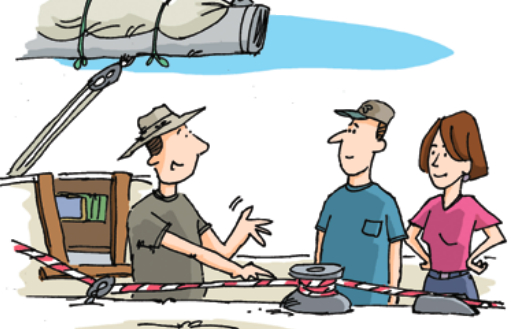
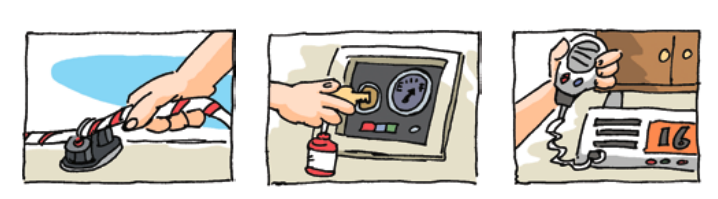
First, if you’re taking inexperienced sailors out for a pleasure cruise, don’t alarm them, but tell them that — in the unlikely event that you should suffer a heart attack, or fall overboard, or whatever — their emergency procedures are simple: drop the sails, turn on the motor, go to the assistance of the man overboard, radio for help. Then show them how to accomplish these tasks as simply as possible. Show them the halyards and how to release them. Show them the jibsheets and how to release them. Have them start the engine. Show them how to operate the radio. Do it coolly and efficiently and add some humor where appropriate. Finish by telling them that no one has ever had to use these emergency procedures for as long as you’ve been sailing. That should give some comfort.
Intelligent guests will be impressed that you’ve taken the time to prepare them for the worst, even though it’s unlikely to happen.
Practice a response
Of course, before you can instruct guests on what to do in an emergency or man-overboard situation, you have to be confident and sure that you know what you’re talking about. The way to build that confidence is to regularly practice emergency situations on your boat and challenge yourself to improve your response times. This doesn’t have to be arduous or detract from the enjoyment of your precious sailing time.
If you’re a singlehanded sailor, regularly ask yourself, “What would I do if I suddenly suffered severe medical symptoms or fell overboard?” Would I be wearing a life jacket? Would the boat be on autopilot? What are the potential variables and how would I respond in each situation?
Many singlehanders leave a line trailing from the stern and have their ladder halfway down and suspended by a bungee cord. End up in the water and you’d have to get to that line quickly, but at least you’d have a chance.
If you sail with one crew, practice your procedures as if that person fell in the water and you were left aboard alone. What would you do first? Second? Third?
When you practice by throwing a fender overboard, don’t let your crew assist in the retrieval in any way — that person would be in the water.
Also bear in mind that a fender weighs a lot less than a person with soaking-wet clothing. On a nice warm day, at the dock, entice your crew into the water and see what you would have to do to get him back on board if he were unconscious and unable to climb the ladder. Then switch roles and get wet yourself.
What is the best man-overboard recovery procedure? While there are many expert opinions and recom-
mended techniques, the real answer has to be the method that’s best for your boat, your capabilities, and the conditions at hand. You are the one who has to figure out what will get you back to that person in the water the fastest, given your boat and your safety equipment. That’s why it’s important to try different procedures and imperative to practice them.
Steps to recovery
Immediately, when someone goes over the side, start yelling, “Man overboard!” to alert everyone aboard to the emergency. As quickly as possible, start throwing life preservers in the water and deploy a Lifesling apparatus if you have one. Someone should be continually pointing to the man overboard and never take his eyes off him so you don’t lose sight of him. Then get back to him as quickly as possible.
Exactly how you do that depends on the situation. You might be able to simply turn around and sail back. You could sail a figure-eight course to get to a position from which you approach the man overboard while bringing the boat head to wind. It might be easier to drop all sails, start the engine, and motor back to the person.
As I’m usually out on my own, I practice by throwing my man-overboard pole in the water and timing the retrieval. I make my best times when I release the jibsheet and use the main to sail a figure eight back to the pole. But that’s me and my boat. The only way to find out what works for you is to practice.
When you do practice, don’t create a real crisis situation with an impromptu drill under difficult conditions. I’ve seen this happen with a skipper who felt it was important to perform the drills under “live fire” conditions.
In a howling gale on a rain-soaked deck, he threw a fender over the side and screamed, “Man overboard!” What ensued was close to panic. Crewmembers were scrambling to look for someone. People were stumbling to loosen life rings from the rail and toss them. An elderly crewmember was having heart palpitations that could have triggered a heart attack. The boat was lurching and pitching as the skipper wrenched the wheel around and tried to tame a runaway boom.
While this may approximate the most extreme situation, it creates the perfect conditions for a real emergency that could cost someone his life. Always conduct your drills under controllable conditions and announce your intentions well in advance. You and your crew will gain much more confidence from the constant repetition and successful retrieval of a man overboard (Note: use a dummy, not a real person –Eds.) than you will from potentially failing in extreme conditions.
As skipper, you’re responsible for your ship and the lives of everyone aboard. It’s a daunting responsibility. Before you leave the dock, prepare your crew to handle the worst that could happen. That way they can safely enjoy the best that can happen.
Don Davies has sailed the North Channel, Georgian Bay, and Lake Huron extensively aboard a Contest 31 and, more recently, his 1974 Grampian 30 that he keeps at Highland Yacht Club on Lake Ontario. He has written several books and his screenplay, Bluenose, The Movie, is currently in development.
Thank you to Sailrite Enterprises, Inc., for providing free access to back issues of Good Old Boat through intellectual property rights. Sailrite.com