An old boat’s wiring gets a facelift
Issue 96 : May/Jun 2014
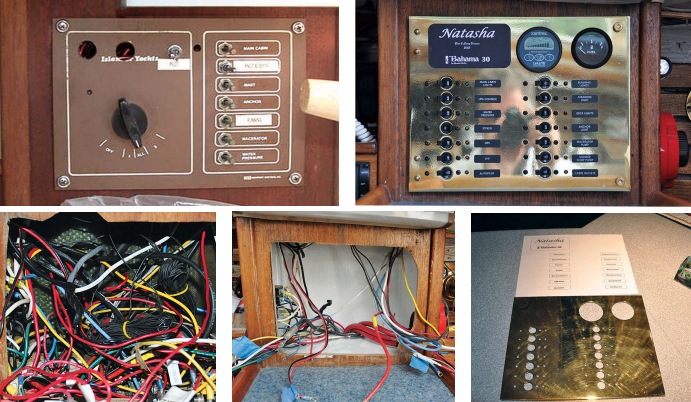
When repowering Natasha, our 1978 Islander Bahama 30 (see “Repowering to a Sail Drive,” July 2013), I was well aware that, as part of the engine replacement, I would have to take a serious look at the 35-year-old original wiring. As is common for boats of this vintage, the wiring and connections were somewhat suspect. That, coupled with years of this-will-do additions by various owners, had created a rat’s nest of wiring that I surveyed with trepidation. Electrical wiring was never my strong suit and the work looked daunting so, before tackling this project, I reviewed Charlie Wing’s Boatowner’s Illustrated Electrical Handbook for guidance on how to do marine wiring properly.
As is typical on older boats, many of the “circuit breakers” on the original panel were serving double or triple duty to protect a variety of electrical additions. Everything from water pumps to GPS plotters had been added to available circuits over the years. It wasn’t going to be a matter of upgrading the current panel as much as designing a completely new one. Blue Sea Systems, West Marine, and other sources sell ready-made panels but I found none that could make maximum use of the limited space I had on the Islander. My only real choice was to design and construct a custom panel.
Circuit separation
From a design perspective, I wanted to isolate critical electrical functions to limit collateral damage should one circuit or piece of equipment fail. Separating the VHF radio from the GPS plotter from the propane control seemed to be a logical way to go, so failure in one circuit would not affect others. I also designed the panel to separate functions into groups that reflected cabin and sailing needs.
Although most sensitive electronic components require a specific inline fuse, other circuits simply require a circuit breaker of the appropriate amperage to protect the wiring. I calculated amperage loads for each electrical device (water pump, lights, and so on) and purchased the appropriate number of Blue Sea Systems C-Series single-pole circuit breakers.
By including LED indicator lights on the panel, I would be able to tell with a quick glance what was switched on and what wasn’t. I used green LEDs for breakers that should always be on when we’re aboard (propane sniffer and cabin lights, for example), amber LEDs for sailing instruments, and red LEDs that should only be on when
actually in use (such as the macerator pump and navigation lights). I also wanted to include a battery monitoring system on the panel and selected the Xantrex LinkLite Battery Monitor. Since the control panel that came with the new Beta diesel had no room for a fuel gauge, the electrical panel seemed a logical place to put that as well.
A panel with polish
The next decision to make concerned the material for the panel. I would have preferred ABS plastic for its textured surface and ease of workability, but the material had to be 3⁄16 inch thick or less to allow for the circuit breaker switches. ABS plastic of that thickness is not rigid enough and the entire panel would flex unacceptably. The next choice was metal, and to reflect the cabin décor, I chose polished brass.
I laid out the locations of the gauges, breakers, and indicator lights on a piece of stiff cardboard to ensure the dimensions were appropriate. I then scribed the hole centers onto the brass plate and took the panel to a sheet metal shop. Brass is brittle and, when drilling anything other than very small holes, there’s a chance of creating ragged edges. The sheet metal professionals punched the holes, which left a very smooth finish.
Then the polishing began. Starting with 200-grit and working up to 600-grit sandpaper on a random orbital sander, I cleared the industrial finish on the brass of all fine scratches. I finished with a buffing pad with a metal-polishing compound until the brass shone and wiped it down thoroughly with acetone before spraying it with clear lacquer to preserve the polished surface.
Assembly
I could then begin assembling the panel. To connect the positive terminals for all the circuit breakers, I used a pre-drilled 1⁄2-inch 22-gauge copper plumbing strap manufactured by All Around. As the holes on the strap did not perfectly align with positions of the breakers, I simply kinked the strap until they did. I wired the indicator lights to the individual breakers and to a common ground wire. Then I sorted out all the new wiring, crimped it with heat-shrink terminals, and attached each end to the correct breaker after a wipe with Dielectric Silicone Compound, a corrosion inhibitor. I printed the boat-name label on adhesive mailing-label material and used labels from Blue Sea to identify the function of each breaker.
I modified the compartment that housed all the wiring by enlarging the opening to accommodate the new panel, and painted the interior white to make it easier to see and identify the wires. I installed a small bus bar to connect a few ground wires at the panel, and connected that to a much larger ground bus bar in the battery compartment. This removed a great deal of ground wiring from the panel compartment, where it had simply contributed to the wiring clutter.
Since I am right-handed, I hinged the new panel on the left so that, when the front was swung open, I could do most of the work with my right hand. The panel fasteners allowed a 1⁄8-inch gap between the panel and cabinet front to provide ventilation and to prevent the accumulation of moisture in the compartment.
Although this was a considerable amount of work and expense (mostly the cost of 14 circuit breakers and the Xantrex LinkLite), the panel has worked very well. All the electrical circuits are independent and controlled from one location. The wiring diagram I prepared during construction stays with the boat for quick reference. What’s more, the new look complements the cabin.
Bert Vermeer and his wife, Carey, live in a sailor’s paradise. They have been sailing the coast of British Columbia for more than 30 years. Natasha is their fourth boat (following a Balboa 20, an O’Day 25, and another Islander Bahama 30). Bert tends to rebuild his boats from the keel up. Now, as a retired police officer, he also maintains and repairs boats for a number of non-resident owners.
Thank you to Sailrite Enterprises, Inc., for providing free access to back issues of Good Old Boat through intellectual property rights. Sailrite.com