Registries can reveal a lot
Issue 96 : May/Jun 2014
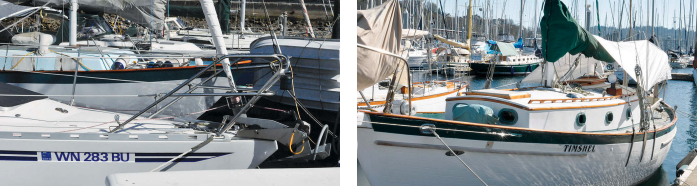
We’re all curious about the good old boats out there. You’ve probably learned to recognize some boats by their sail insignias, cove stripes, the shapes of their hulls, and other identifying features like portlights. The next time you’re stumped, check to see if there’s a state registration number on the bow. If not, the boat is probably documented with the United States Coast Guard (USCG). In that case, just the name and hailing port is all you need to look up a wealth of information about that boat — more than many owners probably realize.
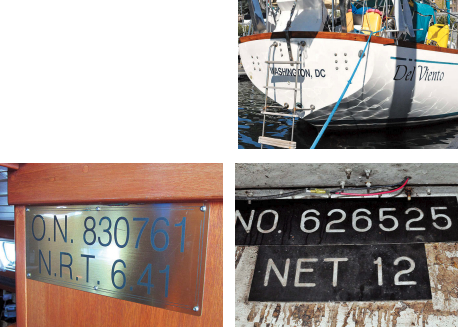
For example, anyone walking our docks can see the name and hailing port of our documented boat, Del Viento, Washington, D.C. With just this information and a smartphone, they can access the USCG Port State Information Exchange (PSIX) system and begin a process that will reveal the complete documentation details for our boat.
The USCG website describes the PSIX system as a “weekly snapshot of Freedom of Information Act (FOIA) data on U.S.-flagged vessels, foreign vessels operating in U.S. waters, and Coast Guard contacts with those vessels.” Anyone can access and search PSIX data from either a USGC website or a National Marine Fisheries Service (NMFS) website. The two sites allow different search criteria and display different types of information.
It’s generally best to begin a search on the USCG PSIX site. This will provide the vessel identification number (VIN). Entering this number on the NMFS “vessel search” page will reveal that Del Viento is a 1978 model built by Fuji Yacht Builders. The listing will also show my name and address, the name of the previous owner, the two previous names of our boat, our call sign, our boat’s dimensions and tonnage, and that she’s built of fiberglass. It will also display our documentation number and the date it expires.
Used together with the NMFS system, the PSIX system can do more than identify a particular boat type — or satisfy my curiosity over who owns Loose Change, the 82-foot Hatteras in the transient slip. For example, before committing to a particular name for my next cruising boat, I can use the PSIX system to see if any other documented boat has that name.
If I want to reach out to owners of C&C 30s, for example, I can look them up. By searching on the first few hull identification number (HIN) characters common to all C&C 30s — ZCC30 — and using “%” as a wildcard, I found that 109 of them are documented with the USCG. (The HIN is the number stamped or molded into the transom of a boat built after 1972.)
Are you curious about the fate of the beloved documented boat you sold 20 years ago? Well, let’s hope someone didn’t go and rename it Wet Dream.
Naming criteria
When it’s time to name your boat, get creative. You can name your documented boat anything you like as long as you heed four rules:
- The entire name, no matter how many words, cannot be more than 33 characters long.
- All the characters in a name must be from the Latin alphabet or be Roman or Arabic numerals.
- A name may not be identical, actually or phonetically, to any word or words used to solicit assistance at sea.
- A name may not contain or be phonetically identical to obscene, indecent, or profane language, or to racial or ethnic epithets.
Any number of boats can have the same name, but every boat will have a unique vessel identification number (VIN) — which is different from the hull number (HIN) assigned by the manufacturer. And even if you change the name (through the USCG) or ownership of your documented vessel, the official documentation number (the VIN) assigned to your vessel will never change.
Marking your vessel
The Coast Guard is clear about how documented vessels are to be marked. It wants the name, hailing port, and documentation number clearly visible.
For recreational vessels, the name and hailing port can be anyplace on the outside of the hull, so long as they are clearly visible and clearly legible. The letters and numbers can be applied using any means or materials but they have to be “durable markings” and at least 4 inches tall. The hailing port in particular must be comprised of two elements: a place (a town or city, for example) and a state, territory, or possession of the United States.
For all documented vessels, the official, assigned VIN must be marked on a clearly visible interior structural part of the hull. The number must be “permanently affixed so that alteration, removal, or replacement would be obvious and cause some scarring or damage to the surrounding hull area.” The number must be marked in numerals at least 3 inches high preceded by the abbreviation “NO.”
Michael Robertson and his wife, Windy, bought a cruising sailboat in Mexico, sold their Washington, D.C., home, and dropped out of their high-pressure lives in 2011 to voyage with their two daughters, Eleanor (10) and Frances (7). They’re currently aboard their Fuji 40, Del Viento, in Mexico’s Sea of Cortez. You can catch up with them at www.logofdelviento.blogspot.com.
Thank you to Sailrite Enterprises, Inc., for providing free access to back issues of Good Old Boat through intellectual property rights. Sailrite.com