A long-term problem cured
Issue 96 : May/Jun 2014
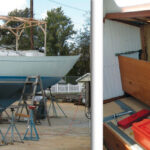
Secret Water is an aging and much-loved 1965 Allied Seabreeze 35. During my stint as owner (1996 until present), she has had her share of annoying deck leaks, mostly minor in nature. I’ve managed to stem the ingress of water everywhere except around the chainplates. After many years of struggling with this problem, it was time to come up with a fix once and for all.
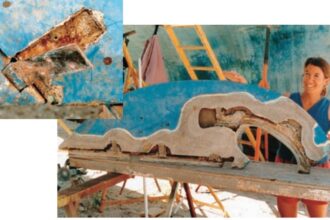
Leaks at chainplates are not only a nuisance, they are dangerously destructive. Many boat sales have been rejected after a competent marine surveyor appraised the chainplates. Salt water entering next to and remaining in contact with the stainless steel can lead to crevice corrosion and eventual failure. This puts the rig and the safety of the crew in jeopardy, to say nothing of water-damaged bulkheads and interior cabinets, along with sodden bedding, books, and food stores. Except as garnish for a late-afternoon margarita, salt on the rim of the glassware is not welcome!
Secret Water’s construction is pretty typical. Chainplates made of stainless-steel flat bar pass through the deck and are bolted below to bulkheads or gussets. Fortunately, Allied Boat Company had the foresight to build with a generous deck flange, so the chainplates, which are well outboard, do not pass through balsa core. I’d tried sealing them with all the usual products with varying degrees of success. But sooner or later I would detect a drip (or worse, a puddle) indicating that, once again, I had lost the battle.
It was time to get creative. Once more, I removed the chainplates from the boat. This allowed me to inspect them properly and really clean up the remains of past sealants that had failed.
Coffer dams
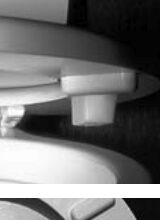
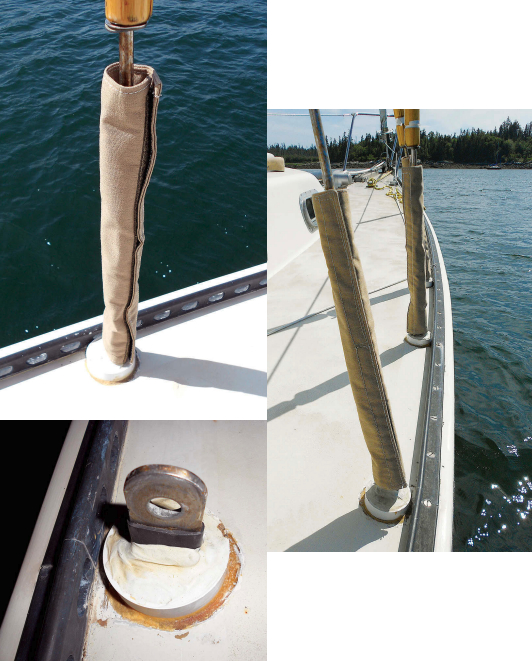
My newest approach was to place a “perimeter collar” around the deck opening. Cutting a 2-inch PVC pipe coupling in half gave me a collar about 3⁄4 inch high. While keeping the chainplate centered, I epoxied the collar to the deck. This has the obvious advantage of ensuring any standing water is below the sealed joint. It also makes a large cavity to fill with sealant to obtain more contact with the chainplate.
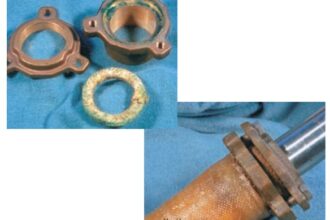
Now for the really innovative part of my approach. I’m convinced past failures can be attributed to the sealant not bonding well to the stainless steel. This time, I encapsulated the chainplate, in the appropriate region, with heavy-wall heat-shrink tubing. I used the type that’s lined with heat-sensitive adhesive — the material the electrical trades-people use to ensure a weather-tight seal for cables. Using a heat gun (a hair dryer isn’t up to this job), I shrank the material onto the chainplate until I could see the adhesive ooze out both ends. No way will water migrate down along the metal.
The trick now was to find a sealant that would bond to the heat-shrink tubing, the PVC, and the gelcoat deck. I experimented with several of the popular marine brands with limited success. Then I discovered the heat-shrink tubing is made of polyolefin, a plastic that is notoriously resistant to adhesives.
I found the answer in Bond & Fill Flex PVC joint adhesive. This is used in the building trades for installing PVC exterior trim and is available in lumberyards for about $10 a tube. I filled the dam with the sealant and it cured in about 24 hours. After two years of service, the material has remained as flexible as the day it cured. It claims to be highly resistant to UV and I anticipate a long service life.
The chainplates have remained bone dry. Not a drop has entered the boat. The only downside is the somewhat less than “proper yacht” appearance on deck. But sometimes form follows function. It seems a small price to pay for a dry interior. My talented wife created Sunbrella turnbuckle covers that do an adequate job of concealing the deck collars.
Art and Sandy Hall and their not-so-inclined-to-sail Pekingese, Kitri, can be found sailing their Allied Seabreeze 35, Secret Water, on Penobscot Bay, Maine. Occasionally they’ll push way Down East for some solitude. A significant enjoyment while cruising is exploring “eel ruts” in their Peapod dinghy that is set up with two rowing stations.
Thank you to Sailrite Enterprises, Inc., for providing free access to back issues of Good Old Boat through intellectual property rights. Sailrite.com