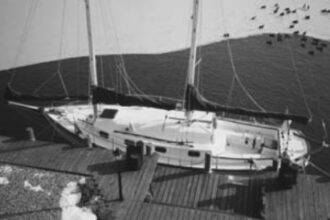
. . . but none the worse for the off-road experience
Issue 96 : May/Jun 2014
That bright October afternoon, conditions were perfect for our Sunday motorcycle ride. We rumbled along for a few miles in the warm sun, looking at the fall colors and soaking in the mountain air. As we banked around a curve, there appeared before us an eye-popping wreck. I put the bike on its stand and we stepped off into the dusty high desert. With an eye out for nasties, we picked our way through the rabbit brush toward a small sailboat perched on the edge of a ravine.
The high desert is not the usual final resting place for sailboats. As we got closer, we could see the bright yellow hull lying on its starboard side in the dirt, almost tipping over into a dry coulee. It looked a little like a plane crash. The boat’s rigging was uncoiled like a crazy tangle of steel spaghetti. Colorful bungee cords littered the chewed ground. Looking back toward the road, I could easily read how this sad little drama unfolded.
A bent and detached trailer hitch was still engaged to a 2-inch ball, the lone safety chain sporting a clearly insufficient shackle. Like the path of destruction from a tornado, mangled fenders, lengths of channel iron, and shattered wooden boards marked the path from the boat back to the highway. It was clear that the two-wheeled trailer had apparently flown off the road and into a drainage ditch that stripped the trailer away from the boat like a dry husk. The sturdy boat literally tore the trailer apart as it continued on, skidding on its retracted keel and plowing a fair-sized furrow to where it now lay. One yard more and she may have rolled over into the ravine, but miraculously she had stopped just short. Marooned and abandoned, the boat now lay in the dust after what must have been a dramatic wreck.
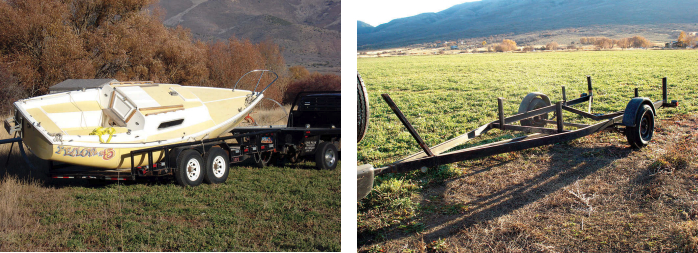
A wish granted?
We shook our heads. What a shame. For the last two years, Sue and I had been looking for a capable trailer-sailer. Our big boat lived in Rockland, Maine, and, as part-time cruisers, we work in Utah during the winter season. Boat withdrawal is a serious ailment for us. It’s excruciating to be so far away from our beloved floating home for months at a time. We needed a little sailboat to help us endure the separation. As we live near two high mountain lakes, it was easy to imagine spending the autumn weekends anchored out in deserted coves surrounded by grazing deer and diving eagles. We had searched locally for a vessel, but in vain. We could not find a small seaworthy boat in our price range.
When we followed the trail of destruction back to the marooned yellow sailboat, we noticed that the hull, unbelievably, was still in one piece. It was at least 150 feet from the road, every bit of it tough sledding, so we expected to see a few jagged holes and ruptures in the hull. But as we examined the boat more closely, we determined that the hull-to-deck joint was still intact and the hull, although scored in a few places where it had
skidded along in the gravel, had no obvious breach.
Closer examination revealed one deep gouge created as the well-built boat tore the front support off the trailer, but in general, the yellow mini-cruiser looked like it had survived its rowdy trip. The nameplate on the boat identified it as a Balboa 20, a vessel from the drawing board of Lyle Hess, designer of many “skookum” ocean-going craft, including Lin and Larry Pardey’s hardy sailboats. There she lay, a beached yellow derelict and a golden opportunity!
Sue rolled her eyes at my obvious excitement. She knew all too well that the steam that was starting to come out of my ears meant a mad adventure was sure to follow. She correctly guessed that this wasn’t really a shipwreck at all . . . but a boat for sale! It was obvious that the unlucky owner had to get the boat out of its present resting place. He would have to hire a flatbed and a crane of some sort. Then, when he got the boat home, what was he to do with it? It was a little large to be a birdbath. It was our great luck that this sturdy boat was marooned right on our beach. We scrawled a note, included our phone number, and affixed it to the transom, “Will buy boat, as is, where is.”
That evening brought a phone call from the boat’s owner and, following Sue’s suggestion, I offered him a “reasonable” price. A reasonable price for a shipwreck, that is. Actually, it was a ridiculous amount, but he immediately and gratefully took our offer. We were the surprised and happy owners of a beached Balboa 20.
Recovery and a refit
Our four-wheel-drive farm tractor has forks as well as a loader bucket so, while Sue drove out to our new mini-yacht with our hay trailer and farm truck, I put the forks on the John Deere and followed in high gear. We put two slings around our new boat’s yellow belly and the forks creaked as she was lifted from the high desert floor. She had no hidden damage to the hull and, as she rose from the desert sand, we were gratified to see that the swing keel was still firmly in place. Sue backed the flatbed under the hull and we lowered her gently onto half a dozen fenders. We loaded the mast next, and Sue took off slowly for home with our prize, the tractor following in formation carrying the parts of the trailer that could be loaded on the forks.
The boat trailer seemed at first to be nothing but scrap steel, but a close examination revealed promise in that pile of twisted wreckage. We brought the bent metal home and blessed our luck that the trailer axle was still relatively straight and the wheels and the brand-new tires were unharmed. The rest of the trailer was not so lucky. The frame was twisted and buckled, and jagged tears showed where welds had failed and cross-members had torn off. There was still one lone upright remaining where a board had once been attached to cradle the hull. The rest of the uprights had either been torn loose or mowed flat. The frontmost support, where the bow had once rested on a rubber roller, was torn completely off the frame, and we found it lying in the dirt some yards away from the wreck.
Starting early the next Saturday morning, we carefully straightened each bent piece of the trailer using a coal-fired forge and a large anvil. The trailer was constructed of thick channel iron, so blacksmithing techniques worked well in reshaping and straightening each part. We “repaired” the smaller parts of the trailer frame on an anvil with a sledgehammer and torch — a delicate operation to be sure. With a MIG welder, we reconstructed the trailer, complete with a new winch and new 2 x 8 boards for the cradle.
At the end of a long Saturday, the heap of metal was once again welded together, and we were pleased to see that this jigsaw puzzle now looked a lot like a boat trailer. With a coat of black paint, it was as good as new. It was an exciting moment when the little Balboa once again met the trailer, settling into its place as if it had never left.
The boat itself was next. The mast was straight, the rigging unkinked, the boom and sails fine. The rudder was not only perfect, it was still attached to its brand-new laminated tiller. The little roller furler was worth several times more than we paid for the boat and the cockpit cushions looked new. The hull had a small puncture hole at the waterline, a tiny knife slit, and the galley countertop had cracked where the hull side flexed as she landed hard in the dirt. A few hours of glasswork made her sound again, but the worst of the restoration wasn’t due to the wreck at all.
It wasn’t the gouges in the hull or the mangled boat trailer, but the neglected interior that made us question our sanity in messing about in this old boat. The carpeted cabin smelled as bad as it looked. Poorly bedded deck hardware had resulted in small leaks that had led to unappetizing mildew and stains under the carpet. As if the carpeted interior wasn’t a bad enough idea, mice had held council in the bilge over the summer, lending a truly uninhabitable air to the interior.
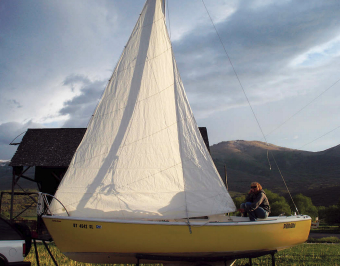
Sanitized and restored
Holding our noses and donning rubber gloves, we tore out every bit of the original carpet, exposing underlying insect nests and much unidentifiable bilge detritus. We bought bleach in mass quantities, and for the next few days we bleached the cabin sole, cabin sides, bow, stern, quarter berths, countertop, cabinets . . . and then we did it again. After removing everything portable from the interior, we put a hose in through the companionway and filled her six inches deep with bleach water. It was bath time, and she was her own bathtub. We let her soak. After we siphoned the water out and vacuumed the bilges dry, the interior became much more appealing. She appreciated the attention. All she needed was a day in the warm sun with the hatches open and she smelled as sweet as a desert rose.
Finally she was habitable. The original contact cement that had held the carpet to the hull had hardened to the point where some work with an oscillating sander left a pleasing orange-peel finish, a fine texture for new paint. We donned our Tyvek and within a couple of hours had painted the overhead and V-berth white, making the interior seem much lighter. We then replaced the carpeting on the cabin sides with bright cedar battens screwed onto expanded PVC strips glued onto the inside of the hull. Every piece of deck hardware, including the mast step, bow pulpit, and genoa track was re-bedded with 3M 5200 and reinforced with proper stainless-steel fender washers or backing plates made in our machine shop. We repositioned the chainplates and bolted them on the outside of the hull. Pressure washing her outside proved her to be dry inside. She was ready to launch and she was really looking good.
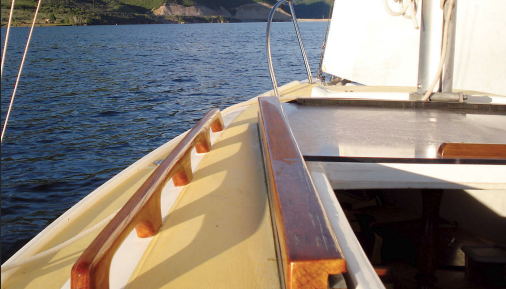
Our little yellow mini-cruiser now sails in our high mountain lakes during the cool spring and summer month and we never cease to be amazed at her seaworthiness. We fondly regard her as our big cruising boat’s little sister. Setting a small Bruce anchor off her robust anchor roller, we stay overnight in small calm coves, watching the sun rise and set over the nearby mountain peaks. On such quiet evenings, we sit together in the cockpit before retiring, savoring the fruits of our imagination in restoring the small yellow shipwreck. We realize once again that the universe always seems to provide sailors what we need as long as we have a little vision, a little inventiveness, and plenty of sweat.
Nick Bigney grew up in Boston and spent his youth on the ocean. Sailing came naturally to the great-great-grandson of a Yankee privateer who died of injuries suffered in the War of 1812. Nick imagines Captain Tom Duncan striding the deck, proud to have at least one of his progeny under sail. Nick and his wife, Sue, have homes in Texas and Utah and boats in Maine and, now, Utah.
Thank you to Sailrite Enterprises, Inc., for providing free access to back issues of Good Old Boat through intellectual property rights. Sailrite.com