Improve your marlinspike seamanship with knots, bends, and hitches
Issue 36 : May/Jun 2004
During my two-plus decades of Boy Scouting (as a Scout during my youth and then as a Scoutmaster), knots and knot-tying played an integral role in the program. Without them how could the lashings of a signal tower be begun or ended? Or how could the lines of a tent be properly secured and made taut?
As a sailor, I, like many others, took knot-tying for granted along with sail trimming, bottom painting, using proper nautical terminology, and so on. However, it wasn’t until my most recent experience as a Sea Scout skipper (adult leader) for a Sea Scout ship, that I realized that knots, on a real-world level, are very important tools.
There exist approximately 4,000 different knots. Many of them are highly specialized, used for one-of-a-kind applications, and a few are even patented. In Scouting, I used about 25 knots. In sailing, I have found that the following dozen knots can get the tasks aboard ship completed in accord with good seamanship.
Proper terms
Knot is a generic term for any loop or entanglement of line, whether created intentionally or accidentally (what could be called a “ lump in the rope”). More precisely, as distinct from a bend or hitch, a knot secures the two ends of the same line.
A bend joins two separate lengths of cordage together. (One working definition: a “rope-to-rope knot.”)
A hitch is generally used to attach a line to a post, rail, or ring. (A “rope-to-something knot” is what a hitch could be called.)
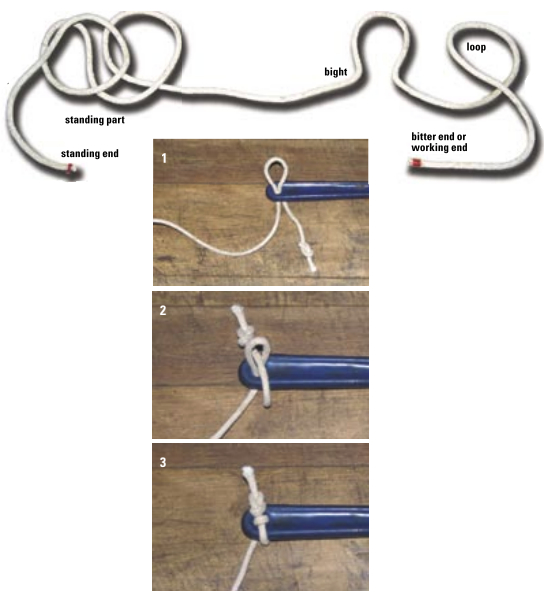
A few other terms will assist in simplifying what appears to be a universal knot-tying dilemma. They include the bitter end, standing part, bight, and loop (see illustration on Page 42). The bitter end of a line is its very end, while the standing part is the main section of the line. A bight is formed by bending the standing part of a line into a U-shape, and a loop is a small circle formed in the standing part.
By their design, some knots are easily untied, while others require some degree of coaxing. While a knot is used to secure, there may be instances where a “quick release” modification may be desired. This is called making a knot “slippery” and is usually accomplished by incorporating a bend in the last step of the tying process. One of the most common slippery knots is the bow knot used to tie your shoes. In actuality it is a double-slipped square knot. Some other knots that can be made slippery are the figure-eight, sheet bend, clove hitch, two half hitches, and cleat hitch.
Incidentally, a few words concerning relative knot strength or efficiency: based on a rope strength of 100 percent, the efficiency of a knot is that percentage of breaking strength of a line left after the knot has been tied in it. Do not confuse breaking strength with safe working load. The breaking strength is commonly five times that of the safe working load.
The figure-eight knot
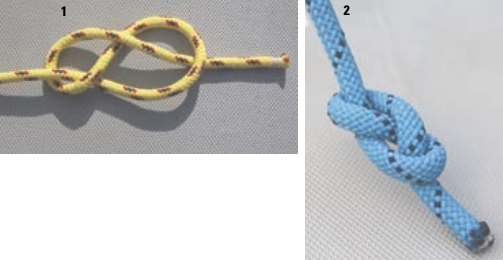
The figure-eight is the sailor’s No. 1 stopper knot and is believed to have gotten its name from Darcy Lever in his book Sheet Anchor (1908). Shown below, this knot is used to prevent jib and mainsheet ends, halyards, and other control lines from coming unreeved from blocks and fairleads. It is easy to tie and more importantly easy to untie, even when wet. To make the most of the knot, tie it at least 4 inches from the bitter end. As is always the case, the breaking strength of a line is reduced when there is a knot present, and a figure-eight is no exception. It reduces the line’s strength to 45 to 50 percent of unknotted line.
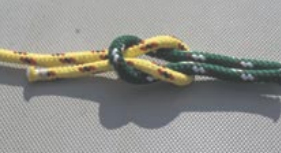
Reef knot, or square knot
The reef, or square, knot is said to be one of the most useful knots known. The ancient Greeks, Romans, and Egyptians all used this knot. The Romans called it the Hercules knot. The reef knot is used to tie together two ends of the same piece of line, such as conventional sail ties, tying in battens, and tying lashings. It is easy to tie and untie, except when wet and under heavy load. If used on small stuff, which can pull very tight, it becomes very difficult to undo. In this instance, use a sheet bend, which affords superior performance and is simpler to tie. A reef knot is not a bend and is quite weak, reducing the breaking strength of the tied line to 45 percent.
Knute hitch
This is a simple, yet effective, hitch to attach a line to anything with a hole in it, not much larger than twice the diameter of that line. It is probably centuries old, but master rigger Brion Toss gave it its name in 1990. The knute hitch is used for fixing lanyards to knives and tools, thus keeping them out of Davy Jones’ locker. It can also be employed to attach halyards to flags and even sails. The efficiency of this knot is somewhere in the neighborhood of 55 percent.
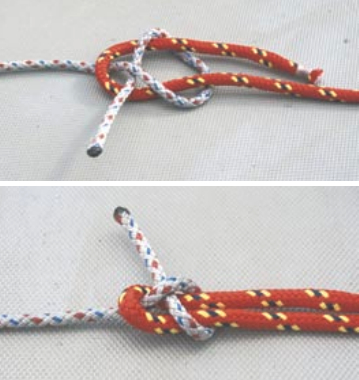
Sheet bend, or becket bend
The sheet bend is the knot you thought that the reef knot was — simple, honest, easy to tie. Stone Age fishing nets have been found with mesh knots resembling sheet bends. However, it was first called by this name in David Steel’s book, The Elements and Practice of Rigging and Seamanship (1794). The sheet bend is principally designed to attach two lines of different diameters. It is ideal when using a lightweight throwing line as the messenger to haul a heavier working rope into position. The sheet bend is neither a strong nor a secure knot. It is easily untied and reduces the line’s strength to almost 50 percent of that of the smaller line.
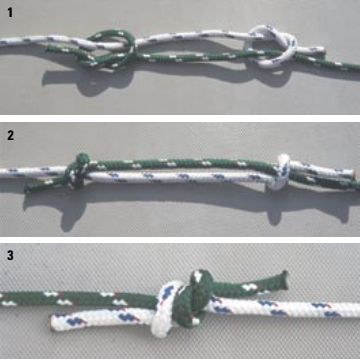
Fisherman’s knot
The fisherman’s knot is actually a bend. In Isaak Walton’s The Complete Angler (1653), it was also called the water knot. Throughout the centuries that followed, the fisherman’s knot has been referred to by several names including: angler’s knot, ring knot, gut knot, true lover’s knot, and others. The fisherman’s knot is a strong and secure bend used for joining two similar lines together. It can also be used to form endless loops or slings. In addition to tying together line, it works well with webbing, such as webbing sail ties. The efficiency of the fisherman’s knot is about 70 percent.
Bowline
The bowline is the most common knot seen aboard sailboats. In early nautical history, it was referred to as the seafarer’s knot. However, it wasn’t until 1794 that David Steel illustrated the “bow line knot” in his book, The Elements and Practice of Rigging and Seamanship. The bowline is possibly the most useful knot aboard a sailboat. Use it wherever a loop is needed. It is ideal for securing jib sheets to the clew (see illustration on Page 41). To tie the knot, see Page 44. It is easy to untie, even after having been dunked in the water and put under heavy load. The bowline is 40 percent weaker than the line and 30 percent weaker than an eye splice, giving it an efficiency of 60 percent.
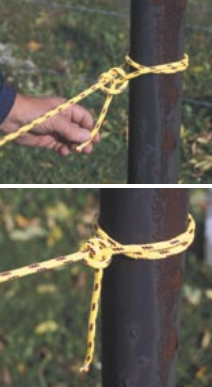
Two half hitches
On shapes and in places where the clove hitch won’t go, using two half hitches is probably the best choice for simplicity and security. In 1794, David Steel referred to this hitch by name in The Elements and Practice of Rigging and Seamanship. Two half hitches are commonly used for making a line fast to a bollard, pile, or spar. They are easy to tie, adjust, and untie. Two half hitches have a breaking strength of approximately 70 percent. Taking a round turn before tying the two half hitches increases that percentage.
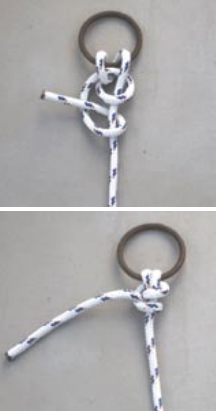
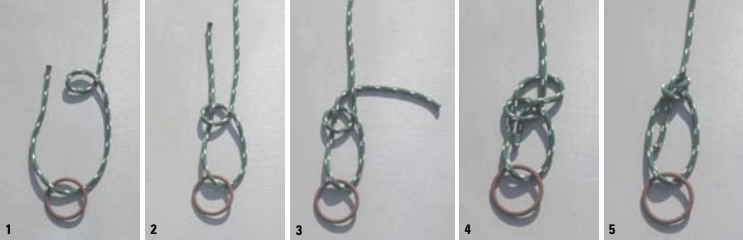
Anchor bend
Sometimes called the fisherman’s bend (not to be confused with the fisherman’s knot), the anchor bend’s name is misleading. It is actually a hitch! David Steel recommended this knot in his 1794 book. The anchor bend makes a more secure loop than a bowline and is handy for making fast to a buoy, spar, or ring (see illustration on Page 44). It is an especially secure hitch for wet and slimy conditions, such as are often found on an anchor. Because it is only 25 percent weaker than the line (75 percent efficient), the anchor bend is often preferred to a bowline, but it is difficult to untie.
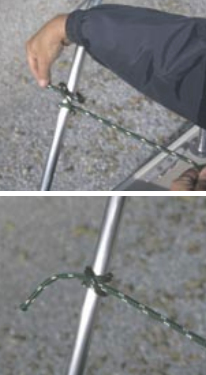
Clove hitch
The clove hitch is a simple, yet versatile, knot that is held in place by friction. Once called a builder’s knot, William Falconer in his Universal Dictionary of the Marine (1769) gave it its current name. It is a good knot for tying fenders to lifelines and for securing a line around a post or piling. The clove hitch is not designed for heavy pulling. It is easy to tie, but will hold well only when the load on the knot is steady and at right angles. If pulled around, the clove hitch will work itself loose. When wet, it can jam and be difficult to untie. Its breaking strength is about 60 percent.
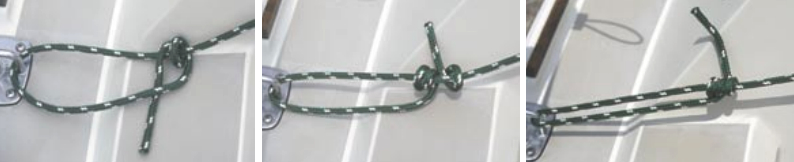
Tautline hitch
Although more commonly found around the campsite securing the guy lines of a tent, the tautline hitch is equally at home aboard ship. Two common variations of this “slide and grip” knot are the classic Midshipman’s hitch and the newer Tarbuck knot, which was devised by climber Ken Tarbuck in 1952. The tautline hitch is primarily used to tension a line that tends to sag over time, such as a clothesline or the guys of a tarp or cockpit tent. The tautline hitch holds in one direction but can be slid along itself in the other direction for easy adjustment. The efficiency of this oneway “ratchet” knot is about 65 percent.
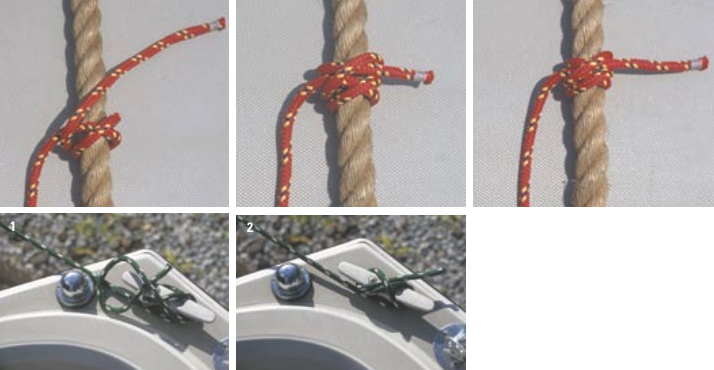
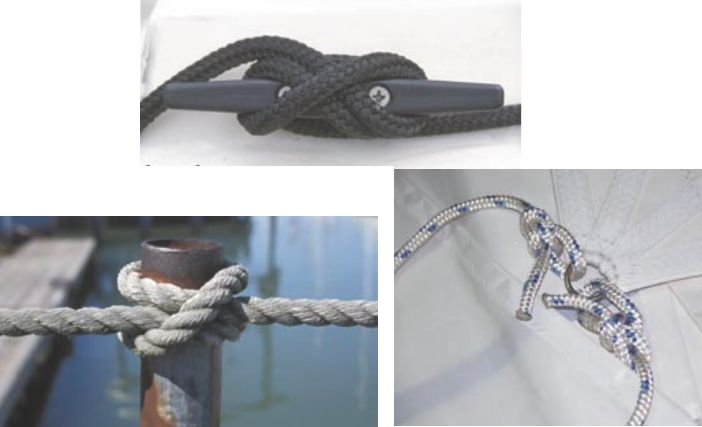
Making fast to a cleat, at left: Finish this one off by twisting one loop and making sure the bitter end is lying underneath the final wrap. See finished cleat on Page 41.
Rolling hitch
A close cousin to the venerable clove hitch, the rolling hitch exhibits the “slide and grip” functionality of the tautline hitch. In earlier times, it was often referred to as Magner’s hitch or a Magnus hitch. This knot allows a small line to be secured to the standing part of a larger line. It is useful for applying tension to a sheet, constructing a towing bridle, or extracting a fouled anchor. Like its cousin the clove hitch, the rolling hitch’s breaking strength is about 60 percent.
Cleating
One can tie a knot through a cleat or pass a loop over both ends. However, the proper way is to use a figure-eight pattern around the cleat and finish this off with a twisting loop, making sure that the free end of the line is underneath the final wrap. Cleating a line is not a hitch, bend, or even a knot, but rather an age-old method of making fast. It is universally used to secure halyards, outhauls, downhauls, docking lines . . . the list is almost endless. It is never used for fastening sheets, as sheets often have to be released in a hurry. The efficiency of a properly cleated line is nearly 80 percent.
Learning how to tie knots can be confusing at first. However, with a little practice and some hands-on application, sailing will be easier and safer. Bear in mind that there may be more than one way to tie a knot. It doesn’t matter how it’s tied, as long as it comes out correctly.
Thank you to Sailrite Enterprises, Inc., for providing free access to back issues of Good Old Boat through intellectual property rights. Sailrite.com