Cruisers learn to race — Bahamas style
Issue 70 : Jan/Feb 2010
We were with cruising friends, enjoying a lazy morning of harbor-watching in Nassau, where the parade always included a number of native sloops, or “smacks,” the brightly painted sailing workboats we all thought would be such fun to sail.
“Anyone for a smack race?”
The question came from a young man who’d approached us on the dock. Anyone? Most likely everyone! We could hardly believe our good luck.
On Sundays, the workboats we so admired became raceboats. This Sunday, the race was special. As one of a series of elimination races, it would help to determine which boats would be used in an upcoming regatta pitting American racing skippers against Bahamian captains, all of them sailing island smacks. Our recruiter told us where to gather and when, then left us with a bit of friendly advice: “Oh . . . better not bring anything you don’t want to get wet.”
The comment was way more than a hint of what to expect, but we happy cruisers were so flattered about being asked to crew, it was easy to ignore its implications. It didn’t even bother us to know we’d been picked randomly for our bulk and not our sailing sense. Thus prepared, our three large captains and two small mates changed into crew clothes and marched our collective ballast toward the designated dock.
In the short time it took to walk a few blocks, we learned that even ordinary smack racing was far more than a Sunday pastime for the sailors. All along the waterfront, conversations centered on the boats and their captains. Emphatic voices carried the good-natured teasing and the not-so-good-natured bickering, all expressing themes familiar to racers everywhere: which are the hot boats and which the also-rans, who are the smart skippers, and who the wannabes.
Small boat, big sail
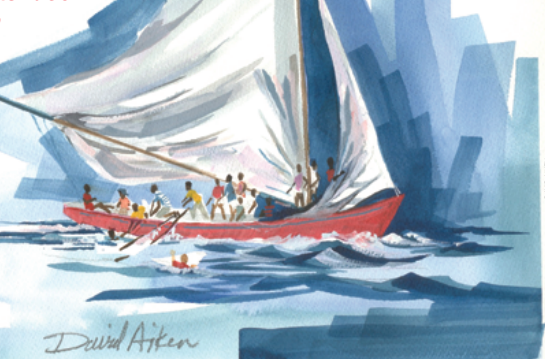
We found our smack. Clara Naomi was only 28 feet on deck but, as a typical island sloop, she carried a mainsail that seemed better suited to a 40-some footer. By comparison, the tiny jib appeared mis-rigged. The boat had no cockpit or cabin to speak of, just a flush deck over a nearly empty cargo hold.
When all the crew had assembled, 18 of us stepped aboard. We were shorthanded at that, as the usual crew numbered 22. A few quick instructions stressed the most important thing to remember: when the boat tacks, move to the high side. What could be easier? Small-boat sailors already know that. We were ready.
As the boat headed for the channel, we heard suggestions (orders?) from many sources and wondered which voice we should actually pay attention to. Much of the shouting related to the immediate goal of heading for the channel, a pre-race challenge in itself, as the smack had no auxiliary. Wind and current in Nassau Harbour are notorious for disrupting the best-laid plans. Yet, of necessity, the sailing plans for these boats are governed by wind and current.
From the time we drifted out of the slip, every move sparked multiple discussions . . . not an ideal way to handle onboard discipline. But this boat didn’t fit a typical raceboat profile, nor did she have a typical crew hierarchy. This was a family boat. On this day, the father and two sons were on board and, except for our group, the rest of the crew were regulars. Everyone wanted — and apparently got — a say in tactical decisions. Though often distracting, this variation on captaining was accompanied by a contagious good humor that kept us all in the upbeat mood of race day.
We’d been the last boat to the leave the dock but we were first to have a man overboard. While attempting to untangle the jibsheets, one crewmember absentmindedly stepped off the foredeck, quietly slipping into the water with hardly a splash. The right combination of laughter and helping hands brought him back aboard with what was probably the speed of much practice. He was hardly even wet. With all crew aboard and again at the ready, we could now try a few tacks. And so the fun began!
Scrambling under the boom
Well, not everyone sees fun the same way. As guest crew, we soon found our part in the basic tacking procedure to be a bit more involved than gracefully shifting to the other side as the boat smoothly came about. There was the long, low boom to consider. Close to the mast, there was not enough room for even a small person to fit under the boom, so tacking time prompted a mass scramble. Everyone had to get to a place on deck where he or she would fit, then scoot under as quickly as possible by whatever means seemed doable. Some opted to slide on their backs, while others tried a belly glide; either way, grace was a forgotten factor. Timing was truly crucial. Too soon, and a belly-glider would be rudely startled by a face-full of seawater. Too late, and a back-slider might get ungracefully swept off the suddenly low side.
Arriving last at the starting line, we dropped the sails and also the grappling hook that was our anchor. Here was a unique way to start a race. No stopwatch timing of pre-race tacks to assess speed and ensure the best starting-line position — this was easy. Wait for the gun, raise anchor and sails, and away.
A hang-up at the start
The gun fired and the onboard confusion reached a new peak. Boat after boat moved out but, while our anchor-pullers heaved smartly, nothing happened. More hands, more pulls, more shouts, and finally, the hook broke free enough to be dragged aboard — bearing an unwelcome gift. Caught in its grapples was a huge tangle of rusty cable that no doubt weighed more than the anchor itself. More orders (not exactly cheerful ones) and the cable was released to trap another unlucky race-starter.
Now that we were the last boat to start, we needed all the speed we could muster. A fast trimming of sails and out came the pry, a long plank that is pushed out over the windward side to serve as a platform for as much weight as may be needed to balance the boat. (For those familiar with log-canoe racing, the smacks share some of the canoes’ traits, though it’s debatable which boats are the more tender.) With pry in place, three crewmembers moved gingerly out toward the outboard end, so “this boat can stand up and walk.”
Close call with a party
Stand up she did but she didn’t walk — she ran. The boat was sailing beautifully, aimed straight for a small dock on shore where an outdoor patio party was in full swing. Onlookers were smiling and waving as the boat sailed on, closer and closer to the happy partygoers.
“Now we’re movin’, Dad,” called one of our skippers.
“Come on, come on, just keep this boat movin’!”
“And what you think I’m doin’, Mon? You think you can do better, you come on back here and do it!”
The exchange continued, each side extolling the moving capabilities of this boat relative to which skipper was steering, all of which had the predictable but unfortunate side effect of lessening concentration at the helm.
“Tack, Mon, TACK!” and the 18-person scramble ensued as we crawled, kicked, and wiggled our way to the high side while that long boom seemed to sweep over the small dock, the sloop’s proximity scattering the no-longer-smiling onlookers.
“OK, now, we’re gainin’, Mon, now just keep gainin’!”
“Mon, you think I’m sleepin’ back here? I been steerin’ these boats since long before you came along . . .”
Suddenly, with no prior command as warning, the boat turned into the wind. The smack stood up. The pry went down. A sharp cracking sound was followed almost immediately by three loud splashing sounds.
Smack racing rules are very strict about some things, one being that the boat must return from a race with the same crew that was on board for the start — all of them — or it loses points. Now that the pry no longer existed, the value of the pry-riders, particularly that of the lone tourist in the trio, could reasonably be in question but, thanks to the rules, all three splashes were retrieved with remarkable speed.
Seeking a better breeze
Now, with no other boats in our vicinity, the captain decided to head off on a different tack, literally. If we found that proverbial better breeze, we might be able to catch the fleet at the next mark. For a time it did seem that our position was improving, though it would never be clear if this impression was based on actual gain or misplaced optimism. And then the wind began to fade.
“Time to lighten the boat,” announced the skipper. Our curiosity definitely aroused, we watched as a deck hatch was pushed aside to reveal a number of filled sandbags. Eager hands reached in, hauled the bags out, and emptied the contents overboard. Once more we were grateful for smack- racing rules.
“Hey look, Mon, we’re goin’ to meet some boats at the mark. We won’t be first in this race, but maybe now we won’t be last either.”
A surge of renewed spirit ran through the crew. Now when we tacked, we all side-slid to the high side like a sailor’s chorus line; kicking was kept to the barest minimum. “Get ready!” was the command as we closed on the mark with two other boats.
At this stage in a smack race, we were told, anything goes. The screaming, the shoving, even the colliding were all acceptable methods of rounding the mark in good smack-like fashion. And it did put us back in the race — still last, but close enough to be considered back in anyway.
“This boat, she really goes downwind, Mon. Now we have a good chance of not being skunked.”
The crew was distributed amidships with great care to balance the boat for maximum downwind performance. The huge main was let out . . . and out . . . and out. Everyone watched nervously for what could be a total, deck-sweeping jibe. No one sat up very straight.
Speeding to the finish
“We’re doin’ it, Mon, we’re passing David!”
This time, enthusiasm grew to real excitement as Clara Naomi continued to pick up speed. It was hard for the ballast to sit still as we moved steadily past the red transom . . . then the mast . . . then the bow. It was true — we had done it! We had passed another boat.
After the committee boat acknowledged our crossing the finish line, we rounded up to wait. Jeering at the last boat was one of the unwritten rules we intended to obey. However, our exuberant shouts were quickly silenced by the sight of a broken stay flogging in the breeze.
“We had to take it easy,” said the red-boat skipper, nodding toward the reason.
A long and awkward pause was finally broken. “Were we last after all?”
Another pause.
Then Dad spoke. “Well, I’ll tell you what I think. When you can sail a boat like this, on a day like this, in a place like this, then you don’t need to worry about being first or last. You’re just sailin’, Mon.”
Zora and David Aiken have been meandering by boat since 1974, finding inspiration for painting and gathering material for writing. Their books include Good Boatkeeping, Second Edition, Cruising, the Basics, and Fiberglass Repair: Polyester or Epoxy. “Home” since 1978 has been a good old, now classic, 1963 Chris-Craft sloop, Atelier.
Thank you to Sailrite Enterprises, Inc., for providing free access to back issues of Good Old Boat through intellectual property rights. Sailrite.com