Their third boat met their elusive ideal
Issue 70 : Jan/Feb 2010
Sitting in the oyster bar in Key West, four wannabes and an old salt debated the merits of sailboats for cruising: “You must have a heavy displacement hull” . . . “I won’t go back out until I have two hulls under me” . . . “You need a performance boat so you can outrun the weather.” Hale and I planned to become full-time sailors and we were working through our list of preparations. This step was our liveaboard bluewater-sailing course. Our fellow students, Mark and Brad, already owned boats; our instructor, Jeff, had been cruising for years.
Since the only boats we had ever owned were sea kayaks, Hale and I regarded the other three as oracles and we soaked up all they said. We also read all the books and magazine articles, studied the reviews, and looked at our savings. We determined the size and quality of the boat we thought would suit us best and the budget needed to acquire and equip it. Those factors dictated the year and condition of the sailboat we would buy. We were both in our early 30s and anxious to get “out there.” The sensible option — buying a starter boat for coastal cruising — did not appeal to us and, in our antsy state of mind, chartering different boats to get a feel for options felt like a waste of money.
Armed with a book on evaluating used boats, and with more enthusiasm than turned out to be good for us, we set out to buy our dream boat. While oblivious to the fact that we knew nothing about boats, fiberglass, or leaks beyond what we’d gleaned from typed words, we were confident in our ability to find a good deal. Cabo Rico 38s, with their pretty clipper bows and stunning teak interiors, felt salty and right to us. We looked at only two and chose what we were sure was the better one. Despite our distrust of the broker, our dislike of the seller, and the warnings of “a lot of hard work” from the surveyor, we signed on the dotted line and she was ours. Who were we to be afraid of a labor of love?
Flaws revealed
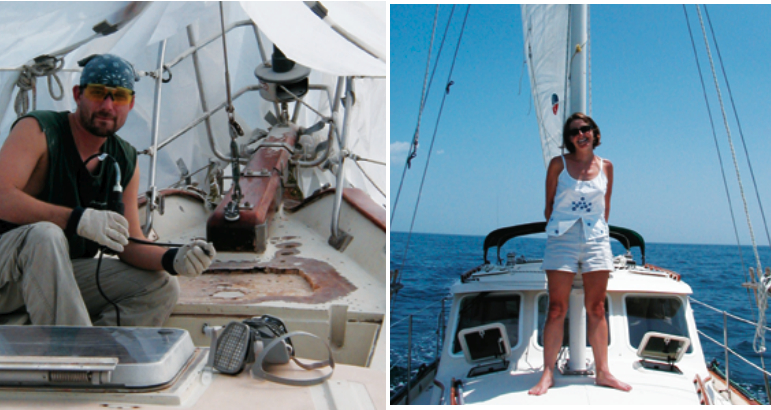
On the trip home, her batteries leaked noxious fumes and liquid, her leaks appeared with a vengeance, and her engine showed its reluctance to give even one more hour of service. Determined, we set to work on her at the dock and later in a boatyard. A year and a half later, the most endearing part of the experience was my undying adoration for the boatyard Rottweiler. We had found holes drilled through the holding tank, soggy cabin sides and deck, and countless problems too embarrassing to list. We’d learned an amazing amount about ripping up teak decks and soles, cutting up fiberglass, and re-coring with foam.
We’d discovered that the true love of Florida lovebugs is not other lovebugs but uncured epoxy, into which they would joyously dive. We’d ground, sanded, and primed every exterior inch of the hull and topsides. We’d bought more power tools than a carpenter. We’d realized that we were not experts at setting up watertight canopies or really at anything that had to do with restoring a boat. We’d stripped half her bottom to gelcoat in preparation for a new primer coat using a bit of each method suggested by every one of the 100 or so boatyard experts who had stopped by with words of wisdom. And we’d done all of this on weekends and vacations while traveling the world working our 70-hours-a-week information-technology jobs.
One rainy day, sitting in the boatyard, Hale wrote down everything that remained for us to do for the boat to be ready to sail. He divided that into out-of-the-water jobs and once- launched jobs. The hours and costs involved were daunting and, given our high-pressure careers, did not make sense.
A demoralizing prospect
By this time, even with the southwest-Florida humidity, the no-see-um bites, and the steps backward, I had developed a bond with this boat that was just as strong as the looming work was intimidating. Looking at our options was demoralizing. To continue with the work might break us financially and psychologically. If we sold her at this point, we would incur a huge financial loss because we were determined to be brutally honest with prospective buyers. We would also face an emotional loss. I have never been a quitter, and that prospect was an even bigger obstacle for me than the finances.
Keeping her would sit better with my spirit but would be a commitment to the boat over ourselves. We felt torn and unable to make a decision, so we continued rebuilding — long weekend by long weekend.
Around that time, our neighbors, with whom we had shared dreams of the cruising life, returned after six weeks into what was to have been an indefinite stint in the islands. They immediately put their boat on the market. They had quickly learned that living aboard not only didn’t make them happy, it made them unhappy.
This was the impetus that forced us to face reality. We were looking at another five years of working every weekend and vacation before we could even launch our boat. This might have been acceptable if we had known we would love the reward. But what if we didn’t? As much as it pained my soul to give up, we did just that. But we were giving up on this particular boat so as not to give up our cruising dreams. That conclusion allowed us to sell her. Tears streamed down my face as we passed the papers to a couple even younger than we were and wished them well.
Smaller, newer, and ready for sea
We now knew what we needed: a boat built solid enough to take whatever the ocean threw at us but newer and in pristine condition. This meant a much smaller boat, of course, since our budget had hardly grown during the financial bath we took on our first try.
We found her: a beautiful Pacific Seacraft 32 for sale by an immediately trustworthy man who owned her, a flats boat, and a Hatteras sportfisher. Did I mention the employee who did nothing but look after his boats? Far Tortuga was truly a creampuff and we were suddenly the type of people we’d always secretly hated: those who came into the boatyard on a Friday and left the next Monday.
After a three-month trial cruise in the Florida Keys and the Bahamas, we were hooked. Cruising was definitely in our blood. We knew we wanted to make this lifestyle ours for as long as possible. About two months into the cruise, however, we admitted to each other that we had overstepped in our reaction to the first boat experience. Far Tortuga was perfect for this type of cruise but too small for the two of us and all the stuff we felt necessary for life aboard once we sold our home.
Certainly this was a personal determination. Many couples live happily in much smaller boats, but we acknowledged that we are not the type to minimize on spares, books, or provisions. Again we fell into tormented questioning. Would we ever be satisfied with a boat? Were we being too picky? Was something holding us back from fully embracing the cruising life? We decided it was none of those things. We simply still did not have the right boat.
Another quest
We were back at square one but, finally, with the experience we needed. We knew all about good old boats, a little about sailing full time, and a lot more about ourselves. With Far Tortuga on the market and a summer stretching ahead of us, we got down to work. Hadn’t I been an excellent manager of data in my career? Couldn’t I apply the same decision-making processes here? My Finding the Perfect Boat spreadsheet had 65 columns, 170 rows, and 22 formulas. In truth, this did nothing to relieve the stress of buying a boat, but it did open our eyes to possibilities we had not considered and it prevented us from ignoring facts when our heartstrings tugged.
Somewhere in the middle of hurricane season, we sold Far Tortuga to a meticulous doctor who would care for her as we had. Another goodbye tore at my heart as Hale set off with the new owner on the week-long delivery trip. Now, we were free to concentrate on our search.
We put more than 7,000 miles on our car as we criss-crossed the country examining boats. We saw dream boats and boats of wrecked dreams. We met helpful brokers and dishonest brokers. We encountered owners desperate to sell and owners blind to reality. We had several close calls and quite a few calamities. Eventually we found her on landlocked, man-made Lake Lanier in Georgia. As karma would have it, this was the same lake on which we had taken our first sailing lessons, belonged to our first sailing club, and woven our dream as we floated aimlessly on windless days.
Bigger, older, and experienced
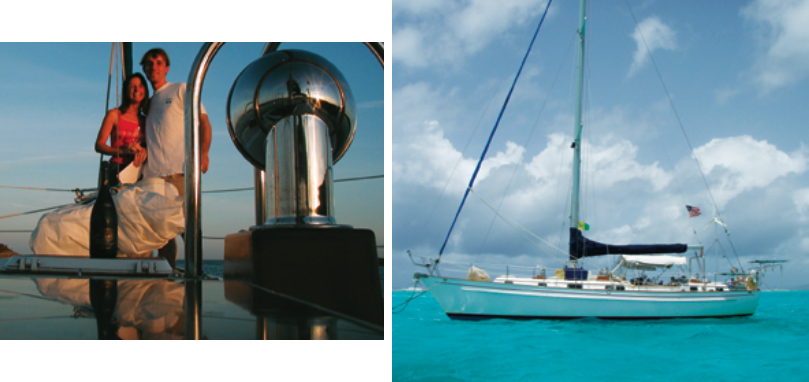
Our Kelly-Peterson 44 was similar in many ways to our first boat: heavy fiberglass construction, built in 1979, susceptible to wet decks, and with an aura of faraway places. But now we knew the difference between good old boat and simply old boat. She’d been sailed hard and put away wet by her first owner, but her second owner had devoted four years to bringing her back to her original glory. He’d addressed the known issues, re-cored the deck, and updated the systems. A lightning strike had helped by ensuring new wiring and electronics throughout the boat. The sparkling paint, brand-new tanks, and shining brightwork had more in common with our creampuff than our boatyard boat. Finally, we had realized the perfect marriage of quality, care, and cost.
We made an offer within a day of seeing her, slept on her that night, and owned her just a week later.
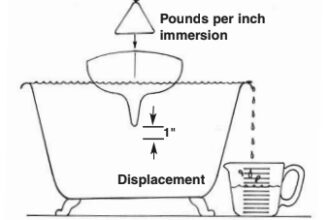
The Kelly-Peterson 44 was created by racing designer Doug Peterson and broker Jack Kelly and combines the qualities of a performance design with the comforts of a roomy liveaboard. Her 30,000-pound displacement in 38.8 feet of waterline makes her a moderate-displacement sailer, and she has a sail-area-to-displacement ratio of 16.5. A long fin keel and cutaway forefoot reduce wetted surface to gain speed but the husky skeg-hung rudder and completely protected propeller keep us from feeling too exposed on the underside. Our particular boat has a removable inner forestay that we fitted with a small staysail for heavy-weather sailing. We find we use it just as often for assistance in pointing upwind.
The Kelly-Peterson has a well-balanced rig, sails well on virtually every point of sail, and is capable of 8.3 knots hull speed. Its cockpit is comfortable for life at anchor and also provides secure corners when we’re under way — and the aft deck is perfect for fishing. The roomy interior has dual staterooms and plenty of ventilation while the teak and Taiwanese craftsmanship give our boat the ambiance of a classic yacht.
Of course we had work to do. We outfitted her with solar and wind generators to be ready for the alternative energy lifestyle to which we aspired. We built a new dodger/Bimini and added a staysail. We supplemented gear to upgrade her from lake boat to ocean-cruising boat. And we changed her name to reflect our first sailing experience together on Cayuga Lake in upstate New York. The two Native American meanings of Cayuga were perfect in their representation of our boating journey. “From the land of swampy waters” and “starting place” fit our horizons both behind and ahead.
Cruising at last
We are now in our third year of sailing the islands aboard Cayuga and every day we are grateful for this boat. She carries us through storms that shake our confidence in ourselves but not in her, she is a warm and welcoming home each evening, she earns accolades from those we meet, and we still had the funds after purchasing her to be out here living our dream life. The lessons we learned in our boat-buying process help us every day. We tackle fiberglass jobs with little more thought than that required when putting on a coat of wax. We quickly made alterations to add conveniences that we enjoyed on our modern boat. We know how to find leaks. We know how to make things fit into small spaces. And we certainly know the truth of the overused statement that all boats are compromises.
When a Cabo Rico or Pacific Seacraft floats next to us in a tropical anchorage, my heart fills with mixed emotions. The owners of those boats must wonder why my eyes are unnaturally bright when I dinghy over to say, “Beautiful boat. We used to own one.” Our journey to our ideal boat has left me with great appreciation for the unique rightness of each boat to its individual cruising owner.
Susan Merriman has been cruising full time with her partner, Hale Bartholomew, since leaving her career in information technology education. Aboard Cayuga, their Kelly-Peterson 44, Susan and Hale have traveled the Bahamas, the U.S. Eastern Seaboard from the Florida Keys to Maine, the Dominican Republic, Puerto Rico, and the eastern and southern Caribbean. Susan is temporarily back on land in the U.S. while she works to refill the cruising kitty.
Thank you to Sailrite Enterprises, Inc., for providing free access to back issues of Good Old Boat through intellectual property rights. Sailrite.com