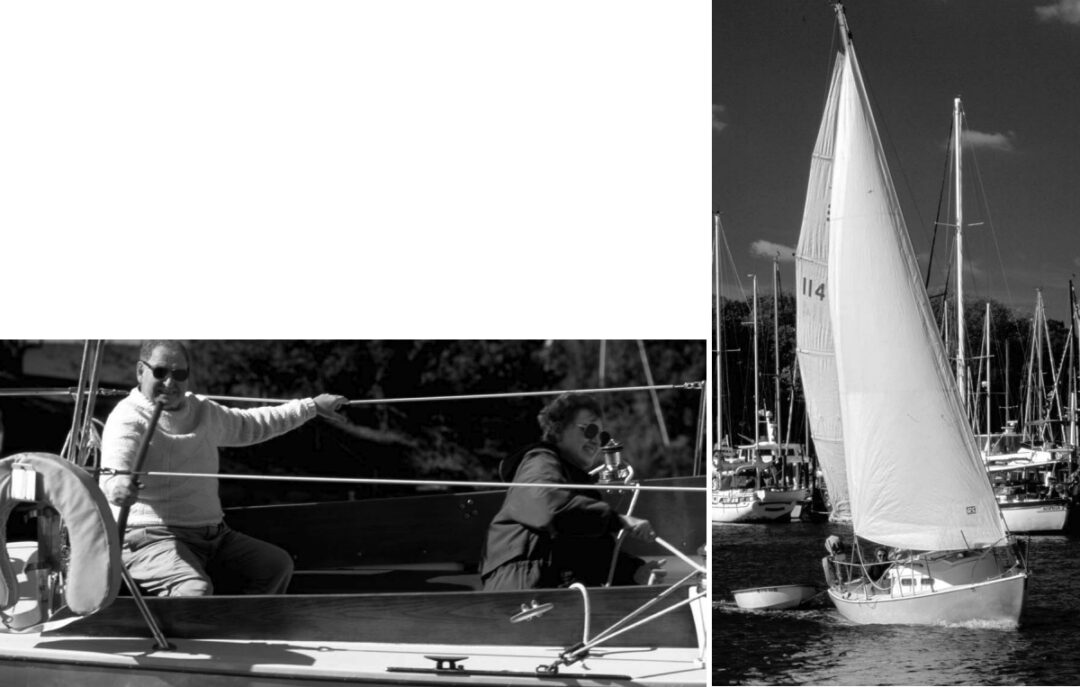
John Smith and Pat Tengel lavish love on Pocahontas, their 1965 Pearson Commander
Issue 6 : May/Jun 1999
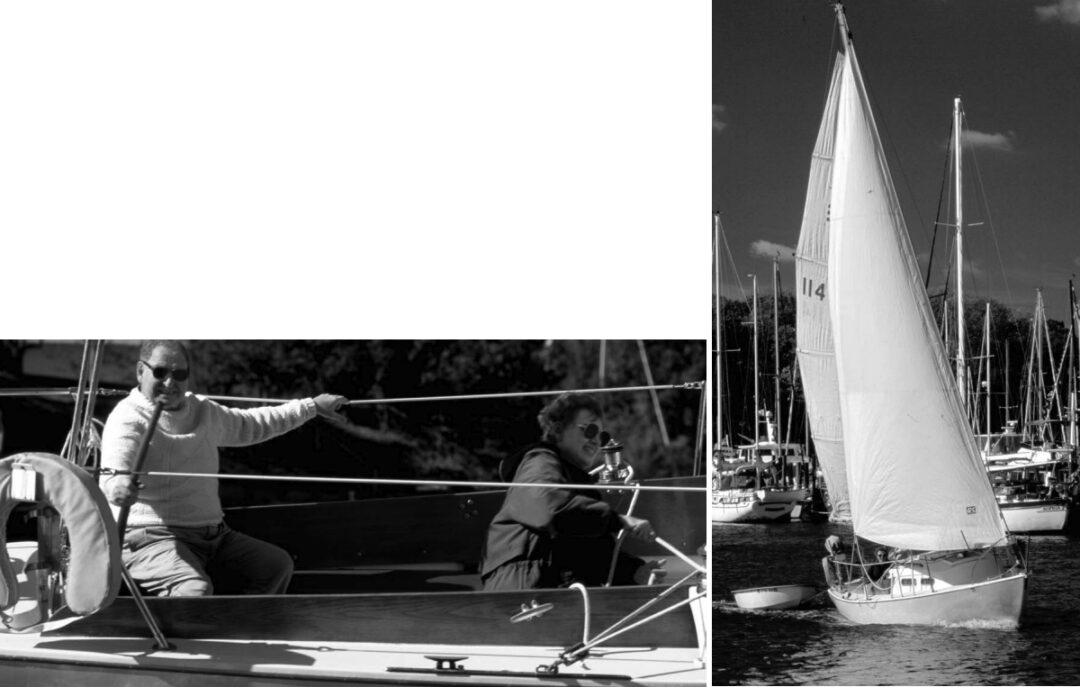
Not many cruising couples today would take a 26-foot “bare bones” sailboat on a grueling, 1,200-mile trip through three Great Lakes and the isolated waterways of Canada. But with just two years of experience under their belts and a tiny boat by today’s standards, John H. Smith, and his longtime friend, Pat Tengel, headed off in a Pearson Commander on an adventure that took them across the Great Lakes, through more than 50 locks, around hundreds of islands, through a horrific storm, and perhaps even into the history books. Recently, John, who spends his off-season surfing the web for any tidbit of information he can find about improving his classic Alberg-design boat, has been told that the cruise they took in 1972 may well be the longest single journey ever made by a Pearson Commander.
That says something about the boat . . . and the couple. Today, 27 years after that voyage, John and Pat are still together sailing on Pocahontas. There are no contracts binding this trio. But, then, there is no need for one. The love and respect between this couple, whose relationship will turn 30 next year, is obvious.
Sailing has helped bond their relationship, which has lasted far longer than most relationships sealed with a marriage contract. They work as a team on board, John at the tiller, Pat helping tend the sails. When bad weather hits, that love and respect are even more evident. In the past with Pocahontas plowing through high seas and John at the tiller, Pat admits, “I had all the faith in the world in him. I slept.”
When you see the long, sweeping lines of Pocahontas and observe how well she handles rough seas, it quickly becomes apparent why Pocahontas is still in the family. The couple has put many hours into keeping her condition pristine and has added safety and comfort features that place her on par with modern boats.
Today, John and Pat, who moved to Maryland and the Chesapeake Bay in 1974, sail “from dockside restaurant to dockside restaurant” in the tradition of Chesapeake Bay sailors. But in their youth they were seeking adventure.
“You did things without really thinking. We had blind optimism,” says John, who believes the optimism of the ’70s helped fuel their spontaneity. He was working on submarines as a metallurgist with U.S. Steel Research Laboratory in Pittsburgh at the time. For a man who had grown up along the shores of the Delaware River in New Jersey, and whose heart yearned for the sea, Pittsburgh was not exactly the ideal place to live. The Ohio and Allegheny rivers, though fine for motorboating, proved too narrow and commercial for sailing. He was 220 miles from the Chesapeake Bay, and 100 miles from the Great Lakes. In between were many small lakes, one of which served as a place for him to learn how to sail.
As a 30-year-old single man, John thought nothing of buying a sailboat and then learning to sail it. His first investment was a 16-foot Comet. He paid the owner, who then took him out on the lake to show him how to sail it. They promptly capsized.
“We had to get the Coast Guard to rescue us and tow us back,” John says. “But it didn’t put me off.” Anyway, he concedes, the guy already had his money. He enjoyed daysailing in the wooden Comet, but soon found that the 100-mile commute for just a few hours of sailing was a bit too much. “I wanted something I could stay aboard.”
So, he started looking for a boat with a cabin. Since he was a few years ahead of the recreational sailboat boom of the ’70s, it wasn’t easy finding a used boat. He finally located a 5-year-old Commander in Cleveland, 120 miles from home.
“It seemed like such a huge boat. It seemed like you couldn’t see the bow, it was so far away,” John remembers. He describes the Pearson Commander as “a scaled-down Triton,” which was the first design Carl Alberg ever made in fiberglass. Two feet shorter than the Triton, the Commander has the same hull (a full keel with attached rudder, mast, and sail plan) as another Alberg-designed Pearson, the Ariel, but the Commander has a bigger cockpit and a smaller cabin.
Down below, the boat has a V-berth in the bow, with a head tucked between the berths and fitted with a cover. A curtain can be drawn for privacy. The galley — which lost out when the Ariel cabin was shortened for the Commander model — is small, but adequate. There is room below for several people to sit down.
It would seem that the Ariel, often referred to as the “cruising version,” might have fit the couple’s needs better than the Commander, which was marketed as a daysailer or weekender. But John was single, with no plans beyond racing and spending weekends aboard — exactly what the Commander was built for.
The boat came with a spinnaker, a storm jib, and a huge 170-percent genoa, perfect for racing in the Midget Ocean Racing Class, which John planned to do. Another selling point was that the original owners had hardly used the boat, John notes. They had never slept aboard or used the head, so the boat still looked new. At $6,000, the price was also right.
With a name like John Smith, he naturally had to name the boat Pocahontas. That name has brought its share of tales. John recalls the time his yacht club sailed across Lake Erie to Canada, and they were going through customs. The lines were long, and the custom officials were agitated. He had trouble convincing the official that he really was John Smith sailing the Pocahontas. Behind him, the next guy in line was getting very nervous. His name was Charlie Brown, and he had sailed across on Good Grief.
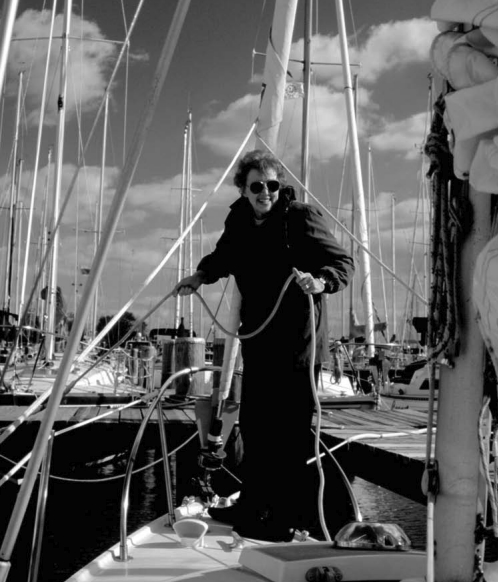
Pat met John through the Pittsburgh Ski Club where they both satisfied another passion for adventure. “A couple weeks after I bought the boat, I went to the ski club to round up a crew,” John remembers. Pat, who taught at a nearby college, had taken a “dry land sailing course” years before in college and thought that qualified her as “knowledgeable.” So she volunteered.
“I thought I would learn from the crew,” John says. As it turns out, none of his “expert crew” knew anything, so they learned along with him. Pat teases that he kept her on as crew because, “I was the only one who could get the sail in before the wind caught it.” The two have been inseparable ever since.
Sailing on the Great Lakes in the early ’70s, when boats had no instruments or communications gear, taught the couple to be self-sufficient and to appreciate the seaworthy design of the Commander. They remembered one time when a yacht club race turned almost to disaster when a line squall blew up on Lake Erie and caught the fleet miles from shore. The original boom on Pocahontas attached to the mast with a gooseneck fitting, which allowed them to reef the mainsail by rolling it around the boom. It was a doomed design, and in 40-knot winds the mechanism broke.
They stashed the boom below and continued the race with just the foresail. “Then 75-knot winds knocked us down, first on one side then on the other,” John says. The wind was so strong it compressed the jib sheets and yanked the knot at the end of each sheet through the block. “The sheets were flying straight forward,” John recalls. At that point, they gave up the race and turned toward home. John soon replaced the original reefing system with a jiffy reef, which did away with the flimsy gooseneck.
The fact that Pocahontas survived this and other batterings on the Great Lakes is a testament to Carl Alberg’s seaworthy design. Built heavy, as all of the early fiberglass boats were, the Commander, and her sister, the Ariel, are not fast, but are known to be strong boats that don’t pound in heavy seas, a real plus that has many owners, including John and Pat, calling them a joy to sail.
Joining the Erie Yacht Club offered John and Pat more than just the congenial company of fellow yachters and the opportunity to race their boat. “It was very important to be part of a good yacht club for exchange facilities because at that time there were not many boatyards,” he notes.
Even at home there were no facilities for hauling boats in the winter. “We did it ourselves after the Halloween crossing, which was called the ‘two-bottles-of-rum crossing,’” John says. After this last cruise of the season to Canada, club members got together every weekend for most of November to haul their boats.
Their decision to make the long Canadian cruise came about because John’s company had an unusual arrangement that allowed employees to take extended 8-week vacations every five years. John came up with the idea for the 1,200-mile cruise after realizing that he could make a complete circle of three Great Lakes by taking the Trent-Severn Waterway, an old military canal between lakes Ontario and Huron, and then crossing from Lake Huron to Lake Erie through a series of rivers. The canal had recently been turned into a recreational canal, but few boaters were taking advantage of it in 1972.
“It was a convenient circle. I don’t know if anyone had ever done it before,” John says of the cruise. “In the yacht club, it was quite an event.”
John and Pat learned all they could about sailing in the two summers preceding his extended vacation. They prepared Pocahontas for the journey with a few new pieces of equipment, including a sewage holding tank, which was mandatory in Canadian waters.
John installed a depth sounder prior to the long trip after they missed a port because they were too far offshore. “When I sailed along the shore of Lake Erie, I was afraid of running aground. Everything there was 100-foot banks with nothing distinctive on shore. I stayed so far offshore, sometimes three miles off, that I missed a port and sailed all night,” he says. When he ended up in Buffalo instead of Barcelona, N.Y., he knew it was time to get a depth sounder.
John and Pat set sail on their historic cruise over the Fourth of July weekend as part of a yacht club cruise to Port Dover, Ontario, on the north shore of Lake Erie. Then, instead of heading home, they set their sails on an easterly course toward Buffalo, N.Y., Niagara Falls, and Lake Ontario. At Niagara Falls, they followed the shipping route through the Welland Canal, a series of six locks that detours ships safely around the falls. Little Pocahontas was wedged into the locks with a big ship throughout the 12-hour journey.
“I had done a lot of planning, but the rest was seat-of-the-pants,” John remembers. They hit their first obstacle at Trenton, Ontario, at the eastern end of Lake Ontario. The very first bridge in the Trent-Severn Waterway had a bridge clearing of just 10 feet. They had to remove the mast, but there was no boatyard to help them wrestle the spar to the deck. The problem was solved when the Royal Canadian Air Force Base Yacht Club offered to help them in exchange for a day spent crewing in the club’s Soling one-design race. They crewed for the club commander, who was short of crew. That obligation taken care of, Pat and John had eight Canadians helping them unstep their mast for the 250-mile-long journey through rivers, lakes, and connecting canals.
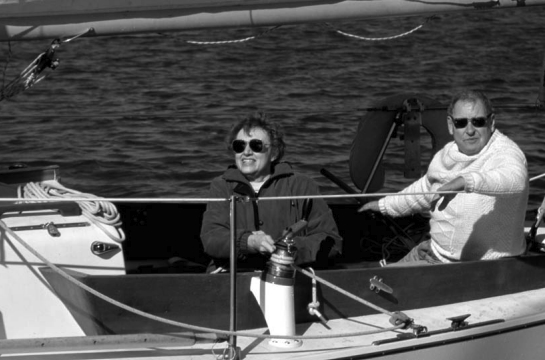
The 50 locks included one that employed a railway to haul them up and over a mountain. “Each lockmaster took great pride in trying to outdo the others in keeping the grass cut, the flowers growing, and everything pristine,” John says.
The couple didn’t mind the Commander’s lack of cabin space even on this two-month cruise. They simply set up a barbecue in the roomy cockpit and enjoyed the beautiful rugged hills and isolated plains of Canada as they cooked and dined.
The canal ended at Port Severn in Georgian Bay, an arm of Lake Huron. Here Pat and John faced an even bigger obstacle: navigating through this rocky bay of islands. “You had to count the islands to know where to turn. We miscounted,” remembers John. “We ran aground and got a leak at the depth sounder.” The damage was minor; he fixed it with a little underwater epoxy applied from inside the boat.
The couple was out on Lake Huron when they faced the worst weather of the trip. “The waves were too big: 12 feet high. They looked like they were up to the spreaders. We shouldn’t have been out there, but there was no weather forecasting in those days,” John says. “I tied myself onto the boat with a rope. We submerged the bow. We were surfing, going nine knots,” several knots faster than the hull speed of the boat.
They bypassed the nearest harbor, which was too small to enter in a storm, and sailed all night. At dawn, they pushed into Goderich, Ontario, weary, but whole.
At the southern end of Lake Huron, a series of lakes and rivers — St. Clare River, Lake St. Clare, and the Detroit River — carried them south to the western end of Lake Erie. Now they were on familiar waters.
The trip taught John and Pat to appreciate cruising. “Each day you get going, you make certain decisions, and you get instant feedback,” John says. “If you make good decisions, at 3 p.m. you’re sitting in the cockpit with a drink. If you make bad decisions, you’re sailing through thunderstorms and eating with the mosquitoes.”
The couple moved to Maryland in 1974 when John took a job with the National Institute of Standards and Technology (NIST) formerly the National Bureau of Standards. As a metallurgical engineer, he does research on new metals and high-pressure cylinders. Pat works with the University of Maryland Extension Service.
They found the Commander to be well-suited to the Chesapeake, where sailors are hardly ever more than a few hours out of a port, unlike the Great Lakes, where they often endured bad weather because ports were 40 or 50 miles apart.
The boat’s full keel helps with directional stability, and the 3-foot 8-inch draft is shoal enough to allow them access to most of the bay’s beautiful, but shallow, creeks.
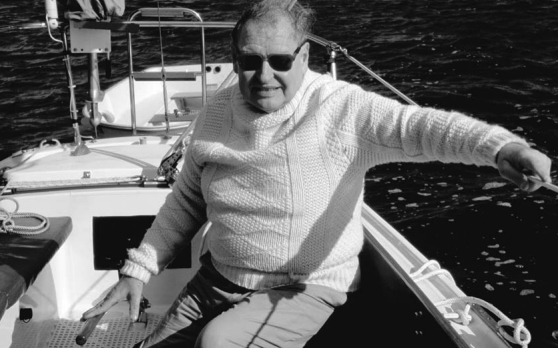
Pat says the big cockpit is perfect for Chesapeake gunkholing. There’s plenty of room to stretch out and get comfortable while sailing up a river or creek, taking in the constantly changing scenery. When she’s not sightseeing, Pat’s favorite sailing position is lying stretched out on the cockpit cushions enjoying the warm summer sun.
“The big cockpit is perfect for the kind of sailing we do here — sociable daysailing,” John says. There’s plenty of room in the cockpit for friends who occasionally join them for a daysail to a favorite dockside restaurant. John admits that someday they may look into buying a bigger boat, but they vow it will be another good old boat with a classic design, like the Commander.
“I guess I have more respect for something old and in good shape than something new, just out of the box,” he says.
Pat is equally adamant. She doesn’t want a new boat with a five- or six-digit price tag. “I don’t want to be married to it,” she says.
But if history offers any insight, their next classic — even without the standard financial contract — will be in the family for a long, long time.
Thank you to Sailrite Enterprises, Inc., for providing free access to back issues of Good Old Boat through intellectual property rights. Sailrite.com