She is loved for her comfort and speed
Issue 99 : Nov/Dec 2014
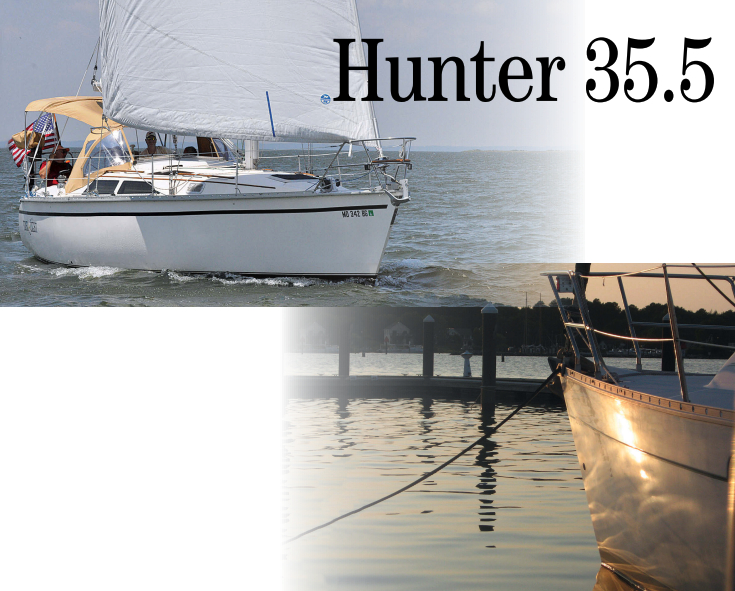
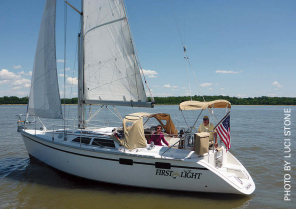
She’s one of the sweetest, cleanest boats in the marina, and two of the best people own her. Bob and Barbara Pulyer’s 1989 Hunter 35.5 Legend always seems to be faster than the other boats in the cruising club fleet, yet Bob and Barbara make sailing First Light look effortless. “If it isn’t easy, we don’t do it,” Bob says. Even though they don’t sail the boat hard, First Light always seems to be first to weigh anchor or arrive at the day’s destination, just as her name suggests.
This might seem somewhat surprising, considering that Hunters are not generally known for their speed. Some sailors have an attitude about Hunters for no good reason, much as the New York Yankees don’t get the respect they’re due. Then again, the Yankees had some bad years in the 1980s and maybe Hunter did too. I sailed a Hunter 37.5 Legend for a while and, though I didn’t think much of her sharp lines or rather stark interior appointments, I must say she was certainly no slouch under sail. This was true even in the notoriously fickle air of the Chesapeake in midsummer. Hunter makes a good product aimed at a certain buyer and, to the chagrin of naysayers, Hunter is still in business and thriving with thousands of satisfied customers. The company must be doing something right. The 35.5 Legend seems to be one of the things it got right and was perhaps a turning point for Hunter. The fractional rig is fast on most points of sail; this boat performs well and, when it comes to First Light at least, always efficiently.
Hunter Marine USA of Alachua, Florida, built about 700 H35.5 Legends between 1989 and 1995. Designed by the in-house design team as a racer/cruiser, this model replaced the Hunter 35 Legend, which had a different layout and a stock draft of 6 feet 6 inches.
Notable features
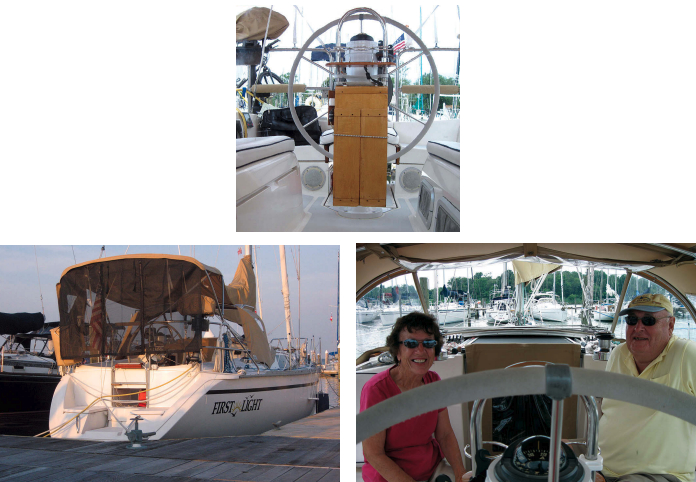
When sitting at First Light’s helm, you get the sense of a well-thought-out design. Whether Hunter developed the design on the factory floor or based it on suggestions from owners, everything seems purposefully designed for comfort and ease of handling . . . just the way the Pulyers prefer. The large stainless-steel wheel is easy to get to and away from, thanks to the cockpit’s very smart modified-T configuration. It’s also possible to see straight ahead unobstructed by the typical bank of instruments mounted above the binnacle. Bob likes the wind, depth, and speed instruments to be right where they are: mounted on the bulkhead. Especially handy is the Uniden WHAM remote microphone for the VHF radio that Bob mounted on the pedestal. He can use it like a handheld but it has the range of the main VHF radio’s masthead antenna.
There’s a lot to like about the Legend series, and Bob likes the inherent stability the most. All of the variably heavy stuff — water, fuel, and holding tanks — is placed along the centerline, lessening trim issues.
Mayor of the marina
Bob, a tad over 70, could be described as the unofficial “mayor” of the marina. Every place has one, and Maryland Marina in Baltimore County, Maryland, is no different. Bob’s variously known around the docks as a canvas maker, a fixer, and a problem solver. He’s the sort of guy who, like any mayor worth his salt, seems to know the ins and outs of a problem and is willing to offer his advice, if not outright assistance. Sooner or later, each sailor there will go to him. If he can, Bob will advise any of the marina’s sailors on how to do something. If they still don’t succeed, more often than not he’ll be right alongside to help.
Some may wonder why they didn’t just let him do the job right in the first place. But there’s method in his approach: Bob wants each one to learn how to do it himself. His unspoken mantra seems to be that owning a sailboat should be an exercise in self-sufficiency. If there’s a lesson to be learned, Bob’s happy to oblige. And he’s always experimenting, researching, and generally puttering about finding new ways to improve life aboard First Light.
If Bob is the mayor, Barb is the first lady of First Light. She is at once cheery and charming, always putting others first, and able to cook up the most delicious desserts and other dishes. On First Light, she’s in charge of provisioning, loading and unloading, assisting in the running of the boat, and bottom painting . . . among other responsibilities. The two work together as a team and that makes First Light a happy ship of the highest order. Barb’s set way of handling the foredeck docking and casting-off duties is an example. There is no unnecessary scurrying about. “If it isn’t easy,” she reminds me, “we don’t do it.”
Small boat beginnings
Bob grew up in the shadow of the Delaware Memorial Bridge on the New Jersey side. One day, a kindly neighbor offered him a beat-up old Lightning if he could make her seaworthy. Bob worked on the classic 19-foot racer and taught himself to sail along the Delaware River, a better place than most to test one’s mettle, especially in a leaky wooden boat.
Bob met Barb at the University of Maryland and, after they married in 1963, he went to work for Princeton while Barb worked for the state’s Department of Education in Trenton. After a stint at IBM for Bob in New York state, they relocated to Towson, Maryland, to raise a family. Barb’s office-management skills, that she honed at an architectural firm and later a wooden-pallet company, would come in handy in helping Bob run the boat in a businesslike fashion.
Third in a progression
First Light was already a good old boat when she came to the Pulyers in 2000. Their previous boat was a Hunter 31.5 named Sanctuary. Their first sailboat, and the one just before the 31.5, was a Super Sea Snark that
they hauled back and forth between Ocean City, Maryland, and their home in Towson.
The typical progression of boat acquisition usually includes a waypoint in the 20- to 30-foot range. But not for the Pulyers. Their jump from the ubiquitous 11-foot Styrofoam Snark — perhaps the entry-est of entry-level boats of all time — to a 31-footer was a rather large one indeed, but one they made without regrets. It is true that a 50-pound boat made of the same material as a fast-food takeout container will teach you a lot about wind shifts, stability, and trim.
Sanctuary taught the Pulyers about big-boat handling, care, and feeding. The boat had been neglected when they purchased her, but they got to work upgrading her and making her respectable again, just as Bob had done with the Lightning many years before. Then it was time to buy a bigger boat, and First Light became the new flagship.
Upgrades aplenty
Bob and Barb are careful and methodical about the upgrades they choose to make to First Light. The goal of each one is to improve comfort and functional ease. Nothing looks added on or gadgety. Everything is there for a reason — no more, no less — starting with the connected desert sand Sunbrella dodger and Bimini system that, with the addition of side and stern netting, gives them full enjoyment of the cockpit. The side curtains, Bob says, help cut down the hot Chesapeake sun while keeping mosquitoes at bay. Bob is ever mindful of windage, however, and everything except the dodger can be struck down and stowed quickly and easily when necessary. Even the dodger has detachable panels.
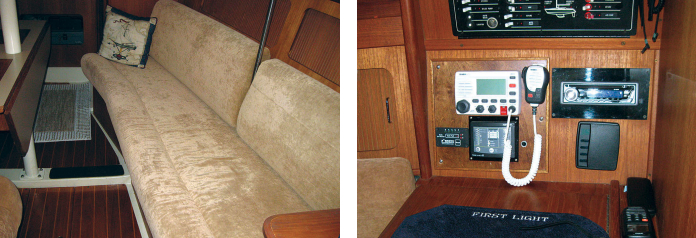
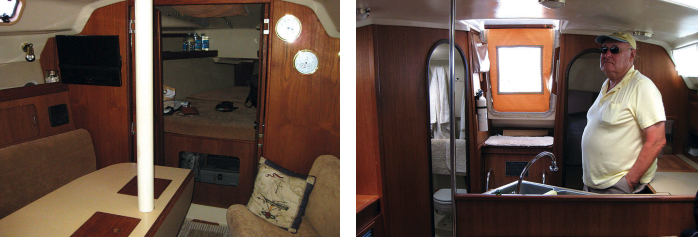
Upon going below, a visitor first encounters a practical galley with a deep double sink. Aft of the galley, the aft cabin occupies the port quarter, and the head compartment is opposite, to starboard. From there forward to the V-berth is one of the most sumptuous “living rooms” ever designed into a 35-foot production boat, made all the better by the Pulyers’ decision to replace all the stock upholstery with 6-inch foam upholstered with a plush mid-brown fabric to set off the boat’s off-white surfaces. The table that swivels around the mast’s compression post allows for ease of movement and can be arranged in several configurations for entertaining or dining.
The Pulyers installed refrigeration, replaced the reverse-cycle heating and air-conditioning system, and most cleverly converted from the original CNG fuel to an LPG system, complete with a custom compartment for the gas that Bob designed himself.
Bob didn’t like the way the stock headsail furling drum was situated inside the well of the anchor locker, so he designed a better setup that included a new anchor locker lid with a piano hinge and an improved bowsprit for a new Schaefer furling system. One benefit was a headsail that no longer swept the deck, vastly improving the view forward from the helm.
Simple sailing goals
Chesapeake Bay is well known as one of America’s greatest cruising grounds. With more than 11,600 miles of shoreline, 4,480 square miles of surface area (550 marinas and 41,000 boat slips in Maryland alone), and countless anchorages, cruisers plying her waters find a great diversity of opportunity and reward. In this, the Pulyers are masters of their universe and First Light will take them wherever they point her bow with expedience and in comfort.
The 10-mile run across to Worton Creek is a favorite weekend cruise. It isn’t uncommon to watch a bald eagle fishing around the anchorage there. Longer cruises are generally made in company with the Northern Chesapeake Cruising Club with Bob at the helm in his current capacity as fleet captain. The fleet never strays far from home, and the Pulyers are content with that. For them, the bay is big enough and interesting enough to satisfy their sailing ambitions for years to come or, as Bob says, as long as its easy. Barb, who is just as content with daysails, heartily agrees.
Steve Allan sails and writes out of Baltimore, Maryland. Being from Toronto and used to the cold, he enjoys sailing a 26-foot sloop year-round on Chesapeake Bay.
Thank you to Sailrite Enterprises, Inc., for providing free access to back issues of Good Old Boat through intellectual property rights. Sailrite.com