Clean, reliable diesel for the DIY cruiser
Issue 86: Sept/Oct 2012
In our early years of cruising, we learned the hard way about how important clean fuel is. I didn’t worry about the fuel as long as the primary fuel filter looked clean. On one offshore passage, however, the seaway was a bit rough, which churned the fuel enough to mix up all the sediment that had been lying benignly in the bottom of the tank. As we motored into a tight marina full of very expensive boats, I discovered how quickly the fuel filters could clog up, starving the engine of fuel. The old adage about aiming for the cheapest boat came to mind, but fortunately we managed to secure a line to a T-dock before damaging anything other than our pride.
We quickly hired a service to clean the tanks and polish the fuel. There was nothing magical about the process. They pumped the fuel out of each tank, processed it through a rather large industrial version of a marine diesel filter, then discharged it into another tank. They cleaned the insides of my tanks with a wand, and pumped the fuel back in . . . all for a rather outrageous price.
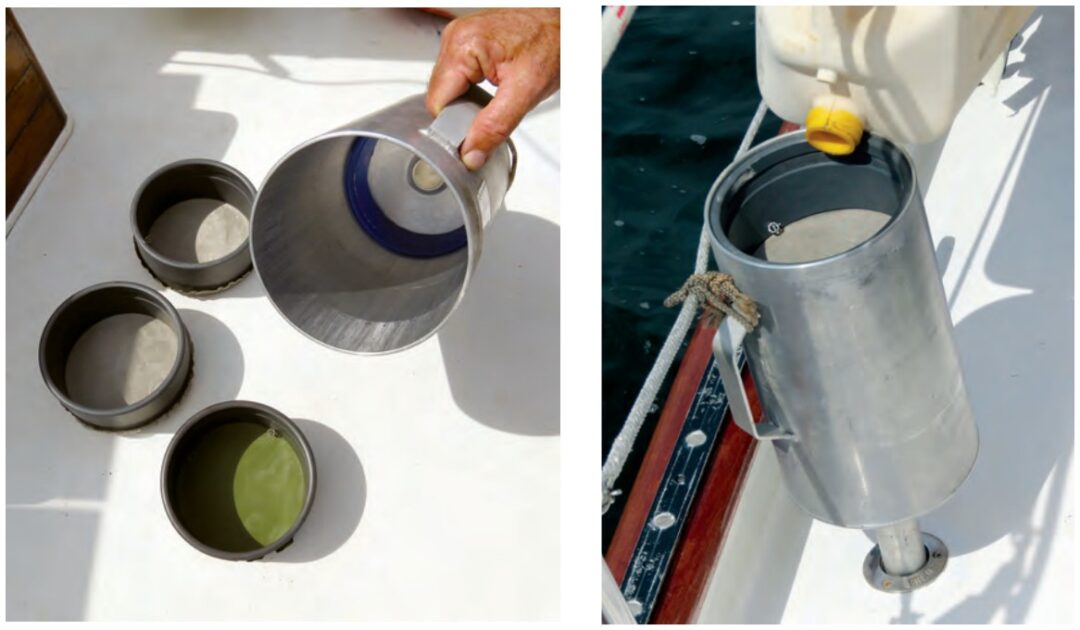
Since that expensive lesson, we have been a lot more careful about our fuel and do what we can to prevent getting contamination into the tank. Our first line of defense is our old reliable Baja filter. We almost always use it when refueling at a marina or fuel dock. This increases the time needed to refuel, however, and there are times when the attendant gets a bit cranky when we insist on using it, especially at a busy fuel dock. Usually we can reach a compromise by using the filter for a minute or two, then doing a quick check of the filters to see whether we are getting water or other contaminants. Only once has an attendant flatly refused to allow us to use it.
Even with the best of precautions, however, we still get water in the fuel tanks. I have replaced the O-ring on the fuel cap, thinking this might be the source, but that didn’t eliminate the problem. I suspect it comes from condensation forming inside the metal tanks as the ambient temperature varies. If not removed or treated, the water will allow algae to grow, which in turn will clog the filters. To combat this, I built a small fuel-polishing system and routinely clean the fuel and tanks. While not my favorite chore, it isn’t difficult. I do this annually or whenever I see any signs of sediment buildup in the primary filter.
As we travel to more remote areas, fuel docks become rare and “jerry canning” is the usual method of obtaining fuel. A notable instance was in Ushuaia, at the southern tip of Argentina, where fuel was rolled down to the dock in rusty 55-gallon drums. We were rafted up with four boats between us and the dock. The process was to carry the fuel cans across the other four boats, siphon fuel out of the rusty drums, lug the fuel cans back one at a time to our boat, and decant them. After repeating the process for a total of about 48 trips, I was definitely ready for a beer.
The fuel-polishing fix
When I decant diesel from fuel cans, especially when it is as suspect as that fuel in Ushuaia, I usually use the fuel-polishing system to transfer the fuel. It is a bit slower than the Baja filter but eliminates any chance of spilling fuel and is probably more effective in removing contaminants and water. In addition, the Baja filter must be cleaned after each use. This takes about 15 minutes and is messy, while the fuel-polishing system requires no cleaning after use.
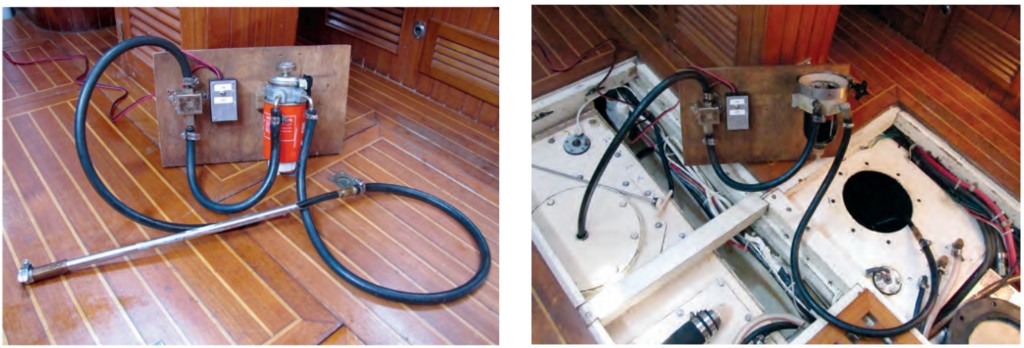
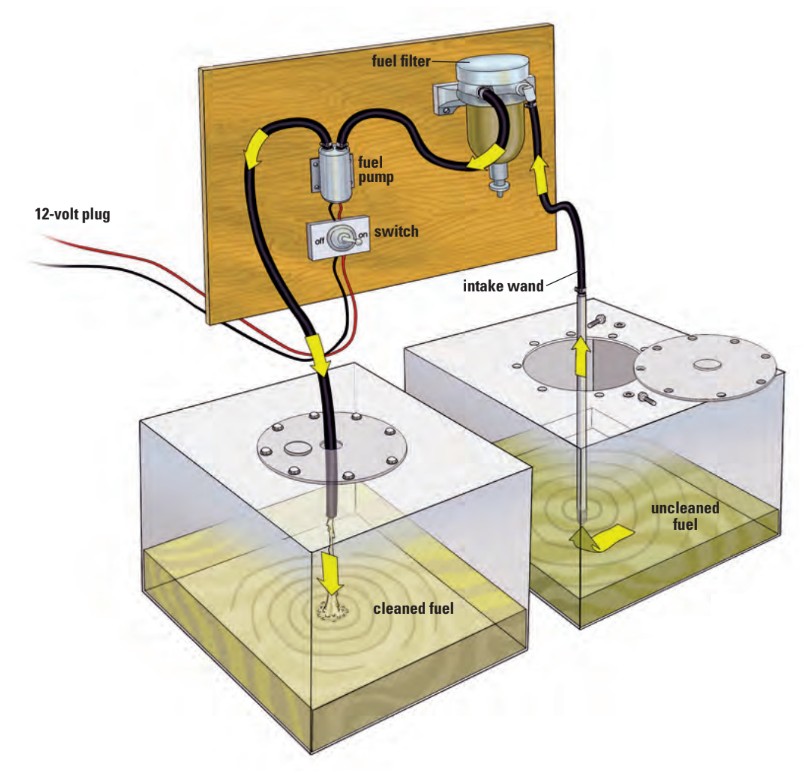
The polishing system is quite straightforward. The intake is via a wand long enough to reach to the lowest point of the fuel tank. I used stainless-steel tubing for the wand but PVC or aluminum tubing would work just as well.
The intake is connected to a diesel filter. I initially used a spare Racor fuel filter. While in South America, I went through my spare filter cartridges at an alarming rate. They were quite expensive, about $25 each, when I could find them at all. I went to an auto parts store and asked for an automotive diesel filter that had inexpensive filters. The clerk was happy to spend some time researching options for me and finally found a complete diesel-filter assembly for a Kia at a cost of $80 and $6 per filter. The disadvantage of an automotive filter is that you can’t see how much sediment or water has built up in the filter. I found that by periodically checking the flow rate I could determine when the filter had become clogged. The filter also came with an electrical connection to monitor the water level inside the filter and a fitting at the bottom to drain off any collected water. By occasionally checking the resistance across the electrical contacts with an ohmmeter, I can determine if too much water has collected inside the filter. If I decide to use it permanently, I think it would be possible to add a resistor and an LED that would light up when water reached an excessive level in the filter.
The outlet of the filter is connected to an electric fuel pump. I found this at an auto parts store by asking for a small universal diesel fuel pump. The least expensive one I found was $38. This included a mounting bracket and hose fittings. The fuel pump is connected via a switch to 12 volts. I use a standard 12-volt plug for the connection.
I mounted everything on a piece of plywood to make it portable. That way, I can use it for either of the fuel tanks below, take it up on deck to decant fuel from the fuel cans, or even loan it to cruising friends with fuel problems. To seal the system when it’s not in use, I insert a bolt into the discharge hose and clamp it, and cap the intake wand with a short hose plugged in a similar way.
The polishing process
To polish the fuel, I wait until the levels in the fuel tanks are below half full. I remove the inspection hatches from both tanks, insert the wand into one, the discharge hose into the other, and start the pump. To begin with, I position the wand so it’s an inch or two higher than the lowest spot in the tank. I monitor the fuel rate and the electrical resistance of the water sensor on the filter and drain the water or change the filter as needed.
When only an inch or so of liquid remains in the tank, I use a flashlight and take a look at what is left. If it looks relatively clean, I continue pumping the tank as dry as possible, then get a bucket and sponge out whatever remains. If it’s mucky or there’s a lot of debris or water in that last inch or two, rather than consuming two or three more filters, I sponge out the remaining liquid and residue. Next, I wipe the entire inside of the tank with rags or paper towels. One tank should hold all the fuel. If not, I pump the excess into fuel cans.
I then repeat the process on the second tank, pumping the fuel back into the first tank. Again, I sponge out whatever remains in the bottom of the tank and wipe the inside of the tank. Lastly, I dispose of the bucket of muck in a responsible manner.
The entire cost of the project was about $150, and it rarely uses more than one $6 filter to polish both tanks. This is far less than what it cost us to have our fuel polished by a service. In addition, I use it frequently for decanting diesel from my fuel cans.
David and Marcie Lynn have lived aboard Nine of Cups, their 1986 Liberty 458, since purchasing her in Kemah, Texas, in 2000, and have sailed more than 65,000 nautical miles in their ever-so-slow circumnavigation. Visit their website at www.nineofcups.com.
Thank you to Sailrite Enterprises, Inc., for providing free access to back issues of Good Old Boat through intellectual property rights. Sailrite.com