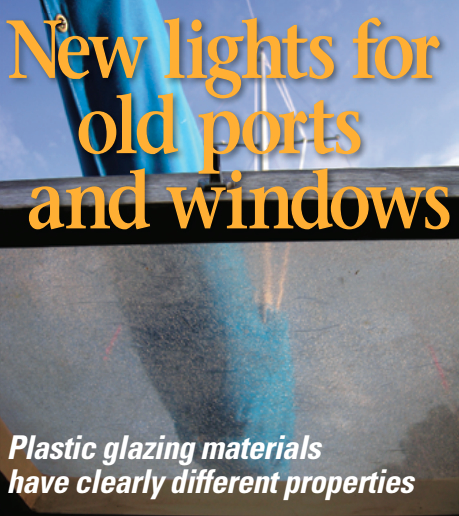
Plastic glazing materials have clearly different properties
Issue 71 : Mar/Apr 2010
For decades, most recreational boats have been built with hatches, windscreens, and ports made of rigid transparent plastics. Clear plastics have replaced glass because of their toughness, cost, ease of fabrication, and durability. Despite these great qualities, there comes a time when any good old boat needs to have some not-so-good old plastic replaced.
The two transparent plastics most commonly used on boats are acrylics and polycarbonates. Acrylics, known commercially by familiar trade names like Plexiglas and Lucite, have a longer history in the marine industry than polycarbonates, which are sold under trade names such as Lexan and Makrolon.
Both types of plastic come in a wide variety of formulations and tints. Each is available in a range of thicknesses with those in typical use on boats being from 0.06 inch to 1 inch.
Acrylics and polycarbonates are very different plastics. Whether you’re replacing old parts or planning a new project to make your boat even better, understanding their relative strengths and faults will help you determine the better choice for the job.
Physical properties
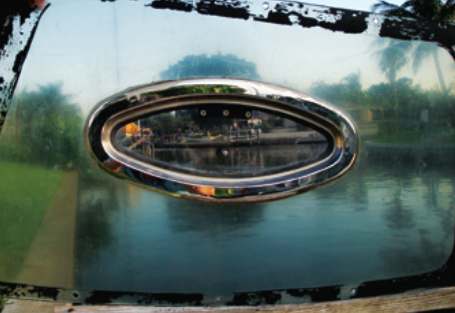
Clarity – Both acrylic and polycarbonate are available in clear and a range of transparent tints. Either plastic has visible-light transmission values that approach or exceed 90 percent, which is comparable to glass. Clarity is most often affected over time in both plastics by surface abrasion (scratching or scuffing) or prolonged exposure to the ultraviolet radiation in sunlight.
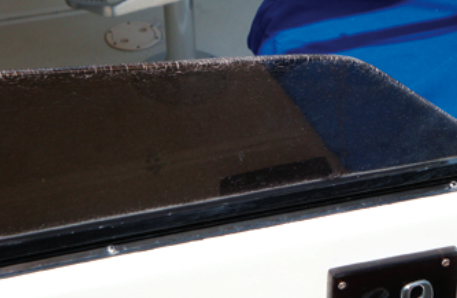
For many years, acrylic was the preferred material in marine applications because polycarbonate, in its natural form, is much less resistant to UV. Old acrylic too long exposed to the sun usually develops crazing that goes right through the plastic, but this could take decades to happen. Overexposed polycarbonate takes on a yellowish cast and the surface becomes hazy. In subtropical climes, this could happen in a year or two. Chemists went to work and developed additives and surface coatings for special grades of polycarbonate that increased UV resistance so it’s now comparable to that of acrylic.
Still, most grades of polycarbonate do not have the surface hardness of acrylic. That means polycarbonate is easier to scratch and mar. It also means it’s harder to polish out blemishes in polycarbonate to restore original clarity. In addition, there is the possibility of eventually wearing away the UV-protective coating.
Mechanical properties
There are three ways to compare the mechanical properties of different materials:
- Determine the force required to make each material fail in tension, compression, or flexing.
- Measure how materials react physically when a steady force is applied to them.
- Observe how they react when a sudden force or impact is applied.
The average tensile, compressive, and flexural strengths of acrylic and polycarbonate are similar, with acrylic slightly stronger in tension and fl ex. Polycarbonate edges out acrylic in compressive strength. Even though there is not generally a great difference in their ultimate strengths, polycarbonate is known as a “tougher” material than acrylic.
A modulus is a ratio of the stress or force applied on an object to the amount that object is strained or deformed before it breaks. A material with a lower tensile modulus (also known as a modulus of elasticity) will stretch more before failure under the same stress than one with a higher modulus. Likewise, the more a material bends or squeezes before it fails, the lower its flexural or compressive modulus. Polycarbonate has significantly lower tensile and flexural moduli than acrylic and will deform more for a given force than acrylic — it is far more elastic than acrylic. Acrylic, on the other hand, with its higher tensile strength and modulus values, can be brittle in service. For a roughly equivalent ultimate strength, polycarbonate’s ability to withstand a significantly higher percentage of deformation without failure than acrylic is one reason for its reputed toughness.
Impact strength is a measure of the ability to resist breaking from a sudden and localized stress. Perhaps the biggest mechanical advantage polycarbonate has over acrylic is its impact strength.
Standard impact strength tests are performed with samples that are either notched (a V-cut the width of the sample) or not. An Izod impact test subjects the material to a local impact with a measured force in the area of the notch. Materials that fail with low impact forces are called notch-sensitive. A notch-sensitive brittle material will often fail under impact in the vicinity of localized stresses, such as around screw or bolt attachment points. Acrylic is known as a notch-sensitive material; polycarbonate is not. Other impact tests use plain (non-notched) samples. All those tests demonstrate that polycarbonate shows a resistance to localized impact that is many times higher than that of available grades of acrylic.
Choosing a plastic
A general understanding of the properties of each material is a starting point to plan your project. Consider two common boat jobs: replacement of portlight lenses and companionway dropboards.
Portlight lens replacement – Many production boats are built with fixed cabin portlights made with acrylic lenses that will eventually need replacement. If in 20 years a portlight has crazed but not broken, it has given good service — the boatbuilder has done a workmanlike job of engineering and installation. A typical installation has the lens held in place with a caulk or rubber seal, sandwiched between metal frames which are, in turn, fastened to the cabin trunk. This installation allows the lens to float, which isolates it from stresses on the boat and absorbs some of the energy of local impacts. The flexible continuous seal provides no notches or stress points from which cracks could easily form if the lens is strained. The relatively high flexural modulus of acrylic can help prevent the lens from flexing enough to pop out of its frame if hit. Unless the service requirements of the boat will change (planning a trip around the Horn), there are three advantages to replacing the original lens with acrylic:
- You know what its service life will be.
- There should be no need to re-engineer the installation to accommodate the different mechanical properties of a different material.
- Acrylic generally costs less than polycarbonate.
Companionway boards replacement – A common custom modification to older boats is replacement of the old wooden dropboards in the companionway.
Dropboards can lead a hard life. They are often kicked, sat upon, stood upon, and even casually dumped into the cockpit locker. Few closed cabins suffer from too much light, especially on rainy days. A transparent plastic might be a good substitute for the old wooden boards. When you consider how to design and install new boards, polycarbonate merits consideration because of its ability to tolerate the abuse you expect to give it.
Getting your hands dirty
Tools – Use the right tools. When working on clear plastics, use saw blades and drill and router bits designed specifically for working with plastics. Blades and bits designed for rapid aggressive cutting can cause chipping or cracking. On the other hand, very fine tools can overheat the plastic in the cutting area which can lead to cracking and crazing later on when exposed to weather.
Cutting – Pay special attention to how you support the material as you cut. Secure your piece to a stable bench before cutting, then cut as close to the clamps as your tool will allow. Vibration or excessive bending can make things go bad quickly. It is also important to control the rate of cut. Polycarbonate is less sensitive to the speed of the tool through the material. With acrylic, too fine a blade or too slow a feed will result in the material re-welding behind the blade. Localized stress from this overheating can also cause crazing after the part has been installed. The same considerations apply to the use of router bits. Cut edges may be finished by removing tool marks with progressively finer sandpaper, then buffing with a white polishing compound.
Drilling – Drilling polycarbonate presents no special problems with standard drill bits, but acrylic may crack in the area where the bit breaks through the back side of the material. An alternative is to drill a small pilot hole through the material and finish with the final drill size, drilling with care from both sides. In any plastic, the hole should be slightly larger than the diameter of the fastener, and it’s a good idea to chamfer both sides of the hole for stress relief.
Fastening – The standard DIY installation procedures for your new part usually involve either mechanical fasteners or bonding (sealing, caulking). Mechanical fasteners should hold, not clamp, plastic to other things. Over-tightened screws and bolts are a common cause of failure when installing plastic parts. They can create local deformation or cracking at the fastener location because the plastic part will not have the same structural or thermal properties as the structure it is fastened to. Tighten the fastener down snug to the surface; resist the temptation to crank it down hard.
Where you are bonding or sealing parts, understand that acrylic and polycarbonate have variable resistances to solvents. Be aware of the contents of both the adhesive (or sealant) used to install the part and the cleaners you clean up with afterward. Many adhesives and solvents used in and around boats can damage plastics. This information is not hard to come by. Talk to your supplier. Read the container. Check the Internet. (Note: A good article on the subject of solvents and their uses appeared in Good Old Boat’s November 2004 issue. –Eds.)
Conclusion
In planning any project for clear plastics, be aware as a buyer. There are many grades of each of these materials for sale. Not all grades of polycarbonate have good UV-resistance and some grades of acrylic are tougher than others. Not just any grade of either plastic will necessarily be suitable for your application. Do your own research and work with an established supplier to make sure that your money and time are well spent. A basic understanding of the properties of these plastics and a little planning of your project will give you the pride of seeing your old boat shine.
Bob Biles has been sailing around Florida and the Bahamas for 45 years. He currently sails on Florida’s Gulf Coast. Bob applied 25 years of experience in commercial plastics to create Seaworthy Goods, a company that designs, manufactures, and sells products to improve sailors’ time afloat, see www.seaworthygoods.com.
Thank you to Sailrite Enterprises, Inc., for providing free access to back issues of Good Old Boat through intellectual property rights. Sailrite.com