A light-air sail simplifies cruising choices
Issue 67: July/Aug 2009
Code Zero — the term sounds like the title of a spy thriller or a military operation, but it’s not. It’s the name of a sail designed for use when conditions are just the opposite of thrilling. Since I added the cruising version of this sail to my inventory, short-handed sailing has become easier and less nail-biting. It allows us to sail in all apparent winds from 5 to 35 knots with just three sails.
The Code-0 is a free-flying sail that sets on its own luff rope. Developed as a light-wind racing sail for reaching and close-reaching, it’s designed to sail at 45 degrees to the apparent wind in 3 to 6 knots of true wind and at up to 100 degrees apparent in 9 to 11 knots true wind speed. (Note: the first Code-0 was a “stealth” sail, built for a boat in the Volvo Ocean Race, that measured as a masthead spinnaker but was used as a jib for sailing upwind in very light air. –Eds.)
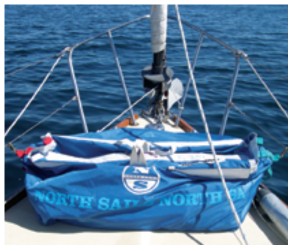
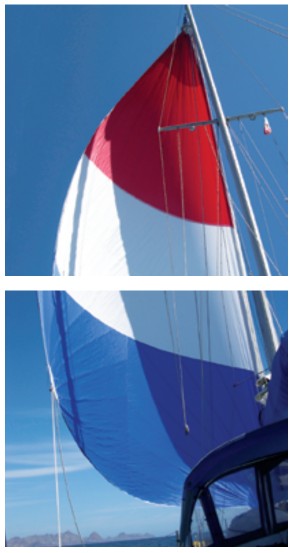
My sail is the cruising version of the Code-0 made by North Sails, which calls it the G-0. Similar sails are available from Hood Sailmakers, Doyle Sails, and many other lofts, some of which have their own names for their versions of what is essentially a de-tuned Code-0. It’s about the size of a 160- to 170-percent genoa but it looks and acts like a cross between an asymmetric spinnaker and a genoa, so it’s much easier to handle than a cruising spinnaker.
The effective range of the G-0 is similar to that of the Code-0. North Sails claims it can be used in 3 to 4 knots of true wind at 36 degrees of apparent wind. However, North states that most of its customers will find acceptable speeds in 8 knots of true wind speed at 45 degrees apparent wind. Although efficiency will drop off when sailing lower than 90 degrees, North expects that the G-0 will be lugged as low as 115 to 120 degrees.
More fun than the engine
I originally bought our G-0 in 2001 to avoid turning on the engine in light air. At the time, we were sailing out of San Diego and cruising up and down the coast of Southern California. This is generally a light-wind area, and I found I was turning on the engine a lot more than I liked.
We generally sail our Bristol 35.5, a heavy-displacement boat, with a 130-percent roller-furling genoa. When the wind drops below 6 knots apparent, our boat speed crashes, but I am loath to take off the 130 and put up the 150 so we can sail faster. I admit to some laziness, but bear in mind that I generally sail singlehanded or with my wife. As I approached 60, I liked less and less the idea of hoisting and handing a big sail by myself. Even though the engine wasn’t a pleasant alternative, it offered a better option far too often.
I have spent money on boat things before, only to be disappointed. Consequently, I was a little nervous about putting out money for something with which I had no experience. As it turned out, the G-0 has filled the light-air gap and cut down on my engine use.
Better ghosting
For me, the G-0 isn’t about sailing at maximum efficiency. Instead, it offers the ability to achieve reasonable speed in light air. The G-0 is a big light-wind sail that’s easier to put up and take down than a genoa, making it particularly useful while sailing short-handed. As a result, we make this sort of sail change more often.
With the G-0, we can make more than 3.5 knots in 6 knots of apparent wind at 45 degrees. With 8 knots of apparent wind, we can make 5.5 knots — not too shabby for a heavy cruising boat. If the wind speed increases above 8 knots at 45 degrees, our boat speed begins to slow. When that happens, I need to fall off a few degrees or replace the G-0 with the furling headsail. We also tend not to do well trying to sail above 45 degrees with the G-0 in any wind speed. That restriction probably has as much to do with the configuration of our boat as it does the sail.
I also use the G-0 as a downwind sail when sailing short-handed and use it to sail much lower than North Sails anticipated. It may not be as powerful as an asymmetric cruising spinnaker but it’s a lot easier to use. I sail as low as 150 degrees with the G-0, even though it’s not designed for this. (Below 150 degrees, it tends to be blanketed by the main and collapse.) I don’t view this as a disadvantage.
Fin-keel boats tend to be slower when sailing lower. The Bristol 35.5 has a modified fin keel with a big skeg, and we’ve found that in winds below 12 to 15 knots apparent, we can make better time toward our destination by sailing at 150 degrees or higher and jibing. Full-keel boats probably will want to sail lower and to do so will need to pole the G-0 out.
Easy to control
When singlehanding or when sailing with my wife, I tend to drop the G-0 when the apparent wind exceeds 12 to 15 knots. The boat moves briskly at these wind speeds, 6.5 knots or better. It’s still easy to control with the G-0, but this is a large sail and, in this range, even small increases in wind strength can have a large effect. To avoid a fi re drill, I prefer to drop the G-0 and use the roller-furling genoa, even though we may lose a quarter to a half knot or more.
The G-0 expands the wind range of our working sails because we’re able to use a smaller jib. We use the G-0 in lighter winds, where it gives us a more powerful sail than a 150 genoa, and it’s much easier to set the G-0 than it is to drop the 130 roller-furling genoa and replace it with the 150.
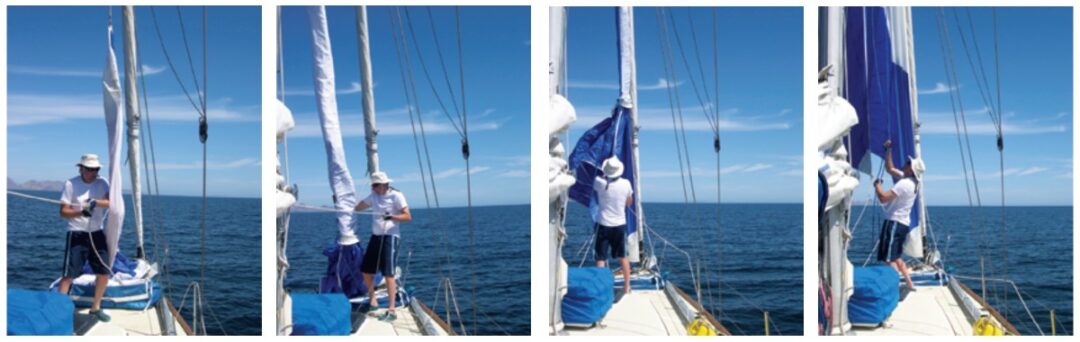
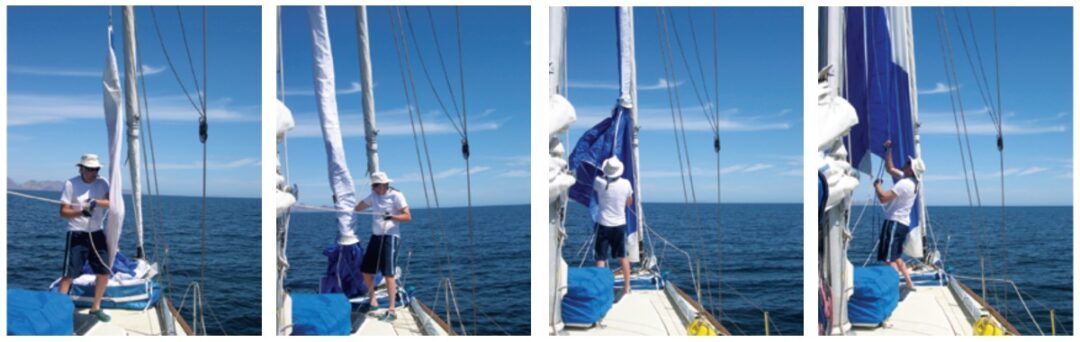
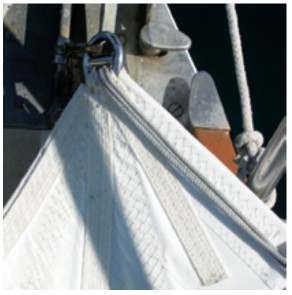
Although North Sails designed the sail to be set outside the foretriangle, like a cruising spinnaker, I set the G-0 inside the foretriangle, which makes it as easy to tack and jibe as a 150 genoa. It’s also a little easier to raise and lower when it’s set inside the foretriangle — in less than 10 minutes from the time I take the G-0 from its locker, it’s drawing wind.
You trim the G-0 the same way you trim a spinnaker, by watching the luff curl. When close reaching, I pull the luff as tight as possible so it has minimal curvature. When running, I ease off on the halyard to give the luff more curve. I tack the sail as I would any genny. When I must jibe, I first pull the lazy sheet tight. This allows the G-0 to be self-jibing. The sail will go through the foretriangle by itself without danger of wrapping around the headstay. Meanwhile, I can attend to jibing the main. Then, at my leisure, I can trim the G-0.
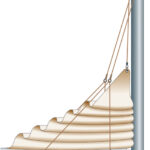
If I were to make this purchase again, I would make one change to our G-0. We bought the sail with a sock. It’s easy to use, but most cruising versions of the Code-0 are now sold with a furler. I haven’t used one rigged in this way but it seems to me that it would make using the sail even easier.
Proven on passage
My crew and I used the G-0 to good advantage on passage from San Diego, California, to La Paz, Mexico. We were three old men in a boat. The youngest was 62, the oldest 67. Because we didn’t have the energy and strength of youth, we preferred ease of use and lots of rest. The G-0 helped provide both.
During the first half of the trip, between San Diego and Bahia Tortuga, we encountered mostly light winds, but periodically they were punctuated with a Force 5 or Force 6. The G-0 made it easy to change down to a smaller sail when the wind increased and to put up more sail again when the wind decreased.
From Bahia Tortuga to La Paz, we primarily encountered heavy winds. We averaged between 6.5 and 7 knots over the ground and at one point we almost reached 9 knots. Through this part of the trip, the apparent winds typically ranged from 20 to 35 knots. This is when having the smaller jib on the furler paid off, because we didn’t have to change down from the 150 genoa, although on a few occasions I considered putting up the storm jib.
The most difficult leg of the cruise was between Cabo San Lucas and La Paz. Less than two hours after leaving Cabo, we encountered what in the Sea of Cortez is called a “screaming norther.” We had winds from 20 to 35 knots on our nose all the way from Cabo to the Bay of La Paz. Most boats making the same passage stopped at an anchorage called Punta Frailes. Eighteen boats anchored there for almost a week waiting for the norther to blow itself out. My crew, however, wanted to keep going, so we did.
Under fully reefed main and genoa, we slogged on. We could have raised a 90-percent jib, as a purist would have done. This would have been more efficient but instead, to keep from beating up ourselves and the boat, we sailed between 50 and 60 degrees off the wind. As a result, the reefed genoa worked well. We tended to make about 6.5 knots over the ground, although at times we were only making 3.5 knots toward our destination. A couple of times, we even slowed the boat down because we were taking too much water over the dodger.
The point of this story is that having the G-0 as our light-air sail allowed us to carry a sufficiently small genoa that we didn’t need to change to a smaller headsail. Admittedly, we couldn’t sail as high or as efficiently with the reefed genoa as with the 90-percent jib, but we wouldn’t have wanted to sail higher. Since most cruisers will bear off when sailing to weather in high winds, maximum efficiency is not an issue. Comfort and reducing the stress on crew and boat become more important considerations. If the going becomes too difficult, most cruisers will find shelter or heave-to.
The G-0 is not for every boat. Only in limited circumstances will it drive a boat to its maximum potential. However, it can make life a lot easier for the short-handed sailor who wants to avoid turning the engine on in light air. At the same time, it can allow a smaller jib to be carried on the roller furler and thus extend the upper range of the working sails. For the short-handed (and older) sailor, these seem to be virtues.
Carl Hunt is a semi-retired economist living in Colorado. He has been sailing for 27 years, cruising his own boats from British Columbia to Mexico. He has also chartered and cruised on other people’s boats on the East Coast, Great Lakes, Caribbean, Mediterranean, and other parts of the world.
Thank you to Sailrite Enterprises, Inc., for providing free access to back issues of Good Old Boat through intellectual property rights. Sailrite.com