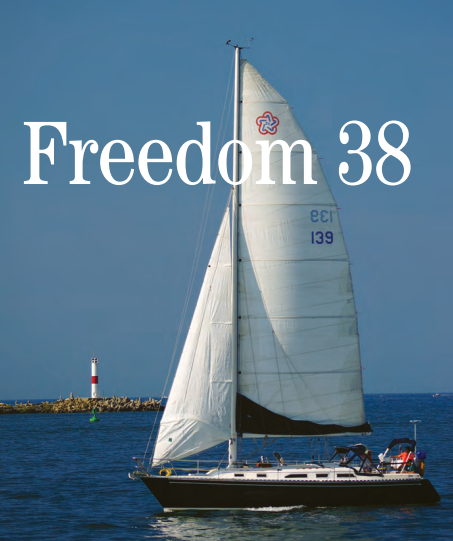
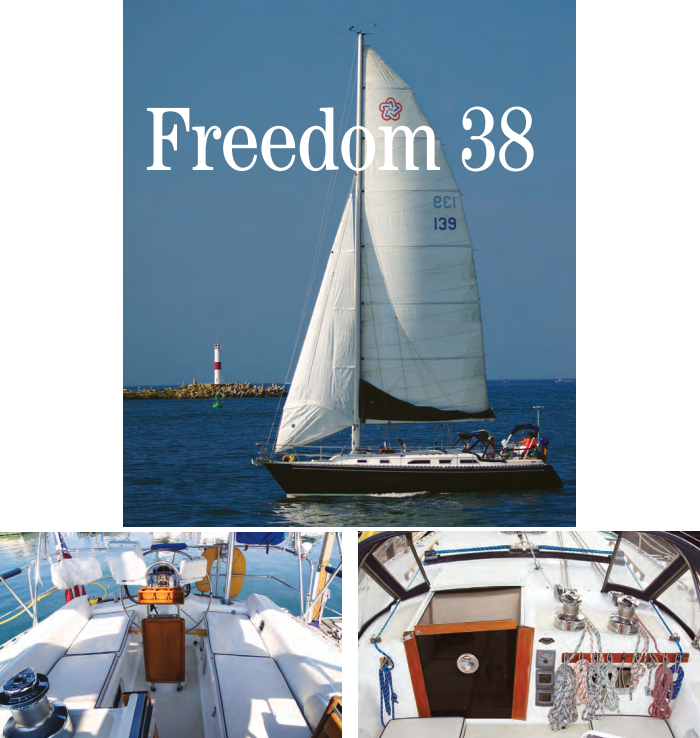
A well-built sloop with an unstayed mast
Issue 94 : Jan/Feb 2014
Frustrated with the sailboat offerings of the time, Garry Hoyt decided to do something about it. The former advertising executive and champion one-design sailor took his ideas to yacht designer Halsey Herreshoff and boatbuilder Everett Pearson of Tillotson-Pearson Industries (TPI). The outcome of this collaboration, the Freedom 40, was introduced in 1977.
The first Freedom 40 was an engineless cat ketch with unstayed carbon-fiber masts and wishbone booms, a flush deck, and a shoal-draft keel with a weighted centerboard. Two words describe the boat: fast and maneuverable. Its success led to the founding of Freedom Yachts and the introduction of several other ketches and a pair of sloops ranging from 25 to 44 feet. (See “The Man Behind the Boat,” May 2002.)
In 1986, Garry sold the business to TPI, which hired naval architect Gary Mull to design a range of new models. The first of these, the Freedom 36, was introduced that same year and heralded things to come. While the hallmark unstayed carbon-fiber mast was mounted well forward, the 36 was not just a big catboat with a vestigial jib but, technically, a fractionally rigged sloop. The boat was clearly a winner; and was soon followed by a half dozen other Freedom models.
In the early 1990s, TPI sold Freedom Yachts to a group of investors that included Paul Petronello, who was a TPI employee and Freedom’s sales manager. After the sale, the new company took the molds and set up shop in Middletown, Rhode Island. It was right around this time that a sugar scoop stern was added to the Freedom 36 to create the Freedom 38.
Her Diamond
A while back, I met Bob and Sheila Allenick at the town docks in Vermilion, Ohio. Their 1991 Freedom 38 caught my eye, and so did its name. Bob told me that, early in their marriage, money was tight and their emphasis was on important things like careers, family, and a sailboat. There never seemed to be enough money for a proper engagement ring. When they purchased the Freedom 38, Bob, seeking to take care of this deficiency, named the boat Her Diamond!
A few years later, I ran into Bob and Sheila again and took the opportunity to go over Her Diamond for a review. (By the way, I’m happy to report that Sheila did eventually get her real diamond.)
Design
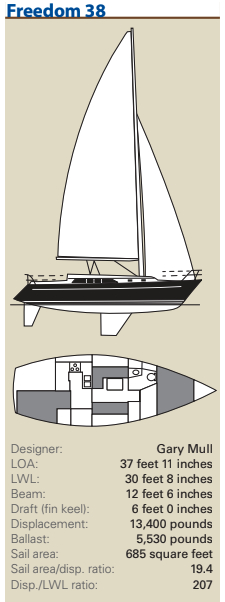
Compared to the earlier Freedoms, the Mull-designed Freedom 38 has a slightly boxier and more angular cabin trunk. Its beam is enormous, its waterline long, and its large mainsail is augmented with a small self-tending jib. The hull is sleek and powerful and has a flat bottom, a fin keel (a shoal keel and wing keel were offered as options), and a spade rudder.
The design focus of the Freedom 38 was on interior volume and easy sailing. To achieve this, the hull has a wide beam and it’s carried well aft, which allows more space for the accommodations and cockpit. It also adds form stability. The rig is simple and powerful and can be handled easily by a singlehander or a short-handed crew.
Construction
The hull and deck are laminated fiberglass with an end-grain balsa core. The outer laminate is coated with a tough isophthalic neopentyl gelcoat. Below the waterline, a vinylester barrier resin beneath the gelcoat is intended to reduce the possibility of moisture penetration. All through-hull fittings are installed in solid laminate.
The standard fin keel is lead (alloyed with a small amount of antimony for hardness) and weighs 5,530 pounds. It’s attached externally with Type 304 stainless-steel bolts. The wing keel is also attached externally and weighs 6,180 pounds, while the 6,500-pound shoal-keel ballast is internal and encapsulated in fiberglass. On all versions, the elliptical rudder and its stock is a one-piece fiberglass layup. As such, there is no way the stock can part from the blade.
The deck joins the hull on an inward-facing flange. The joint is chemically bonded and fastened with 1⁄4-inch stainless-steel bolts on 6-inch centers through an aluminum toerail. The deck hardware is of good quality and conveniently placed.
With the exception of the head, which is a fiberglass module, the boat is “stick-built.” No pans or liners are used. All interior surfaces are teak veneer over marine-grade plywood, trimmed in solid teak, and finished with hand-rubbed oil. The sole is teak and holly and the cabin overhead is foam-backed vinyl held in place with teak battens. When the vinyl overhead in Her Diamond began drooping, Bob replaced it with texture-finished polypropylene sheeting. This eliminated the drooping problem and also allows for easy access to deck hardware. Headroom is 6 feet 1 inch.
Overall, the quality of construction, including the interior finish and joiner work, is above average for a production boatbuilder.
The rig
The Freedom 38’s fractional sloop rig, with its free-standing carbon-fiber mast, is designed for simplicity. The arrangement minimizes sail handling and trimming while providing impressive cruising performance. A CamberSpar tensions the clew of the 195-square-foot jib and also makes it self-tacking. The mainsail is fully battened and came with two reef points and lazy-jacks as standard equipment. The air draft is 55 feet 6 inches.
To improve sail handling, Bob installed Strong Track and a Mack Pack from Mack Sails. The mid-boom mainsheet attaches to a 6-foot Harken traveler that’s just forward of the sea hood. All control lines, including the jibsheet, are led aft on the starboard side through clutches to a pair of Barient 27-48 self-tailing winches mounted on the aft end of the cabintop.
On deck
Spacious decks and very little deck clutter are a direct result of the Freedom 38’s generous beam and the absence of standing rigging. Most noticeably, the sidedecks are 22 inches wide for much of their length.
On the bow, the stainless-steel pulpit has an integral mounting plate for the optional Hoyt spinnaker-pole “gun-mount.” A pair of hefty 10-inch open-throat cleats, a single anchor roller and hawsepipe, and the tack fitting for the self-tacking jib’s CamberSpar round out the foredeck hardware. There is no anchor locker.
Just forward of the cabin trunk is a large forward hatch situated over the V-berth. On the cabintop aft of the mast, a small hatch is above the head, a pair of Dorade vents with stainless-steel cowls plus a larger hatch are over the saloon, and a sea hood protects the companionway hatch.
Teak handrails, each over 4 feet long, are fitted on either side of the cabintop. With the mast set well forward, there’s enough room to store a dinghy and/or a life raft on the cabintop between the mast and the mainsheet traveler. Aluminum-framed portlights and deadlights of various sizes are fitted in the cabin trunk, five to a side.
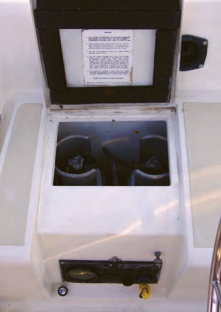
The cockpit is large. The seats are 7 feet long and 20 inches wide and the coamings form 11-inch-high seat backs. An 8-inch-wide bridge deck protects the companionway and two 1 1⁄2-inch drains are fitted aft. Forward, beneath the port cockpit seat, is a cavernous 4-foot-deep locker that provides a tremendous amount of stowage as well as access to the aft portion of the engine. It also houses the galley’s trash receptacle, which is accessed via a pass-through flap in the aft bulkhead. Aft of the cockpit locker is the propane locker with space for two 11-pound tanks.
The engine’s control panel is located in front of the propane locker in the footwell. An opening port in the footwell ventilates the quarter berth. Because the companionway is offset to port, there’s space for an opening port in the forward bulkhead.
The steering system is by Edson, with a pedestal-mounted 32-inch destroyer wheel and a Radial Drive. Access to the sugar-scoop stern is via a centerline stainless-steel swim ladder that swings down from the two-part stainless-steel stern pulpit. Double lifelines connect both pulpits and a slotted aluminum toerail runs stem to stern. Two 8-inch open-throat stern cleats are fitted aft and a similar pair amidships is for use with spring lines.
Belowdecks
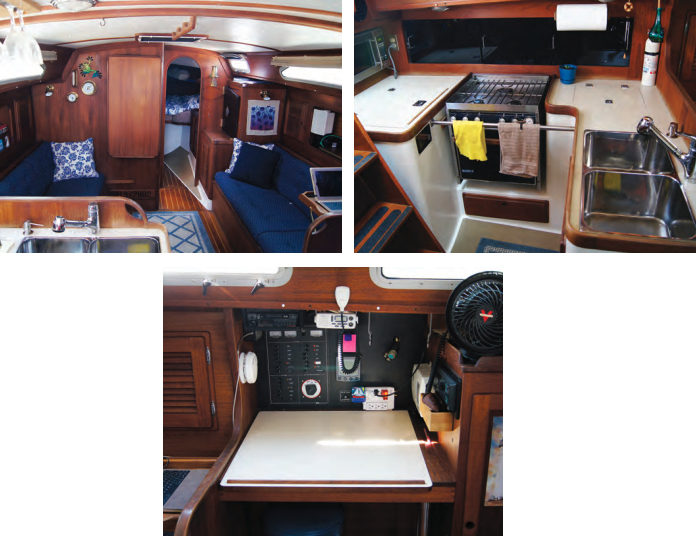
The layout belowdecks in the Freedom 38 is straightforward. A large V-berth dominates the forward cabin. The chain locker is at its foot. Port and starboard overhead bookshelves and a series of drawers and bins beneath the berth provide stowage. Due to its rather large diameter, the mast takes up a significant amount of the cabin’s floor space. To port of the mast, a door opens to the head, and to starboard is a large bureau with three drawers and three lockers.
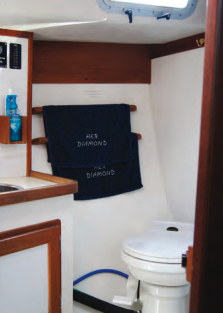
A folding door leads to the saloon via a lobby with a second door to the head and another bureau and a pair of lockers to starboard. The head is a roomy fiberglass module trimmed in teak that contains a VacuFlush toilet, a stainless-steel sink with hot and cold pressurized water, an en-suite shower, and plenty of stowage. The 12-gallon polyethylene holding tank is beneath the vanity.
Seating in the saloon consists of a straight settee to starboard and an L-shaped settee to port. Both are 6 feet 4 inches long with shelving and lockers above and a series of bins behind the seatbacks. A 60-gallon polyethylene water tank is situated under the starboard settee. The long portion of the L-shaped port settee expands into a double berth. Beneath the short leg of the L are the VacuFlush unit, water pump and accumulator, a cartridge filter, and a UV sanitizer. Even with all of this equipment, there’s still plenty of stowage. A large fold-down, drop-leaf table is mounted on the forward bulkhead.
Aft on the port side is the U-shaped galley. A double sink with pressurized hot and cold water is near the boat’s centerline with a 6-gallon water heater beneath it. Outboard is a gimbaled 3-burner stove with oven/broiler and a spacious top-loading icebox, insulated with 4 inches of closed-cell foam, occupies the aft counter. Bob converted the icebox to a refrigerator/freezer by adding a 12-volt Sea Frost refrigeration system. Plenty of bins, drawers, and shelving are provided for provisions and galleyware. The chute to the waste receptacle in the cockpit locker is in the aft galley bulkhead.
Across from the galley on the starboard side is the navigation station. It faces outboard with the electrical/electronics panel above a large chart table with stowage beneath its lift-up surface. Below this, and easily accessible, are the boat’s three batteries. While the navigation station is at a height to be used while standing, for comfort, there’s also a swing-out stool. Just aft of the navigation station is a lined wet locker.
Adjacent to the wet locker is the door to the aft cabin, which contains a large double berth, a bureau and locker forward, and overhead cabinets aft. The 37-gallon aluminum fuel tank is under the berth. Aft cabins like this can feel dark and confining, but that’s not the case on the Freedom 38 as two portlights in the cockpit and a third at the boat’s sheer stripe provide light and cross ventilation.
Under way
The Freedom 38 is well mannered and an easy boat to sail. It is extremely stiff and sails quite flat. Its normal angle of heel is 10, maybe 15 degrees. Bob says he’s never buried the rail — and he’s tried. Her Diamond’s mainsail has three reef points and at 20 knots Bob takes in a tuck. Unfortunately, on the day of our test sail the winds were too light for us to experience any kind of performance sailing. The fractional jib establishes a nice slot that helps when sailing to weather but the boat does not like to be pinched. The Freedom 38 sails best off the wind.
The auxiliary is a 27-horsepower Yanmar 3GM 30F diesel nestled behind the companionway ladder. It turns a carbon-fiber shaft that, in turn, spins a 3-blade Max Prop. The engine will drive the boat along at 6 knots at 2,500 rpm and 7 knots at 3,000 rpm. Access to the engine is good from the front, rear, and port side but poor from the starboard side, where the dipstick is mounted.
Things to check out
Other than the typical age-related problems of gelcoat crazing and the possible delamination of the balsa core, there are no significant issues associated with the Freedom 38. Its carbon-fiber mast might show some signs of age and flex-related surface crazing that is mostly cosmetic in nature.
It’s more of an annoyance than a problem, but the shallow bilge always contains an inch or so of water that has entered via the masthead. At least one good bilge pump is a necessity. Another inconvenience is the narrow opening that makes it difficult to climb into and out of the cockpit locker. The self-tacking jib with its CamberSpar takes up foredeck space and can get in the way of anyone working on the foredeck.
Conclusion
The Freedom 38 delivers uncomplicated sailing, impressive performance, and voluminous accommodations. It’s also appealing to the eye. A boat in acceptable condition will fetch between $75,000 and $85,000. Even though Freedom Yachts is no longer in business, parts and support can be obtained from Warren River Boatworks in Rhode Island. The owner was the former production manager for Freedom Yachts.
Gregg Nestor is a contributing editor with Good Old Boat. He has authored three books on sailing, including Twenty Affordable Boats to Take You Anywhere and The Trailer Sailer Owner’s Manual. He’s currently contemplating his fourth, maybe an e-book.
Thank you to Sailrite Enterprises, Inc., for providing free access to back issues of Good Old Boat through intellectual property rights. Sailrite.com