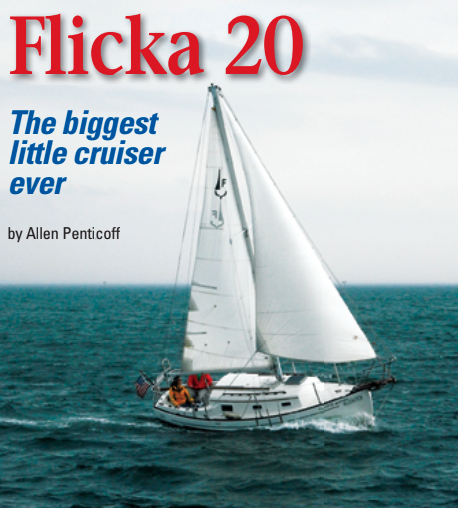
The biggest little cruiser ever
Issue 75 : Nov/Dec 2010
Many of us who dream of cruising spend many years working our way up to a dream boat that we think will accommodate our desires, only to find that the boat becomes “too much.” For those of us who come around to seeing the wisdom of cruising in a small sturdy boat, the stable, salty, and capable 20-foot Flicka is there to take us anywhere our dreams imagine.
Many of the estimated 3,000 Flickas built have done exactly that. Examples can be found almost everywhere in the world. Many of them were built to plans sold by designer Bruce Bingham in the 1970s for amateur construction. Hundreds more are production models built by Nor’Star Marine and Pacific Seacraft.
While attending the St. Petersburg Sailing Association’s inaugural Good Old Boat Regatta last January, I arranged to sail Murray Baxter’s 1984 Pacific Seacraft Flicka, Salar. He’s owned hull number 292 since 1999. While there, I also was able to visit Bruce Bingham, who told me that “flicka” is a Swedish word for a happy, vivacious little girl, which certainly seems appropriate.
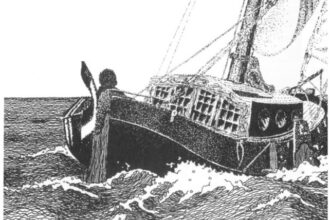
When Bruce was serving in the U.S. Navy, he cruised the backwaters of Rhode Island’s Narragansett Bay, where he encountered a couple of derelict working sailboats of 22 to 28 feet with small cuddy cabins. From his inquiries, he learned they were called “Newport boats,” and had been used for fishing and tending lobster traps around Block Island, where the weather would often turn suddenly from calm to vicious. These sturdy craft intrigued Bruce and, over a period of 10 years, he drew plans for an affordable-to-build 20-foot boat with an enclosed cabin.
Bruce opened his design office in San Francisco in 1972. Shortly afterwards, the drawings were published in Rudder magazine as a seven-part series of how-to articles. Over five years, 400 sets of plans were sold, many of them to Sweden, Australia, New Zealand, and California (and several boats were often built from one set of plans). In these places you will find amateur-built Flickas constructed in fiberglass, thin-wall ferrocement, and different styles of wooden construction. Bruce originally drew a 7⁄8 fractional rig for the Flicka but that was changed to a masthead sloop or cutter rig early on. Just about every other kind of rig was fitted, too, except square, Bruce says.
In 1975, Nor’Star Marine of Santa Barbara, California, began to produce owner-builder hull kits while complete boats were built under contract with Westerly Marine of Costa Mesa. Nor’Star Marine’s Flicka production ended in 1977 and the tooling was sold to Pacific Seacraft in 1978. Pacific Seacraft began a production run of 434 fiberglass boats that ended in 1994 when Pacific Seacraft closed. When the company’s assets were auctioned off in 2007, Steve Brodie purchased much of the tooling, including that for the Flicka, and moved it to Washington, North Carolina. He has no plans to begin production of the Flicka at this time.
Design
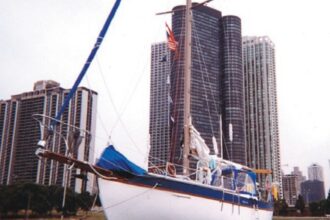
When I first approached Salar at her slip in the St. Petersburg Municipal Marina, I knew right away that she was a Flicka. Her spritely sheer, molded wood-planking look, filigreed ends of the cove stripe in the topsides, and jaunty bowsprit leave no doubt of the Flicka’s fishing boat origins. After a short time aboard, I was impressed with the accommodations and general feel. “Honey, I shrunk the boat,” came to mind. Blindfolded and led aboard without prior knowledge of what boat you were on, you might think it was in the 27- to 30-foot range.
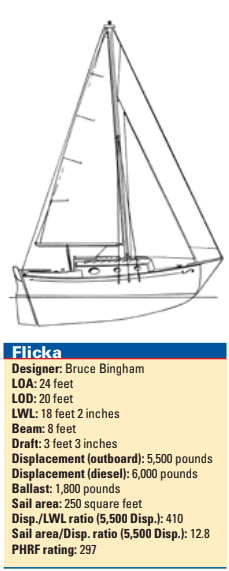
The proportions are pleasing. Some call it cute, but I’d say its classic lines are simply “just right.” The bow is nearly plumb and the sheer saucy, rising aft slightly toward the counter transom. The rudder is outboard. Beam is a trailerable 8 feet and the waterline 18 feet 2 inches. The full keel reaches its deepest 3-foot 3-inch draft just forward of the rudder. The bilges are fairly hard and the garboard full, creating a lot of cabin volume. Ballast is 1,800 pounds, which is 30 percent of the 5,500-pound displacement, and keeps the boat on its feet in just about any weather. The forestay attaches to a sturdy wooden bowsprit that’s secured by a bobstay fastened just above the cutwater.
The high cabin trunk allows standing headroom of 72 inches at the companionway and 69 inches at the galley.
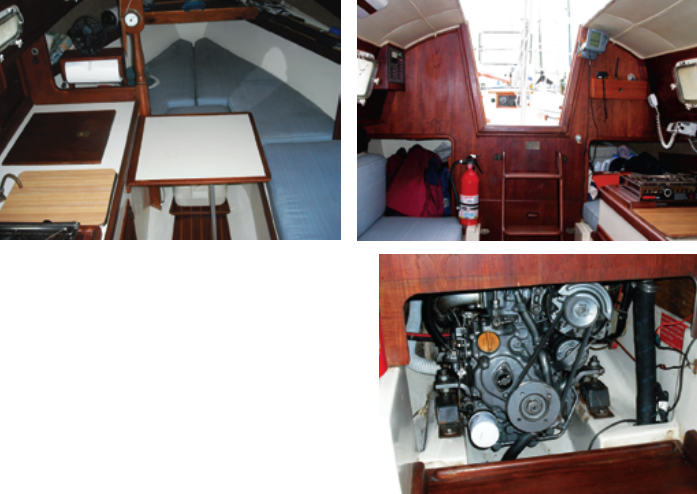
Many of the Pacific Seacraft Flickas came equipped with a Yanmar 1GM10 9-hp inboard diesel. A variety of other engines also were installed, and many boats were fitted with outboard motors. Those with the inboard diesel more readily fit the mission of the go-anywhere boat.
Construction
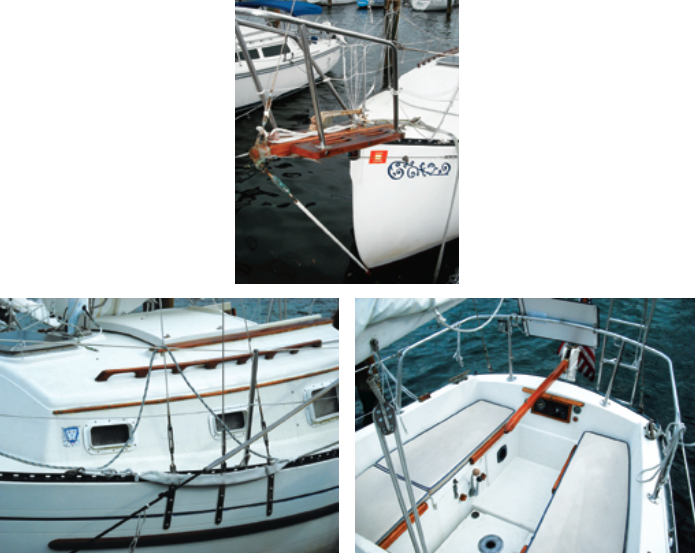
In the Pacific Seacraft boats, the hull is hand-laid fiberglass. A fiberglass interior pan is bonded to it to form a “monolithic structure,” though its effectiveness depends on the quality of workmanship. The deck and cabin trunk are a fiberglass sandwich cored with 1⁄4-inch plywood. The hull-deck joint is a double flange bedded in polyurethane adhesive and through-bolted with stainless-steel bolts. It forms a bulwark, that is capped with either teak or a slotted aluminum extrusion, that lends much to the seaworthiness of this boat.
Among other details that reflect Pacific Seacraft quality are lead ballast, backing plates for the deck hardware, bronze gudgeons and pintles for the rudder, and seacocks with bronze ball valves.
On deck
The cockpit is a bit wider than it is long: 66 inches by 62 inches. The seats are wide and comfortable. A large lazarette hatch is located in the starboard seat. Some boats have additional seating and lockers under the tiller. The bridge deck is high enough to keep out all but the worst seas. A gasketed panel in the footwell provides top access to the engine compartment.
The sidedecks are wide enough to allow crew to move forward easily and the bulwarks, along with good non-skid on all walking surfaces, provide confidence-building solid footing under sail. The cabintop is well suited to sail-handling chores as long as the hatch is closed.
Six screened opening portlights and a large translucent hatch just forward of the mast flood the cabin with light and air. While Salar’s portlights are the standard plastic, it is not uncommon to see them in bronze.
The companionway hatch slides, long handholds on both sides of the trunk, and an eyebrow below make up the teak trim on the cabin. The forward deck is clear and wide for docking and anchoring. There is no anchor locker in the bow but the sturdy wooden bowsprit can accommodate an anchor, with the chain and rode passing through a covered navel pipe to a locker below.
The bowsprit also has whisker stays and is wide enough to permit easy handling of the headsails within the stainless-steel bow pulpit. Sturdy manganese-bronze cleats are located in the usual places. Double lifelines connect the bow and stern pulpits and Salar has a long swim ladder on the transom (a vital safety feature on any boat). There is nowhere on deck to stow a dinghy, though a short kayak might just fit along the sidedeck.
Accommodations
A three-step teak ladder with handholds leads down to the spacious cabin and can be removed to gain access to the engine. Plentiful teak joinerwork, plastic laminate surfaces, and a vinyl headliner give the interior a traditional look with little fiberglass visible. Quality is evident throughout, from the teak-and-holly sole to the turned compression post between the galley and the V-berth. A variety of fabrics were available for the cushions.
The galley is to port. It has plenty of well-designed storage areas. A 53 x 24-inch countertop bounded by teak fiddles supports a two-burner stove aft and encloses a large icebox forward. A foot pump draws fresh water from the standard 20-gallon tank for the useful deep sink. A 23 x 24-inch teak-and-laminate table swings up from the inboard side of the counter to provide a table for the long, comfortable settee opposite, which has two storage areas under the cushion and two more behind the backrest. A small hanging locker area is aft of the settee under the starboard cockpit seat.
My wife, Ruth, endorsed the underway nap potential of the settee during our test sail. Singlehanded sailors would likely sleep here for easy access to the cockpit. A quarter berth to port accommodates another person (or lots of gear) and is provided with small storage spaces for eyeglasses and personal items.
The V-berth is a roomy 77 inches long by 72 inches wide. The 10-gallon diesel tank resides beneath it and the portable toilet is located under the removable aft portion of the berth. Some boats were built with an optional enclosed head in the space aft of a much shorter settee.
Although the boat has four berths, as with most small boats, that always raises the question: where will you put everyone’s gear? On a rainy day with four people aboard, the cabin might be overly cozy.
To starboard, just inside the companionway, is a small electrical panel with six circuit breakers and a voltmeter to handle the boat’s modest electrical needs — a couple of cabin lights, running lights, and the engine starter.
Rig
The Flicka has had many different rigs. Bruce Bingham favored a cat-ketch or cat-schooner rig. For simplicity, production boats have masthead rigs that also provide a large foretriangle to carry larger headsails or accommodate a cutter rig with jib and staysail. The aluminum mast is stepped in a tabernacle and supported by upper shrouds, single spreaders, and forward- and aft-lower shrouds attached to the hull with external stainless-steel chainplates. Although this arrangement provides the widest support angle and freedom from deck leaks, the downside is wide sheeting angles. The three chainplates per side are one of the Flicka’s most prominent identifying marks.
Salar has twin backstays that terminate at each corner of the transom; some Flickas have a split backstay. The jib is set on an 11-inch pendant to clear the pulpit. While most boats have end-boom mainsail sheeting, Salar’s mainsheet leads from the middle of the aluminum boom to the forward end of the cockpit footwell. Some Nor’Star boats have gaff rigs and wooden spars.
Let’s go sailing
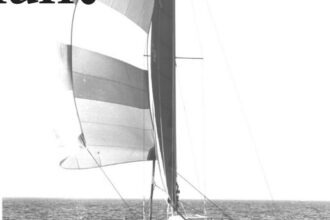
We sailed out of the marina into a breezy Tampa Bay. We reefed at first, but quickly decided it was not necessary. I mention this because the wind was strong enough that an average 20-foot centerboard boat would have definitely needed reefing. Not the full-keel Flicka. Under full sail, she balanced well, tracking upwind as though on rails, and would sail hands-off for several minutes without our touching the tiller. Tacking is a bit slow, as one would expect with a full keel, but the helm felt reasonably light. The Flicka is not tender but, as with other heavy-displacement boats, slowly heels onto its pretty rail and then digs in. Once it finds its groove, it will stay there in a very solid steady state.
While we did not encounter large waves, reports say the Flicka can be a wet ride to windward. The bluff bow and wide beam can kick up spray, and it does not have far to go to find you. Downwind it wallows in following seas like a typical monohull.
Murray reports Salar has seen speeds as high as 6 knots. Many reports say the Flicka will cruise all day at 5 1⁄4 knots. This is in excess of hull speed, yet it does not seem to squat. Bruce Bingham says he was perplexed by the Flicka’s turn of speed and asked the famous designer Philip Rhodes Jr. what he thought. Rhodes speculated that the hull’s abrupt ends and long waterline “fooled” the water into thinking it was a longer boat.
Generally, I am not a fan of bowsprits, but this boat would be wrong without one. It is a competent piece of work that improves anchor handling, increases sail area, and helps balance the boat. It is not so long as to be a major concern when docking. We used it when boarding the boat from the wall of the marina.
Salar has single-speed winches for the headsails only. The jib and main halyards are secured to cleats on the mast. This makes getting proper tension on the halyards difficult. An improvement might be to run the halyards aft to line stoppers and a winch mounted on the cabin trunk at the cockpit.
Conclusion
While researching the Flicka, I read of one repair to a hull-deck joint that was leaking from the screws securing the teak bulwark cap. However, in surveying this yacht, I felt that, given the builder’s quality of work and attention to detail, a well-maintained vessel should have no serious issues with the hull, deck, or rig that will need attention. The Yanmar 1GM diesel may at some point need a new cylinder head because the exhaust port is prone to corrosion.
Although the amateur-built boats vary vastly from one to another in fit and finish, and will be found at lower prices than the Nor’Star or Pacific Seacraft Flickas, a well-made boat could be a bargain. I saw 14 Flickas listed for sale on the Flicka 20 website at prices ranging from $9,750 for a 1977 Nor’Star to $45,000 for a 1990 Pacific Seacraft with enclosed head. Murray paid $28,000 for Salar 11 years ago, and this seems to represent the average of the prices listed today.
The Flicka brochure mentions trailerability. With a heavy-duty trailer and tow vehicle it could be road-portable and ramp launchable, and the mast can be raised or lowered without a crane.
The Flicka in all its various iterations has proven itself on all the world’s oceans by providing safe, inexpensive adventures for those who have the dream to go. It is also a pleasant boat for a simple daysail on protected waters. If the Flicka was good enough for burly singer Burl Ives, it may be good enough, and big enough, for you too.
Allen Penticoff is a freelance writer, sailor, and longtime aviator. He has trailersailed on every Great Lake and on many inland waters and has had keelboat adventures on fresh and salt water. He presently owns three sailboats: an American 14.5, a MacGregor 26D, and a 1955 Beister 42-foot steel cutter that he’s restoring.
Thank you to Sailrite Enterprises, Inc., for providing free access to back issues of Good Old Boat through intellectual property rights. Sailrite.com