
A boat acquisition unfolds like a board game
Issue 100: Jan/Feb 2015
Autumn in the Pacific Northwest brings fickle sailing weather, and given that our Cal 20 needed a keel-off refit anyway, we pulled her out to do the deed. This meant we had no boat in the water. As the season began to settle in and the Cal slowly came back together, I started dreaming of a bigger boat.
My wife was warm to the idea. I was burning hot. In my “spare” time, I cruised the want ads, walked the docks, and racked my brain for ways to find more time and money to make this puzzle work out. We looked at a few boats: a Contessa 26 for $6,000, a Tartan 10 for $10,000, a Contest 30 for $7,000. We knew roughly what we wanted and thought we could afford. The money was never an issue in my mind, if I could just find the right boat.
The Contessa had nice teak decks and a pretty sheer, but no motor and a totally dilapidated interior. The Tartan was interesting: flush deck, full racing setup, good motor and sails, but very little headroom and no head. The Contest was the closest. It had a small center cockpit, a well-kept interior, and a head, bunk, and galley. I was working in a boatyard and this one came in to be cleaned up for sale.
I dragged my boss, Steve, down to the boat to have a look. He gave me two pieces of advice. “Number one, you want to be able to stand in the galley. Number two, you want everyone to have somewhere to sit.” The cockpit had almost nowhere for a party to sit. Back to daydreaming.
Widening the search
The season wore on and rain settled in. Dockwalking gave way to cruising the Internet. One Sunday morning I came across an odd listing. The year before, my buddy and co-worker Rick had bought a Cascade 29 with a trailer . . . his dream boat. I was envious and inspired to give some priority to searches for Cascades in our price range. Mostly, I found half-finished boats with no interior, no motor, or in such disrepair that the only real fix was a chainsaw and a dumpster.
But this time my search for “Cascade sailboat” brought up a listing for a “lot sale” that grouped three motorhomes and one sailboat. The RVs and the sailboat were being sold as a unit: $21,000 for the lot of four.
I immediately fired off an email asking, “How much for just the boat?” Within 10 minutes I had a reply: “Just the boat, $3,500.”

“Where can I see it?” Another 10 minutes passed by: “Boatyard on 42nd and Columbia. Give me a call before you go.” He left his number. I figured it was time to get my “first and last mate” involved.
“Barbara, will you look at something with me?” I punched up the ad and the email chatter and asked, “Can we afford to do this right now?” (As in, at once!)
Her response was something like, “I don’t think we can afford not to look at that.”
I called immediately. His name was Don. He said the boat was in the “old Cascade yard” and some people were already on their way to look at it. He said the boom and some other parts were in his garage and that he really wanted to sell everything at once. But for the agreed price, he would peel off the boat as a separate sale.
Entering a time warp
From then on, and I guess even until now, time became completely elastic. The time that it took Barbara to get dressed to go see the boat was an eternity. The time to drive to the boatyard was as if teleportation were real.
At midmorning on that late October Sunday, Barbara and I found ourselves in a place where history was made: the Yacht Constructors yard where Cascade yachts had been built. When I returned to this site in March 2014, the yard was empty. History, sadly, had moved on. (Note: See “Yacht Constructors: Pioneers in Glass,” by Ed Lawrence, and the companion piece about the founders by Marili Green Reilly, “There Have Always Been Boats,” January 2004. –Editors.)
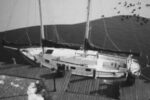
But this was 2008 and a Cascade 29 named Heidi was precariously parked stern-in against a metal building. She sat on four stands with no chains and a single keel block, surrounded by a tent city of variously staged boats. When we arrived, a few prospective owners were stomping around. One guy was giving descriptions to someone on a phone.
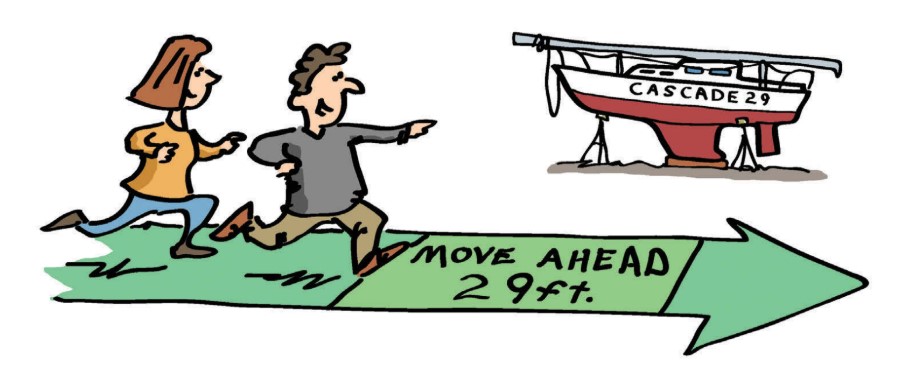
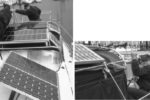
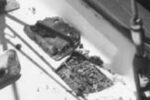
I stood back to give her a good long look. Her mast was tangled and rigging draped through the cockpit with a PFD as a cushion to prevent it from driving through the cabintop. A plastic dinghy was on the foredeck together with several severely decayed cardboard boxes that leaked various items. Her fin had a rust bloom that made it look as though the bulb might fall off. And she was filthy.
Once everyone else had gotten their fill, I scrambled up the ladder, did a little yoga to get around the shrouds, and stepped on deck. I held the ladder while Barbara climbed aboard, and helped her navigate the spaghetti. A thrill ran up my spine. Stopping at the companionway, I poked my nose into the cabin ahead of me and gave a whiff. It smelled musty, but not rotten. Stuff was strewn about everywhere inside. The cushions were on edge, filling the passageway. Sails were crumpled up in the V-berth. A fair bit of the trim was off and scattered about. Newer-looking electrical wires dangled from every corner and overhead.
Competition
Meanwhile, the guy on the phone decided to take another look. As he stepped aboard, we stepped below to make room for him. Everywhere my hands fell as I climbed down felt as if they were meant to be there. The turned post at the bottom of three steps, the overhead handholds . . . everything felt right as I stood tall in the galley. Barbara plopped down behind me on the forward settee and watched as I removed the companionway steps, mostly to expose the motor but also, subconsciously perhaps, to keep phone-call-guy at bay while I did my own private inspection.
The engine was a huge rusting green hulk of a diesel twin with oil everywhere and parts literally falling off. I muttered aloud, “Boy, you sure have to wonder about that!” Phone-call-guy, now off the phone, looked down and asked, “What?”
“Well, I’m no expert,” I replied, “but I bet this motor is a big part of why the boat is still here.” You only had to look to know it would never run without a massive overhaul.
He introduced himself as Matt, explaining that he and his father were buying the RVs and he was there to look at the boat, given Don’s all-or-nothing pitch. He looked less interested by the second, and I couldn’t help but encourage his doubts by pointing out the array of boat bits cluttering every surface and punctuating my observations a few more times with a “Sure makes you wonder” about this and that. Barbara choked hard and muffled a fake sneeze, trying not to laugh her face off at my shameless display.
Dismay
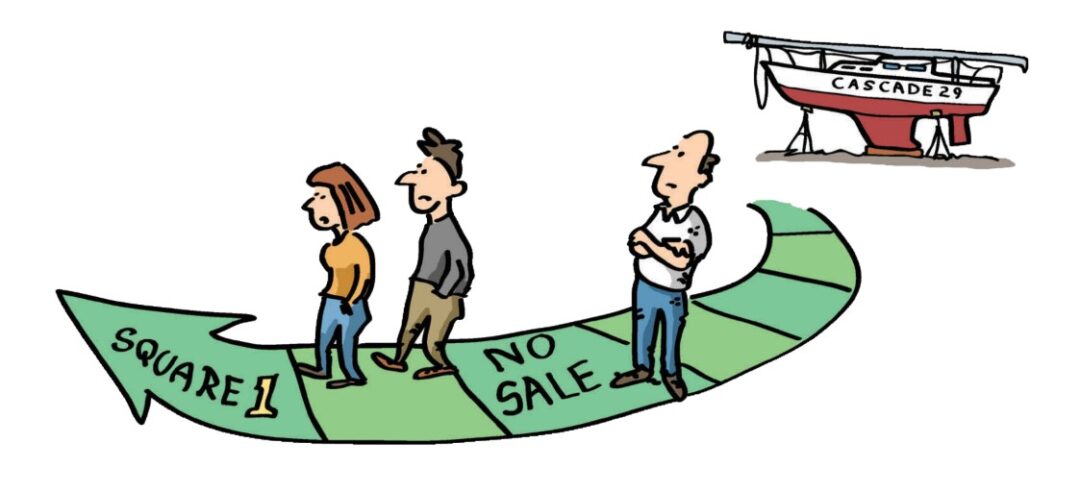
We reluctantly crawled back down the ladder and walked far enough away that we could not be heard. I called Don and, with a nod from Barbara, said, “I’ll give you $3,500 cash right now for that boat.”
There was a pause on the line, then, “I think I just sold it. There’s a guy looking to buy the whole lot. Sorry.” Damn it, Matt and his dad had aced me!
“Well, OK. A deal is a deal. If that changes, give me a call.” Driving away from our boat, I was glum. I should have offered him more! We were both silent, stunned perhaps. But less than a mile later my phone rang.
“It’s him! Barbara, answer quick!” I pulled over immediately.
“Do you still want to buy the boat?” he asked.
“Yes.”
“At the same price?”
“Yes.”
“You’ve got a deal.”
We made arrangements to meet the next day.
Don had bought this boat as a father-and-son project with his son Joel. Evidently she had been purchased from another party by one of the Cascade founders, Hans Geerling, who was at that time the owner of the “old” Cascade yard. He resold her to Don and Joel. Don paid all the bills. Joel was a master electrician who did much of the work. Don added his talents as a high-level hobbyist woodworker and semiretired engineer. They seemed the perfect team to tackle rewiring, replumbing, repowering, refitting, and rigging a medium-sized sailboat, but Joel fell in love with a girl from “back East” and, when he moved there, Heidi’s story was reset.

Elation
The next week of our lives was a warp-speed vortex. We were the proud new owners of a 1973 Cascade 29 sloop, a dinghy, and an ungodly amount of brand-new electrical widgets, yacht fittings, and sundry accoutrements.
The full package included enough parts and equipment to completely refit four similarly sized boats. All I had to do was figure out how to get her out of that yard and back to the water. I called Rick as soon as the deed was done.
“Rick! I bought a boat! A Cascade 29!”
Rick sounded miserable. “Well at least one of us has a boat,” he said. Rick is a good sailor, but even the best of us have awful days and his had been truly rotten. He’d gone out for a solo that Sunday. Coming back under motor, he had lost a sheet to the prop and, with no time to get the sails reset, found himself sideways in the current. Anyone who has ever sailed the Columbia River knows it’s deadly swift at times. Worse yet, he was drifting fast toward an unfinished dock that jutted out in his hopeless path. Not even concrete yet, it was a mass of pilings and sharp unfinished steel beams. He hit broadside, pulverizing the starboard sheer clamp at the chainplate. He managed to jump off and tie up after first bashing down the inside between the rocky shore and the positively lethal obstacle course that made up the unfinished dock. It was probably not the best time to ask him about borrowing his trailer.
The next day after work, I spotted for him while he dove to cut away the fouled sheet and limped back to port. Somewhere in the mix, we agreed to share the cost of a new set of tires for his trailer, since we both needed it. Now we had a way to move Heidi overland, but the problem of airspace still loomed. To move a 10,000-pound object with wheels underneath is one thing. To move it up, over, and around the surrounding obstacles and back down is something else altogether. Luckily, I had gotten to know the operator from Custom Crane Works after watching him perform similar miracles at Schooner Creek Boat Works in Portland, where I worked. For $300 he would do it.
Now only one thing was missing: a truck big enough to move our boat. Enter Daryl Dinwiddie, boatyard mechanic and truck fanatic who owned one monstrous Ford diesel dragster and loved to show off whenever possible. For the cost of breakfast and some fuel, he agreed to haul her to our yard. I arranged to take a long lunch the following Tuesday and a half day off on Wednesday to get her out. Time was of the essence; I believed that if she stayed in that yard one minute longer she would be doomed to rot there.
The extraction
Rick and I met at the tire store at high noon to get new tires on the trailer, then we were off to the yard. The crane was there when we pulled up, and after not much deliberation the trailer and crane were set. Up, up, and away! At that moment the yard owner strode over, claiming he had a lien on the boat. Uh-oh.
I got Don on the phone immediately. Don said that he was completely square with the yard, I faced the guy down and asked what the charges were. When he mumbled something about a $50 stand rental, I handed him the cash, turned back to the crane, and gave the lift signal. There was no way Heidi was not leaving with us. Period.
We had her up, over part of the building, over another boat, and resting securely on her trailer in less than half an hour. I felt like the ringmaster in a circus. The yard was abuzz. A boat was leaving! “Where are you taking it?” someone asked.
“Back to the water, where she belongs!”
The reality of that statement was unclear in the moment, but crystal clear in my dreamlike fantasy. The next day, we met to feed Daryl breakfast and his monster truck fuel in preparation for the short trek to bring Heidi home to “our” yard. We hooked up and got out with no fuss. As we turned onto the main road, however, Daryl nearly stopped my heart when he barked the tires and peeled off, whipping into the lane and swerving the trailer a few times in short strokes, and then put on the steam for real. Following, I had to punch it hard just to keep up. Within the hour, Heidi was safely locked in a side yard awaiting our next adventure.
The adventures begin
We found and installed a new motor, completely rewired and replumbed everything, and made Heidi whole again. The following May, she was launched. Barbara and I have enjoyed her every week since then and are logging many hours of adventure as we voyage ever farther.
We’ve all heard the snarky explanations for the acronym B.O.A.T. Well, I say it stands for Best Of All Things! The best we can hope is to be good stewards, so that Heidi’s tale may never end.
None of this would have been possible without the support and encouragement of quite a few others, most notably my wife, Barbara, and of course Mom and Dad, the entire ’07/’09 crew at Schooner Creek Boat Works, and the original designers and builders at Yacht Constructors who built Heidi.
Seamus Holley’s earliest memory to do with sailing is of his mother, who went sailing with friends (without him — he was 5) in San Francisco Bay and the boat almost sank. Years later, as a cook at a Boy Scout camp, he had access to Lasers and Hobie cats . . . and forgot it all until 2005, when he bought a “Kool” Snark for $25. He later got a job in a boatyard and bought his first “real” boat, a Cal 20.
Thank you to Sailrite Enterprises, Inc., for providing free access to back issues of Good Old Boat through intellectual property rights. Sailrite.com