Be prepared for the worst and hope it never happens
Issue 36 : May/Jun 2004
Oof the many steering systems available to the small ship, none is easier to make, simpler to use, or more sensitive to the person at the helm than the tiller. For this reason, the tiller becomes the logical emergency steering device when a wheel — with its hydraulics, cables, or gears — breaks down.
This introduces one of the great ironies of boat design because when the wheel fails, the emergency tiller must somehow handle a vessel whose size, apparently, demanded the mechanical advantage of a wheel. How alternative methods might be used will be looked at later, but first a look at interim systems.
An often-overlooked fact about steering loss (in a seaway) is the dangerous behavior of the free rudder. It can bang from side to side so violently that it can cause terminal damage to itself and the boat while also proving very hard to capture and hold long enough to attach the emergency tiller. An interim device is indicated, especially if lengthy preparations are required in order to unstow the tiller, clear its working space, and fit it.
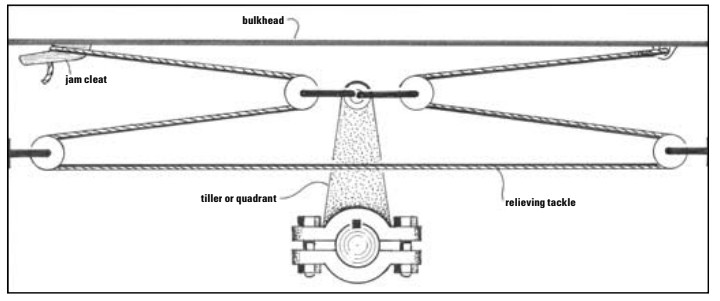
Figure 1 shows a traditional way of damping down the action of an errant rudder. Known as a relieving tackle, its original purpose was to deal with backlash, but it is equally effective at taming the rudder while emergency equipment is organized. To be of use, it must be permanently rigged (but kept slack) in anticipation of being suddenly needed.
(At least one boat design incorporates a tiller with a small downward-pointing notch aft at the midpoint. In case of emergency, sailors can put two overhand knots in a line, drop a loop overboard, and haul the bight back up until the line between the two knots is caught in the notch. They can then steer by taking each end of the line to a cockpit winch. –Ed.)
Rig a tackle
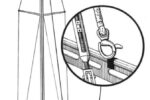
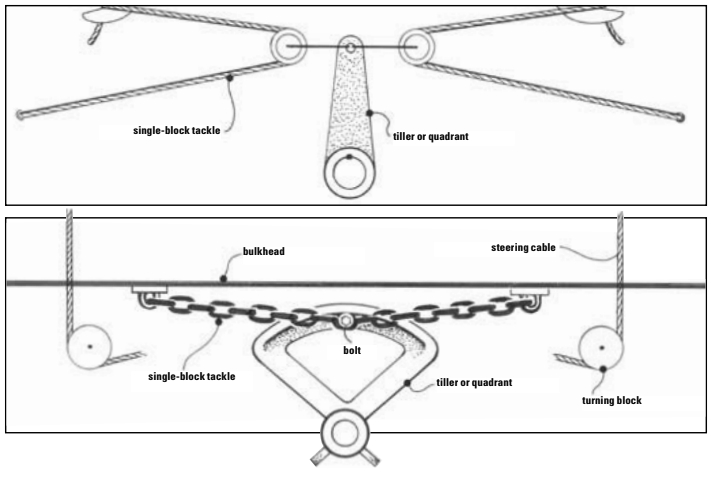
A simpler and more versatile system is to rig a tackle to one or both sides of the rudderstock that can be quickly attached and sweated up when needed. Shown in Figure 2, a single block may suffice, but a purchase of at least 4:1 or more may be needed depending upon boat size.
A complementary device in the form of a single length of chain can help. Also shown in Figure 2, this chain is attached to the ram tiller or quadrant with a single bolt through a suitable link, according to the exact position in which the rudder is to be held. The chain can be permanently fitted between two strong points from where it hangs beneath the quadrant, slack enough to do its job but without too much play when in use.
If your autopilot is of the linear type, operating directly onto the quadrant or ram tiller, this will prove to be a more-than-adequate rudder-damping device. And, as long as it continues to reliably function, there is every reason to presume it will hold the course accurately while repairs are made to the main steering. However, it does not negate the need for an emergency tiller because autopilots, as we all know, can fail when you least expect it.
On the subject of holding a course, it should be recognized that many older boats will steer themselves to windward and downwind with nothing more than a locked rudder. This is especially true of medium-to-long keels with a ketch rig whose docile behavior might even eliminate the need for an emergency tiller.
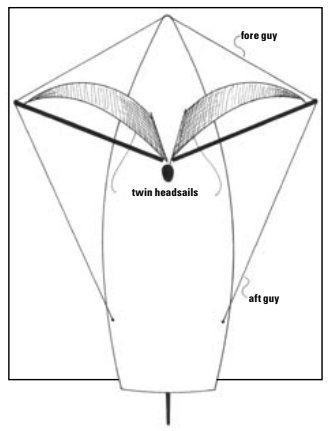
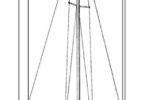
Allow me to digress a moment. With the rudder locked to leeward, where it produces weather helm, and a good spread of fore-and-aft sail (reefed down or otherwise), many vessels will sail themselves to windward ad infinitum. The same vessels, with twin or near-twin headsails set immediately forward of the main mast and with the rudder locked amidships, will sail directly downwind with similar reliability. The secret here is to set the sails to a dihedral angle as shown in Figure 3.
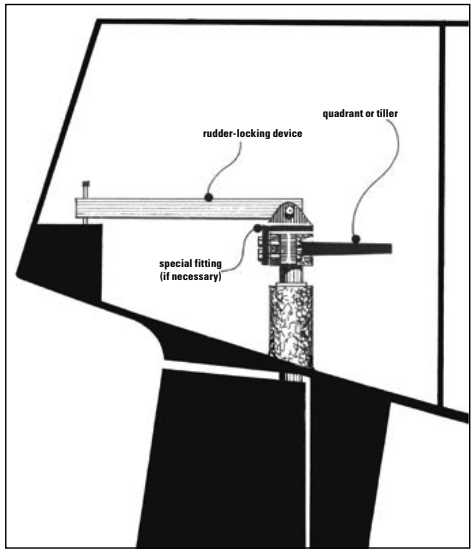
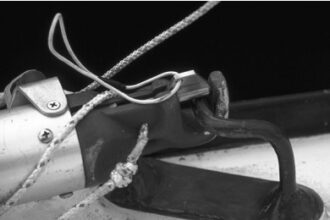
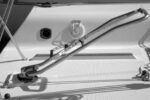
The rudder-locking device (Figure 4) can point forward or aft or any direction between the two where it is pinned to a fixed position. It can be the answer for those unable to fit a proper emergency tiller.
Ill-equipped
A surprising number of offshore vessels are ill-equipped to deal with major wheel-steering breakdown. Most have a means of attaching an emergency tiller, but some have poor access to the rudder-stock head. Others have good tiller access but with obstructions in the way of its working arc. Some are so poorly conceived that a helmsman would be in serious jeopardy handling the tiller.
We all tend to go soft on emergency equipment and procedures because, happily, they are so rarely called upon. I know of a guy who so completely forgot the need for clear space around his emergency tiller that he placed a semi-permanent dive bottle rack in its working arc during a refit. His self-confessed stupidity was only compounded when he chose to leave it there and trust in fate as far as his steering was concerned.
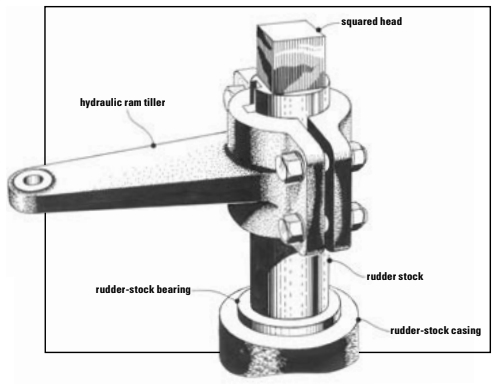
The most universal method of attaching an emergency tiller to the rudder-stock head is by mating male and female squared parts, the male part being on the rudder-stock head, as shown in Figure 5. The stock must protrude well above its ram tiller or quadrant to accommodate the tiller adequately.
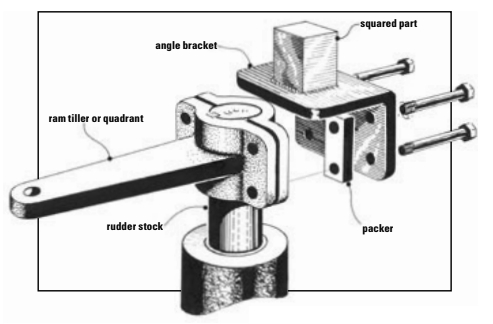
Alternative methods of attachment include the use of normal keyways on either parallel-sided or tapered-end stocks, but these produce a fussier system that is generally unappreciated when fitting the emergency tiller in a seaway — with or without a hyper-active rudder. And where the rudder stock ends abruptly immediately at the top of its quadrant or ram tiller, a creative fitting is necessary. This could be similar to that shown in Figure 6 where an angle-bracket bolts to the back of the existing fitting and then produces a horizontal surface above the stock. On this surface, a squared part is welded.
Removable panel
The emergency tiller itself may protrude through a removable panel in the aft end of the cockpit, where the rudder stock is located behind the cockpit, or it may rise vertically to emerge through a deck or cabintop port. In the latter case, the vertical part will dictate whether the tiller should be in one or two parts. If in two parts, a bearing of some description would be needed at the deck. This is shown in Figure 7.
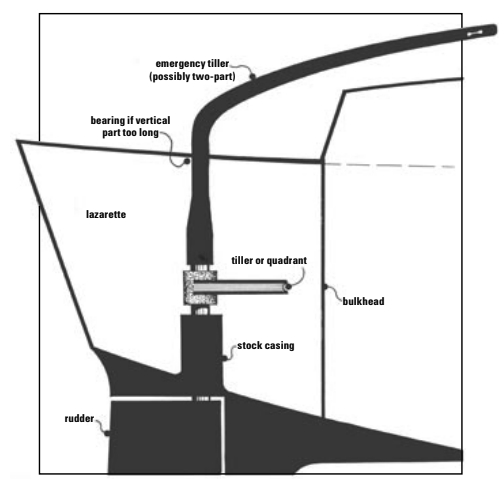
A system I have employed — but thankfully never had to prove beyond a test sail — involved a center-cockpit cutter whose rudder stock was dead center beneath the aft cabin’s double bunk. Rather than extend the emergency tiller vertically through the cabintop, I chose to fit the tiller directly to the stock and steer from down below using a bulkhead-mounted compass that was permanently fitted as an off-watch reference. Blind sailing after losing the main steering is not recommended, but it is better than nothing for vessels unable to do it properly.
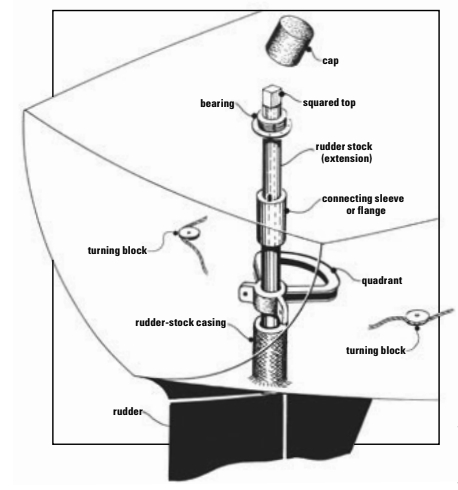
Figure 8 suggests the best arrangement for an emergency tiller connection. A vertical extension of the rudder stock is permanently established. It protrudes through the deck via a bearing. The protrusion is capped off against the elements and should be a watertight threaded type. In adopting this method, careful consideration must be given to how the rudder might be removed when in need of maintenance or repairs. A single, full-length stock would inhibit this operation considerably, suggesting that it should be in two parts. A decision needs to be made here as to whether the break should be external, at the head of the rudder, or internal, just above the ram tiller or quadrant. If external, the join should be by flanges. If internal, it may be by flanges or sleeve depending on circumstances.
Point it aft
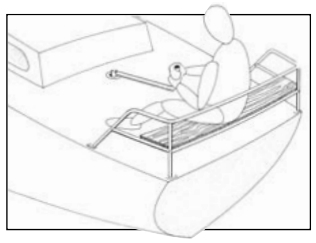
Regardless of how the emergency tiller is fitted, the possibility of pointing it aft, rather than forward, should not be ignored. Some boats lend themselves to this radical concept, thanks to more useful space aft of the rudder stock than forward, complemented by, in some cases, a bench seat across the pushpit’s intermediate rail (Figure 9). Although a back-to-front tiller causes confusion at first, the fact that it is pushed toward the direction of course alteration makes orientation remarkably easy. And for those who have trouble coping or whose aft deck limits useful tiller length, tackle can always be rigged and led to the cockpit.
Whether steering tackle is employed to address space or directional problems or because its extra purchase is needed by a short tiller, its tails can be led to the safety and comfort of the cockpit through turning blocks. If sheet winches are handily placed, they can be used as snubbers to reduce the helmsperson’s workload. Under some circumstances, tails can be fed onto the steering wheel’s self-steering drum so that the wheel itself is used as an emergency device.
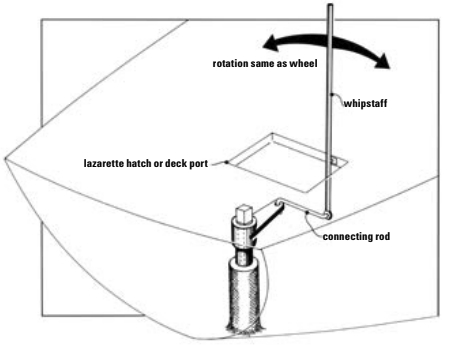
Figure 10 illustrates a method of steering that was used almost exclusively from the 15th to early 18th centuries. Known as a “whipstaff,” this vertical tiller promises a simple alternative to the conventional type and demands less helming space as well. Attached to the ram tiller or quadrant via a connecting rod, the whipstaff can pass through a deck port or lazarette hatch and be pivoted immediately beneath the deck.
The whipstaff provides excellent leverage over its rudder thanks to the fact that it needs to be long to reach a standing helmsperson. And it appeals to most people because it has the same rotation as a wheel. It does, however, presume that a firm object is handy, such as a backstay or rail, to maintain a safe footing (it can also be controlled remotely by tackle).
Any emergency tiller or whipstaff must be strong enough to cope with all demands — from a couple of hours on a calm sea to hundreds of tumultuous miles finishing a voyage. It must be a true tool, not a toy that cannot be relied upon. And it is best stowed up against a deckhead where it cannot be buried over the years by other, less important, items.
While it is unrealistic that a seldom-needed item like an emergency tiller will be easily deployed after a breakdown, it is reasonable to presume it will be durable and reliable once rigged and working. To be anything less is to defeat the objective, which is to gain peace of mind that a steering failure will be an inconvenience, not a death warrant for the little ship.
Steering safety checks
While some form of emergency steering is absolutely vital to sea safety, there can be no denying that regular checks and maintenance of the primary steering system will render it redundant in most cases. With a little preventive attention, the emergency tiller should never be needed. Checkpoints include hydraulics, cable steering, worm gear, and rack and pinion. (See “Steering Systems 101” on Page 34.)
Hydraulics: If your existing steering is not smooth in its operation, it is possible that the oil pipes are too narrow in diameter and/or the ram is too small for the job. An undersized system is doomed to early failure and should be replaced throughout.
A system complementary to boat size and length of pipe run should give decades of smooth, trouble-free operation, needing only basic attention in the following areas:
If the exposed ends of the ram’s piston rod are unprotected, accumulated dust will accelerate seal wear. If socks cannot be fitted, the rod should be cleaned as often as necessary. When ram seals start weeping — typically after three to five years’ regular use — watch them carefully and replace the seals when weeps become leaks.
Also watch the soft hoses between the copper pipe ends and the ram. These are constantly flexing to the ram tiller action while atrophying over time. Always carry spares and, most importantly, replace them ahead of demand.
Keep an overall watch for oil weeps at all junctions and don’t forget to check the oil level periodically. If it is possible to lock the rudder amidships when the vessel is not in use, backlash wear will be reduced considerably.
Cable steering: Cables can only work in conjunction with a quadrant or full wheel. They cannot function on a tiller. Tensioning is usually made on each side of the quadrant, and this should be regularly checked. Slack cable allows backlash, and backlash exacerbates work-hardening in stainless-steel wire rope.
Far and away the most common cable used in boat steering systems is 6 x 19 flexible stainless wire rope, which, because of work-hardening, should be replaced at the least hint of failure. This will be evidenced by “whiskering.” Whiskers (those painful broken surface wires also called fish-hooks) mostly occur around sheaves (turning blocks and so on) where they are subject to constant flexing. These sheaves should be perfectly matched to the wire so that flattening or pinching is eliminated. Their diameter should also be no less than 16 times the diameter of the wire and more, if possible.
A common area of builder optimism is in the mounting of the two sheaves, or turning blocks, one to each side of the rudder stock. Failure here is not unusual, with blocks working loose or ripping out altogether. If there is any suspicion of trouble here, the vessel should not go to sea until the blocks are properly remounted.
Worm gear: These units tend to be beautifully engineered and rarely give trouble, a good thing considering the difficulty in complementing them with an emergency tiller. They give little, if any, rudder-to-helm feedback when operating properly, and they resist being overridden by a tiller when they give trouble. The status quo is best maintained by keeping them in top condition. Cleaning, greasing, and salt and dust protection are generally all they ask.
Some amateur-built boats employ a truck-steering box whose arm is linked to a tiller via a connecting rod. The gearbox is driven by chain from the steering wheel. These units work well and need only occasional greasing. In a breakdown, the connecting rod is easily removed to free the rudder for emergency tiller operation.
Rack and pinion: Like most geared steering mechanisms, the rack and pinion is usually trouble-free. If, however, it gives trouble, an emergency tiller fitted to the rudder-stock head will override the gearing (as long as it is not jammed). The rack and pinion needs only regular cleaning and a light greasing. Silicone paste is a useful alternative. If situated above deck, the assembly should be boxed over to protect it from dust and salt.
Thank you to Sailrite Enterprises, Inc., for providing free access to back issues of Good Old Boat through intellectual property rights. Sailrite.com