Send these tips in advance to all lubberly guests
Issue 36 : May/Jun 2004
Usually, inviting friends to share a holiday on your boat is fine. If you are lucky, they will conserve water, turn off the lights, eat appreciatively, pitch in to help, and not break stuff. But most people, nice as they may be, are pretty clueless about what to do and what not to do while cruising.
My husband and I recently made a long-anticipated trip from Seattle up through the Inside Passage to southeast Alaska and back, covering 3,200 nautical miles in three-and-a-half months. We had no boat systems breakdowns, alarming leaks or smells, unplanned contact with charted or uncharted rocks, or personal illness or injury. It was, in short, a flawless voyage. The hitch was that we wanted to share this wonderful experience with friends. We sent out an itinerary and were pleased that almost everyone promptly signed on to join us for a week or two.
What were we, nuts? For six weeks, during the most scenic and wildife-rich portion of the summer, we entertained back-to-back guests and scrambled to change the sheets and re-provision the galley during turnaround time before the next group arrived. It was a lot of entertaining and a good chance to make some observations about guest behavior on the boat.
Several years ago I wrote Guest Afloat with co-author Sara Slater. Our book offers practical advice on how to be a good guest when aboard. Its aim is to increase guests’ knowledge of what to do and what to expect so they will be able to enjoy themselves and help out competently. Based on the recent summer’s massive guest overload, I have some additional suggestions to help reduce the frustrations close-quarters and long-term guests are apt to create.
Tips for hosts
Because they may sound somewhat cranky, these suggestions are made confidentially to captains and mates:
- Give your guests a proper orientation. Walk them around, show them how the heads work and where the life jackets are kept. Assume they know nothing. Use some nautical terms. This will give them a little time to get used to the spaces and understand what happens where.
- People struggle with the concept of a limited water supply. For example, it often doesn’t occur to guests to turn the tap off between lathering and rinsing, so demonstrate it. Calculate roughly how much water there is for daily use per person and tell everyone what amount that is. Wasteful water habits run deep.
- Even if your batteries have the capacity of Grand Coulee Dam, it may still rankle you when lights are left on and appliances are not turned off. Count on strolling around to check switches. If your guests are observant, they’ll get the idea and help decrease the power drain.
- We had some trouble with guests’ indiscriminate use of ship’s stores. (Funny how they always go for the eggs/lemons/peppers and not the rice . . . ) It’s great that people make themselves at home in the galley, but it’s maddening when they deplete supplies meant for planned menus. Make sure your guests know how long you will be out until the next grocery (and liquor) store visit and that you have to rely on what is there on board.
- If your policy is “bring your own bottle,” give guests plenty of time to shop before casting off. I’ve noticed that people underestimate their liquor intake while on vacation. Sometimes it is very inconvenient to get to a store. Be very clear about how long you will be out and what the possibilities are for re-supplying.
- We made a big mistake by crowding our guests’ arrivals and departures. It would be much better to allow a few days between parties in order to rest up and take care of laundry and provisioning. It’s always fun to share the excitement and energy new guests bring to the boat, but hard to meet it if you feel rushed.
Let’s say that, as boatowners, you have done your part. All is organized, and you are ready to welcome your guests aboard. But your guests have responsibilities too. Before you go, pass along the tips on the next page to prepare them for their time aboard.
Useful tips for guests
Even well-intentioned people could use more knowledge about being a good guest on a boat — especially if you want to be invited back. Here’s what to do and what not to do:
Before you go
- Pack nothing other than basic necessities in easily stowed luggage. Take what will be appropriate for the expected weather and activities, but stick to essentials. They include soft-soled shoes and a pair of beach shoes (always check for stones and mud before boarding), a windbreaker, a hat with a chin strap, sunglasses and sunscreen, a pair of binoculars (never use the captain’s), a small flashlight (for reading and getting up at night), and a minimum of outfits to keep you comfortable on the water. Bear in mind that space is limited and non-essentials are a nuisance.
- Give some thought to thanking your hosts with a gift. Keep it small and stowable: a traditional game such as dominoes, a big clipboard for charts, some special food, a guest log, a great flashlight.
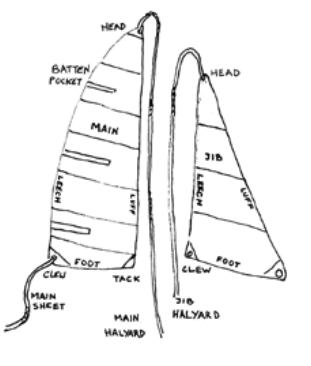
- Learn nautical terms. The special basic vocabulary is short, so learn it. This will help eliminate confusion and allow you to respond quickly and intelligently.
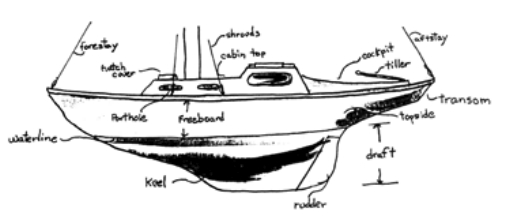
Orient yourself by facing forward to the bow.
Port is the left side of the boat (say, “I just left port,” or “Is there any red port left?”). Starboard is the right side of the boat.
The area aft is toward the stern.
If you want to sound like an old salt, use other proper words.
Galley is the boat’s kitchen. Tread carefully here, first making sure help is wanted and that you do not crowd the cook. If you want to fix something, make sure the ingredients are not part of a planned menu and that you will not deplete a necessary staple. Always remember that the galley is a kitchen on the move and loose items slide around. (A big wake caught me by surprise this summer and a large pan of lasagna jumped the stovetop and went flying. Imagine the mess!) Remember to return utensils to their designated places and latch doors securely. If you are on dish duty, learn to wash using less water and less soap. The good guest always conserves water!
Saloon is the main inside cabin with many purposes. You might eat, play games, read, visit, and sleep here. It’s important to keep things stowed and picked up to avoid spills, stubbed toes, and chaos.
Head is the toilet area. A marine toilet requires more thoughtful use than those in our houses. Put nothing but human waste and small amounts of toilet paper in it. Ask for instructions on how to flush it properly. Always put the lid down after use so that objects do not accidentally fall in while you are under way.
You will also use the head for personal washing. Be conscious of conserving water at all times. Turn off the faucet when your toothbrush is in your mouth! Turn off the faucet before you reach for your towel! Learn to take a Navy shower: get wet and turn off the water, soap up, then turn the water on to rinse. If you don’t take care to conserve, the thump-thump of the electric water pump will give you away to the captain’s listening ear.
Stateroom is the bunk area or sleeping quarters. This space is often cozy, which is another way of saying that it has limited room. Enjoy its uniqueness and keep your gear picked up in case the area functions as a dining table or saloon couch at other times. If you are lucky enough to have a porthole (a window to let in light and air) open at night, remember to close it securely against incoming seawater when you are under way.
Cockpit is our outdoor area. Normally, the boat’s cockpit is near its stern. In a sailboat there will be the tiller or wheel, engine controls, navigation equipment, sheets, winches, cleats, and built-in seats containing more storage. Be alert to the boat’s motion and the activities that go along with sailing. If you know nothing about sailing, stay out of the way until someone gives you a job to do.
At the navigation station you will find equipment used to get to a destination. This includes the compass, charts, GPS, radar, depth sounder, VHF radio, and, often, very sophisticated electronics supplemental to navigation. Never mark the captain’s charts, push buttons, or use the radio without permission! If you are interested in learning how these aids work, watch carefully and ask a few (but not too many) questions.
What to expect under way
Keep in mind that the captain is responsible for your safety and the safety of the boat. You, in turn, are responsible for a spirit of cooperation and goodwill by following rules that ensure your safety.
A good guest will:
- Sit down or stand back rather than be underfoot.
- Move carefully (“One hand for the boat, one hand for yourself”).
- Avoid making loud banging noises.
- Keep from blocking the captain’s view.
- Stow gear and tidy up.
If you are invited to participate actively:
- Volunteer to help stand watch.
- Offer to check the oil, gauges, etc.
- Ask questions if the task is not clear.
- Act only on the captain’s signal.
Be aware that boats are affected by wind, waves, and wakes. Sailboats heel (lean) when sailing. Surfaces do not stay horizontal, so think about where you place your cups, food, and feet to avoid spills and injury.
What to do
It’s fun to have a few activities on hand to amuse yourself while under way. Projects that don’t take up much space and can be contained in your area include: reading, knotwork, crossword puzzles, journaling, knitting, drawing, and shooting photos. Do not expect to be entertained.
If you are lucky enough to have kids aboard, there are many good activities that keep them (and you) from suffering from restricted space:
- Trail bubbles behind the boat.
- Fly a plastic kite.
- Find the funniest boat name.
- Identify the birds.
- Play cards or small board games.
- Open a tiny gift each day.
At the wheel
Let’s say that you are invited to take the wheel or tiller. Experiment to see how far and fast the boat responds to a turn. Learn to keep an eye on the compass in order to stay on course. Notice that handling the boat is very different from steering a car; you are moving through the water rather than on it, as you do on a road. The environment is three-dimensional and you must pay attention to the boating traffic (around you), the weather (above), and the water, particularly the depth (below). The captain will appreciate your understanding that all these forces have to be reckoned with.
At the helm, it is your obligation to carefully watch and anticipate what may happen around you. Be alert and observant because you have no way of knowing how the other boat will behave — or how well informed its captain is of the Rules of the Road. The Rules were created to govern the right-of-way between boats and, if followed, reduce confusion and prevent collision. When a situation comes up and you are in doubt, ask the captain. Simple rules to remember:
- When crossing, you have the right-of-way if you are on the other boat’s starboard side. Maintain course and speed.
- If approaching head-on, you usually alter course to starboard, passing port-side to port-side as if you were driving a car on a road. Make the action early and clearly enough to eliminate confusion.
- When overtaking, keep clear of the overtaken vessel.
Unfortunately, since not everyone knows the Rules of the Road, common sense may require departure from them. Allow enough time and space to give a comfort zone, and call the captain when in doubt. Recite this when needed:
Here lies the body of Jonathan Day
Who died maintaining
his right of way.
He was right, dead right.
He was right all along,
But he’s just as dead as
if he was wrong.
It is extremely important to keep an eye out for drift and debris at all times. Deadheads, fishing lines, crabpot buoys, and logs are all out there lying in wait. Count on it.
Assisting with docking
There can be lots of action when docking, so be prepared to help. Hang the fenders and set out lines. Be prepared to switch all of these to the opposite side at the last minute because sometimes the captain may change his mind. If you are handling lines, make sure you know which line (bow, stern, or midship) should be secured first. The captain depends on working that line to position the boat to the dock. Never try to save a poor docking by putting your arm or leg between the boat and the dock. Fend off with fenders. Once on the dock, secure your line as quickly as possible. Do not be offended if the captain reties your lines; it’s no reflection on your knot, but an innate compulsion to adjust for the heck of it.
Dinghy etiquette
It’s fun to explore new areas, and a dinghy side trip is a perfect way to do this. It is also a good opportunity to give others on the boat a little time and space to be alone. Before leaving, take a look at the chart to orient yourself to the area and see if there are any interesting coves or lagoons to investigate. Remember to tell the captain your intentions and be sure to check the tide table to avoid getting stranded up on the beach.
Dinghy checklist:
- Life jackets (one per person).
- Paddle or oars (in case the engine quits).
- Sufficient fuel.
- Bailer.
- Whistle or noisemaker (the Coast Guard requires this).
- Line to tie up.
Always check your shoes for stones and muck before boarding the dinghy and returning to the “mother ship” after a beach walk.
Boating safety
As a good guest, you will want to inform yourself of basic safety issues on the boat. If the captain’s rules seem excessive, pay attention anyway. It’s the attention to detail that often averts dangerous situations.
- Note the location of the life jackets and fire extinguishers.
- Ask about emergency procedures.
- Find out how to use the VHF radio for emergency and non-emergency communication.
Coping with problems
Guests are responsible for alerting the captain and mate about food allergies, physical disabilities, and medical issues that might cause problems while aboard. Bring your own supplies and medicines; don’t count on more than aspirin and Band-Aids from the boat’s first-aid kit.
Seasickness, though a miserable state to be in, is usually not fatal. Find out what preventions and remedies are available before you are stricken. Sometimes you can fend it off before it sets in. I have found a variety of things that work pretty well: elasticized bracelets called Sea Bands, a cup of ginger tea, a handful of dry crackers or sunflower seeds, a perch where you can safely watch the horizon and anticipate the waves.
We have enjoyed many great guests on our family boats over the years. Their enthusiasm and cooperation inspires us to try to be better hosts. The best guests are good sports who can slow down and tune in to the simpler, more relaxed pace of life at sea. Most of them are invited back . . . how about you?
Thank you to Sailrite Enterprises, Inc., for providing free access to back issues of Good Old Boat through intellectual property rights. Sailrite.com