Bicycle safety flags mark the edges of your trailer
Issue 36 : May/Jun 2004
At a boat show this past winter I overheard a salesman tell a prospective buyer, “Retrieving a trailerable sailboat is easy. It’s just like launching one . . . only in reverse . . . with a few minor changes. Simply run the boat up onto the trailer, hook onto the winch, pull the boat the rest of the way on, and drive up the ramp.” After what seemed to be almost a minute’s pause, the salesman casually added, “Oh, yeah, make real sure that the boat’s centered on the trailer.”
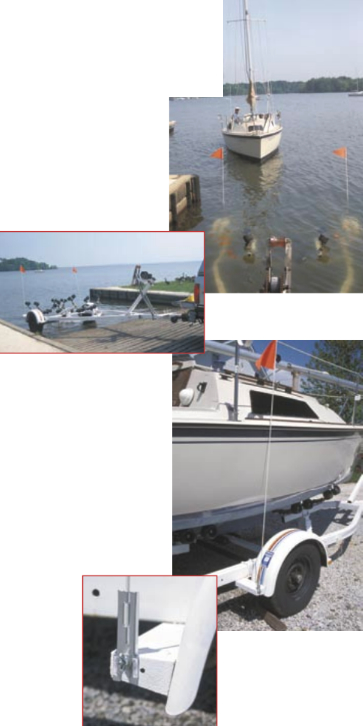
While what the salesman said was loosely true, the offhanded comment or caveat regarding the proper centering of the boat on its trailer is key to a successful retrieval and highway travel. This is especially important for a boat having any sort of keel. This increase in draft and weight over that of a sailboat with a centerboard or daggerboard necessitates that the trailer be submerged, often to the point where only its winch will be above water. Having a single point at which to aim can make proper centering very difficult. Guide-ons, installed near the trailer’s rear corners, provide a lane to sail in and make centering the boat on the trailer much easier.
Store-bought trailer guide-ons cost between $65 and $85. They are not much more than lengths of PVC tubing that are rigidly bolted to the trailer and extend several feet above the water.
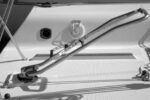
To me, the idea of something “rigid” combined with crosswinds, waves, wakes, and/or piloting errors conjures up all sorts of potential catastrophes, from broken guide-ons to boat damage. A trip to the local discount department store provided me with a better, safer, and, best of all, cheaper set of trailer guide-ons. For only $10.89, I purchased two 6- foot bicycle safety flags and all the necessary hardware (nuts, bolts, and washers) to make my own custom trailer guide-ons.
The rear mounting brackets that hold my trailer’s fenders extend ever so slightly past the maximum beam of my boat. It was here that I drilled a hole in each one and — using a bolt, washer, and wingnut combination — installed my new trailer guide-on flags. The wingnut arrangement allows me to install the flags only when needed. Realizing that each trailer/boat configuration is different, I checked out the trailer/boat combos at my sailing club. Most of the more than 50 trailers present afforded a similar means to attach these guide-on flags. In the worst instance, the addition of two short lengths of perforated steel angle, for an additional cost of $5, brought the mounting points out to the desired width.
Thank you to Sailrite Enterprises, Inc., for providing free access to back issues of Good Old Boat through intellectual property rights. Sailrite.com