GOB’s troubadour tests conductors with an electric baton
Issue 111: Nov/Dec 2016
As part of a major refit of our Tartan 37, Higher Porpoise, we decided to replace all the in-mast conductors while the mast was out of the boat. Because neither of us wanted to have to later go up the mast to fix a mistake, I needed a supply of 12-volt power with which to test the wiring of each mast-mounted light while everything was accessible. With no vehicle access, getting a 12-volt feed to the base of the mast posed a challenge.
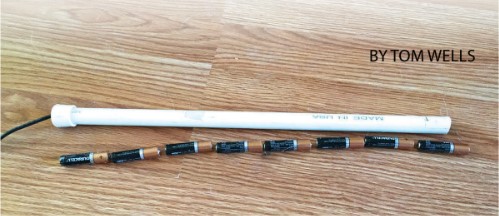
The answer came during one of those 3 a.m. epiphanies that rousts you from a sound sleep. Eight AAA batteries in series will provide 12-volt DC current. All I would need was a container for the batteries and a pair of conductors. It turns out that AAA batteries fit neatly into 1⁄2-inch PVC pipe. After adding two 1⁄2-inch PVC caps, suitable lengths of red and black wire, and two small coil springs, I had a simple, lightweight, and very portable source of power for testing.
Construction
To obtain the springs, I broke and cut away the plastic from a pair of large wire nuts. (It may be necessary to cut off the narrow ends of the springs to create a surface that provides good battery contact.) I then cut a length of 1⁄2-inch PVC pipe to contain the springs and the batteries (14 1⁄8 inches worked for me) and prepared two 1⁄2-inch PVC caps by drilling a hole in the center of each one just big enough to pass an insulated #14 conductor. After stripping both ends of 16-inch lengths of red and black #14 wire, I passed one end of each wire through a cap. Inside the top of each cap, I spread the wire strands and spun the spring onto the wire. This held the spring securely without the need for solder.
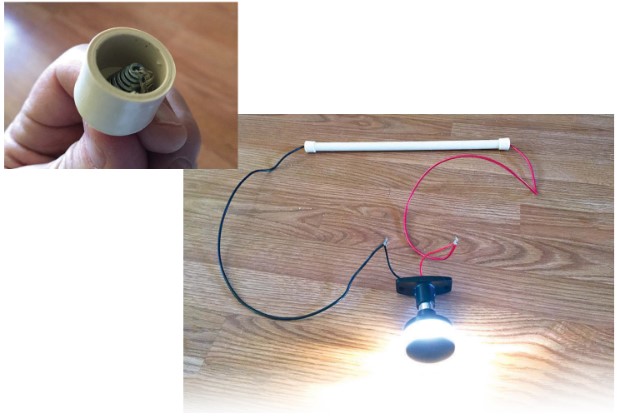
After pushing the cap with the black conductor firmly onto one end of the pipe (there should be enough friction that the cap will hold without glue) I dropped eight AAA batteries into the pipe with their negative poles down. When I pushed the cap with the red wire onto the top end, the project was complete. I recommend covering the exposed wire ends with wire nuts when the tester is not being used.
When testing this mobile power source on the LED anchor light, I had to occasionally push inward on the end caps — just slightly — to get good contact. Otherwise, this small, handheld power source worked perfectly. It is much more convenient than running long conductors from a car or boat.
Tom Wells is a contributing editor with Good Old Boat and, with his musical talents, has earned the title of troubadour. He and his wife, Sandy, have been sailing together since the 1970s. They recently retired and have cast off the docklines to embark on full-time adventures aboard their 1979 Tartan 37, Higher Porpoise, starting in Florida this winter.
Thank you to Sailrite Enterprises, Inc., for providing free access to back issues of Good Old Boat through intellectual property rights. Sailrite.com