. . . and canoe-stern contemporaries
Issue 86: Sept/Oct 2012
This really is a subset of yacht design: canoe-stern fin-keeled cruising boats. I say “canoe stern” rather than “double-ender” because, to me, “double-ender” implies a much sharper stern, often with an outboard rudder, as typified by the Westsail 32 introduced in 1971.
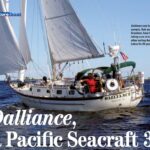
One of the first designers to realize it was possible to increase the performance of cruising boats by incorporating a more modern fin-keel/skeg-rudder underbody beneath this North Sea-inspired design aesthetic was Bob Perry, when he designed the Valiant 40 in 1974. In 1978, Bill Crealock introduced his iteration on this theme with what would become the Pacific Seacraft 37. From a marketing point of view, I look at these fin-keeled canoe-stern boats as a “second generation” of the North Sea breed, with a more modern underbody for better performance but no dramatic alteration to the appearance above the waterline to detract from their globe-girdling aesthetics. However, each style has distinctly different origins (see “Double-enders and Canoe Sterns,” Issue 86).
The success of the Pacific Seacraft 37 led the company to introduce the smaller 34 in 1984 and the 31 in 1987. Apparently, neither Pacific Seacraft nor Bill Crealock was married to the canoe stern, since the 31 sported a conventional transom.
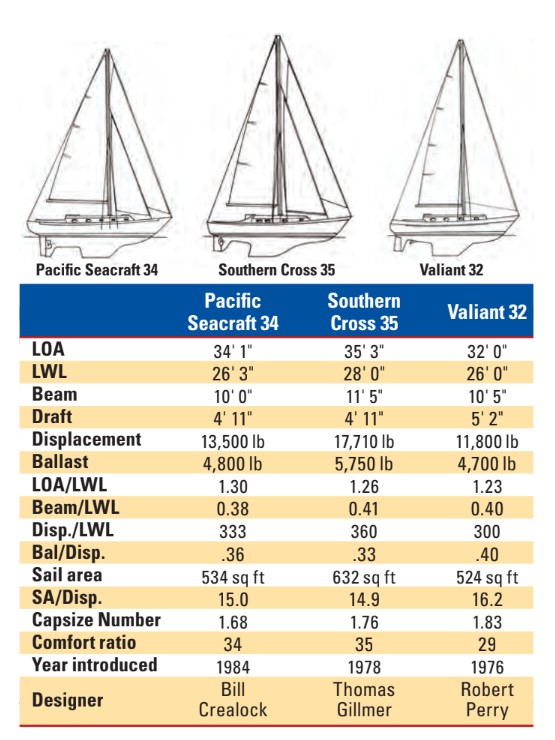
For comparison to the PS 34, I chose the Valiant 32, since a review of the type would not be complete without a Perry design, and the Thomas Gillmer-designed Southern Cross 35.
As was our feature boat, almost all of these fin-keel boats were available with a shoal-draft option. This complicates the comparison somewhat, since the shoal-draft keel is inevitably heavier than the deep keel to compensate for its higher center of gravity. However, the weight of the shoal-draft ballast is seldom mentioned in the literature, and if it is, the published displacement is seldom increased accordingly. For that reason, the table shows the numbers for the deep-draft Pacific Seacraft 34. Indeed, the whole question of published vs. actual displacement is an aside that would be fruitless to pursue. For instance, due to an error in the hull-laminate schedule, the Southern Cross 35 ended up with essentially twice the amount of glass specified, increasing the displacement from the published 14,500 pounds to 17,700 pounds!
When you look at the numbers, what you see with respect to “modern” standards are heavier, moderately canvased, seakindly boats. Due to its heavier displacement, the shoal-draft feature boat would have a slightly higher D/L (343) and slightly lower SA/D (15.0). Increasing ballast weight to achieve the same sailing stability with shoal draft never helps either of these ratios and always lowers performance, but the opening up of shoal-water cruising grounds is often a worthwhile trade-off.
Comparing these boats around an imaginary racecourse would be misleading, as they were not being sold on racecourse performance but on “bluewater” capability, real or imagined, to owners more drawn to distant horizons than race trophies. With that in mind, the only numbers of real importance are the capsize number and the comfort ratio — safety and comfort. All these boats meet the criteria, with the Pacific Seacraft 34, primarily due to narrow beam, topping out with the lowest capsize number of 1.68 and a comfort ratio almost equal to that of the Southern Cross 35. The Valiant 32, due to its lighter displacement and shorter overhangs, brings up the rear with 29 and 1.83 respectively, well within tolerable numbers for a cruising boat. Strictly by the numbers, however, that same lighter displacement could give the Valiant 32 the edge in a good old boat regatta.
Whether any of these boats would perform differently or have logged fewer offshore miles in comfort and safety with a well-designed conventional transom is a moot point, since by its very existence and by its well-earned offshore reputation, the canoe or cruiser stern is now closely associated with exactly this type of cruising adventure.
Rob Mazza is a Good Old Boat contributing editor. A sailor by passion and yacht designer by vocation, he began his long career around sailboats with C&C Yachts back when now good old C&Cs were cutting-edge new.
Thank you to Sailrite Enterprises, Inc., for providing free access to back issues of Good Old Boat through intellectual property rights. Sailrite.com