Observe the ground rules and drive the gremlins out
Issue 37 : Jul/Aug 2004
My friend called with obvious concern in his voice. “John, something very strange is going on; I need your help! My boat is . . . possessed!”
“Possessed, George?” Even if he did own a powerboat, he was a brother boatman, a fellow military retiree, and a good friend. Perhaps I could help him.
“Well, I was getting ready for my annual Coast Guard Auxiliary safety inspection. And when I pushed the horn button,” he continued, “the horn was weak, and the navigation lights came on.” George paused. I could almost hear his brows furl.
“The lights wouldn’t turn off until I stopped blowing the horn . . . ” His voice trailed off in wonderment. Then he asked, half curiously, half sheepishly: “Do you do nautical exorcisms, John?”
Once aboard, I was certain I had solved that particular problem before. Which boat was it? And what was the solution? Where had I first seen the elusive gremlin that powers circuit “B” when the switch for circuit “A” is flipped? Then it came to me: I had encountered these symptoms on my first boat. I bought it back in the early ’60s from “Honest John, Your Trustworthy Used-Car Salesman” while stationed in Biloxi, Mississippi.
Why buy an old wooden boat from a used-car salesman? I suspected it had been unloaded on him as a part of a “distress sale” and could be bought for a song. He knew his cars, perhaps, but not his boats. I did get a bargain: a well-built, homemade 28-foot cutter, complete with bunks, dedicated galley, enclosed head, even a fine little inboard.
Worried wife
Later, I found I was more than right on the circumstance of the boat’s sale to Honest John. The owner’s wife had been worried. Her hardworking professional husband was showing the warning signs of stress and overload. She had recommended that he get a hobby; she wasn’t ready to be a rich widow just yet.
“How about buying some plans and building that boat you always wanted?” she had suggested. She was right on target. Build it he did, and he did a pretty fair job. Then he shipped it down to the Gulf Coast where a local sailmaker took care of the final work and launching.
His wife was pleased. He would return home to central Mississippi after a relaxing weekend on his boat, his mental and physical health much improved. She was no sailor, but one weekend she decided to drop by the boat for a surprise visit. She sure surprised him! She also surprised the little honey he had shacked up with him down below. Honest John had been the first to offer cash for the discredited cutter. Not believing the old sailor’s taboo against renaming boats, I immediately changed the cutter’s name from the moniker of the previous owner’s mistress to the Mary Lu Too.
As I became familiar with my new boat, I found the gremlin. When I turned on the spreader lights, the bilge pump ran. I finally discovered that a corroded ground connection was the cause. When the spreader-
lights switch (on a panel with pilot lights for each circuit) was turned on, the pilot light for the bilge pump glowed and the bilge pump ran rather anemically. I found that the common grounds for the pump and lights were lost due to the corrosion but that the fancy switch panel with the individual pilot lights was wired with a separate ground to the battery.
Hurries back
Electricity is speedy, tenacious, and predictable. When released from its confines by an operating switch, it rushes through its destination, doing its work (light, motion, heat), then hurries back to the confines of the battery. But if the return path is blocked — by a disconnected or broken wire or a loose or corroded connection — it will hunt for any other alternate electrical path that will take it home. Until you understand how there can be other paths and then how to find them, the strange symptoms can be a real mystery.
The seemingly troubled — but apparently independent — electrical circuits have this in common: faulty grounding circuits. Each of these circuits has a common source of power (the battery) and a common negative bus (sometimes just the negative battery post).
The gremlin is set loose when these independent circuits do not have a common negative bus. With more than one ground, they lack a single, common good ground. Multiple or poor return circuits are the breeding ground for those gremlins. When one of the multiple grounds fails due to corrosion, a loose connection, or a broken wire, the circuit served by that bad ground will attempt to find an alternate return path to ground.
Are you ready to dance the electrical two-step? There are just two easy steps in troubleshooting the bad-ground gremlin:
Step one: Determine which circuit (horn, anchor light, running lights) causes the problem when activated.
Step two: Find which circuit is simultaneously activated that should not have been activated.
The answer to the first step tells you which circuit has lost its ground; the answer to the second tells you which circuit is providing the mystery ground.
What changes?
Hoping to shorten the troubleshooting time on my friend’s runabout, I asked what he had done to the electrical system recently.
“Not a thing. I just finished recommissioning her, dewinterized the motor, and put the battery back in.” Good clue: the battery had just been reconnected. I checked the wires at the battery terminals. The heavy wire at the positive terminal going to the starter and the wire serving the positive bus were both snugged down properly. But he must have been distracted when he hooked up the negative wires; the nut wasn’t tightened. The heavy ground wire to the motor block carried current (the motor cranked and started), but the wire serving the negative bus wasn’t making good contact. Beneath the heavy wire there was a light wire that had been added later, and it was making good contact.
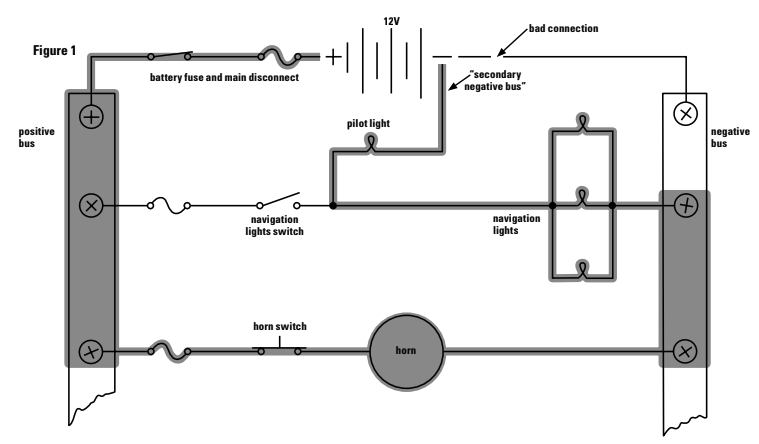
When George had installed a fancy electrical switch panel with lighted rocker switches some years previously, the small pilot bulbs required a ground. He had simply run that ground wire directly to the battery’s negative post, rather than to the negative bus. In doing so, he had inadvertently created an alternate ground or a “secondary negative bus.”
Looking at the wiring diagram of George’s boat (Figure 1), the simplicity of the two steps becomes obvious. When he pushed the horn button, electricity flowed through the switch, through the horn, but then found there was no ground because the negative bus had been isolated from the battery by a weak connection.
Diagnosis: That tenacious electricity did find a ground via the navigation lights and the bulb in the lighted switch, which had its own ground wire to the battery.
Solution? Confirm the diagnosis by attaching a jumper wire from the battery’s ground terminal and fasten the other end to the horn’s ground connection. Blow the horn. If it works right (and it should), search out the missing ground with a good multimeter. Also note that the navigation lights did not light up.
Impress your friends
This is just one scenario, and if your boat develops a gremlin, you can bet it won’t be exactly the same. First consider what has been done recently to the electrical system. Additions or modifications are the usual suspects. Then do the electrical two-step, restore the proper ground connection, and impress your friends with your expertise.
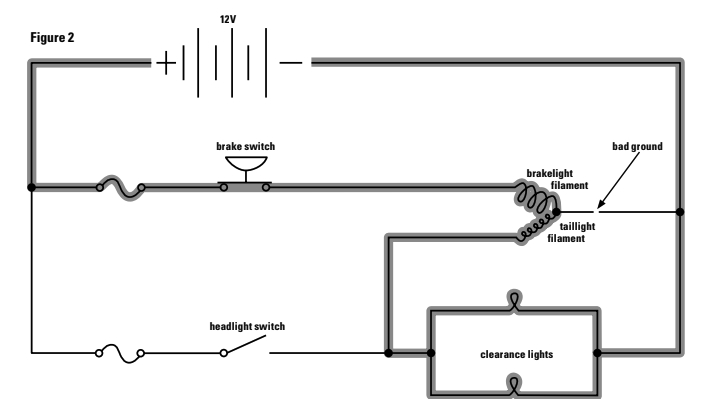
Another common place to find this sort of bad-ground gremlin is on a trailer used for towing smaller sailboats. The diagram of a tow vehicle and trailer hookup (Figure 2) illustrates the typical scenario. Remember the two-step: step one, the circuit you were trying to activate is the turn signal; step two, the circuit that shouldn’t have worked is for the clearance lights.
Diagnosis: The most likely problem is either that the shell of the dual-filament bulb is corroded and not making electrical contact with the socket or that the bracket holding the socket to the trailer frame is corroded and not providing the required ground circuit. Therefore, the larger filament in the dual-filament bulb, not receiving its ground through the bulb’s shell or the bracket holding the bulb, found a ground through the other filament in the bulb and through all the clearance lights.
Solution? Confirm your diagnosis by attaching a jumper wire to a good ground, preferably your trailer or tow vehicle’s frame, and touch the other end to the shell of the dual-filament bulb. If it works right (it will!), clean the bulb and run a separate ground from the socket to the trailer frame.
Thank you to Sailrite Enterprises, Inc., for providing free access to back issues of Good Old Boat through intellectual property rights. Sailrite.com